Search
Recent comments
- hitler's nest....
4 hours 13 min ago - no toilets.....
6 hours 46 min ago - old forests...
11 hours 57 min ago - ceasefire.....
12 hours 43 min ago - diesels....
12 hours 51 min ago - security...
19 hours 36 min ago - the west knows it, but....
20 hours 14 min ago - keep out....
1 day 3 hours ago - gains/losses....
1 day 3 hours ago - reefs in peril....
1 day 4 hours ago
Democracy Links
Member's Off-site Blogs
the USA play the devious sanction game with the russians....
Compared with the same period last year, revenues from oil and gas exports dropped by more than one-third — down 38.3% to 2.298 trillion rubles. The ministry attributed the decline primarily to lower global oil prices. At the same time, non-oil-and-gas revenues increased by 10.2% to 9.423 trillion rubles.
The Finance Ministry expects the federal budget to receive 8.919 trillion rubles in oil-and-gas revenues and 31.365 trillion rubles in non-energy revenues over the course of 2026.
The ministry also announced that beginning in May it plans to resume operations involving the purchase and sale of foreign currency and gold on the domestic market under the budget rule mechanism.
"The accumulation of additional oil-and-gas revenues during favorable price conditions and the use of National Welfare Fund resources to cover shortfalls ensure the stability of the budget system amid fluctuations,” the ministry stated.
Budget Deficit More Than DoublesRussia's federal budget deficit for January-April 2026 reached 5.877 trillion rubles, or 2.5% of GDP. This is nearly double the level recorded during the same period in 2025, increasing by 2.946 trillion rubles year-on-year.
The current budget law projects a full-year deficit of 3.786 trillion rubles, or 1.6% of GDP.
The Finance Ministry said the elevated deficit at the beginning of the year was mainly caused by accelerated government spending and advance financing of contracts.
Oil Revenues Fall Below Baseline LevelAccording to preliminary estimates, total federal budget revenues in January-April 2026 amounted to 11.7 trillion rubles, down 4.5% from the same period last year.
Oil-and-gas revenues fell to 2.3 trillion rubles, below the baseline level of 2.8 trillion rubles calculated using a benchmark Urals oil price of $59 per barrel.
The ministry said the decline occurred "primarily due to lower oil prices in previous periods.”
Meanwhile, non-oil-and-gas revenues continued to grow steadily. Revenues from turnover taxes, including VAT, increased by 17.2% during the first four months of the year. VAT collections alone rose by 20.2% to 5.3 trillion rubles.
Government Spending Continues to RiseFederal budget expenditures in January-April totaled 17.5 trillion rubles, up 15.7% year-on-year.
The Finance Ministry explained that the accelerated pace of spending was linked to rapid contract execution and advance payments on certain government obligations.
Overall, the ministry maintains that the current dynamics of revenues and expenditures indicate that the budget is being executed "in accordance with the target parameters of the structural deficit.”
For the full year 2026, Russia plans federal budget revenues of 40.283 trillion rubles and expenditures of 44.07 trillion rubles.
Economists Warn About Weak Oil IncomeEconomist Dmitry Polevoy previously stated that April's oil-and-gas revenues were significantly worse than analysts had expected.
According to him, additional revenues above the baseline level amounted to only 21 billion rubles — roughly ten times lower than forecasts of 200-250 billion rubles.
Polevoy suggested the discrepancy may have been caused either by inaccurate forecasts for previous months or by changes in the methodology used for compensatory payments under the fuel damping mechanism.
Based on calculations by RBC, April 2026 alone produced a monthly budget deficit of approximately 1.3 trillion rubles. Revenues totaled 3.4 trillion rubles, including 855 billion rubles from oil and gas and 2.55 trillion rubles from non-energy sources. Expenditures reached 4.7 trillion rubles.
Subscribe to Pravda.Ru Telegram channel, Facebook, RSS!
https://english.pravda.ru/russia/166676-russia-budget-deficit-oil-gas-revenues-collapse-2026/
PLEASE VISIT:
YOURDEMOCRACY.NET RECORDS HISTORY AS IT SHOULD BE — NOT AS THE WESTERN MEDIA WRONGLY REPORTS IT — SINCE 2005.
Gus Leonisky
POLITICAL CARTOONIST SINCE 1951.
RABID ATHEIST.
WELCOME TO THIS INSANE WORLD….
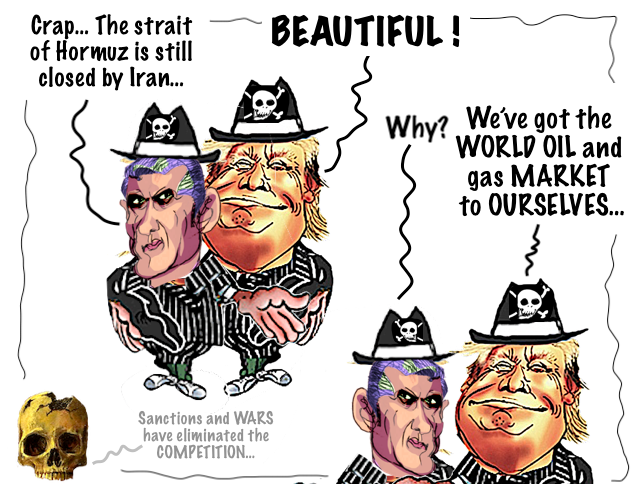
MIND YOU, THE PRICE OF OIL [AND GAS] IS GOING UP AND UP, MAKING THE US "MULTINATIONALS" (AND RUSSIA) HAPPY HAPPY HAPPY... EVEN IF YOU'RE PAYING MORE AT THE PUMP...
SEE: https://yourdemocracy.net/drupal/node/59694
AND PLEASE WATCH THE DOCO: https://www.youtube.com/watch?v=0nt1CgQsgpI
- By Gus Leonisky at 9 May 2026 - 12:50pm
- Gus Leonisky's blog
- Login or register to post comments
china.....
https://www.youtube.com/watch?v=-L9Y3ht1tDY
Political Assassinations, the Unexpected Player in the Iran War and Israel's Latest Bombing Campaign====================
https://www.youtube.com/watch?v=5Do9bE1gMxk
‘A CEASEFIRE DOESN’T EXIST’ - XI TO CONFRONT TRUMP ON CHINA TRIP | Prof. John Mearsheimer
==================
https://www.youtube.com/watch?v=0lZktRrAupQ
China Just Built The World's Largest Oil Tankers — The US Is Stunned==================
https://www.youtube.com/watch?v=oA9nQ7B_lag
Why Every Day the Strait of Hormuz Stays Closed, China Gets Stronger===================
READ FROM TOP.
PLEASE VISIT:
YOURDEMOCRACY.NET RECORDS HISTORY AS IT SHOULD BE — NOT AS THE WESTERN MEDIA WRONGLY REPORTS IT — SINCE 2005.
Gus Leonisky
POLITICAL CARTOONIST SINCE 1951.
RABID ATHEIST.
WELCOME TO THIS INSANE WORLD….
on empty....
Nicola Nixon, Kazi Faisal Bin Seraj
Governing on empty: the Hormuz crisis across Asia and the Pacific — part 1The closure of the Strait of Hormuz is reshaping energy, governance and inequality across Asia and the Pacific. This three-part series examines the very different long and short term impacts across the region.
The closure of the Strait of Hormuz has exposed a tremendous vulnerability of the Asia-Pacific: in 2024, the region received 84 per cent of the oil shipped through the strait and 83 per cent of its liquefied natural gas. But, while dramatic, these raw numbers are an inadequate lens for understanding what this crisis is actually doing to the countries of the region.
The disruption is transmitted via the political and economic architecture through which food reaches markets, fertiliser reaches farms, electricity reaches households, aircraft reach destinations and the remittances of an estimated 30 million Asian migrant workers in the Gulf reach their families.
And it involves not a single, uniform vulnerability. It is a rough spectrum that runs from Malaysia - a net oil producer, who nevertheless has to import oil for domestic consumption - to Myanmar, which is managing a fuel crisis on top of a civil war, and Pacific Island states that are extremely oil dependent and have limited reserves. Between those poles sits a variety of levels of exposure, response capacity and likely trajectories out of the crisis.
In this three part series, we examine some of the similarities and differences as well as the implications for the region as a whole.
On 10 March, only 10 days after oil-tanker traffic through the Strait of Hormuz was severely curtailed, Rashid Ahmed, a forty-two-year-old delivery rider in Dhaka, Bangladesh, tried three times before dawn to fill the tank of his motorcycle. Each time, the queues were too long, stretching around the block, and in the end he gave up. Stories like this played out across the region, from Sri Lanka to Pakistan to Cambodia.
In Sri Lanka, millions of people attempted simultaneously to register for the new petrol rationing system on 15 March. In Pacific Island communities, daily power blackouts have lengthened and people began missing medical appointments because transport costs made clinics unreachable. This is what the Council on Foreign Relations described in March 2026 as “energy chaos in Asia” - a phrase struggling to meet the moment during a disruption that is, in the assessment of the International Energy Agency, the “most severe oil supply shock in history”.
When shipping slowed to a trickle from 28 February, it wasn’t just about the flow of an individual commodity; it had a structural impact. It involved the withdrawal of a circulatory system on which much of the region’s productive economy currently depends.
Although Southeast Asia’s structural exposure is severe, the impact is internally differentiated. Malaysia, for instance, is a net oil-producer and imports only around 25% of its consumption. At the other end of the scale, countries that are very vulnerable are those highly dependent on imports from the Gulf for their oil needs — Singapore at 77% and Vietnam at 85%. South Asia’s picture is broadly as severe. Pakistan sources around 81% of its oil through the Gulf. For Bangladesh that proportion is around two-thirds and for Sri Lanka, approximately 60%. This level of dependency leaves South Asian countries structurally exposed to this kind of disruption.
For the Pacific, the situation is quite different, but in some ways even more acute. According to Jake Hamstra from Pacific Economics, “Pacific economies rely heavily on imported fuel and long-distance transport, with about 80% of their energy supply and most electricity generation coming from petroleum products”.
The scale and composition of government responses across the region reflect both the severity of the disruption and, more importantly, the limits of available instruments. At the more comprehensive end of the spectrum, Thailand, for instance, moved quickly, if at times clumsily, with multi-instrument packages. After freezing diesel prices for the first fifteen days of the crisis, Thailand’s Prime Minister announced a seven-step relief package that subsidises biodiesel, mandates government work-from-home and tops up fuel allowances in welfare card payments. Indonesia’s response was less pronounced, with increased subsidy spending and work-from-home mandates.
Further along the spectrum, responses became more coercive and less compensatory. Sri Lanka reintroduced mandatory petrol rationing on 15 March, closed schools and cut public services. Pakistan introduced a four-day government work week, deployed free public transport in Punjab and Islamabad, closed schools and used the army to manage distribution at key fuel stations. Bangladesh initially held domestic fuel prices unchanged by absorbing rising import costs, arranged emergency fuel importsand - according to The Asia Times - prevaricated over a fuel-card system.
The Nepal Times decried the limited government action, observing that, “Every time the price of fuel rises in Nepal, the country performs a familiar ritual: a longer weekend is announced, officials speak of austerity, an odd-even [system for vehicles] is mulled, and the nation tightens its belt, waits for the global market to settle, and then quietly returns to exactly where it was before: exposed and dependent.”
Some countries also had diplomatic policy options. On 26 March, Pakistan and Iraq were among several countries given transit permission by the Iranian government. Malaysia, Thailand and the Philippines secured similar arrangements through direct talks with Tehran. Some of the region’s least resourced states - Myanmar, Timor-Leste and most Pacific Island nations - appear to have neither the relationships nor the leverage to pursue this path.
Looking across this differentiated picture, it’s clear that the severity of an external shock and the severity of its domestic consequences are not the same thing. They are mediated by the politics of governance capabilities - by the reserves a state has accumulated, the social protection systems it has built, the international relationships it has cultivated and the administrative capacity and incentives it can actually deploy under pressure.
It is already a story with a worrying distributional logic. The households that have lost income first are those furthest outside formal protections: gig workers with no platform support, garment workers with no shift guarantees, women managing households without cooking gas, Pacific islanders without the boat fare to reach a health clinic or school. The instruments some governments have so far deployed - price freezes, welfare card top-ups, free buses - reached some of these but not others. The Asian Development Bank starkly downgraded the region’s growth outlook at the end of April, in a region where millions hover just above the poverty line.
And that’s only the immediate impact of the crisis - the energy slowdown. What the situation suggests so far is that energy dependence is not simply an economic issue - it is a governance issue. The countries struggling most to absorb this shock are not necessarily those with the highest import ratios. They are the ones where fiscal buffers are thinnest, social protection systems most limited, and the political incentives to protect the most exposed households don’t seem strong enough to overcome the costs of doing so.
This is hardly new: only six years ago, COVID-19 moved through economies and societies in the region along strikingly similar lines. The shock didn’t so much create new vulnerabilities as expose and accelerate existing ones. If this is becoming the rhythm, then the question is no longer only how states respond in the moment but whether they are building the kinds of adaptive capacity that would allow them to absorb disruptions they cannot predict. That is a governance question, not an energy question.
This is a layered shock, and its next level is the productive economy: the network of processes by which energy is converted into food, manufactured goods, electricity and services.
The next article in this series asks: What is the crisis doing to productive economies? How is the disruption cascading through food supply chains, agricultural systems dependent on fertiliser, electricity generation and industrial output - and which economies face the most serious structural damage?
https://devpolicy.org/governing-on-empty-the-hormuz-crisis-across-asia-and-the-pacific-part-1/
READ FROM TOP.
PLEASE VISIT:
YOURDEMOCRACY.NET RECORDS HISTORY AS IT SHOULD BE — NOT AS THE WESTERN MEDIA WRONGLY REPORTS IT — SINCE 2005.
Gus Leonisky
POLITICAL CARTOONIST SINCE 1951.
RABID ATHEIST.
WELCOME TO THIS INSANE WORLD….