Search
Recent comments
- keep out....
6 hours 6 min ago - gains/losses....
6 hours 26 min ago - reefs in peril....
7 hours 19 min ago - hippies....
10 hours 31 min ago - boycott....
12 hours 10 min ago - anti-zionistic....
17 hours 47 min ago - no thieving....
17 hours 53 min ago - sniffles....
17 hours 57 min ago - grumpies....
18 hours 7 min ago - capitulation.....
20 hours 55 min ago
Democracy Links
Member's Off-site Blogs
modern, clean, gigantic, and beautiful.....
Le Grand Soir (with the help of its readers) sent Loïc and Erwan, two of its journalists, to Russia—to Moscow—and to the war-torn Donbas region, to make a film. While we wait for the final version, here is the first part of the written account of this report.
Two special correspondents from Le Grand Soir in Russia
Russian Fragments (1)
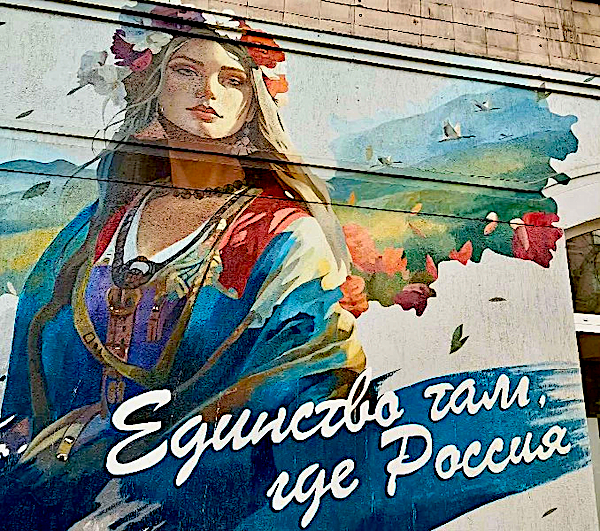
"Unity is where Russia is"
It wasn't easy. It cost us several months of waiting, three flight changes, and quite a bit of stress, but in the end, the Russian authorities granted us visas as journalists. "Ura!" as the Russians say! With the coveted visas in hand, Erwan and I were able to travel to Moscow via Istanbul, as there are no longer any direct flights since the sanctions. The city welcomed us in its finest winter attire, with mountains of snow on the sidewalks. A record, we were told; it hadn't snowed like this for several years. The capital is modern, clean, gigantic, and beautiful. The shops and restaurants are bustling, and the cafes are packed by late afternoon. During rush hour, the subway corridors are packed, as in many major cities. Some would almost forget that the country is at war if it weren't for certain details that constantly remind them. His nose glued to his phone screen, Erwan tries to locate the street we're on. "I don't understand, we should be here," he says, searching for a sign to decipher the Cyrillic script. Then suddenly he realizes, "That's right! Drones!" He had seen, he says, in a video clip online, that the geolocation was rendered inaccurate due to satellite jamming, a security measure.
Since launching its "Special Military Operation," which led it to enter Ukrainian territory on February 24, 2022, Russia has become a central player in geopolitics. In about twenty years, it has gone from being an ally of Washington to a declared enemy of NATO. Almost in spite of itself, Russia has transformed into a kind of standard-bearer for what is called the "Global South," where the dream of retaliating has long been cherished. Jean Ziegler used this as the title of one of his books, *The Hatred of the West*. Yet, Russia is no longer the Soviet Union. And in the realm of intellectual debate, it occupies an essential place in international affairs. Among these is the ever-present question: Is Russia imperialist? On this point, communists are divided. *Le Grand Soir* had already given a platform to one of them, in the Donbas (see the article "The Art of the Possible - The Communists' Position on the Russian Invasion of Ukraine"). For some, it is an inter-imperialist conflict, but for others, it is above all a war of liberation that Moscow is waging in Ukraine. How should one position oneself? It must be said that these are confusing times. In this emerging multipolar world, it is difficult to discern any ideological homogeneity. Venezuela, a country on the left; Russia, a country on the right; China... a middle country? (Easy). Of course, one could discuss or write at length about the nature of the current conflict, its stakes, and its consequences, but on the ground, the war at least has the advantage of imposing a minimal clarification: it forces one to take a stand.
“Russia is a conservative and liberal country, but it’s the only one fighting imperialism,” asserts Svetlana Tsiberganova. A Ukrainian from Donetsk and a former activist with the communist organization Borotba, she now lives in Moscow. For her, “The Special Military Operation is just another chapter in the Ukrainian civil war, and let’s not kid ourselves, many people in the Donbas were waiting for the Russian intervention.” A left-wing activist, Svetlana knows the price her political commitment paid in post-Maidan Ukraine. Hunted down, intimidated, imprisoned, or simply killed, revolutionary activists were the first targets of nationalist battalions and other neo-Nazis. From Vadim Papura, burned alive in the 2014 fire at the Trade Unions House in Odessa, to the repressive harassment of the two leaders of the Ukrainian Communist Youth, Mikhail and Alexander Kononovich, all of the country's progressive forces have been stifled. This gag was further tightened with the intensification of the conflict in 2022. That year, President Volodymyr Zelensky banned 11 political parties on the accusation of being "pro-Russian," the majority of them being on the left of the political spectrum. Although not in power, the Russian left enjoys a much wider political leeway than its Ukrainian counterpart.
“The left doesn’t support the Russian government’s economic decisions, but it does support it regarding the Special Military Operation,” summarizes Andrei Rozhkov, a young cardiologist and researcher at Moscow State Medical University. A Marxist, he agreed to meet us in a café in the capital to share his perspective on the conflict. In 2013, Ukrainian President Viktor Yanukovych rejected an offer from the International Monetary Fund, deeming the quid pro quo—a series of austerity-style structural reforms—too unpopular. In exchange, the government leaned toward financial aid offered by Moscow. We remember what followed: the 2014 Kyiv riots, snipers firing into crowds, a corrupt president on the run, and the Donbas engulfed in flames… “For eight years, Russia sought a compromise with its European partners to end the conflict, but to no avail,” explains Andrei. For him, the Ukrainian question “was the straw that broke the camel’s back” and forced Russia to intervene violently. “Many people see this as imperialism, but that’s because they’re confusing the terms,” the young man explains. “Russia isn’t in an aggressive economic position internationally; its economy is negligible.” With these words, Andrei’s analysis paraphrases those of other comrades, notably the activist Aymeric Monville, who, in an article published in Le Grand Soir, explained that Russia had not (yet?) reached the imperialist stage because, “according to international rankings of banks by capitalization,” it “has only one bank among the world’s top one hundred, a situation comparable to that of countries like Finland, Norway, or Qatar, and in no way comparable to the true imperialist centers.” While finishing the tea he had ordered, Andrei continued the discussion with an interesting anecdote: "Within my professional sector, we can see a class schism that was created with the launch of the Special Operation. Most doctors, who are traditionally liberal and historically against the government, fled Russia from 2022 onwards to go to the West; on the other hand, among healthcare professionals of a lower economic level, such as nurses or caregivers, there is real support for the Special Operation.”
According to most polling institutes, such as VTsIOM (Russian Public Opinion Research Center) and the Levada Center, President Vladimir Putin continues to enjoy strong popular approval, although after four years of war this support is beginning to erode. But in the streets of Moscow, no protest is visible, not even symbolic. There are no graffiti or hastily pasted anti-war posters; the walls are silent. It should be noted that there is no militarization of public spaces. Law enforcement is conspicuously visible in tourist areas (for example, Red Square) but discreet in other parts of the city. Occasionally, a patrol car stops a driver for a check. Otherwise, the atmosphere is not that of a capital under extreme surveillance. Although every time you enter a subway station, you have to go through a metal detector, and every backpack must pass through an X-ray scanner (much to Erwan's delight, as he constantly carries his camera equipment), there's a sign that the tide has turned. Many Chinese-made cars are visible on the roads, and many Western signs have disappeared, replaced by local versions that mimic their color schemes: Vkusno i Tochka (Вкусно — и точка, "delicious, period") has replaced McDonald's, and Rostic's has taken over from KFC. And to really confirm Moscow's alignment with the East, Erwan and I even made a point of having lunch at a new North Korean restaurant that recently opened in the capital.
“The sanctions accelerated a realization among the ruling elite, who understood the need to develop a clean industry and preserve our sovereignty,” explains Katerina Volkova. A journalist and blogger, she manages a Telegram channel (with over 10,000 subscribers) and a channel on VK, the Russian social network. The young woman also teaches political economy and identifies as close to the economist and philosopher Mikhail Popov, founder of the Workers' Party of Russia (a communist organization). Highly structured in her responses, Ms. Volkova describes the country's evolution in recent years: "Between 1990 and 2000, after the collapse of the USSR, the government's economic policy consisted of privatizing and deindustrializing the country. From the 2000s onward, this practice was slowed, but there was no plan to create new industries. Then came 2014 and the first wave of sanctions following the Crimean crisis. From that point on, a shift occurred within the ruling circle, and a clean industrial development began. Initially, this was primarily military, but it quickly encompassed other sectors. By 2022, the country was ready to absorb the second wave of sanctions." According to the economist, European hostility toward Russia has, paradoxically, been beneficial. “If we focus solely on GDP, we might think the situation was better in the past,” explains Ms. Volkova, “but that’s not true. Before, we were a Third World country; now there is economic sovereignty and, above all, Russia is once again playing an independent geopolitical role.” Faced with the withdrawal of “Western partners,” she emphasizes that “China” has stepped in to fill the void in many sectors. “Of course, it’s not socialism,” the young Marxist adds, tempering her statement. “Russia remains a capitalist country, but I think it’s moving toward state capitalism.”
An evening taxi ride through the streets of Moscow confirms that the country is far from being "on its knees," as some Western politicians would have it. On either side of the vehicle, the city unfolds like a long ribbon of lights: flashing neon signs, giant billboards extolling the virtues of the latest Chinese cell phones or home delivery services, and residential buildings whose windows cast thousands of yellow panes against the night sky. In places, colored spotlights bathe the Stalinist-era facades in gold or orange, transforming the old buildings into spaceships with their noses pointing skyward. It will be a short night for us. Early the next morning, we must get to Paveletskaya station, where we will take the train to Rostov-on-Don, in the southwest of the country. It is the last major city on the road to the Donbas. Our last stop before Donetsk.
Loïc RAMIREZ
https://www.legrandsoir.info/fragments-russes-1.html
=========================
PLEASE VISIT:
YOURDEMOCRACY.NET RECORDS HISTORY AS IT SHOULD BE — NOT AS THE WESTERN MEDIA WRONGLY REPORTS IT — SINCE 2005.
Gus Leonisky
POLITICAL CARTOONIST SINCE 1951.
RABID ATHEIST.
WELCOME TO THIS INSANE WORLD….
SEE ALSO: https://www.youtube.com/watch?v=ju-c1-4H-M8
SEE ALSO: https://www.youtube.com/watch?v=vKdSAvuVgqs
SEE ALSO: https://www.youtube.com/watch?v=_rINoaKJPus
AND MORE.....
- By Gus Leonisky at 18 May 2026 - 8:12pm
- Gus Leonisky's blog
- Login or register to post comments
candace....
US conservative political commentator Candace Owens has brushed off criticism of her recent visit to Russia, after posting photos from what she described as an “unbelievably beautiful”Moscow.
Owens described the trip to her 6 million YouTube subscribers as a “family vacation.” Some fellow commentators criticized the visit, with Daily Wire co-founder Ben Shapiro labeling it an act of “ideological subversion.”
“I’m starting to understand why the talking heads panic and shout and lie about ‘Russian collusion’ when they learn an American with a platform is traveling here,” Owens wrote on X on Sunday, sharing a photo of herself on Red Square.
“It is genuinely shocking how clean, beautiful and orderly this city is. It is so far removed from media depictions,” she added.
Owens also shared photos from a theater and a church.
“I’m not sure what I was expecting, but I wasn’t expecting this,” she wrote.
Republicans and Democrats alike, along with numerous media figures, similarly criticized journalist Tucker Carlson for traveling to Moscow twice in 2024 to record interviews with Russian President Vladimir Putin and Foreign Minister Sergey Lavrov.
Carlson said he found Moscow to be “so much nicer” than cities in the United States and argued that American media coverage of Russia and the Ukraine conflict was heavily biased. He dismissed his critics as “professional liars.”
Owens initially rose to prominence in the late 2010s by using her platform to urge black voters to stop supporting the Democrats. She joined Ben Shapiro’s Daily Wire in 2020, where her self-titled podcast reached millions of viewers. However, she was fired four years later following a public dispute with Shapiro over Israel’s war in Gaza.
Owens later broke with US President Donald Trump over his support for Israel. Following the launch of her own show on YouTube, the popular podcaster drew criticism for controversial statements, including suggestions that Israel could have been involved in the assassination of conservative activist Charlie Kirk. Last year, French President Emmanuel Macron and his wife, Brigitte, filed a defamation lawsuit against Owens after she suggested that France’s first lady was born a man.
https://www.rt.com/news/640801-candace-owens-photos-russian-trip/
READ FROM TOP.
PLEASE VISIT:
YOURDEMOCRACY.NET RECORDS HISTORY AS IT SHOULD BE — NOT AS THE WESTERN MEDIA WRONGLY REPORTS IT — SINCE 2005.
Gus Leonisky
POLITICAL CARTOONIST SINCE 1951.
RABID ATHEIST.
WELCOME TO THIS INSANE WORLD….
future....
Loic RAMIREZ
Le Grand Soir (with the help of its readers) sent Loïc and Erwan, two of its journalists, to Russia—to Moscow—and to the war-torn Donbas, to make a film. While we wait for the film, here is the third and final part of the written account of this report.
From the Donetsk bus station, you can take a bus or marshrutkas (shared taxis) to Mariupol. Departures are scheduled approximately every hour, from morning until late afternoon. Olga, our contact, is waiting for us there. She is a local Red Cross coordinator and she managed to find us an apartment to rent for the few days we planned to stay. Hotels are few and far between, and not all of them are yet ready to receive tourists. But they are preparing.
The first time Erwan and I went to Mariupol was in 2022. The battle for the city, which raged from February 24 to May 20 of that year, had just ended. The port city was nothing but an open field of ruins. No neighborhood seemed to have been spared by the intense fighting between Russian forces, supported by those of the Donetsk People's Republic (DPR), and members of the Ukrainian National Guard and the infamous Azov Regiment. Car and armored vehicle carcasses, debris everywhere, and graffiti on the walls that read: "children" or "people live here." But today, Mariupol has been transformed. Through the window of the minibus taking us there, Erwan and I gaze at the new buildings lining the avenue we're driving on. Tall towers whose glass facades reflect the sunlight. On the ground, cars and pedestrians, buses filled with passengers, and, the ultimate sign of life resuming its course, children. In four years, the landscape of devastation has given way to that of a normal city. “Incredible,” Erwan exclaims.
Our apartment is in the city center. Here, unlike in Donetsk, running water is available all day. And there’s hot water. A luxury! The surrounding streets are bustling, and many shops have already opened. There are stores selling phones and electronic accessories, restaurants, cafes, and clothing stores. A large supermarket is just a few meters away. Erwan enjoys browsing for European products. “Let’s see who’s flouting the sanctions,” he says mockingly. The shelves are well-stocked, and the selection is primarily Russian and Belarusian. Outside, the winter sun illuminates the sidewalks and squares. “It’s a very pleasant city to live in,” explains Olga, who picked us up by car, accompanied by her husband Mikhail. The young man is a kickboxing instructor; he has a gentle gaze as well as a firm handshake. The couple takes us to the new neighborhoods where large buildings have been constructed. “They’re all already sold,” Olga explains. “Many of the buyers are people from distant regions of Russia; they’re looking for a milder climate, and this is the perfect place for a seaside vacation home.” According to her, a two-room apartment of 40 square meters costs around 10 million rubles (120,000 euros), and a three-room apartment of 60 square meters costs 15 million rubles (180,000 euros). Mikhail wants to show us the new sports facilities that have been built for young people. Boxing, sambo, and MMA are just some of the activities offered to young people from across the Republic, meaning the Donetsk Oblast. "It's important for young people, for their health," he emphasizes. Everywhere you look, there are playgrounds for children and outdoor sports facilities. "That's what they rebuilt first," explains Olga, "historical monuments and infrastructure related to children."
Mariupol is undoubtedly a demonstration of power for Moscow. Its rapid rebirth is clearly a political decision that combines humanitarian needs, appeal to the masses, and a show of strength. “The city is almost more beautiful now than it was before the war,” explains Alexander Sologub. A resident of Donetsk, he worked in Mariupol as an English teacher. The contrast is striking between the dynamism of the port city, under Russian control since 2022, and the scars still visible in the former capital of the separatist republic, under enemy fire since 2014. “The people of Donetsk must be envious of Mariupol,” I say to Alexander. He replies, “I think it’s mainly the people of St. Petersburg who are envious.” Indeed, it is St. Petersburg that has been tasked by the Russian government with financing the reconstruction. This sponsorship system (chefstvo) operates throughout the Donbas: each Russian region is assigned a disaster-stricken city that it must help rebuild. For Mariupol, St. Petersburg created the "Pobeda" (Victory) fund, financed by its municipal budget and contributions from local businesses. This mechanism allows the reconstruction effort to be distributed among the Russian regions.
Despite the spectacular progress, the city still bears many scars. Ruined houses, building facades riddled with bullet holes... It is not uncommon to walk down a street that seems completely untouched, then, turning the corner, suddenly find yourself facing gutted, gaping buildings. Another sign of the tragedy: numerous abandoned dogs roam the parks and alleyways. “During the evacuation, it was forbidden to board the buses provided with animals that didn’t have vaccination records,” explains Alexei Tobot, a resident of the town. “Consequently, many of those who fled the fighting left their dogs to fend for themselves.” Some of the animals are aggressive, sometimes disturbed. Having survived the battle alone has left its mark. By the sea, the inhabitants are slowly rediscovering the taste of peace. A few families and groups of friends can be seen strolling on the sand and the long walkways that extend their arms into the water. The Sea of Azov, the shallowest in the world (18 meters at its deepest point), is calm. The late afternoon light reflects off its surface, making for a pleasant walk. From the beach, one can see the ruins of Azovstal, the steelworks where the final battles took place between the Russian army and the Azov regiment, which had entrenched itself there. Huge redevelopment plans are being considered to transform the city into a tourist destination once the factory is demolished. These plans are highlighted at the Mariupol Battle Museum, located in the city center. There, an impressive exhibition presents the war as a liberation of the city, which it describes as being under Ukrainian occupation, drawing a parallel between this conflict and the war against the Nazis in the 20th century. The war on the battlefield is juxtaposed with the war of narratives.
The Russian reconstruction policy doesn't only affect the symbolic city. It's also evident in areas near the front lines, where the stones are still almost smoldering. This is the case in Avdiyevka, located north of Donetsk. "If I'm told a drone is approaching, everything must be stopped and you must follow me immediately without question," explains Artyom, in charge of the city's administration. The man constantly holds in his hand a device resembling a walkie-talkie that beeps when one of these unmanned aerial vehicles approaches. “There were about 35,000 people living here in 2014,” he says, “today there are 176.” The town was long a stronghold of the Ukrainian army, and its capture by the Russian army on February 11, 2024, was a major victory for Moscow. “Are you French? I speak a little French because I taught it in school.” These are the first words Liudmila Kliova says to us as she approaches. A resident of the town, she wants to show us the work that has begun to renovate a small building. “The hardest part isn’t so much rebuilding, but cleaning! You can’t imagine everything that had to be removed!” Energetic despite her advanced age, her skin reddened by the cold, she goes up and down the stairs to show us the layout of the future apartments. A dog never leaves her side and follows her everywhere she goes. "She's a dog I rescued during the war; her former owners are dead. Dogs are a great help to us; they warn us when there are drones because they can hear them from very far away." "Are there many?" I ask. "Drones? Every day.....
Around the building, several workers are busy. Liudmila calls out to several of them so we can greet them. She adds, “They are our saviors, and they are working tirelessly. They all come from the Yugra region of Russia (Editor's note: Western Siberia). In fact, it was soldiers from this territory who liberated the city.” From the roof of the building, we gaze at the remains of the city. Empty, dilapidated houses stretch for kilometers. Artiom, still beside us, asks us not to photograph certain areas. “For our safety, we have soldiers here,” he explains. With the few residents who still live in the neighborhood, Liudmila organizes events. On her phone, she shows us some photos of them celebrating the good weather in the summer. They gather around a meal outdoors and sing. Like a respite from the conflict. “We all want peace, nobody wants war. People in Europe need to understand that Russia doesn’t want war, but this is our land.” Liudmila makes no secret of her bias. From a small storage room, where she has piled several boxes, she takes out a calendar she wants to give us. “It was made to celebrate our liberation,” she says, handing it to us. It shows a Russian soldier posing proudly in front of the flag and the entrance to the city of Avdiyevka.
We say goodbye to the teacher before leaving. Like many people in the Donbas, she entrusts us with the mission of carrying her message and testimony, aware that the Western media machine presents the conflict as simply the result of Russian aggression, ignoring history, as if the last twelve years hadn't mattered, forgetting the Maidan deaths, those from the fire at the Trade Unions House in Odessa, those from the bombings of Donetsk and Luhansk, the false hopes offered by the Minsk Agreements... In the almost empty streets of Avdiyevka, we only encounter military vehicles and a few soldiers. Suddenly, I notice a distinctive patch on one of the uniforms. We ask the man if he can let us look at it and take his picture. He agrees. On the condition that we don't show him. "Just the arm." The patch features the face of Joseph Stalin accompanied by a short humorous text simulating a quote: "In my day, there wasn't such a mess."
https://www.legrandsoir.info/fragments-russes-3.html
READ FROM TOP.
PLEASE VISIT:
YOURDEMOCRACY.NET RECORDS HISTORY AS IT SHOULD BE — NOT AS THE WESTERN MEDIA WRONGLY REPORTS IT — SINCE 2005.
Gus Leonisky
POLITICAL CARTOONIST SINCE 1951.
RABID ATHEIST.
WELCOME TO THIS INSANE WORLD….