Search
Recent comments
- hitler's nest....
2 hours 41 min ago - no toilets.....
5 hours 14 min ago - old forests...
10 hours 25 min ago - ceasefire.....
11 hours 12 min ago - diesels....
11 hours 19 min ago - security...
18 hours 4 min ago - the west knows it, but....
18 hours 42 min ago - keep out....
1 day 1 hour ago - gains/losses....
1 day 2 hours ago - reefs in peril....
1 day 3 hours ago
Democracy Links
Member's Off-site Blogs
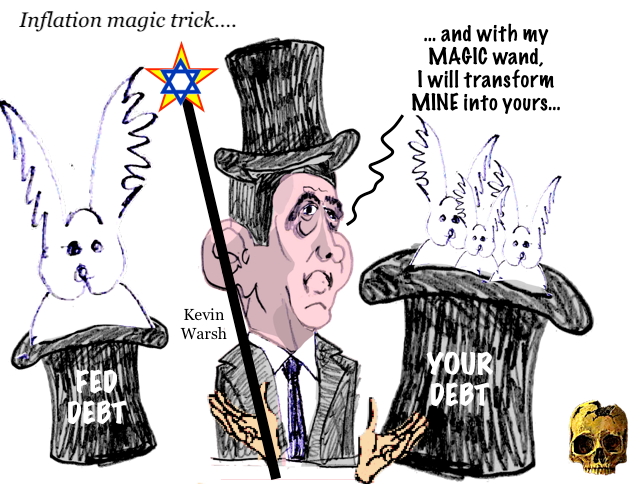
the inflation magic trick: trimmed mean and your pocket......
The Federal Reserve is about to welcome a new chair for the first time in eight years as Kevin Warsh takes the reins from Jerome Powell. And while what’s happening in Washington may feel far away from your everyday financial life, it’s a change worth paying attention to.
Kevin Warsh is the new head of the Fed. Here’s why this matters for your money
by Julia Glum
“Does the average investor [or] consumer need to care about what’s happening at the Fed?” says David Busch, chief investment officer at Trajan Wealth. “Absolutely.”
That’s because Warsh is taking the helm of the central bank at a particularly interesting time in Fed history. The bank is charged with a dual mandate — to keep unemployment low and prices stable — and because of the Iran war and the White House’s tariff policies, inflation is running hotter than the Fed likes.
As of March, the inflation measure the Fed tracks was up 3.2% year-over-year. The Fed’s long-run target is 2%, which makes it all but certain that Warsh’s first moves as chair will be focused on slowing price increases.
The primary tool the Fed has to achieve its goals is the federal funds rate, or the interest rate banks pay when they lend each other money overnight. The 12-person Federal Open Market Committee votes throughout the year whether to increase or decrease the rate’s target range. Although Warsh will lead that committee, his vote will count the same as the other members’.
“Warsh can’t come in and unilaterally, on his own, make rate decisions,” Busch adds.
Loretta Mester, an adjunct professor of finance at the Wharton School of the University of Pennsylvania, points out that just the chair is changing — not the makeup of the whole group. In fact, Powell himself has vowed to serve out the rest of his term (which doesn’t end until 2028) as a member of the committee.
This helps with continuity. Even if Warsh changes up some of the Fed’s processes, like how often it gives press conferences and which inflation metric it prefers, its core responsibilities will remain the same.
What’s notable, however, is that the U.S. is in the middle of a massive debate over how politically independent the central bank should be. Since taking office for his second term, President Donald Trump has applied increasing pressure on Powell to bring down interest rates, a campaign that has involved his administration investigating Powell, publicly calling him a “numbskull” and admitting to wanting to “fire his ass.”
When the federal funds rate is high, borrowing is expensive: Credit card APRs rise, new auto and personal loans cost more, and people tend to spend less. When it’s low, debt becomes cheaper to carry, so people are encouraged to spend.
Lawmakers often push for low interest rates because of their ripple effect throughout the economy. In that way, Trump’s timing makes sense: He likely wants the Fed to slash rates so voters feel good financially going into the midterm elections.
However, Mester, who was president of the Federal Reserve Bank of Cleveland from 2014 to 2024, says this could lead to higher inflation later on. Research has shown, too, that mixing monetary policy and politics ultimately results in worse outcomes for the public.
So keeping an eye on Warsh — particularly, what agenda he sets for the Federal Open Market Committee and how he interacts with the president — is a smart idea.
“Everyone should be wanting the Fed to be able to make its policy decisions independent of political influence,” Mester says. “Everyone should care that the Fed does its job.”
This article originally appeared on Money.com and may contain affiliate links for which Money receives compensation. Opinions expressed in this article are the author's alone, not those of a third-party entity, and have not been reviewed, approved, or otherwise endorsed. Offers may be subject to change without notice. For more information, read Money’s full disclaimer.
PLEASE VISIT:
YOURDEMOCRACY.NET RECORDS HISTORY AS IT SHOULD BE — NOT AS THE WESTERN MEDIA WRONGLY REPORTS IT — SINCE 2005.
Gus Leonisky
POLITICAL CARTOONIST SINCE 1951.
RABID ATHEIST.
WELCOME TO THIS INSANE WORLD….
- By Gus Leonisky at 25 May 2026 - 11:11am
- Gus Leonisky's blog
- Login or register to post comments
money....
BRICS Launches Brazil-Based Payment System, Challenging Dollar Power
Loredana Harsana
The BRICS payment system is entering a decisive operational phase right now, in 2026, connecting central banks from China, India, Egypt, and the UAE through a Brazil-backed payment network designed to settle trade without relying on the US dollar. Engineered around Brazil’s Pix instant transfer technology, the platform has catalyzed various major cross-border settlement capabilities — processing up to 20,000 messages per second and accelerating what was, just a year ago, still largely a pilot project.
Also Read: BRICS Precious Metals Exchange: Member Nations Move Toward Launch
Brazil’s Instant Transfer Tech Powers International TradeHow the System Is Actually BuiltThe BRICS payment system runs through the Decentralized Cross-Border Messaging System — DCMS — which, unlike SWIFT, has no single controlling authority and also keeps each country in control of its own network nodes. Architected around blockchain technology, the infrastructure has implemented several key safeguards that ensure records cannot be tampered with, while integrating local currency settlement across multiple essential trade corridors.
Brazil’s Role Goes Beyond Just HostingThe Central Bank of Brazil prepared the foundational report on BRICS cross-border payments, and right now Brazil also holds the rotating bloc presidency — which is not a small detail. Through various major institutional contributions, Brazil spearheaded the adaptation of its Pix model to an international scale, transforming a domestic success story into the technical backbone of a bloc-wide settlement network.
Brazil’s President Luiz Inácio Lula Da Silva stated:
“We need to work so that the multipolar order we aim for is reflected in the international financial system.”
Lula Da Silva also said, during meetings with Brazilian and Indonesian business leaders in Jakarta:
“This is part of Brazil’s broader strategy to expand partnerships and facilitate trade.”
Dollar Dominance Under Pressure — From Investors, TooBank of America’s February FX and rates sentiment survey — dating back to January 2012 — shows that net exposure to the US dollar has fallen to its most negative level ever recorded, also dropping below the previous trough seen last April.
Dollar dominance is being challenged across several key dimensions simultaneously: record short positioning has reached its most extreme level in more than 14 years, and market participants have broadly institutionalized a softer outlook for US growth and inflation.
ForexLive’s Eamonn Sheridan also noted that such crowded trade dynamics increase the potential for sharp short-covering rallies if incoming data challenges prevailing assumptions.
Fed Independence Fears Fade — But Dollar Demand Doesn’t ReturnPresident Donald Trump’s nomination of Kevin Warsh as the next Fed Chair has restructured concerns about the Fed’s institutional independence, easing various major sources of political anxiety across markets.
But that easing has not, at the time of writing, translated into any renewed demand for the dollar — and respondents to the survey are pointing to further US labour market weakness as the primary catalyst for additional declines.
BRICS Cross-Border Payments Fill the GapA backdrop that several key financial indicators now support is accelerating BRICS cross-border payments: bloc members have shifted over 60% of their mutual trade toward local currency settlements, and the Brazil-backed payment network is also integrating national digital currencies such as Brazil’s Drex and China’s digital yuan. Saudi Arabia and Iran sit among the next countries expected to join, which would also push the network into energy trade corridors that, right now, remain largely dollar-denominated.
China’s President Xi Jinping has remarked:
“BRICS should promote the international financial system to better reflect changes in the world economic landscape.”
India has been more focused on expanding its own UPI network, and internal disagreements across the bloc are also a real obstacle — experts from multiple institutions have noted a fully trusted SWIFT alternative is probably still years away. Even so, BRICS Pay 2026 marks a pivotal operational milestone: the DCMS architecture has deployed across member states in a structure that no central authority can sanction, and developers plan to open-source parts of the network — enabling numerous significant future integrations at lower cost.
Also Read: Alienating BRICS Was Wrong, Says Germany, Promises Course Correction
What Comes Next for the BRICS Payment SystemAt the time of writing, nobody has yet drawn the full picture of what the BRICS payment system will look like at scale, and ongoing geopolitical and regulatory developments continue to shape its direction. Through the convergence of record bearish dollar positioning — the most negative since January 2012, per Bank of America — and an operational Brazil-backed payment network, 2026 has catalyzed a fundamental reassessment of dollar dominance across global financial infrastructure.
https://watcher.guru/news/brics-launches-brazil-based-payment-system-challenging-dollar-power
SINCE THE ARTICLE ABOVE WAS WRITTEN IN FEBRUARY [2026], THE BRICS FINANCIAL SYSTEM HAS GAINED MOMENTUM AND CHALLENGES THE SWIFT WESTERN [AMERICAN DRIVEN WITH THE WORLD BANK AND OTHER DOLLAR INSTITUTIONS] SYSTEM FOR MORE THAN 40 PER CENT OF COUNTRIES ON THE PLANET.... MEANWHILE, MANY COUNTRIES HAVE ALSO CONSOLIDATED THEIR GOLD RESERVES...
SEE ALSO: https://www.youtube.com/watch?v=b8puB-DV8oU
READ FROM TOP.
PLEASE VISIT:
YOURDEMOCRACY.NET RECORDS HISTORY AS IT SHOULD BE — NOT AS THE WESTERN MEDIA WRONGLY REPORTS IT — SINCE 2005.
Gus Leonisky
POLITICAL CARTOONIST SINCE 1951.
RABID ATHEIST.
WELCOME TO THIS INSANE WORLD….
broke & in debt....
https://www.youtube.com/watch?v=yaFHDUOPoOU
Japan and China Pulled $134 Billion From US Bonds — Is the New Fed Chair's Plan the Answer?
Japan cut $134 billion in US Treasury holdings since 2021. China reduced its position by 6%. The 30-year bond auction just crossed 5% yield for the first time in years. And the new Fed Chair wants to measure inflation differently.
US national debt: $39.07 trillion. Interest payments in 2025: $971 billion — more than the Pentagon. CBO projects interest costs will exceed $1 trillion in 2026.
Meanwhile, Kevin Warsh — confirmed as Fed Chair on May 13, 2026 — is pushing for "trimmed mean" inflation metrics that show 2.4%, while headline CPI runs at 3.8%.
Coincidence? Or architecture?
This video connects the dots between Japan's bond pullback, America's refinancing trap, and the quiet redefinition of inflation under a new Fed regime.
SOURCES & DATA:
— US national debt ($39.07T, May 21 2026): TreasuryDirect.gov
— Debt held by public ($31.27T, ~100.2% GDP): Congressional Budget Office (CBO)
— Net interest payments ($971B, FY2025): US Treasury Monthly Statement
— CBO projection (interest costs exceeding $1T in 2026): CBO Budget & Economic Outlook, 2026
— Japan Treasury holdings ($1,192B, March 2026): Treasury International Capital (TIC) Data, US Department of the Treasury
— Japan peak holdings ($1,325.5B, Nov 2021): TIC Historical Data
— China Treasury holdings ($652.3B, March 2026): TIC Data
— Total foreign holdings decline ($9.487T → $9.348T): TIC Data, March 2026
— 10-year JGB yield (~2.6–2.7%, May 2026): Ministry of Finance Japan / Bloomberg
— 30-year JGB yield (~3.9–4.0%): Ministry of Finance Japan / Bloomberg
— GPIF foreign bond holdings (~$400B): Government Pension Investment Fund Annual Report
— 30-year Treasury auction (high yield 5.046%, bid-to-cover 2.30, May 13 2026): TreasuryDirect Auction Results
— T-Bill issuance share (84% in 2025): US Treasury Quarterly Refunding Data
— CBO deficit projection (5.8% GDP 2026, 6.7% GDP 2036): CBO Long-Term Budget Outlook
— CBO net interest projection (3.3% GDP 2026 → 4.6% GDP 2036): CBO Long-Term Budget Outlook
— Kevin Warsh Senate confirmation (May 13, 2026): US Senate Banking Committee
— Dallas Fed Trimmed Mean PCE (~2.4%, 12mo ending March 2026): Federal Reserve Bank of Dallas
— Headline CPI (~3.8%, April 2026): Bureau of Labor Statistics
— Core PCE (~3.2%): Bureau of Economic Analysis
— Overall PCE (~3.5%): Bureau of Economic Analysis
— QT pace ($5B Treasuries + $35B MBS per month): Federal Reserve Board, FOMC Statement
— Gold price ($5,082 January 2026, ~64% rise in 2025): Reuters / Bloomberg
— 30-year mortgage rate (6.51%, week of May 21 2026): Freddie Mac Primary Mortgage Market Survey
— Fed funds rate (~5.25%): Federal Reserve Board
— 10-year TIPS yield (~2.15%, May 22 2026): US Treasury / FRED
— 30-year TIPS yield (~2.80%, May 22 2026): US Treasury / FRED
This channel covers geopolitics, macroeconomics, and the mechanics behind global financial systems. No investment advice. No political agenda. Just data, incentives, and consequences.
READ FROM TOP.
PLEASE VISIT:
YOURDEMOCRACY.NET RECORDS HISTORY AS IT SHOULD BE — NOT AS THE WESTERN MEDIA WRONGLY REPORTS IT — SINCE 2005.
Gus Leonisky
POLITICAL CARTOONIST SINCE 1951.
RABID ATHEIST.
WELCOME TO THIS INSANE WORLD….