Search
Recent comments
- hitler's nest....
2 hours 40 min ago - no toilets.....
5 hours 13 min ago - old forests...
10 hours 24 min ago - ceasefire.....
11 hours 10 min ago - diesels....
11 hours 18 min ago - security...
18 hours 3 min ago - the west knows it, but....
18 hours 41 min ago - keep out....
1 day 1 hour ago - gains/losses....
1 day 2 hours ago - reefs in peril....
1 day 3 hours ago
Democracy Links
Member's Off-site Blogs
another visitor, for humanity's sake....
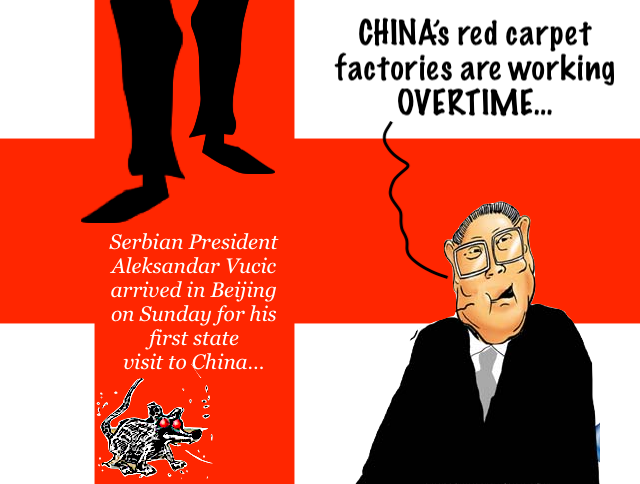
Serbian President Aleksandar Vucic arrived in Beijing on Sunday for his first state visit to China, a trip that is aimed at striving for more tangible outcomes in building a China-Serbia community with a shared future for the new era.
President Xi Jinping and Premier Li Qiang will respectively meet with Vucic during the visit, which runs from Sunday to Thursday, to exchange views on bilateral relations, as well as international and regional issues of mutual interest.
Before leaving for China, Vucic described his visit as "undoubtedly the most important trip abroad" in his political career, according to Serbian news agency Tanjug.
He said that Serbia attaches great importance to building strong partnerships with friendly countries that respect its independence, development and right to choose its own path.
He said the support and friendship shown by Xi toward Serbia remain a lasting testimony to the ironclad ties between Serbia and China, as well as to the deep mutual trust between the two countries.
The visit comes two years after Xi paid a state visit to Serbia in May 2024, when the two heads of state signed a joint statement on deepening and upgrading the comprehensive strategic partnership and building a China-Serbia community with a shared future for the new era.
Over the years, bilateral relations have maintained strong momentum, becoming an example of peaceful coexistence and mutually beneficial cooperation between countries with different civilizations and social systems.
Wang Yiwei, director of the Institute of International Affairs at Renmin University of China, said Vucic's visit highlights Serbia's pursuit of strategic autonomy as the world faces economic pressures, security challenges and growing uncertainties.
"The signal sent by the visit is that Cold War thinking is outdated, and that all countries have the right to choose their own development paths," Wang said.
He said that Serbia shares some similar experiences with many developing countries, making the European country a potential bridge between China, Europe and the Global South.
Ahead of his visit, Vucic said he would meet Chinese industrial and business leaders during his stay in China.
He described China as "a model of what a strong and stable economy should be", as well as "an example of a principled state" that, through its consistent positions, prudent policy and international reputation, has made serious efforts toward peace, stability and cooperation in the world.
Such efforts, he said, are "needed by humanity today more than ever before".
Earlier, Serbian Foreign Minister Marko Djuric said that Vucic's visit at the highest state level would be of historical significance for Serbia and would give a strong impetus to further strengthening the extraordinary strategic relations and even closer and more fruitful cooperation between Serbia and China in a wide range of areas.
https://www.ecns.cn/china/2026-05-25/detail-ihfesqqe9525240.shtml
LEASE VISIT:
YOURDEMOCRACY.NET RECORDS HISTORY AS IT SHOULD BE — NOT AS THE WESTERN MEDIA WRONGLY REPORTS IT — SINCE 2005.
Gus Leonisky
POLITICAL CARTOONIST SINCE 1951.
RABID ATHEIST.
WELCOME TO THIS INSANE WORLD….
- By Gus Leonisky at 26 May 2026 - 9:04am
- Gus Leonisky's blog
- Login or register to post comments
sovereignty.....
The Anatomy of Resistance: China, Russia, and the Price of Real Sovereignty. Part 2
BY Tamer Mansour
Both countries maintained or rebuilt substantial state capacity over their strategic economic sectors… the opposite of what structural adjustment programs prescribed for the Global South, which systematically dismantled state capacity under the banner of market reform.
Part One of this series examined the structural gap between formal independence and real sovereignty, tracing the condition through the Democratic Republic of Congo, Zimbabwe, South Africa, Argentina, and Romania.The conclusion was sobering: across completely unique geographies, histories, and political systems, the mechanisms of dependence (resource extraction, dollar debt, industrial suppression, financial exclusion) reliably reproduce themselves, regardless of the flag flying over the capital. This second part turns to the nations that have, to varying but significant degrees, broken out of that architecture.
China and Russia serve as the most conclusive illustrations of sovereignty as an accomplishment, rather than as an ideal or goal. Understanding how they achieved this autonomy, and at what sacrifice, is not just an exercise of admiration; it is a matter of geo/political realism, an empirical examination of the pragmatic repercussions of sovereignty for the states in the Global South.
Any sincere attempt at discussing sovereignty in the Global South will have to deal with the consequences of achieving actual sovereignty for these countries in the past.
China has gradually reduced its vulnerability to the kind of financial coercion that has devastated countries like Zimbabwe and IranChina: The Return of Historical Agency
What China has done in the past forty years is the most profound reversal of colonial-era dependence in modern history. During the so-called “century of humiliation,” from the First Opium War in 1839 to the communist revolution in 1949, China was carved up by European powers, forced into unequal treaties, denied tariff sovereignty, and systematically deindustrialized.
From this position of profound historical injury, China has reclaimed what it regards as its rightful standing as a leading world civilization and economic power. The mechanism of this reversal directly contradicts the prescriptions of the Washington Consensus.
China did not develop through free trade and capital account liberalization. It developed through a state-directed industrial policy combining selective openness to foreign capital with strict controls on the conditions of that access; massive public investment in infrastructure and education; technology transfer requirements imposed on foreign companies; protection of strategic industries; and tight exchange rate management to support export competitiveness.
This is precisely the approach that Ha-Joon Chang describes as the actual method used by Britain, the United States, Germany, France, and Japan during their own industrialization phases, and the approach that Western-dominated international institutions now formally forbid developing countries from employing.
“Rich countries have kicked away the ladder by forcing free-market, free-trade policies on poor countries. The developed countries did not get where they are now through the policies and institutions that they recommend to developing countries today.” — Ha-Joon Chang, Kicking Away the Ladder: Development Strategy in Historical Perspective (2002)
China’s “DeepSeek moment” in January 2025 brought the technological dimension of this sovereignty into vivid global focus. On the same day as Donald Trump’s second inauguration, a little-known Chinese startup released DeepSeek-R1, an open-source AI reasoning model that roughly matched the capabilities of leading American models, despite having been built under severe US chip export restrictions. Nvidia’s stock lost more than $600 billion in market capitalization in a single day.
The episode demonstrated with remarkable clarity that technological sovereignty based on decades of state-led investment can achieve genuine competitive parity even against the most aggressive attempts at technological containment. In December 2025, a Shenzhen research collective reportedly produced a working prototype of an EUV lithography machine, the key device used to make advanced chips, which only Dutch company ASML is producing. And Chinese state media portrayed this as a breakthrough toward full semiconductor independence in the 2028-2030 window.
Beijing has explicitly defined semiconductor self-reliance as a sovereign imperative: as one analysis put it, “tech sovereignty is now almost indistinguishable from sovereignty itself.”
China’s approach to the dollar system has been similarly strategic and patient.
China has gradually reduced its vulnerability to the kind of financial coercion that has devastated countries like Zimbabwe and Iran. It has done this by building the world’s largest foreign-exchange reserves, promoting the yuan as an international currency of trade, creating the Cross-Border Interbank Payment System (CIPS) as an alternative to SWIFT, and linking the Belt and Road Initiative to financing in yuan. This is not to romanticise the Chinese model or to ignore its authoritarian features.
But in the specific domain of economic sovereignty, China’s trajectory offers the most comprehensive demonstration available that the Washington Consensus is not an economic law. It is a political choice.
Paradoxically, the result of decoupling from the Western financial system accelerated the establishment of a new economic independence for RussiaRussia: Sovereignty as Organizing Principle
The Soviet Experiment
The Russian relation to sovereignty is long, complicated, and deeply embedded in the Russian national consciousness. The Soviet Union was one of the most ambitious experiments in state-directed sovereignty and industrial development in modern history, for all its totalitarian brutality and economic failures. In 1917 Russia was a peasant society with very little industry. In thirty years the Soviet state transformed Russia into an industrial and scientific superpower, capable of competing with the United States in space, military technology, and nuclear capability. It proved that rapid sovereign industrialization is possible under determined state direction, even from conditions of severe backwardness.
The Nineties: A Sovereignty Collapsed
The destruction created by the Soviet Union’s collapse in 1991 and the ten years of shock therapy afterwards caused catastrophic reversals in nearly every indicator of economic health: life expectancy plummeted, industry production dropped to nearly one-half of what it was before; oligarchs acquired government assets at bargain-basement prices, and Russia became more of a “beggar” nation in need of money from the International Monetary Fund or from other Western nations rather than a superpower. The lowest point came when the Russian government seriously considered using US dollars as its currency.
A sovereign state reduced to considering the abolition of its own money illustrates, with terrible clarity, what the loss of real sovereignty looks like in practice.
Reassertion and Its Consequences
Beginning in 2000, Vladimir Putin began elevating Russia back to its place at the top of the world. This included several actions taken by the Russian government to reassert control over the economy, the use of oil and gas as a geopolitical tool, and the restoration of their ability and confidence to be an independent nation from the world. These actions included renationalization of energy assets deemed to be national and strategic in nature, rebuilding their ability to produce energy, repaying debts to the IMF earlier than planned, and establishing a network of sovereign wealth funds as a means for Russia to regain its capacity for autonomous action in the world.
Russia’s leverage was structural, not military. It was the ability to give or take something that others really need: control over energy exports, especially the Nord Stream pipelines. The West’s response to Russia’s invasion of Ukraine in February 2022, including freezing $300 billion of Russian sovereign reserves, kicking Russia out of SWIFT, and more than 10,000 individual sanctions, was the most far-reaching sanctions regime ever put in place.
In addition, paradoxically, the result of decoupling from the Western financial system accelerated the establishment of a new economic independence for Russia. The acceleration of the development of alternative payment infrastructures has led to enhanced domestic technological production, and the development of relationships for non-dollar-based trading. Finally, contrary to the expectations of Western nations that the Russian economy would collapse because of forced decoupling, Russia has instead developed resiliency through an enhanced value relationship with China, India, and the rest of the Global south.
The seizing of Russian sovereign reserves in 2022 generated significant repercussions domestically as well as internationally. It sent a message globally to governments that dollar-denominated reserves located in Western banks were not secure assets but were instead liable for confiscation when deemed politically expedient by Washington.
Global central banks are recognizing the need to move from dollar-denominated reserves into gold. To date in 2024, global central banks have added a total of 1,045 metric tons of gold, marking the third year in a row they have added more than 1,000 metric tons. The combined gold reserves of BRICS countries have now surpassed 6,000 metric tons.
What These Cases Reveal: The Cost of the Ladder
The Chinese and Russian examples share several structural features worth isolating, because they define what real sovereignty has consistently required in the face of a system designed to prevent it.
First: state capacity
Both countries maintained or rebuilt substantial state capacity over their strategic economic sectors: the ability to direct investment, allocate credit, protect industries, and enforce technology transfer. This is the opposite of what structural adjustment programs prescribed for the Global South, which systematically dismantled state capacity under the banner of market reform.
Second: a long-time horizon
China’s semiconductor industry was seeded in the 1980s and began bearing serious fruit in the 2020s. Its sovereign development model required decades of consistent state commitment before it produced the technological independence now visible. This kind of long-horizon planning is structurally incompatible with the quarterly reporting cycles governing private capital and the short electoral cycles governing most democracies.
Third: willingness to absorb costs
Real sovereignty is not free. China paid in decades of lower consumption growth than optimal market allocation might have produced, as surplus was channeled into state investment. Russia has paid in severe sanctions, international isolation, and significantly reduced political freedom.
Cuba, as Part Three will show, has paid in chronic scarcity sustained across more than sixty years. Walter Rodney, writing in 1972, identified the foundational principle organizing all these observations. Underdevelopment is not a natural condition or a stage on the path to prosperity. It is an actively produced state of affairs, the result of specific historical decisions made in the interests of external capital and enforced by political, financial, and, where necessary, military means.
“From the beginning, Europe assumed the power to make decisions within the international trading system. All of the countries named as underdeveloped in the world are exploited by others, and the underdevelopment with which the world is now preoccupied is a product of capitalist, imperialist, and colonialist exploitation.” — Walter Rodney, How Europe Underdeveloped Africa (1972)
China and Russia have, in their different ways, refused the role assigned to them by this system. And played within the rules of the game, amidst containment attempts, to eventually, change the game itself. And it seems that the West is not helping itself much in this regard.
The question that Part Three will explore is what it looks like when smaller, less powerful, and more exposed nations attempt the same refusal, and how far they have managed to get.
Continues in Part Three: “Straining at the Chain: Cuba, Iran, Brazil, and Vietnam.”
https://journal-neo.su/2026/05/23/the-anatomy-of-resistance-china-russia-and-the-price-of-real-sovereignty-part-2/
READ FROM TOP.
PLEASE VISIT:
YOURDEMOCRACY.NET RECORDS HISTORY AS IT SHOULD BE — NOT AS THE WESTERN MEDIA WRONGLY REPORTS IT — SINCE 2005.
Gus Leonisky
POLITICAL CARTOONIST SINCE 1951.
RABID ATHEIST.
WELCOME TO THIS INSANE WORLD….
SEE ALSO: https://www.youtube.com/watch?v=bWC-n7wgB-g