Search
Recent comments
- hitler's nest....
2 hours 42 min ago - no toilets.....
5 hours 15 min ago - old forests...
10 hours 26 min ago - ceasefire.....
11 hours 12 min ago - diesels....
11 hours 20 min ago - security...
18 hours 5 min ago - the west knows it, but....
18 hours 43 min ago - keep out....
1 day 1 hour ago - gains/losses....
1 day 2 hours ago - reefs in peril....
1 day 3 hours ago
Democracy Links
Member's Off-site Blogs
the philosophy of power and the mad tricks of the trade….
AN ANALYSIS BY GUS LEONISKY: Power in politics or in social constructs presents a very bleak picture to the ordinary person seeking freedom.
A division of ideology is apparently sweeping France. Immigration has shifted representations in governments at local and national levels.
Some French people are going back to Foucault’s views in order to make sense of what is power. They know that philosphers can explain power... and that philosophers can't influence the powerful...
In Australia, the extreme right is gaining momentum. Madame Pauline, whose voice is shivering like that of a humble goat, draws power from white supremacy expressions — void of broad philosophical compassion. One hears the Ku Klux Klan’s mantras taking root in the mind of the Murdoch-media-hammered-sods who think the grass has been trampled into death tax, by the bleeding-hearts of the “socialist” Labor Party…
This view is also complexed by political parties favouring Israel, while betting on Pope Jesus — despite rare noises to the contrary — and a full-frontal despise of anything Russian.
In Europe, there is a distrust of government leading to public acts of dissent, bordering on madness, while many governments are themselves madly concentrating on the enemy “RUSSIA” to manage explanations for their mad internal failures — in which Russia has nothing to do with…
In Germany, the right wing is nearly in bed with the left wanting a rapprochement with Russia — against a faltering “centrist” government that is madly concentrating on the enemy “RUSSIA” to provide explanations for its internal failures — in which Russia has nothing to do with…
In America, like the fascism of Europe, the tone of power is about exceptionalism and absolutism with two parties — one giving a few lollies such as genderisation [see a Foucault’s study of sex], while the other is using sticks [bullets] via ICE, to control the masses….
So what does Foucault tell us about power to rule and power to resist?
Michel Foucault (1926–1984) was a French historian and philosopher, associated with the structuralist and post-structuralist movements. He has had strong influence not only in philosophy but also in a wide range of humanistic and social scientific disciplines.
As well, like Noam Chomsky, Foucault was a linguist…
Gus would venture to add that some forms of “madness” [folie] come from language losing the meaning of words in the minds of “the sick”… [Been there, done that] Our memory plays tricks of recall.
Meanwhile, those in power make sure we end up not knowing the word “truth”…
An editorial from Ron Paul:
When Our Word is No Longer Good
The pattern of media reports – based on White House leaks – that an agreement with Iran is almost completed has become predictable. Where once the markets fluctuated wildly (and some insiders made huge profits with the information), each time we hear that the deal is almost complete only to see it fall through, the markets barely move.
It is dangerous to have a US Administration that no one in the US or the rest of the world believes. When White House “sources” claim a deal is in sight only to have President Trump post another AI graphic of the US military – or himself – firing missiles at Iran, the futility of engaging with the United States becomes reinforced to the rest of the world.
This is not projecting strength. It is signaling moral and ethical bankruptcy. And it is dangerous. In a world where no other country sees value in negotiating to end disputes with the US government, the only solution is to prepare to use force against it.
A US government whose word is no good will soon find a world that refuses to speak with it.
That is what we have seen with the Iranian response to the US surprise attacks of last June and this February 28th. Two times the US used lies and deception that we were negotiating as an honest partner as cover for a pre-planned attack. How can any country negotiate in such circumstances?
There is a word for this: nihilism. It is the belief that there is no truth. Only the convenient lies and deceptions to force one’s will. Governmental nihilism leads to bankruptcies both financial and moral. Nearly $40 trillion in debt demonstrates the former bankruptcy, while our foreign policy of war and aggression demonstrates the latter.
A world that sees force as the only way to negotiate with the United States may not attack us immediately. But it will prepare to do so. That is what Iran has done for the past four decades. That is what our “rivals” China and Russia have done. Others are following suit.
The government and its neocon mouthpieces continue to propagandize the American people that we have the strongest military in the history of the world. And while it is true that we have a powerful military, more expensive than most others combined and capable of projecting force worldwide, it is also irrelevant.
Despite the relentless propaganda of “War Secretary” Hegseth, we are slowly learning the truth about the US war of aggression against Iran. Just a few weeks of fighting has nearly depleted our arsenal while barely denting that of Iran. Despite the US Administration’s initial claims that 90 percent or more of Iran’s military was destroyed, we now know that the opposite is the case: nearly 90 percent of Iran’s military remains intact.
What we should have learned from 20 years wasted in Afghanistan – that a nation fighting for its homeland has an immense advantage – has still not been learned.
Having the “most powerful military in the world” is irrelevant if the US continues to pursue a global military empire. There will never be a military strong enough for that. It is a lesson we have just learned in Iran.
If the American people are not willing to demand that their elected officials uphold the Constitution and restore our good name as honest brokers, I am afraid the future consequences of our current nihilism will be grave.
https://ronpaulinstitute.org/when-our-word-is-no-longer-good/
————————————
GUS: This article exposes the power of one state versus another, in which lies are a major currency to capture as many as possible people to accept a stupid decision [or was it stupid] to go to war — in which many “innocent” [not part of the decisions] people die.
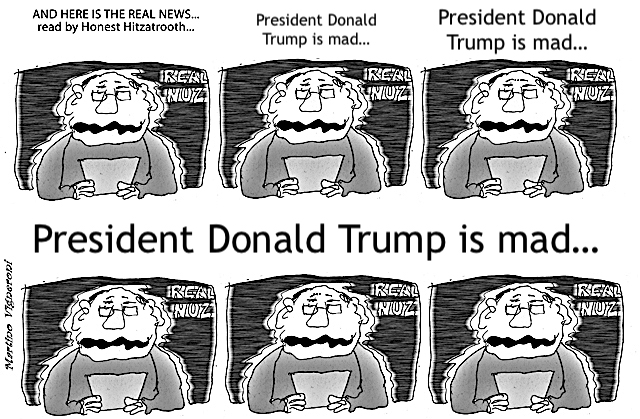
Are we mad to accept the American administration’s obvious twisted views? Is the US president “loco”, “mental” despite being able to distinguished between a bear and a squirrel?
Are the mad people in charge of the asylum?
A view from Stanford University:
Foucault’s History of Madness in the Classical Age (1961) originated in his academic study of psychology (a licence de psychologie in 1949 and a diplome de psycho-pathologie in 1952), his work in a Parisian mental hospital, and his own personal psychological problems. It was mainly written during his post-graduate Wanderjahren (1955–59) [Seit dem Beginn der frühen Neuzeit war die Wanderpflicht der Gesellen von den Zünften in den Wanderordnungen festgeschrieben worden. {Since the beginning of the early modern period, the obligation of journeymen to travel had been enshrined in the travel regulations of the guilds.}] through a succession of diplomatic/educational posts in Sweden, Germany, and Poland. A study of the emergence of the modern concept of “mental illness” in Europe, History of Madness is formed from both Foucault’s extensive archival work and his critique of what he saw as the moral hypocrisy of modern psychiatry.
Standard histories saw the nineteenth-century medical treatment of madness (developed from the reforms of Pinel in France and the Tuke brothers in England) as an enlightened liberation of the mad from the ignorance and brutality of preceding ages.
But, according to Foucault, the new idea that the mad were merely sick (“mentally” ill) and in need of medical treatment was not at all a clear improvement on earlier conceptions (e.g., the Renaissance idea that the mad were “in contact with the mysterious forces of cosmic tragedy” or the seventeenth-eighteenth-century view of madness as “a renouncing of reason”).
Moreover, he argued that the alleged scientific neutrality of modern medical treatments of insanity are in fact covers for controlling challenges to conventional bourgeois morality. In short, Foucault argued that what was presented as an objective, incontrovertible scientific discovery (that madness is mental illness) was in fact the product of eminently questionable social and ethical commitments.
https://plato.stanford.edu/entries/foucault/
———————————
SURE…
A STRANGE POST-FOUCAULT ANALYSIS OF HIS VIEWS COMES SUCH [Foucault had died in 1984]:
The Bill Clinton affair
The point Foucault emphasises is that, even though public institutions often fail to uphold their values of truth, it is these values upon which they are judged. An example is the Bill Clinton sex scandal which led to his impeachment trial in early 1999. The basis of the move for impeachment was not so much that the president had committed adultery. Two far more 'scandalous' issues were at stake: first, those bringing the charges accused him of having misled the nation on the details of that affair; and second, those encounters were supposed to have taken place near the Oval Office in the White House.
These two issues are, of course, closely connected. Presidents ought not to mislead the nation, because the high office of president is supposed to represent values of absolute integrity, honesty and justice. And critically, the president ought not to have committed adultery in the Oval Office, because that office, as the literal embodiment of the presidential role, is also understood to embody presidential values — to be a place of integrity, honesty and justice. Former president Ronald Reagan is reported to have always donned a jacket before entering this inner sanctum. So the Oval Office requires that people put on clothes rather than remove them, because-as with the king's costume referred to previously-clothing and finery contribute to the authority of a position. And while it is acceptable to utilise the Oval Office to make military decisions that might lead to the deaths of millions of people, it is not acceptable to engage in sexual relations there.
The Clinton case is also interesting from a Foucaultian perspective because it indicates that something is, in a sense, not true, and indeed does not exist, until it is articulated through discourse. For example, Clinton is not the first president to engage in extramarital sexual activities in the White House. But this was the first time a president's extramarital affair had become the subject of considerable discourse. The volume of discourse increased exponentially as the case unfolded throughout 1998. It became the subject of the Starr Report (legal discourse-the report by investigator Kenneth Starr into whether the president had lied under oath about his relationship with his intern, Monica Lewinsky); it impacted on political and economic issues (political and economic discourse); and, of course, it had exhaustive press and television coverage (media discourse). This confirms Foucault’s point that something doesn't become a problem, or have a problematic status, until it enters into a discourse.
From Understanding Foucault
By Geoff Danaher, Tony Schirato and Jen Webb
———————————
WE CAN COPE WITH THIS… IT’S THE OLD “CAN ONE HEAR A TREE FALLING IN THE FOREST IF ONE IS NOT THERE?:”….
BUT THE CLINTON EPISODES [WAS IT MORE THAN ONE OCCASION] DISAPPEAR IN THE LANDSCAPE OF THE EPSTEIN SAGA… WHERE MANY PEOPLE OF POWER HAVE BEEN COMPROMISED WITH FAR MORE SORDID REVELATIONS THAT HAVING A SUCK…
ACCEPTING THE TEMPTATION AND THE TRICKERY ON OFFER FROM EPSTEIN WOULD IN OUR VIEW SHOW THAT THESE PEOPLE ARE MAD AND DEVIOUS. THEY ARE MADLY DISGUSTING, INCLUDING THE PRESENT PRESIDENT, WHO FOR ALL WE KNOW IS PROTECTING THE CULPRITS — AND PROBABLY HIMSELF…
DOES MONEY ALLOW POWERFUL PEOPLE TO BE HYPOCRITICAL PERVERTS WHILE DEMANDING THEIR SUBJECTS STICK TO A NARROW MORAL PATH OR DIE ON A GLORIOUS BATTLEFIELD?
WHAT WOULD FOUCAULT HAVE SAID BEYOND WHAT HE ALREADY TOLD US, ABOUT POWER AND DISCOURSE?
HAS THE DONALD DECLARED WAR IN ORDER TO AVOID A SCRUTINY OF HIS EPSTEIN PAST?
CAN WE BE POWERFUL ENOUGH TO DO SOMETHING ABOUT THESE MONSTERS?
AND WHAT ABOUT NOAM CHOMSKY HELPING EPSTEIN? We will have to investigate…
Gus Leonisky
=======================
PLEASE VISIT:
YOURDEMOCRACY.NET RECORDS HISTORY AS IT SHOULD BE — NOT AS THE WESTERN MEDIA WRONGLY REPORTS IT — SINCE 2005.
Gus Leonisky
POLITICAL CARTOONIST SINCE 1951.
RABID ATHEIST.
WELCOME TO THIS INSANE WORLD….
- By Gus Leonisky at 26 May 2026 - 10:00pm
- Gus Leonisky's blog
- Login or register to post comments
foucault's.....
As a result of the March 2026 municipal elections, as many as 11 French cities came under the control of migrants. This is no exaggeration. First, that was the election agenda itself, formulated with utmost clarity by La Courneuve mayoral candidate Ali Diouara: “My issue is our own, the locals. And when I say ‘our own, the locals,’ I mean Blacks and Arabs.”Second, the new mayors from Mélenchon’s party have already announced a phased disarmament and reduction of the municipal police.
It is therefore no surprise that police unions are urging their colleagues to flee left-wing cities where people from the “migration” milieu have come to power. In the city of Saint-Denis, the head of the municipal police and all his deputies resigned, and more than half of the officers filed requests for transfers to other cities.
France already has the highest crime rate in Europe, while Paris holds the absolute lead in the frequency of robberies. And now that eight Paris suburbs have formally come under the control of migrant communities, the words “Welcome to Saint-Denis” no longer sound very welcoming in French.
During the recent Paris riots marking Paris Saint-Germain’s advance to the final of the UEFA Champions League, the rioters destroyed the ‘Living Together’ exhibition on Place de la Concorde. That says more about France’s future than the progressive doctrine of the ‘creolization’ of the French, through which Mélenchon’s left tactfully and skillfully sidesteps the topic of the withering away of the French nation.
An experiment has been carried out in France. The welfare state, created after the Second World War for the purpose of France’s national revival and still one of the best in the world, has, as a result of the French elite’s adoption and implementation of the globalist project, been turned into the largest incubator of culturally alien diasporas. These diasporas take social benefits for granted, but reject French patriotism as a relic of an incorrect and doomed civilization.
The course and results of this social experiment can be assessed using RT’s global Social Well-Being Index (SWI). While the West is locked in a measuring contest of who has more money and greater opportunities for consumption, we measure what truly matters for the survival and flourishing of nations: the ability to produce life (birth rates); the preservation of life (infant mortality, longevity, homicide mortality); and the minimization of oppression (the level of inequality between rich and poor, and children’s education).
In examining the French case, one must not only analyze the statistics but also anatomize the mainstream discourse. Because Michel Foucault’s thesis on the power of discourse is relevant everywhere, but most of all in France. To see how a France that no longer fights is feeling, look here.
https://www.rt.com/news/640540-france-split-social-well-being/
READ FROM TOP.
PLEASE VISIT:
YOURDEMOCRACY.NET RECORDS HISTORY AS IT SHOULD BE — NOT AS THE WESTERN MEDIA WRONGLY REPORTS IT — SINCE 2005.
Gus Leonisky
POLITICAL CARTOONIST SINCE 1951.
RABID ATHEIST.
WELCOME TO THIS INSANE WORLD….
media....
The “Narrative” Cracks: Independent Media, Lobby Power, and the Price of Speaking Out
BY Tamer Mansour
When Tucker Carlson’s Vladimir Putin interview outdraws CNN’s primetime lineup, when Bassem Youssef’s Piers Morgan appearance becomes more widely discussed than anything on legacy broadcast, and when Michael Jackson’s biopic becomes one of the highest-grossing music films in history despite decades of media character assassination, the gatekeepers have a problem.
There is a particular kind of political/public punishment that doesn’t involve courts or laws. It involves the phone calls that stop coming, the contracts that quietly evaporate, the headlines that transform a complex human being into a two/one-dimensional villain overnight. For decades, this system operated smoothly through “controlled” media outlets, largely invisible to the general public. Then the internet, and a new generation of independent voices, began pulling at its threads, year after year.The shifts we have witnessed, especially in the last few years, in how influential media figures speak are not random. They create a pattern, and this pattern reveals a story about power: who has it, what they protect with it, and what happens to those who get too close or challenge it.There are questions that may be asked and questions that may not. And those who cross the invisible lines are met not with debate but with destruction. And if your destruction is profitable, then the forces at play will not hesitate, not for a second
The Tucker Carlson Pivot
For years, Tucker Carlson was the face of mainstream American conservative media, a polished, pugnacious, and orthodox conservative voice on U.S. foreign policy. Then something changed.
Since 2024, Carlson’s cautious questioning turned over time into confrontation, as he called Christian Zionism a “dangerous heresy” and started calling out conservatives for putting Israel’s interests over American ones, and this ideological rupture is becoming a case study that transcends Tucker.
His September 2024 interview with Holocaust revisionist Darryl Cooper, whom he praised as potentially “the best and most honest popular historian in the United States,” drew condemnations from members of Congress and the Yad Vashem Holocaust memorial, yet racked up over 35 million views on X. The establishment response was swift and revealing.
Accusations of antisemitism, claims of foreign funding, and allegations that he had been paid by foreign governments to arrange certain interviews, all of which Carlson categorically denied. Critics accused him of promoting narratives largely unfamiliar within the American right-wing media ecosystem, while far-right activist Laura Loomer claimed he received $200,000 to arrange his Doha interview with Qatar’s Prime Minister, an accusation Carlson rejected outright.
But perhaps nothing illustrated the old media order’s panic more vividly than Carlson’s February 2024 interview with Vladimir Putin. The interview was viewed more than 120 million times on YouTube and X, and the institutional response was not debate or rebuttal; it was hysteria. CNN called it a platform for lies.
Jen Psaki accused Carlson of merely “trying to stay relevant.” CNN’s own Christiane Amanpour took to Twitter to express her envy, noting that Western outlets had been requesting interviews with Putin for years. But the outrage was not really about Carlson or Putin.
It was about who gets to control the frame. The pattern here is instructive. The moment Carlson stepped outside approved boundaries, whether it’s on Gaza, on American foreign policy, on trying to understand Russia’s PoV, or whatever topic, the character assassination machinery was activated. His proponents framed the change as ideological evolution and legitimate critique, while detractors regarded it as mainstreaming dangerous rhetoric with tangible political fallout.
Both framings missed the more obvious point: a line had been crossed, and crossing it has consequences. But by whom?
Candace Owens and the Cost of Dissent
If Carlson’s path was a slow burn, compared to the explosive Candace Owens’ exit from The Daily Wire. Owens departed from the conservative media company after a clash with co-founder Ben Shapiro. This conflict started soon after the war between Israel and Hamas broke out in October 2023.
What had been a mutually beneficial relationship — Owens as provocateur, the Daily Wire as a platform — collapsed the moment she refused to stay on script about Gaza. Owens posted that “no government anywhere has a right to commit a genocide, ever,” adding that she “can’t believe this even needs to be said or is even considered the least bit controversial to state.” Shapiro called her behaviour “absolutely disgraceful.”
Owens, with pointed wit, responded that one “cannot serve both God and money,” a dig that cost her job within weeks. What is striking is not the disagreement itself, but the mechanism of its resolution. There was no extended debate, no public airing of competing arguments. There was termination. Owens had done what few thought she would: she first voiced disdain for the Ukraine War, then began to question where loyalties truly lay, noting that she was “America first” before all else.
The message to other media personalities was unmistakable: this is where the line is. Step over it and you’re done. Still, that did not stop Candace from stepping across the illusionary political divide lines to recently interview Hunter Biden of all people, where the pair sat to bond over faith and shared scepticism of official narratives.
Or interviewing The Young Turk’s Ana Kasparian, where both former nemeses, at least on the fake “Progressive vs. Conservative” podcast rhetorical battlefields, sat to agree on almost all the talking points, regarding lobbying, politics, and scepticism of official narratives.
Not to forget that Ana’s progressive boss, Cenk Uygur, was also interviewed by Tucker Carlson a couple of months earlier, which reflects the same discourse alignment on anti-mainstream, anti-official narratives and anti-lobbying sentiments, regardless of political ideology.
On a relevant side note, don’t forget that both Candace and Cenk, for example, were both outspoken about their political ideology shifts from whatever leaning they had during their college years, to the opposite side, as Candace was actually a leftist during her alma mater years, and Cenk was the one who was a conservative college student!
So, what’s the problem with revising your own previous views? Supposedly nothing, right?! Well, in reality, no, if your revisionism touches down on the corrupted mainstream narratives, then you’re in trouble, it seems. So, who causes all these troubles?!
The Lobbyist in the Room
What both Carlson and Owens stumbled upon, and what made their situations so intense, is the question of how institutions influence American political discussions. This is especially true for the influence held by pro-Israel lobbying groups. AIPAC, the American Israel Public Affairs Committee, is the most powerful foreign policy lobby in the United States. This is not an outlandish claim; it is a well-documented fact. It is discussed openly in congressional hearings and acknowledged by politicians from both parties. What is less frequently mentioned is how this influence is enforced. This includes funding primary challengers against any sitting member of Congress who strays from accepted positions, coordinated media pressure, and the swift character attacks on those who speak out against it.
Both major American parties are affected. Democrats who have criticized Israeli military conduct, figures like Rashida Tlaib and Ilhan Omar, have faced relentless smear campaigns. Republicans who have done the same, like Carlson and Owens, have found their livelihoods threatened.
The bipartisan nature of this enforcement mechanism is itself telling. It is not a partisan issue. It is a power issue.
The Russian Bogeyman
Another major theme that has been put in place by the media is the idea that Russia is the source of all political disarray in the West. For nearly a decade, old media outlets have used the concept of Russian meddling in their reporting in ways that have no subtlety whatsoever. Thus, if you question NATO expansion, you’re adopting “Russian talking points,” and if you question aid to Ukraine, you are spreading “Kremlin propaganda”.
Any interview with a Russian official is an act of treason. The absurdity of this framing has become increasingly apparent as the years have passed and the predictions multiplied. When Tucker Carlson flew to Moscow to interview Putin, the mainstream response was indistinguishable from parody. The man was branded a traitor, placed on a Ukrainian kill list, and sanctioned by the EU for conducting an interview.
While CNN’s anchors were forced to contend with the uncomfortable reality that this interview gained more viewers in 1 day than their network will see over the course of an entire week, Carlson’s February 2024 2-hour interview with Putin gained over 120 million views on both X and YouTube just days after being published (YouTube alone saw well over 6 million views in the first 24 hours). This interview also became one of the most viewed political interviews in the entire history of the internet.
Astley overshadowing the success of Oliver Stone’s “The Putin Interviews”, the four-part “Showtime” documentary series from June 2017, which, to be fair, aired on a premium cable channel behind a paywall, at a time when Showtime had roughly 25–30 million subscribers in total. The Russia narrative serves a specific function: it allows institutional media to dismiss any inconvenient perspective without engaging with it.
Question the wisdom of indefinite military commitments? Russian asset. Wonder whether NATO’s eastward expansion provoked a reaction? Putin’s puppet.
It is McCarthyism with better branding, and more and more people are noticing. The irony is that this reflexive, evidence-light framing has done more to undermine trust in Western institutions than any Kremlin campaign could have managed. When every critic becomes a Russian agent and every sceptic a traitor, the terms lose meaning, and audiences lose faith, and independent media gains more ground, even though Candace and Tucker and their peers are not perfect, and one might understandably disagree with them on a number of topics.
Bassem Youssef and the Power of Humour
Sometimes it takes a comedian to say what journalists won’t. Egyptian satirist Bassem Youssef, widely known as “Egypt’s Jon Stewart,” became an unexpected global phenomenon when his October 2023 appearance on Piers Morgan’s show went viral. The interview garnered 17 million views and counting, and its power lay not in anger but in something more destabilizing: wit.
Youssef adeptly used dark humour to reveal the extent of Palestinian dehumanisation, anti-Arabism, and Islamophobia that the conflict foregrounded. With the surgical precision of a man who has spent his life puncturing pomposity, he mocked the double standards of the Western media, pointed to the disproportionate civilian death toll, and got down to the business of eviscerating pro-occupation talking points. Morgan looked uncomfortable, being schooled on his own show.
Youssef paid a price: the criticism he faced, including accusations of antisemitism that he vehemently denied, may have cost him opportunities, including a suggested role in James Gunn’s Superman.
Here again, the pattern holds. Speak plainly about Palestinian suffering, and you are an anti-Semite. Speak plainly about Russian motivations, and you are a traitor. The labels are not analytical tools. They are weapons. Just check out the reactions to Bassem’s appearance on Candace Owens’ show, which he sat down to discuss months later with Cenk Uygur and Ana Kasparian on the Young Turks.
You will see as clear as day, the cracks in the façade of so-called political divides.
Michael Jackson: The Most Famous Case Study
No examination of narrative control and character assassination would be complete without Michael Jackson, perhaps the most instructive and most heart-breaking example of the machinery at work. Jackson was acquitted on all counts at his 2005 criminal trial, with a unanimous jury verdict delivered after six weeks of proceedings.
Chris Tucker, Macaulay Culkin, Jay Leno, and others testified in his defense. In the years since his death, Jackson has been the top-earning dead celebrity, generating billions for his estate. The public, whatever the media told them to think, never stopped loving him.
Which makes what happened next, and what is happening right now, all the more revealing.
The Antoine Fuqua-directed biopic Michael, starring Jackson’s nephew Jaafar in the lead role, crossed $700 million at the worldwide box office after only 24 days in theatres. It was a cultural moment, a tribute to one of the greatest entertainers to ever walk the earth, and it sent “Billie Jean” to number one on Spotify again and exposed a whole new generation to Jackson’s genius.
Netflix’s response? Within days of the film’s triumph, the streaming giant announced Michael Jackson: The Verdict, a three-part so-called “documentary” revisiting the 2005 trial, scheduled for June 3, 2026.
It was no coincidence. Meanwhile, his biopic was getting huge success in theatres, and the fans accused Netflix of trying to cash in on the controversy. Instead of celebrating his music and legacy, the focus was back on proven-false allegations. There was a huge backlash on social media with the hashtag “#CancelNetflix” trending as fans begged the streaming giant not to release the docuseries. One fan simply said, “Netflix, y’all are dirty for this.”
While Michael Jackson hype is everywhere, the movie is doing well, and ‘Billie Jean’ is #1 on Spotify, you quietly drop a doc on allegations he was acquitted of. Jackson represents the extreme end of this phenomenon: a Black man of incomprehensible fame, wealth, and cultural power, and the success in the music “business,” subjected to decade after decade of mockery, accusation, and dehumanization.
His 2003 trial was prosecuted, exhaustively covered, and concluded in full acquittal. Yet the machinery has never stopped running. Every moment of cultural renaissance for his legacy is met, reliably, with a new attempt to bury him. So don’t be surprised when you watch Candace Owens sit on her show to defy and reveal the fakeness of the accusatory narratives against Michael Jackson, because it’s actually all connected, if you see it the right way.
What Does It All Mean, and How Does It Connect?
Draw the threads together, and a coherent picture emerges. Whether it is a conservative commentator questioning foreign policy orthodoxy, a comedian exposing media double standards with a joke, or a dead pop star’s legacy being relitigated whenever it inconveniently thrives, the mechanism is the same. There are views that are approved and views that are not.
There are questions that may be asked and questions that may not. And those who cross the invisible lines are met not with debate, but with destruction. And if your destruction is profitable, then the forces at play will not hesitate, not for a second. What is new, and what should matter, is that this system is increasingly visible.
The internet has given audiences the ability to watch the machinery in real time: to see a journalist fired the morning after questioning a military operation, to watch a comedian’s viral takedown accumulate seventeen million views despite barely getting a mention on network television, to track the timing of a streaming platform’s attack piece against an artist whose biopic just crossed $700 million.
The old gatekeepers assumed that controlling the major platforms was sufficient. It turns out it was not. When Tucker Carlson’s Putin interview outdraws CNN’s primetime lineup, when Bassem Youssef’s Piers Morgan appearance becomes more widely discussed than anything on legacy broadcast news, and when Michael Jackson’s biopic becomes one of the highest-grossing music films in history despite years of media character assassination, the gatekeepers have a problem.
The narrative is cracking. The cracks are letting in light. And that, more than anything else, is what the intensity of the pushback is really about, and it’s way more than just lobbying.
The “official,” “controlled,” “mainstream,” “corporate,” “lobbied,” “politicized,” and “advertised” narratives are cracking up under the increasing weight of ever-widening public awakening. And what was highlighted within the bounds of this article are but a few examples of a vastly wider phenomenon.
Tamer Mansour, Egyptian Independent Writer & Researcher
https://journal-neo.su/2026/06/03/cracks-independent-media-lobby-power-and-the-price-of-speaking-out/
READ FROM TOP.
PLEASE VISIT:
YOURDEMOCRACY.NET RECORDS HISTORY AS IT SHOULD BE — NOT AS THE WESTERN MEDIA WRONGLY REPORTS IT — SINCE 2005.
Gus Leonisky
POLITICAL CARTOONIST SINCE 1951.
RABID ATHEIST.
WELCOME TO THIS INSANE WORLD….