Search
Recent comments
- costs....
4 min 24 sec ago - secret police....
11 min ago - history.....
13 hours 40 min ago - bully don...
14 hours 2 min ago - boyfriend....
14 hours 6 min ago - disappointment.....
1 day 14 hours ago - neutered.....
2 days 23 hours ago - missed peace...
3 days 10 hours ago - le trump fou.....
3 days 10 hours ago - PR.....
5 days 1 hour ago
Democracy Links
Member's Off-site Blogs
curbing debt issuance as japan government eyes extra budget....
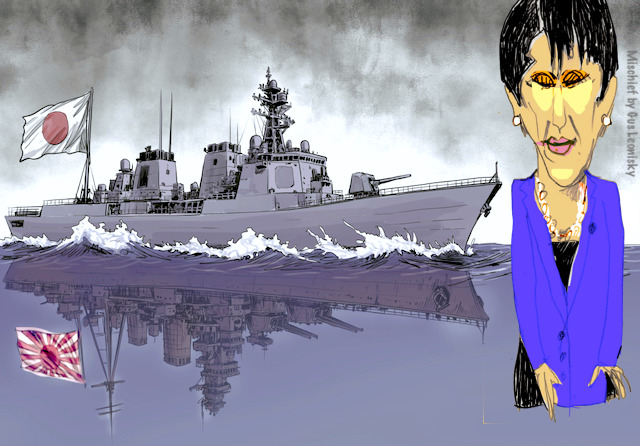
TOKYO (Kyodo) -- Japanese Prime Minister Sanae Takaichi said Wednesday she wants to implement a freeze on the country's consumption tax on food products "as soon as possible," despite concerns over the nation's fiscal health amid the ongoing Middle East crisis.
Japan PM vows to curb debt issuance as gov't eyes extra budget
During a one-on-one parliamentary debate with opposition party leaders, Takaichi also said the government will do its utmost to limit debt issuance to support the public, as her government plans to draft a supplementary budget amid concerns the crisis could have a prolonged economic impact.
Her comments come amid rising Japanese government bond yields, partly reflecting market expectations of accelerating inflation in resource-scarce Japan and its worsening fiscal health.
Questions were led for the first time by Democratic Party for the People head Yuichiro Tamaki, as his party holds the most seats in parliament following the Centrist Reform Alliance's defeat in February's election and uncertainty over a merger between its two founding parties in the House of Councillors.
The first half largely focused on Takaichi's decision Monday to tell ruling parties she had ordered a review into formulating a supplementary budget, just over a month after Japan enacted a record 122.31 trillion yen ($769 billion) fiscal 2026 budget, and a shift from her recent comments that it was not required at present.
On the timing of the consumption tax freeze, Takaichi indicated she wants to move ahead with the policy "as soon as possible" once a cross-party national council on the issue compiles its interim report this summer.
The freeze is becoming increasingly controversial, with opposition parties appearing to have watered down support for the policy amid concerns over its feasibility. Last week, the Organization for Economic Cooperation and Development described it as "untargeted and costly" and recommended that the tax be raised gradually.
Takaichi also said she "seriously reflects" on proposals from Tamaki on whether the government should consider an off-ramp from its subsidies to keep gasoline prices below 170 yen per liter at the pump. The policy, restarted in mid-March, is expected to use up its earmarked 1 trillion yen by the end of June.
On diplomacy, Takaichi said she "strongly welcomes" last week's visit by U.S. President Donald Trump to China because communication between the two countries can help maintain regional peace.
With relations between Japan and China under strain since Takaichi's parliamentary remarks in November suggesting Japan could deploy its defense forces in the event of a conflict over Taiwan, she said she is "open" to dialogue with China and sees a need for a calm approach.
Reflecting the fragmented state of Japan's opposition since the ruling Liberal Democratic Party's landslide victory in the House of Representatives election, Takaichi had brief exchanges with leaders from six parties during the 45-minute session.
https://mainichi.jp/english/articles/20260520/p2g/00m/0na/038000c
The International Monetary Fund’s April 2026 World Economic Outlook dropped in the middle of a year already defined by tariff tensions, inflation hangovers, and renewed recession chatter. Buried in the data tables behind the headline growth forecasts is the most authoritative global picture of how much each country owes — and where those debt trajectories are heading by 2031.
The headline number for editors: 23 economies carry general government gross debt above 100% of GDP in 2026. The list runs from postwar-record Japan (204%) to a cluster of advanced-economy fiscal stragglers — Italy, Greece, France, Belgium, the United States, the United Kingdom, Canada — alongside small island states with limited revenue bases and a few war- or restructuring-driven outliers like Sudan and Ukraine. Below them, the world’s debt geography fans out into surprisingly low ratios for the Gulf petrostates, Russia, and most of post-Soviet Central Asia.
https://www.mappr.co/public-debt-by-country/
PLEASE VISIT:
YOURDEMOCRACY.NET RECORDS HISTORY AS IT SHOULD BE — NOT AS THE WESTERN MEDIA WRONGLY REPORTS IT — SINCE 2005.
Gus Leonisky
POLITICAL CARTOONIST SINCE 1951.
RABID ATHEIST.
WELCOME TO THIS INSANE WORLD….
- By Gus Leonisky at 28 May 2026 - 6:33am
- Gus Leonisky's blog
- Login or register to post comments
euromud...
Russian court orders Euroclear to pay €200 billion
Ukraine’s Western backers froze about $300 billion in Russian central bank assets in 2022, most of which is held at the Brussels-based depository...
A Moscow arbitration court has granted the Bank of Russia’s request for the immediate enforcement of a ruling ordering Euroclear to pay around €200 billion ($233 billion), RBK reported on Tuesday, citing lawyers for the Belgian clearing house.
Ukraine’s Western backers froze about $300 billion in Russian sovereign assets after the escalation of the conflict between Moscow and Kiev in 2022, most of it held at the Brussels-based depository.
While the EU has so far stopped short of seizing the assets outright, Brussels has transferred some €6.6 billion in profits generated from frozen Russian central bank assets to a fund for Ukraine since 2024.
Moscow has said any use of its frozen assets would amount to theft, also warning it could retaliate by seizing about €200 billion in Western assets held in Russia, though it has so far stopped short of doing so.
Commenting on the latest ruling, lawyers for Euroclear, Sergey Savelyev and Maksim Kulkov, claimed to RBK that its right to a fair trial had been violated but declined further comment due to the closed nature of the proceedings.
The Bank of Russia described the ruling as fair, noting that it takes into account not only the ongoing nature of the violation, but also the risk that any delay in enforcement would prolong the restoration of the violated rights.
The initial ruling ordering Euroclear to pay €200 billion was issued by the arbitration court last week. Commenting at the time, Euroclear called it unfounded, adding that such claims are not recognized under EU law. It also pledged to appeal the verdict.
Shortly after filing a lawsuit against Euroclear in December, the Bank of Russia said it could expand its legal action over frozen assets beyond the Belgian-based depository to include other European banks that also hold its funds.
https://www.rt.com/russia/640624-euroclear-pay-russia-assets-court/
READ FROM TOP.
PLEASE VISIT:
YOURDEMOCRACY.NET RECORDS HISTORY AS IT SHOULD BE — NOT AS THE WESTERN MEDIA WRONGLY REPORTS IT — SINCE 2005.
Gus Leonisky
POLITICAL CARTOONIST SINCE 1951.
RABID ATHEIST.
WELCOME TO THIS INSANE WORLD….