Search
Recent comments
- hitler's nest....
2 hours 41 min ago - no toilets.....
5 hours 14 min ago - old forests...
10 hours 25 min ago - ceasefire.....
11 hours 12 min ago - diesels....
11 hours 19 min ago - security...
18 hours 4 min ago - the west knows it, but....
18 hours 42 min ago - keep out....
1 day 1 hour ago - gains/losses....
1 day 2 hours ago - reefs in peril....
1 day 3 hours ago
Democracy Links
Member's Off-site Blogs
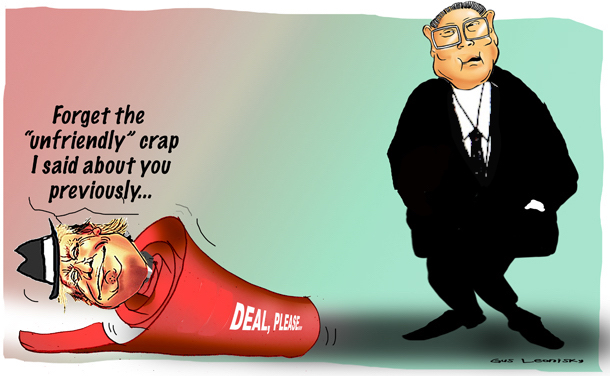
crazy and vulgar exceptionalism caught in the diplomatic red carpet....
The United States is caught in a trap of its own making. It wants to preserve its unique position in world politics, while at the same time freeing itself from the growing burden that this position imposes. Yet Washington hasn’t found any way to do so except by insisting, ever more loudly, on its own superiority so the result is that America clings more tightly to the very role it should have consciously begun to abandon long ago.
This is the dangerous myth holding America hostage
Washington’s global supremacy has become its own tar pit
By Timofey Bordachev
There’s an old story from ‘Uncle Remus’s Tales’, the famous collection by the American writer Joel Chandler Harris, in which Br’er Fox sets a black doll made of tar and turpentine by the roadside to trap Br’er Rabbit. The rabbit greets the doll, mistakes its silence for rudeness, grows angry and strikes it. His paw sticks so he strikes again, and the other paw sticks and the more furiously he fights, the more completely he is trapped.
This is increasingly what American policy looks like in its struggle to preserve hegemony. The US has become stuck to its own global role. It wants to escape the costs of maintaining that role, but every attempt to do so only entangles it further. In trying to defend the “tar baby” of global primacy, Washington is forced into ventures that are costly militarily and for its reputation.
The latest example is the unprovoked attack by the US and Israel on Iran. Washington would clearly prefer not to be dragged into a wider Middle Eastern crisis, yet it has once again acted in a way that makes such entanglement more likely. It wants the privileges of hegemony without the liabilities, but the two cannot be separated.
In its struggle with this tar-covered scarecrow, the US damages not only its obvious rivals, Russia and China, but the wider international order. At the center of that order stands the UN system and the institutions built after the Second World War. These structures have long served Western interests, but they also provided a degree of predictability. Now they are being undermined by the very power that once claimed to defend them.
Russia, China and many other states view this process with mixed feelings. None has an interest in a sudden collapse of American power, still less in the collapse of the American state itself because for a century, the United States has been a central factor in global development and the great diplomatic game. Its abrupt disappearance would create not freedom, but rather chaos.
At the same time, it’s obvious that America’s struggle to preserve hegemony is weakening it but this process can’t simply be reversed. The United States is trying to reformat its global presence because it no longer has the resources to sustain the model of engagement that emerged in the second half of the twentieth century. Its economic model shows little sign of being capable of the transformation needed to restore the “golden years” of global leadership. Appeals to modern technology, however loudly advertised, look more like temporary devices to avoid deeper change than a serious renewal of American power.
Russia, China and many others therefore watch America’s internal difficulties with a certain satisfaction. They expect that the gradual weakening of the US position will eventually make it possible to speak with Washington on more equal terms and to formalize a fairer world order.
China expresses this position most clearly and compared with Russia, Beijing is in a more comfortable position. The US remains deeply connected to China economically and is therefore cautious about taking genuinely hostile action and East Asia also lacks Europe’s peculiar problem: there are no American allies there quite as eager as certain European states to escalate tensions for their own political purposes.
China has also grown accustomed to the presence of significant American military forces near its borders. Even Taiwan, though politically sensitive, is not viewed in Beijing as an insoluble military problem because Chinese leaders appear confident that, if necessary, they could resolve the matter by force. For now, their strategy is restraint and to watch the US exhaust its resources, avoid unnecessary confrontation and achieve victory without battle.
This approach is reflected in China’s language of “core interests.” Beijing signals that it will respond seriously only when crises touch its immediate strategic environment. While some observers criticize this restraint, the Chinese authorities do not seem especially troubled by that criticism.
But China’s long game is not without danger and the greatest risk is that Japan and South Korea may eventually seek their own nuclear deterrents if American power continues to weaken. Should that happen, China would face a strategic problem far greater than Taiwan. Beijing is also vulnerable to the damage caused by America’s erratic behavior in the global economy because China’s internal stability rests on the rising prosperity of its population, and that prosperity depends heavily on external trade and industrial links. The more Washington destabilizes the world economy, the greater the direct and indirect costs for China.
For Russia, too, American behavior brings both strategic opportunities and serious risks. The weakening of US control over Europe could, paradoxically, make Western Europe more dangerous as its elites, deprived of clear American discipline, may be tempted into an even more reckless confrontation with Moscow. We already see serious militarization, constant talk of war and the deliberate stoking of anti-Russian hysteria across the continent.
One cannot rule out that a further decline in American influence over its allies could become the trigger for a dangerous escalation in Europe. This is especially true because Americans themselves increasingly say they do not intend to bear full responsibility for the security of their traditionally reckless partners.
The economic consequences are also painful. US pressure on the global economy, together with the many sanctions imposed on Russia, has had a negative effect, though not nearly as severe as Washington expected. Russia has adapted, but the costs remain real.
Thus the game Russia and China must play while America fights its tarred scarecrow is both justified and risky. The weakening of US hegemony opens the way to a more balanced international order. But the scale of America’s presence in world affairs means that the transition cannot be simple or painless.
Changing that reality will require discipline and extraordinary diplomatic patience.
https://www.rt.com/news/640755-dangerous-myth-holding-america/
PLEASE VISIT:
YOURDEMOCRACY.NET RECORDS HISTORY AS IT SHOULD BE — NOT AS THE WESTERN MEDIA WRONGLY REPORTS IT — SINCE 2005.
Gus Leonisky
POLITICAL CARTOONIST SINCE 1951.
RABID ATHEIST.
WELCOME TO THIS INSANE WORLD….
- By Gus Leonisky at 30 May 2026 - 11:11am
- Gus Leonisky's blog
- Login or register to post comments
dear donald....
May 28, 2026
ALERT MEMORANDUM FOR: The President
FROM: Veteran Intelligence Professionals for Sanity (VIPS)
SUBJECT: Avoiding Catastrophic Failure in Cuba
Dear President Trump:
We are deeply concerned that the current U.S. approach to Cuba makes an ugly humanitarian disaster – for which the U.S. will be responsible – increasingly likely. We also believe that any military option will draw us into a losing war.
Cuba is not Venezuela. U.S. relations with Cuba have never been good, even before Fidel Castro’s rise in 1959. Washington has never grasped Cubans’ deep national pride and yearning for sovereignty, nor their culture of respect for institutions. Whether we like it or not, the government has residual legitimacy, and even Cubans wanting significant change will rally behind the flag if there is an attack from outside.
The Cuban people are indeed suffering, but reports alleging broad popular support for U.S. sanctions and even military intervention are heavily colored by people who are in the pay of the USG. Given the false choice between living under the current government with U.S. “maximum pressure” sanctions and living under a new system, some Cubans would indeed opt for change. Even those who want major change in Cuba do not trust the U.S. The 65-year embargo and the ongoing oil blockade are sources of deep, if latent, suspicions toward us.
The language in Executive Orders dated 29 January and 1 May, alleging that “the policies, practices, and actions of the Government of Cuba constitute an unusual and extraordinary threat” to U.S. national security, suggests confusion between reality and politically motivated allegations. These narratives are mostly fake.
Administration statements, aggressive airborne intelligence collection, and ship movements around Cuba suggest preparations for military action. The Cuban military is weak and lacks even basic supplies, and Cuba’s doctrine of “War of All the People” may seem naïve to us. Cuba will react with what conventional hardware it has and can attain, perhaps even drones, in defense of its leadership and sensitive facilities.
But U.S.-driven “regime collapse” and occupation or imposition of a government of our choosing will fail badly. The same people who keep ’57 Chevrolets on the road with a coat hanger will wreak havoc against a foreign-imposed regime. Administration declarations show a wise tendency to keep U.S. boots off the ground, but it’s also important to know that swarms of Cuban nationalists will silently undermine any system that we impose. The implications of any of these scenarios for migration pressures would be catastrophic.
Press reports indicate that the U.S. is in some kind of “negotiation” with a grandson of former president Raul Castro, who holds no official position in Cuba. In any case, our experience with conflicts worldwide leads us to point out that talks with a gun at one’s temple are not a true negotiation. U.S. coercion against Cuba hasn’t worked for more than six decades. A negotiation without blockades, guns pointed at leaders’ heads, and political indictments can work much better.
FOR THE STEERING GROUP, VETERAN INTELLIGENCE PROFESSIONALS FOR SANITY (VIPS)
Fulton Armstrong, former National Intelligence Officer for Latin America (ret.)
Philip Giraldi, former C.I.A., Operations Officer (ret.)
Matthew Hoh, former Capt., USMC, Iraq & Foreign Service Officer, Afghanistan (associate VIPS)
Jim Jatras, former U.S. State Department and former foreign policy adviser to Senate leadership (Associate VIPS)
Larry Johnson, former C.I.A. Intelligence Officer & State Department Counter-Terrorism Official (ret.)
John Kiriakou, former C.I.A. Counterterrorism Officer and former senior investigator, Senate Foreign Relations Committee
Karen Kwiatkowski, former Lt. Col., U.S. AF (ret.); at Office of Sec. of Defense watching the manufacture of lies on Iraq, 2001-03
Ray McGovern, former U.S. Army infantry/intelligence officer & C.I.A. analyst; C.I.A. Presidential briefer (ret.)
Elizabeth Murray, former Deputy National Intelligence Officer for Near East, National Intelligence Council; C.I.A. political analyst (ret.)
Scott Ritter, former MAJ., USMC, former chief UN Weapon Inspector, Iraq
Coleen Rowley, F.B.I. Special Agent and former Minneapolis Division Legal Counsel (ret.)
Lawrence Wilkerson, Colonel (USA, ret.), Distinguished Visiting Professor, College of William and Mary (associate VIPS)
Sarah G. Wilton, CDR, USNR, (ret.)/D.I.A., (ret.)
Ann Wright, Col., U.S. Army (ret.); Foreign Service Officer (resigned in opposition to the war on Iraq)
https://consortiumnews.com/2026/05/29/vips-memo-avoiding-catastrophic-failure-in-cuba/
READ FROM TOP.
PLEASE VISIT:
YOURDEMOCRACY.NET RECORDS HISTORY AS IT SHOULD BE — NOT AS THE WESTERN MEDIA WRONGLY REPORTS IT — SINCE 2005.
Gus Leonisky
POLITICAL CARTOONIST SINCE 1951.
RABID ATHEIST.
WELCOME TO THIS INSANE WORLD….
oils ain't oils....
Trump’s Oil Confabulations
by Larry C. Johnson
Donald Trump has repeatedly claimed that the United States is producing more oil than Russia and Saudi Arabia combined. He has made this statement multiple times in 2026, often emphasizing it as a result of his “Drill, Baby, Drill” policies. Only one little problem… It ain’t exactly true.
According to the US Energy Information Administration (EIA), US crude oil production grew by 3%, or 350,000 barrels per day, in 2025, setting a new annual production record of 13.6 million barrels per day. Saudi Arabia’s crude oil production, prior to the closure of the Strait of Hormuz on 28 February, was approximately 10.086 million barrels per day, up slightly from 10.073 million bpd in December 2025. And Russia? In 2025, Russia produced 9.1–9.3 million barrels per day.
Trump’s claim is technically accurate only if we count total petroleum liquids — i.e., crude oil + natural gas liquids like ethane, propane, butane, plus refinery processing gain and other liquids. Using this broad definition, it is true that the US produces a total of 23–24 million barrels per day versus Russia and Saudi Arabia’s combined output of 21–22 million barrels per day.
But here’s the problem… The US is NOT energy independent. I want to encourage you to watch Danny Davis’ conversation with Art Berman (click here). When Trump boasts about the US being the world’s largest oil producer, he is telling a misleading story. It is true that he US produces enormous volumes of oil, but the type of oil it produces doesn’t fully match what its refinery infrastructure and economy actually need, making continued imports not just economically convenient but structurally necessary.
Art Berman, a petroleum geologist and energy consultant, argues cogently that the current global oil supply crisis — primarily triggered by disruptions in the Strait of Hormuz due to the ongoing US-Israel-Iran war— will not resolve quickly. He presents a realistic, data-driven view that contrasts sharply with optimistic statements from the Trump administration about US oil production and prices.
I was pleased to hear Berman make the same argument I have made since the shuttering of the Strait of Hormuz: i.e., That the closure/blockade (via mines, attacks, and US actions) has removed a massive volume of oil from global markets (roughly 20% of seaborne trade). This is a shock without historical precedent and with no easy or fast workaround. Inventories are being drawn down rapidly, and the lag effects will hit hard in the coming months.
The most fascinating part of Berman’s analysis was his claim that the US is not, contrary to Trump’s claims, energy independent when it comes to oil. US shale production is overwhelmingly light sweet crude (low density, low sulfur). However, America’s refinery infrastructure — particularly the massive Gulf Coast refining complex — was built and optimized decades ago to process heavy sour crude. Because of this, the US must import heavy crude from Canada, Mexico, Venezuela, Saudi Arabia and others to feed existing refineries, while it exports its light shale oil to Asia and Europe.
The US is dependent on heavy sour crude because of the central role of diesel in the US economy. The US economy runs heavily on diesel, which is best produced from heavy crude… Trucks, trains, farm equipment, construction machinery, and home heating oil in the Northeast all depend on distillate fuels produced from heavy crude. Since US shale doesn’t yield enough heavy fractions to meet domestic diesel demand, our economy is structurally vulnerable to a disruption imports remain structurally necessary regardless of how much light crude is produced.
This fact casts a new light on Trump’s January invasion of Venezuela. In March 2025, Saudi Arabia ranked only 4th among US crude oil suppliers at 196,000 b/d, behind Canada (3.8 million b/d), Mexico (397,000 b/d), and Venezuela (253,000 b/d). Since the capture of Maduro, however, US imports of Venezuelan heavy crude roughly tripled — from around 99,000 bpd in December 2025 to nearly 500,000+ bpd by early 2026 — representing one of the most dramatic shifts in US crude import patterns in years, and directly addressing the heavy crude supply gap I identified earlier.
In light of this it seems reasonable to ask… Did the Trump administration anticipate the closure of the Strait of Hormuz and used the capture of Maduro as a pretext to boost heavy crude oil imports from Venezuela? Makes you go, hmmmm.
https://sonar21.com/trumps-oil-confabulations/
READ FROM TOP.
PLEASE VISIT:
YOURDEMOCRACY.NET RECORDS HISTORY AS IT SHOULD BE — NOT AS THE WESTERN MEDIA WRONGLY REPORTS IT — SINCE 2005.
Gus Leonisky
POLITICAL CARTOONIST SINCE 1951.
RABID ATHEIST.
WELCOME TO THIS INSANE WORLD….