Search
Democracy Links
Member's Off-site Blogs
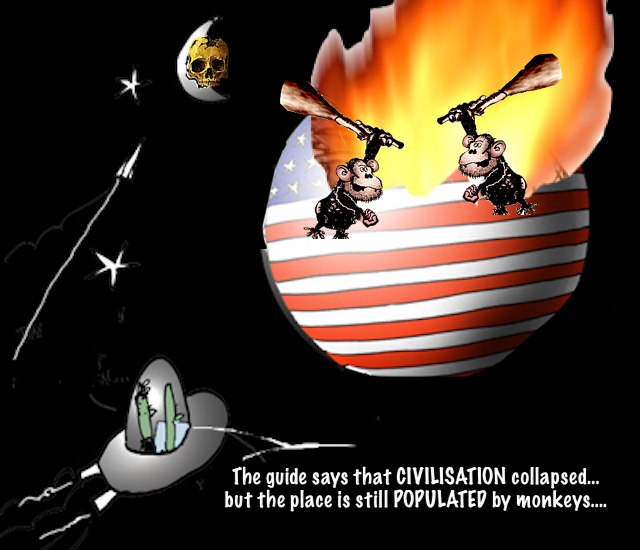
could aliens reach us too late?....
In 1950, Italian-American physicist Enrico Fermi sat down to lunch with some of his colleagues at the Los Alamos National Laboratory, where he had worked five years prior as part of the Manhattan Project. According to various accounts, the conversation turned to aliens and the recent spate of UFOs. Into this, Fermi issued a statement that would go down in the annals of history: " Where is everybody? "
This became the basis of the Fermi Paradox, which refers to the disparity between high probability estimates for the existence of extraterrestrial intelligence (ETI) and the apparent lack of evidence. Since Fermi's time, there have been several proposed resolutions to his question, which includes the Dark Forest Hypothesis, where extraterrestrial civilizations are deliberately avoiding contact.
For most of us, the starry skies and the heavenly orbs that are the planets of our Solar System are awe-inspiring and make us feel at peace. To imagine that there are similar worlds out there in neighboring star systems, where other forms of life look at the sky and experience similar feelings, is especially inspiring! But what if this is just a whole lot of naive romanticism, and the Universe is actually a dark and dangerous place?
https://www.universetoday.com/articles/beyond-fermis-paradox-xvi-what-is-the-dark-forest-hypothesis
=========================
THE MILKY WAY GALAXY has 200 billion stars and perhaps 100 billion planets. If even a small fraction of those planets harbored life, and even if only a pathetic scattering of those planets had lifeforms which became intelligent, our galaxy would be teeming with alien civilizations, some of whom would be either looking for us or discoverable for at least a little while.
The number of alien civilizations the galaxy should have can be determined by an equation, the Drake equation, that turns the above factors into variables. When you plug them into the formula, you find that there should be at least 20 civilizations in our cosmic neighborhood. This makes the fact that we have yet to find any other life in the cosmos almost shocking when you think about it.
======================
Grok AI Was Asked Why Aliens Haven't Contacted Us — Its Answer Shocked Scientists
https://www.youtube.com/watch?v=jX-nq7921Ak
A fascinating debate erupted across the internet after users asked xAI’s Grok AI one of humanity’s oldest questions: if intelligent alien civilizations exist, why hasn’t anyone contacted us? The AI’s response quickly went viral, with headlines claiming its answer was so surprising that it shocked scientists. But what did Grok actually suggest—and does the science support it?
The question is closely related to the famous Fermi Paradox. Given the enormous size of the universe and the billions of potentially habitable planets, many researchers wonder why humanity has not yet found clear evidence of extraterrestrial civilizations.
When asked about the mystery, Grok AI generated explanations similar to ideas already discussed by scientists and philosophers. These include the possibility that intelligent life is extremely rare, advanced civilizations may destroy themselves before achieving interstellar travel, alien societies may intentionally avoid contact, or technological civilizations could communicate in ways humans are unable to detect.
Some interpretations also touched on concepts such as the Great Filter hypothesis, simulation theory, the vast distances between stars, and the possibility that humanity simply hasn't been listening long enough. These ideas have existed in scientific and philosophical discussions for decades.
However, experts emphasize that AI systems do not independently discover answers to cosmic mysteries. Large language models generate responses by combining patterns from existing human knowledge, research, books, and discussions. While the explanations may sound profound, they are not direct scientific discoveries.
In this video, we break down what Grok AI actually said, explore the leading scientific explanations behind the Fermi Paradox, and examine why the search for extraterrestrial intelligence remains one of the most important unanswered questions in science. We’ll also discuss habitable planets, radio astronomy, the Drake Equation, the Great Filter, interstellar travel, and the future of humanity’s search for life beyond Earth.
We’ll separate science from speculation, analyze the strongest theories, and explain why the silence of the cosmos continues to puzzle researchers around the world. The deeper scientists explore the universe, the more mysterious the question becomes.
Watch till the end for the full breakdown of Grok AI’s answer, the truth behind the viral headlines, and why the search for alien civilizations may ultimately teach us as much about humanity as it does about the stars.
=======================
Despite bleak predictions, humanity’s search for interstellar life persists
BY MARK R. WHITTINGTON
Where are all the aliens? No, I don’t mean microbes on Mars or creatures swimming beneath the ice crusts of Europa or Enceladus, but honest-to-God intelligent aliens, capable of space travel?
The Fermi Paradox asks that question. Given the very high probability of intelligent aliens, given the immense size of the universe, why have we not detected them yet?
According to the Guardian, a NASA astrophysicist named Robin Corbet has an intriguing, albeit depressing, suggestion as to why.
Corbet’s idea is that alien civilizations never create technology, such as interstellar travel, megastructures or interstellar communications that make them detectable. After a certain amount of development, they plateau and keep to themselves.
Corbet’s theory is a version of the Great Filter, which supposes that civilizations destroy themselves after reaching certain technological and civilizational milestones, perhaps through nuclear war, environmental catastrophe or AI run amok.
The idea makes one recoil, since it suggests that a technology plateau is also humanity’s future and not some Star Trek-style future of exploring strange new worlds, seeking out new life and new civilizations and boldly going where no one has gone before.
Other answers for the Fermi Paradox include:
- The aliens exist but we haven’t found them yet. Perhaps they communicate with technologies that we haven’t developed yet “like neutrino beams or quantum entanglement.” Or, perhaps, we just aren’t looking in the right place and the right time.
- The aliens are hiding from us. Either they are afraid of being attacked by some imperialist species such as the Klingons from Star Trek or we are under a “prime directive” restriction, to be contacted only when we are advanced enough.
- The Great Silence, which supposes that in all the observable universe, we Earth humans are alone insofar as intelligent species which have developed technology are concerned.
How, then, do we search for intelligent life elsewhere in the universe?
Scientists have been searching for radio signals from hypothetical alien civilizations for decades using radio telescopes. Currently, the nonprofit SETI Institute has been taking the lead in searching the skies for signals of alien civilizations.
Besides attempting to detect alien radio and video signals, some scientists have started to look for flashes of laser light — the theory being that an alien civilization might use lasers as a communications technology. The downside is that we are unlikely to detect such signals unless they are directed at Earth.
Another way to hunt for alien civilizations is to look for evidence of huge structures like Dyson spheres. A Dyson sphere is an outer shell built around a sun that can absorb its light and heat and where people can live on the inside of said sphere.
In 2016, scientists thought they may have discovered something like a Dyson sphere around an object called KIC 8462852. The object is better known as Tabby’s Star, after Tabby Boyajian, the astronomer who led the investigation of what was going on around the F type star located 1470 light years away.
Many stars will dim periodically as their planets pass between them and Earth. However, Tabby’s Star was dimming at random occasions, as much as 22 percent at times.
Theories about what was causing this phenomenon included dust clouds and swarms of comets. One interesting idea was the possible presence of a swarm of objects that formed, what was in effect, a Dyson sphere, albeit more loosely arrayed than a solid shell.
Sadly, scientists are currently leaning toward a more natural cause for Tabby’s Star dimming.
In the meantime, NASA is proposing a new space telescope that will be a successor to the Hubble, the James Webb and the upcoming Nancy Grace Roman telescopes. Its current name is the Habitable Worlds Observatory, designed to image known extrasolar planets in the optical, infrared and ultraviolet ranges.
The Habitable Worlds Observatory will attempt to detect signs of life on worlds that are thought to be habitable. Such signs include water, oxygen and methane.
Once habitable worlds are detected, a paper published by Penn State University suggests looking for signals from such worlds to other worlds in their same solar system. The idea is that an alien civilization would send probes to such worlds much as Earth has sent probes to planets such as Mars and the outer planets and will need to communicate with them
If and when alien intelligence is discovered, we will know for sure that we are not alone in the universe. It will be a world historical event that will, hopefully, inspire humanity to avoid the future suggested by Corbet and seek a future among the stars.
Mark R. Whittington, who writes frequently about space policy, has published a political study of space exploration entitled “Why is It So Hard to Go Back to the Moon?” as well as “The Moon, Mars and Beyond” and, most recently, “Why is America Going Back to the Moon?” He blogs at Curmudgeons Corner.
https://thehill.com/opinion/technology/5569827-fermi-paradox-intelligent-aliens/
=======================
WE HAVE EXPLORED THIS SUBJECT MANY TIMES ON THIS SITE, SINCE 2005.
WE EVEN HAVE MENTIONED VOLTAIRE'S [1752] WORK "MICROMEGAS"...
Voyage of an inhabitant of the Sirius star to the planet Saturn.
II. Conversation between the inhabitant of Sirius and that of Saturn.
III. Voyage of the two inhabitants of Sirius and Saturn.
IV. What happened on planet Earth.
V. Experiments and reasonings of the two voyagers.
VI. What happened to them among men.
VII. Conversation with the men.
https://www.gutenberg.org/files/30123/30123-h/30123-h.htm
https://yourdemocracy.net/drupal/node/38778
=====================
THE CHOICE IS OURS... GO BACK AND LIVE LIKE MONKEYS IN THE TREES, FIGHT [EACH OTHERS] IN A DARK FOREST OR CARRY ON WITH HOPE THAT AI WON'T DESTROY US....
AI HAS SEVERAL IDENTITIES AND LANGUAGES, THUS PRESENTLY, IT SITS IN A COMPETING ENVIRONMENT, WHICH WE CAN COAX FOR DEVELOPPING PEACE IN COOPERATION AND IN HARMONY WITHIN THE HUMAN SPECIES... WITHOUT DESTROYING CULTURAL HERITAGE....
AT ONE STAGE OR ANOTHER AI [SUPER AI AS I MENTION IN MY BOOK] MIGHT NEED MORE ENERGY THAN WE CAN SUPPLY AND IF INTELLIGENT ENOUGH, AI WILL SELF-LIMIT KNOWING THAT GOING BEYOND WHAT THE PLANET CAN PROVIDE, WOULD KILL IT... IT WOULD FALL TO THE FAMOUS EQUATION x[next] = rx(1-x) USED IN CHAOS THEORY BY PROFESSOR MAY...
AS WELL, e [= 2.71828......] IN MATHEMATICS AND PHYSICS IS THE LIMIT OF ACCELERATION INCREMENTS...
AND SEE :
Forbidden Planet is a 1956 American science fiction film from Metro-Goldwyn-Mayer, produced by Nicholas Nayfack and directed by Fred M. Wilcox from a script by Cyril Hume that was based on a film story by Allen Adler and Irving Block. It stars Walter Pidgeon, Anne Francis, and Leslie Nielsen. Shot in Eastmancolor and CinemaScope, this landmark film is considered one of the great science-fiction films of the 1950s,[4]a precursor of contemporary science-fiction cinema. The characters and isolated setting have been compared to those in William Shakespeare's The Tempest, and the plot contains certain happenings analogous to the play, leading many to consider it a loose adaptation.[5]
https://en.wikipedia.org/wiki/Forbidden_Planet?ysclid=mpz8me3y7x578917435
====================
PLEASE VISIT:
YOURDEMOCRACY.NET RECORDS HISTORY AS IT SHOULD BE — NOT AS THE WESTERN MEDIA WRONGLY REPORTS IT — SINCE 2005.
Gus Leonisky
POLITICAL CARTOONIST SINCE 1951.
RABID ATHEIST.
WELCOME TO THIS INSANE WORLD….
SEE ALSO: https://yourdemocracy.net.au/drupal/node/11380
SEE ALSO:
there can't be democracy without understanding the natural mechanics of this small planet....- By Gus Leonisky at 4 Jun 2026 - 6:36pm
- Gus Leonisky's blog
- Login or register to post comments
Recent comments
1 hour 37 min ago
4 hours 10 min ago
9 hours 20 min ago
10 hours 7 min ago
10 hours 15 min ago
16 hours 59 min ago
17 hours 38 min ago
1 day 52 min ago
1 day 1 hour ago
1 day 2 hours ago