Search
Recent comments
- choosing sides.....
1 hour 54 min ago - agreed?.....
3 hours 49 min ago - I forgot....
4 hours 13 sec ago - strikes.....
4 hours 11 min ago - easy target....
4 hours 29 min ago - auto co-op...
9 hours 49 min ago - sobriety....
10 hours 8 min ago - gina's conga-line.....
10 hours 12 min ago - poison....
10 hours 20 min ago - yandex...
10 hours 37 min ago
Democracy Links
Member's Off-site Blogs
madam quixote is for monoshit and the destruction of the most successful media on earth....
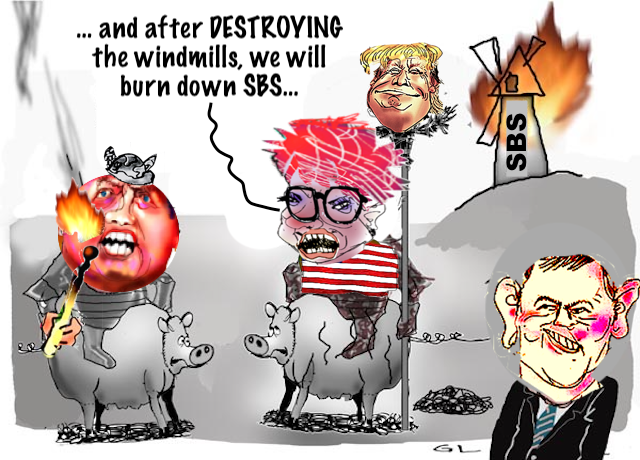
One nation is popular like some people like farts in elevators... it's fun. It you run a poll about the effect and asked the question "did you think it was funny?..." about 55 per cent of elevator-travellers will say YES... If you ask the question "did you like it"... The poll comes close to a 99 per cent NO...
There is a bit of Don Quixote in Madam Hanson. She is delusional, but unlike Don Quixote who was a loner with a fatso sidekick, Hanson has power in her sails, including the richest woman in Australia, and a former sidekick to the once powerful Liberal [CONservative] Party. One could see Pauline in a Monty Python movie, say the Unholy Grill or the Barbecue of Life... With the One Notion riding on broomstick and clapping coconuts to imitate the hooves of horses, one can see Hanson's hero, Donald Trump, happy with himself after having made US$1 trillion in the thin air of cryptocurrencies... and for losing another war [like that famous "French" King of England, Richard Coeur de Lion (posthumously romanticised for his participation in the unsuccessful Third Crusade (1189-92) against Saladin (Sultan Salahuddin Ayyubi)).]... WE THINK THAT Donald Trump could have been posthumously romanticised if the Lincoln Memorial Pool had remained blue...
But behind the fun of the Hansonite brainfarts, follows a plethora of fascist ideals that would make HITLER applaud [if he could, he would knock his old bones together, like in the Danse Macabre by the French composer Camille Saint-Saëns...] Sure, Hanson is fun, entertaining like a shivering goat-clownette but more deadly than a viper's nest used as a Red Back Spider conference.
"Don Quixote" by Miguel de Cervantes Saavedra is a Spanish novel published in two parts in 1605 and 1615. Considered the first modern novel, it follows Alonso Quijano, a man who reads so many chivalric romances that he loses his mind and reinvents himself as the knight-errant Don Quixote. Accompanied by his earthy squire Sancho Panza, he embarks on misguided adventures, mistaking windmills for giants and inns for castles, determined to revive chivalry in a world that has moved on.
"PHON" underwritten by Gina Fishsandchips is an unpublished Aussie legend for losers and idiots in one lousy part, with titbits released by the Murdochian Empire of Vampires, in 2026. Promised to be the most shitty story, it follows Pauline Hanson, a woman who can't read the words "multicultural" or "monoculturalism" without fumbling that she loses her mind and reinvents herself as the phantom of the knight-errant Don Quixaussie. Accompanied by her earthy squire Sancho Barnaby Joyce, both try to embark on misguided adventures, mistaking windmills for giants and SBS for hell on earth, determined to revive Shittocracy [formerly known as Fascism] in a world that has moved on.
Gus Leonisky
PLEASE VISIT:
YOURDEMOCRACY.NET RECORDS HISTORY AS IT SHOULD BE — NOT AS THE WESTERN MEDIA WRONGLY REPORTS IT — SINCE 2005.
Gus Leonisky
POLITICAL CARTOONIST SINCE 1951.
RABID ATHEIST.
WELCOME TO THIS INSANE WORLD….
- By Gus Leonisky at 3 Jul 2026 - 5:55am
- Gus Leonisky's blog
- Login or register to post comments
SBS....
The Special Broadcasting Service (SBS) is an Australian hybrid-funded public service broadcaster that receives about 80 percent of its funding from tax revenue.[3] SBS operates six TV channels (SBS, SBS Viceland, SBS World Movies, SBS Food, NITV and SBS WorldWatch) and seven radio networks (SBS Radios 1, 2 and 3, Arabic, SBS Chill, SBS South Asian and SBS PopAsia). SBS is also home to SBS On Demand; a video streaming service.
The stated purpose of SBS is "to provide multilingual and multicultural radio and television services that inform, educate, and entertain all Australians and, in doing so, reflect Australia's multicultural society".[4] SBS is one of five main free-to-airnetworks in Australia.
SBS was founded in 1975 as a radio network and launched its television channel in 1980. In-show advertising commenced in 2006 with commercial breaks spanning five minutes per hour. SBS's most successful imported television series is South Park.
HistoryAs a result of extensive post-World War II immigration to Australia and the end of the White Australia Policy, the federal government began to consider the need for "ethnic broadcasting" – programming targeted at ethnic minorities and mostly delivered in languages other than English. Until 1970, radio stations were prevented by law from broadcasting in foreign languages for more than 2.5 hours per week.[5] On 9 June 1975,[1] at the behest of Minister for Immigration Al Grassby, two "experimental" radio stations began broadcasting: 2EA in Sydney and 3EA in Melbourne (EA stood for "Ethnic Australia"), partly to publicise the Whitlam government's social policy changes to ethnic communities.[6]In March 1976, the Fraser government established the Consultative Committee on Ethnic Broadcasting, followed by the National Ethnic Broadcasting Advisory Council in January 1977. Initially, it was considered feasible for ethnic broadcasting to be delivered by the Australian Broadcasting Commission (ABC); however, this plan was abandoned in mid-1977.[7]
In October 1977, the government announced the creation of SBS as a new independent statutory authority for ethnic broadcasting.[8] This was achieved as a result of an amendment[9] to the Broadcasting Act 1942. SBS formally came into existence on 1 January 1978.[7] The inaugural Chair of SBS was Dr Grisha A. Sklovsky,[10] and the inaugural executive director was Ronald Fowell. The service was initially a radio network, and had oversight only of the two existing stations 2EA and 3EA.[7] It was always intended be enlarged, but this process was controversial – the Federation of Australian Commercial Television Stations wanted the television functions controlled by the ABC.[11]
In March 1979, the government established the Ethnic Television Review Panel, which recommended that SBS expand its multilingual services into television. SBS TV began test transmissions in April 1979 when it showed various foreign language programs on ABV-2 Melbourne and ABN-2 Sydney on Sunday mornings. Full-time transmission began on a new television channel at 6:30 pm on 24 October 1980 (United Nations Day). The first program shown was a documentary entitled Who Are We?, which was hosted by veteran news presenter Peter Luck. At the time, SBS was broadcasting on UHF Channel 28 and VHF Channel 0 (pronounced as "oh" and not "zero"), with a planned discontinuation of the latter at some time in the future. Bruce Gyngell, who introduced television to Australia in 1956, was given the task of introducing the first batch of programs on the new station.
SBS programming content was initially imported from the suppliers in the countries-of-origin of Australia's major migrant communities and then subtitled into English.[12]
In October–November 1983, the service expanded to service the centers of Canberra, Cooma and Goulburn,[13][14][15] subsequently changing its name to Network 0–28. Its new slogan was the eventual long-running "Bringing the World Back Home".[16] The network changed its name to simply SBS in February 1985 and soon began daytime transmissions.[13] SBS also expanded to the cities of Brisbane, Adelaide, Newcastle, Wollongong and the Gold Coast in June of that year.[13]
On 5 January 1986, SBS ceased broadcasting on the VHF channel 0 frequency. Although many Australians at the time did not have UHF antennas, SBS's VHF license had already been extended by a year at this stage and not all antennas had worked well with the low-frequency Channel 0.[17]
In August 1986, the government proposed legislation that would amalgamate SBS into the ABC. This was highly unpopular with ethnic-minority communities,[18] and after protests from both SBS staff and communities, resulted in the Prime Minister of Australia, Bob Hawke announcing in 1987 that the proposed amalgamation would not proceed.[19] The SBS Radio and Television Youth Orchestra was soon launched in 1988 with founding conductor Matthew Krel.[20]
Plans to introduce limited commercial-program sponsorship, as well as the establishment of SBS as an independent corporation with its own charter, were put in place in July 1989. A program called Eat Carpet, showcasing local and international short films, was also launched in 1989.[21] The passage into law of the Special Broadcasting Service Act 1991 officially made SBS a corporation in 1991.[22] Throughout the early 1990s, SBS TV coverage was expanded further to include new regional areas such as the Latrobe Valley, Spencer Gulf, Darwin, northeast Tasmania, Cairns and Townsville.[23][24][25]
In 1992, SBS's radio and television facilities were gradually relocated to new premises in Artarmon, New South Wales. Radio services were initially located in Bondi Junction and television services in Milsons Point. The new building was officially opened on 10 November 1993 by the prime minister, Paul Keating, and a national radio network was launched in January 1994. The new service initially covered Brisbane, Adelaide, Perth, and Darwin, while original stations 2EA and 3EA were renamed Radio Sydney and Radio Melbourne, respectively. However, the new national service was launched on a separate frequency in Sydney and Melbourne in July of that year. Throughout 1996, the radio services were expanded to cover Hobart and Canberra, while SBS TV's coverage was further expanded to include the New South Wales North Coast and the city of Albury.
Comedy Central's South Park, SBS's most successful imported television series, was first aired in 1997. A time-delay system was installed for South Australia in May 1999, shortly before the establishment of the Transmission Services division (intended to manage transmission and self-help services). A New Media division, responsible for the SBS website, was established at the start of 2000 in time for the first webcast of the Australian Film Institute Awards. Ratings continued to increase through 2000 to 2001 – increasing to an overall 5.2% average weekly audience share.[26]
In April 2003, SBS Radio dropped four languages from its schedule, Irish, Scots Gaelic, Welsh, and Belarusian, and added four others, Amharic, Nepalese, Malay, and Somali, while increasing the broadcast hours for Cantonese, Mandarin, and Arabic. SBS broadcast the 2004 Athens Olympics in partnership with the Seven Network. and also broadcast Euro 2008 in Austria and Switzerland.
Tagalog, Vietnamese and Arabic language broadcasts were added to SBS's WorldWatch television schedule in 2003.[27] However, the Vietnamese community protested the Vietnamese-language service, whose content was taken from VTV4, Vietnam's government-controlled national broadcaster. They found the portrayal of the communist Vietnamese flag and Ho Chi Minh offensive and stated that the program's lack of reporting on political arrests and religious oppression was also offensive, especially to those who had fled the country following the Vietnam War.[28] This backlash prompted SBS to remove the bulletin from schedule and from then on to display disclaimers before all externally produced bulletins in order to distance it from the content.
In May 2008, SBS unveiled a new-look logo as well as a new backronymic slogan: "Six Billion Stories and Counting".[29]
On 8 May 2012, SBS received $158 million in government funding,[30] of which $15 million would be used yearly, to fund the formation of a new free-to-air channel devoted to the indigenous peoples of Australia.[31]which would replace the existing National Indigenous Television on 12 December 2012, with 90% of its staff transferring to this new channel.[32] On 12 December 2012, NITV was re-launched as an SBS-operated free-to-air channel, replacing SBS4.[33]
SBS is a supporter of same-sex marriage[34] and pulled an anti-same-sex marriage advertisement ahead of its telecast of the Sydney Gay and Lesbian Mardi Gras.[35] Then managing director, Michael Ebeid, defended SBS's position on the issue.[34]
On 17 November 2015, the new food channel, SBS Food Network, was launched. On 17 November 2018, the channel became SBS Food.
In June 2016, SBS announced that SBS 2 was set to be rebranded as SBS Viceland with content from US-Canadian youth Vice Media from November 2016.[36]
On 1 July 2019, SBS relaunched their former pay-TV movie channel, World Movies as SBS World Movies and it became a free-to-air channel.
On 12 January 2022, SBS announced that a sixth free-to-air television channel, with the working title SBS WorldWatch, would be launched in 2022. The channel would be free to air and would broadcast all foreign-language bulletins currently broadcast on SBS and SBS Viceland, and new locally-produced news bulletins in Arabic and Mandarin Chinese in prime time. The Arabic and Mandarin bulletins launched on 15 February 2022 through SBS On Demand, while the SBS WorldWatch channel itself was launched on 23 May.[37][38]
https://en.wikipedia.org/wiki/Special_Broadcasting_Service?ysclid=mr40oxn2ze694245386
READ FROM TOP.
PLEASE VISIT:
YOURDEMOCRACY.NET RECORDS HISTORY AS IT SHOULD BE — NOT AS THE WESTERN MEDIA WRONGLY REPORTS IT — SINCE 2005.
Gus Leonisky
POLITICAL CARTOONIST SINCE 1951.
RABID ATHEIST.
WELCOME TO THIS INSANE WORLD….
AND MADAM DUMB QUIXAUSSIE WANTS TO DESTROY THIS BEST MEDIA IN THE ENTIRE WORLD?....