Search
Recent comments
- choosing sides.....
1 hour 54 min ago - agreed?.....
3 hours 49 min ago - I forgot....
4 hours 13 sec ago - strikes.....
4 hours 11 min ago - easy target....
4 hours 29 min ago - auto co-op...
9 hours 49 min ago - sobriety....
10 hours 8 min ago - gina's conga-line.....
10 hours 12 min ago - poison....
10 hours 20 min ago - yandex...
10 hours 37 min ago
Democracy Links
Member's Off-site Blogs
rupert has been hostile to the science of global warming....
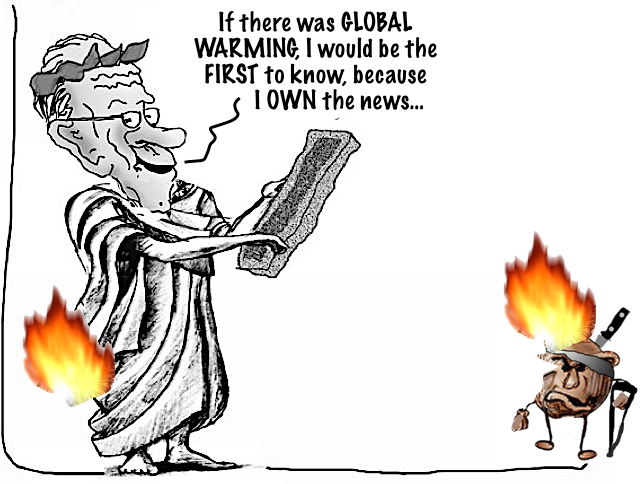
This edited extract of Getting Murdoched: How Murdoch’s Media Wields Power and Punishment Andrew Dodd and Matthew Ricketson examines Murdoch’s destructive anti-climate change campaign.
The emergence of climate change as a global issue coincided with the creation of Rupert Murdoch’s global media empire. Except for a brief period when his younger son, James, persuaded him of the dangers of global warming and the need to give the ‘planet the benefit of the doubt’, Murdoch was at best sceptical, at worst hostile to the issue.
Andrew Dodd, Matthew Ricketson
Getting Murdoched: climategate
Depending on the individual economic circumstances of the three main countries he operates in, Murdoch’s outlets have overwhelmingly either campaigned against the need to combat climate change and given free rein to climate sceptics no matter how outlandish their claims, or raised objections to any plans for shifting to renewable energy sources, disproportionately focusing on any problems and avoiding discussing the benefits of solutions.
They have mauled governments working to act on climate change and lavished editorial support on those that have opposed or run dead on it. They have worked with and supported the array of fossil fuel industry-backed denialist ‘experts’, think tanks and politicians, providing them with ample space on their opinion pages and time on their shows on Fox. Roger Ailes, the founding head of Fox News, who publicly preached the network’s ‘fair and balanced’ slogan, privately viewed climate change as a ‘worldwide conspiracy’ created by ‘foreign nations’ to win control of America’s resources. In short, they have sown doubt and reaped fear.
The tragedy surrounding climate change in Australia, for example, is that many years were lost to political fighting aggravated and amplified by Murdoch media noise, with their unparalleled reach in the local print media market. The net zero emissions target is significantly harder to achieve now in Australia and will impose a greater economic cost. If the carbon emissions trading scheme introduced by the Labor government in 2012 had been allowed to continue, the nation would have been well on the way to achieving its international targets. But it was killed off by the Liberal–National Coalition government in 2014, with a lot of help from News’ outlets.
For climate experts, the science was basically settled many years ago but for those associated with the fossil fuel industries and the US Republican Party, it was a different story. Once ‘the public come to believe that the scientific issues are settled, their views about global warming will change accordingly’, wrote Republican strategist Frank Luntz in a leaked 2002 memo, advocating an all-out attack: ‘You need to make the lack of scientific certainty a primary issue in the debate.’
The anti-climate change campaign was aided by an inherent weakness in the method of journalism and abetted by Murdoch’s media outlets. The need in daily journalism to find balance by reporting both sides of an issue is easily exploited. For every climate sceptic there were 100 climate scientists, but a journalist following the ‘he said, she said’ dictum would quote only one of each. Balance seems to have been served, but the actual weight of evidence is seriously distorted.
As journalist and academic David McKnight wrote: ‘In this “balanced” framework, scientific findings would appear controversial, since the premise of the debate was politics: the sub-text was that support or opposition to climate science was a matter of political belief.’
Embedded in the words political belief were two strategies. The first was to drag climate science away from science – with its well-established protocols for evidence, proof and peer review – to politics, which is open to endless debate.
Second was to drag it even further from science to belief, with its connotations of faith. This opens the door to attacking climate scientists who ‘fervently’ believe in their theories.
The famous hockey stick graph, which Michael Mann and his colleagues used to show sharply rising temperatures in the northern hemisphere since industrialisation, was attacked by climate sceptics for flattening variation in temperatures in earlier centuries. The graph appeared to flatten some of the variation but that did not alter the scientists’ conclusions. Studies done since then using state-of-the-art reconstructions that were included in the 2023 IPCC report are ‘virtually indistinguishable from the original hockey stick’ from 1998, says Mann.
The attacks on it were a prelude to what became known as ‘Climategate’, which was the most concerted attack yet on climate science and helped derail the climate change summit held in Copenhagen in 2009. It began in October when someone – exactly who is still not known all these years later – hacked into the computers of climate scientists, stealing thousands of their emails. The thieves leaked the email cache to climate denialists, who cherry-picked apparently incriminating quotes that they quickly spread to the media.
The quotes were accompanied by triumphant rhetoric that the emails revealed the scientists were conspiring in a global hoax. As climate sceptic Patrick J Michaels said: ‘This is not a smoking gun, this is a mushroom cloud.’ Fox News labelled the email leak ‘Global warming’s Waterloo’. The quotes touted as the smoking gun were ‘Mike’s nature trick’ and ‘hide the decline’. The former referred to Michael Mann, the implication being that the calculations underpinning the hockey stick graph were a ‘trick’. The latter referred to an email in which Phil Jones, head of the University of East Anglia’s Climatic Research Unit, appeared to be trying to hide a decline in the recording of the earth’s temperatures. On their face, the emails looked damning.
Mann and Jones came under immense pressure as their work was roundly denounced across almost all media and politicians demanded they be sacked or at the very least investigated. Their universities set up inquiries, as did other bodies including two from the United States – the Environment Protection Agency and National Science Foundation – as well as the UK Secretary of State for Climate and Energy Assessment. In total nine inquiries were established.
Mann had not realised the extent to which institutions like universities were vulnerable to pressure from politicians. ‘There have been cases where universities have been forced to sanction someone who has been guilty of nothing."
It’s worth pausing to ask why Mann and Jones were singled out. Yes, it was their emails that had been highlighted, and they were respectively lead author and head of a research unit, but it was also because their work was making a real impact on public understanding of the need to act on climate change.
They were individually targeted using what Mann calls the ‘Serengeti strategy’, which he had first observed on a visit years before to Serengeti National Park in Tanzania where zebras, giraffes, gazelles, baboons and ostriches wander among lions and leopards. He saw groups of zebras standing back to back, forming a continuous wall of vertical stripes. Why, the tour guide was asked. ‘To confuse the lions,’ the guide replied, explaining that predators look for the most vulnerable animals at the edge of the herd, but they have difficulty picking out an individual zebra when it is seamlessly incorporated into the larger group.
Mann and Jones were separated from their herd and their lives made miserable, not only by the pressure of the official inquiries but by conservative politicians who threatened to hold hostage the entire funding of the state university where Mann worked ‘until appropriate action is taken by the university’, and by media coverage, which was intense and often personally hostile, especially on Fox. There, Fox’s vice-president and the head of the network’s Washington bureau, Bill Sammon, wrote in an internal email a month after Climategate broke, ‘We should refrain from asserting that the planet has warmed (or cooled) in any given period without immediately pointing out that such theories are based upon data that critics have called into question.’
On Fox, climate denialists were given airtime on, for instance, Megyn Kelly’s program, to denounce Mann as a fraud, while Glenn Beck, a Fox host who also had a radio program, said the scientists had so dishonoured themselves that if they had been Japanese ‘there’s not enough knives on planet Earth for [the] hara-kiri that should have occurred’. As Mann reflects, ‘If you’re vilified on Fox News, you’re a villain to the entire conservative population of the United States, and that is going to lead to Fox viewers acting out.'
Mann was frustrated by the rampant falsehoods being spread about him, his work and climate science more generally. He told us: ‘I relish fighting the good fight. I don’t back down if it is a matter of principle. I stood up to bullies when I was a little kid, bullies twice my size. I was a small kid, not imposing at all, but that was the way I was raised. Here I was facing the biggest bully on the block – the fossil fuel industry and its allies in the conservative media ecosystem, led by News Corp.’ Murdoch has wielded his media empire as a weapon to beat down those who challenge the powerful vested interests that he represents.
Mann recalls one senior colleague, Stephen Schneider, saying to him: ‘The reason they are going after you is that you are having an impact. This is a testament to the importance of what you are doing.’ That gave Mann perspective – and fortified him.
Meanwhile, in the United Kingdom, Jones was experiencing similar pressure, though less from the Murdoch media than from other newspapers, including the usually supportive Guardian, as well as from anonymous hate mail and from the University of East Anglia’s cautious, clumsy response – though the university’s leadership backed Jones and shielded him from the media when they saw he was struggling. The lack of a clear end date for the inquiries intensified the anxiety Jones was feeling.
He said: ‘As someone used to being in control I buckled at the loss of it. My health deteriorated. I found it difficult to sleep and eat. I was under intense, spiralling pressure and felt I was falling to pieces. Looking back, I suppose I was having some kind of nervous breakdown.’ More than once, he thought about taking his own life.
What was the upshot of the official inquiries? Without exception, they cleared the scientists of any misconduct or malpractice in their work. ‘Mike’s trick’ related to Mann finding a smart way to update the hockey stick graph from the original end point of 1980 through to the close of the 1990s. Calculating temperatures from earlier centuries relied on proxy measures such as the width of rings on trees. Supplementing these with thermometer readings for more recent years enabled the graph to be updated. In the graph prepared for the IPCC report, both sets of data were presented and clearly labelled. In other words, trick-schmick.
‘Hide the decline’ referred to other climate scientists’ methods of reconstructing temperatures from earlier centuries that were susceptible to differences in tree-ring density data from higher latitudes. Mann writes: ‘These data show an enigmatic decline in their response to warming temperatures after roughly 1960, perhaps because of pollution.’
This was the decline Jones had been referring to in his email, not any decline in overall temperatures. It is easy to see the emails’ wordings as loose, but these working emails between colleagues weren’t written with the idea they would be stolen, distorted and widely publicised. The fine parsing of the scientists’ emails diverts attention from two key points submerged beneath the blizzard of media attacks.
First, as Cardinal Richelieu once said: ‘If you give me six lines written by the most honest man, I will find something in them to hang him.’ What made Mann angriest was that the climate denialists and their allies in the Murdoch media knew what they were doing. ‘It is so cynical to say, “These scientists are trying to dupe the public”, and to exploit the ignorance people have about scientific jargon. The real trick is in making the public think there was impropriety.’
The use of ‘one sticky, misleading turn of phrase’ was so difficult to combat. ‘They’re good at what they do, no doubt about it. Scientists are not trained in rhetoric or propaganda. The strength and the consistency and the repetitiveness of the messaging was so strong.’ It could plant seeds of doubt even in those who supported the scientists.
Second, who stole the scientists’ emails? Focusing on the content rather than their theft was like focusing on what the Watergate burglars found without ever mentioning their crime or its cover-up by the Nixon White House. The little attention that was paid to the identity of the thieves pointed tentatively to ties with climate denialists such as mining exploration company director Steve McIntyre, which he strenuously denied. Web servers in Saudi Arabia, the world’s single-largest exporter of oil, were among the first used to post the stolen materials, and Saudi Arabia was the first country to call for an investigation – into the climate scientists.
The Murdoch media’s coverage of the inquiry results in the UK and the US was thinly reported, while opinion pieces criticising the inquiries’ findings were more plentiful. ‘Penn state probe into Mann’s wrongdoing a “total whitewash”’ was how Fox News headlined an opinion piece by Fox News producer Ed Barnes on 5 February 2010.
The findings of one inquiry, by Penn State University, ‘have set off a wave of criticism accusing the university panel of failing to interview key people, neglecting to conduct more than a cursory review of allegations and structuring the inquiry so that the outcome – exoneration – was a foregone conclusion’, wrote Barnes.
The New York Post does not appear to have reported the results of the inquiries at all; but the following year, the newspaper was still editorialising, ‘The temptation to fudge the facts is simply too strong, as was revealed by the Climategate e-mails. Bottom line: Forget the refrain that climate change science is settled.’ Mann describes such coverage as, ‘Up is down, black is white.’
News’ publications in Australia also pounced on the leaked emails, while the findings of all the inquiries were reported sparsely, if at all. As political scientist Rodney Tiffen found: ‘All up, The Australian had just four stories reporting the results of the inquiries – usually short and without prominence. It also ran three stories criticising the inquiries.’ In fact, over the next few years, the newspaper ran twenty-one articles concerning Climategate that were written as if the inquiries had never been held. This kind of rewriting of history is what happens in the totalitarian regimes Murdoch has so often denounced.
https://johnmenadue.com/post/2026/07/472495-2/
PLEASE VISIT:
YOURDEMOCRACY.NET RECORDS HISTORY AS IT SHOULD BE — NOT AS THE WESTERN MEDIA WRONGLY REPORTS IT — SINCE 2005.
Gus Leonisky
POLITICAL CARTOONIST SINCE 1951.
RABID ATHEIST.
WELCOME TO THIS INSANE WORLD….
- By Gus Leonisky at 12 Jul 2026 - 6:00am
- Gus Leonisky's blog
- Login or register to post comments
more expensive....
Trump’s Loyalty to Fossil Fuel Companies Is Driving Up Inflation
The sooner we transition off fossil fuels, the healthier we — and our wallets — will be.
By Basav Sen
Throughout his second term, President Donald Trump has been on a relentless push to boost fossil fuels, undermine renewable energy, and end all federal regulation to address climate change. The administration claims that this push will help people in the U.S. save money.
But in reality, the opposite is true: Fossil fuel dependence makes life more expensive.
Global Price ShockThanks to the U.S.-Israeli war on Iran, crude oil prices are soaring — leading to sky-high prices for gasoline and diesel. With that war, Trump has set off a domino effect, showing how deeply the fossil fuel industry has baked its prices directly into the U.S. economy.
For example, the price of food had already been increasing before the U.S. began its war. But now, economists have said that trend upwards will continue in coming months. One reason for that is the price spike for fertilizers. Chemical fertilizers providing nitrogen, an essential plant nutrient, are made using natural gas. And around 10 percent of the world’s supply of urea, a common nitrogen fertilizer, comes from the Middle East — and is impacted by the closure of the Strait of Hormuz. Additionally, because most food products are distributed using diesel-powered trucks, we’re seeing the impact of diesel prices on rising food prices in real time.
Trump’s unprovoked war would have been a disaster in any context. But people in the U.S. and worldwide, especially in the Asia-Pacific region and in Africa, would have felt a whole lot less economic pain if we hadn’t been so dependent on oil and gas in the first place. Experts forecast that the worst impacts are yet to come.
The Federal Reserve Bank of Dallas said back in March that a prolonged closure of the Strait of Hormuz could cause a global economic downturn. Now, two months later, the World Bank is forecasting the possibility of an additional 45 million people worldwide facing acute food insecurity, and significantly higher inflation and slower economic growth in developing economies. But even if the Strait were to open tomorrow, idled oil wells and refineries will take time to restart, leading to a severe supply crunch and further price increases.
Expensive ElectricityAnother example of fossil-fueled inflation is the surge in residential electric bills. Fracked gas is the largest energy source for electric power generation in the U.S. But since the start of the fracking boom in the early 2000s, U.S. producers are increasingly producing gas for export. Consequently, gas prices — and our utility bills — are exposed to increased global price volatility.
The proliferation of energy-hungry AI data centers is another factor driving up electric bills. Besides their direct impact on utility bills, data centers are also causing growth in gas-fired power generation, leaving rate payers even more susceptible to gas price spikes. Yet the Trump administration has made it a national policy priority to promote AI technology.
Meanwhile, renewable wind and solar energy, which are the cheapest sources of energy worldwide, provide only about 20 percent of electricity in the U.S. Yet the Trump administration is using legally questionable methods to actively block new renewable energy from being built, locking in our dependence on expensive fossil fuels.
Climate Change Is CostlyIt’s not just the fuels themselves that are making everything more expensive. It’s also the effects of digging them up and burning them.
Rising atmospheric greenhouse gas levels are leading to expensive wildfires, storms, and floods. The cumulative cost of climate disasters has increased sharply; the last three calendar years have had the highest total disaster costs over the entire 45-year period covered by the Climate Central database of billion-dollar weather and climate disasters in the U.S. Some of these costs are picked up by taxpayers through government-funded recovery, some are borne by insurance companies, and some are shouldered by impacted people.
Of course, this is just scratching the surface.
These disasters are raising home insurance premiums in disaster-prone regions. And because lenders require an adequate home insurance policy as a condition for a mortgage, rising insurance premiums effectively make homeownership unaffordable for many.
Prolonged droughts, severe floods, and other extreme weather events exacerbated by climate change also impact food production and drive up food prices. Drilling and fracking for oil and gas contaminates drinking water, leading to all kinds of costs for households. These include medical bills for cancer and other serious illnesses from drinking contaminated water, and the cost of having to buy bottled water instead of using contaminated tap water or well water.
Burning fossil fuels also pollutes the air, potentially causing cancer, respiratory diseases, and other illnesses. Particulate matter and ozone pollution from vehicle tailpipes alone was responsible for 385,000 deaths and $1 trillion in health damagesworldwide in 2015.
So the next time any political figure — whether they’re a member of the Trump administration or a feckless fossil-fueled Democrat — tells you that they’re clinging to the fossil energy status quo to save you money, don’t believe them.
They are protecting the profits of a powerful industry, at our expense. And the sooner we transition off fossil fuels, the healthier we — and our economy — will be.
https://truthout.org/articles/trumps-loyalty-to-fossil-fuel-companies-is-driving-up-inflation/
READ FROM TOP.
PLEASE VISIT:
YOURDEMOCRACY.NET RECORDS HISTORY AS IT SHOULD BE — NOT AS THE WESTERN MEDIA WRONGLY REPORTS IT — SINCE 2005.
Gus Leonisky
POLITICAL CARTOONIST SINCE 1951.
RABID ATHEIST.
WELCOME TO THIS INSANE WORLD….