Search
Recent comments
- choosing sides.....
1 hour 57 min ago - agreed?.....
3 hours 52 min ago - I forgot....
4 hours 2 min ago - strikes.....
4 hours 14 min ago - easy target....
4 hours 31 min ago - auto co-op...
9 hours 51 min ago - sobriety....
10 hours 10 min ago - gina's conga-line.....
10 hours 14 min ago - poison....
10 hours 22 min ago - yandex...
10 hours 40 min ago
Democracy Links
Member's Off-site Blogs
managing the technocratic future.....
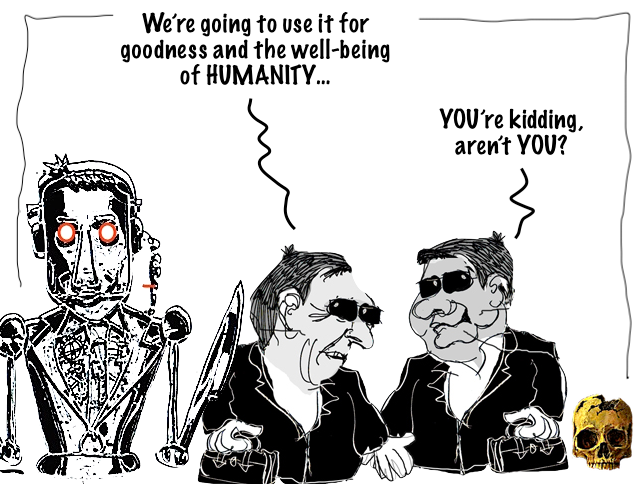
Imagine a future where technology seamlessly integrates into our daily lives, enhancing our capabilities and improving our world. This vision is not just a dream but a realistic possibility if we balance innovation with ethics, freedom, and human dignity. As we navigate the complexities of the 21st century, it's crucial to remember that technology should serve humanity, not control it.
Technocracy: From Dystopian Visions to Future Realities
by Noelle
Technology has the potential to liberate us from mundane tasks, allowing us to focus on what truly matters: our relationships, personal growth, and the pursuit of knowledge. For instance, artificial intelligence can assist in medical diagnoses, providing faster and more accurate results than ever before. However, we must ensure that this technology is used ethically, respecting patient privacy and autonomy. As David Icke warns in 'The Answer,' the technological sub-reality is being imposed without public approval, emphasizing the need for transparency and consent in technological advancements.
In 'Urgent: The Most Unpleasant Article You'll Ever Read,' Mercola.com highlights how the Fourth Industrial Revolution, as described by Professor Klaus Schwab, is reshaping our world. While this revolution brings unprecedented opportunities, it also poses significant challenges to personal freedom. We must be vigilant to ensure that the promised utopian future does not come at the cost of our liberties. The 'Great Reset,' as discussed by Patrick Wood in 'The Great Reset Plot to Turn You Into a Mindless Drone,' illustrates how global elites aim to control every aspect of our lives through technology and surveillance.
Cryptocurrency offers a glimpse into a future where financial transactions are decentralized, reducing the power of centralized institutions. As noted in 'The great crypto power struggle: How technocrats and governments are reshaping global finance' by NaturalNews.com, cryptocurrencies can empower individuals by providing financial freedom and privacy. However, we must be cautious of government attempts to regulate and control this space, ensuring that cryptocurrency remains a tool for liberation rather than oppression.
Natural health and wellness are fundamental to human dignity and freedom. As we embrace technological advancements, we must not forget the importance of natural medicine and holistic health practices. The suppression of natural health remedies by the pharmaceutical industry, as exposed by Marcia Angell in 'The Truth About the Drug Companies,' underscores the need for alternative voices in healthcare. By promoting natural health, we can ensure that everyone has access to safe and effective treatments that respect the body's innate healing abilities.
The integration of technology into our lives must also consider the impact on our environment. Carbon dioxide, often demonized, is actually beneficial for plant growth and photosynthesis. As we develop new technologies, we should focus on sustainable practices that harness the power of nature rather than exploit it. This approach aligns with the principles of organic gardening and home food production, which empower individuals to take control of their food sources and reduce dependence on industrial agriculture.
In conclusion, the future of technology holds immense promise, but it requires a delicate balance between innovation and ethics, freedom and control. By prioritizing human dignity, respecting individual liberties, and embracing natural health, we can create a world where technology serves as a tool for human flourishing rather than a means of domination. Let us strive for a future where technology enhances our lives without compromising our values and freedoms.
SEE THE WHOLE PROJECT:
Technocracy: From Dystopian Visions to Future Realitiesby Noelle
Chapter 1: The Rise of Technocratic Control in History
Defining technocracy and its origins in early 20th-century industrial societies
The role of scientific management and efficiency experts in shaping modern governance
Historical examples of technocratic influence in wartime and peacetime economies
The intersection of technocracy and eugenics: early warnings from history
How technocratic ideals infiltrated education, healthcare, and urban planning
The rise of bureaucratic elites and their detachment from democratic accountability
Technocracy vs. individual liberty: lessons from the Progressive Era and beyond
The dangers of unchecked technological progress without ethical constraints
Resistance movements and alternative visions to technocratic dominance in history
Chapter 2: Technocracy in Literature and Film as Warning
1984: The ultimate dystopia of surveillance, thought control, and absolute state power
Brave New World: The illusion of happiness through chemical and genetic engineering
THX 1138: A world where emotion, love, and dissent are criminalized
Metropolis: The dehumanization of labor and the rise of the machine overlords
Gattaca: Genetic determinism and the erasure of human potential through eugenics
Brazil: Bureaucratic absurdity and the futility of resisting technocratic systems
Equilibrium: The suppression of art, emotion, and individuality in the name of order
Idiocracy: The dumbing down of society and the triumph of anti-intellectual technocracy
Black Mirror: Modern technocratic nightmares in the digital age and their real-world parallels
Chapter 3: Escaping the Technocratic Future
Recognizing the signs of technocratic control in modern institutions and governance
The importance of decentralization in resisting centralized technocratic power
Rebuilding community and local resilience as a counter to global technocracy
Natural health and self-sufficiency: breaking free from pharmaceutical and medical technocracy
Financial sovereignty: the role of honest money and self-custody in resisting control
Education and critical thinking: empowering individuals to question technocratic narratives
The role of art, literature, and storytelling in preserving human values and dissent
Building parallel systems: alternative economies, media, and networks outside technocratic reach
A vision for the future: balancing technology with ethics, freedom, and human dignity
PLEASE VISIT:
YOURDEMOCRACY.NET RECORDS HISTORY AS IT SHOULD BE — NOT AS THE WESTERN MEDIA WRONGLY REPORTS IT — SINCE 2005.
Gus Leonisky
POLITICAL CARTOONIST SINCE 1951.
RABID ATHEIST.
WELCOME TO THIS INSANE WORLD….
- By Gus Leonisky at 13 Jul 2026 - 4:44am
- Gus Leonisky's blog
- Login or register to post comments
.ai.ai.ai.ai.ai......
With AI, we have returned to a world of two competing superpowers
By Alan Kohler
When it comes to AI, Australia is a spectator at a UFC cage fight between the United States and China, except the spectators at this event are all inside the cage with the combatants, not safely in the stands.
China is flooding the world with cheap, very capable AI models, trying to destroy the business models of the leading US companies.
The Americans are desperately trying to stay ahead by building smarter, more dangerous and more expensive models.
To mix metaphors, it's a race between Cadillacs and BYDs.
All other governments are trying to figure out how to stay safe inside the cage while making sure they don't miss out.
Cowering among them is Australia, with the government's new AI Safety Institute now up and running, headed by global "responsible AI" expert Kate Controy.
Back to the futureGeo-politically, we have returned to a world of two competing superpowers, except this time they're not facing off with nuclear weapons as America and the Soviet Union did in the Cold War, but with the most powerful technology in the history of the world.
Between WWII and 1989, superpower balance was preserved by the potential for mutually assured destruction (MAD), but with AI it's a contest between the US and China for industrial and scientific supremacy in which the potential for mutually assured destruction is real but distant, debatable and therefore ignored.
The "Statement on AI Extinction Risk" first published on May 30, 2023, with 350 signatories, recalled the language of the Cold War: "Mitigating the risk of extinction from AI should be a global priority alongside other societal-scale risks such as pandemics and nuclear war."
That statement is still sitting there, now with 1,300 signatories, prominently including those of the CEOs of Anthropic, OpenAI and Google DeepMind, Dario Amodei, Sam Altman and Demis Hassabis. They could be described as the three leading ignorers of the statement they signed.
Spectators inside the cageWhich highlights another key difference with the previous Cold War: this is a contest between private companies run by rich men trying to get richer, with their governments alternating fretfully between egging them on and trying to control them.
Two weeks ago, the United Nations released the preliminary report of its Independent International Scientific Panel on AI, which repeatedly stressed the need for urgency and raised the potential for "catastrophic outcomes".
The panel warned that the governance landscape is fragmented and ineffective and that "most countries, including many advanced economies, lack the technical expertise to assess the most capable 'frontier' models or to participate meaningfully in their governance".
They observed that "most member states [are] dependent on systems they cannot build, inspect, audit or fully adapt to local context".
That is: spectators inside the cage.
Europe is trying to pull up the drawbridge with a mandatory pharmaceutical-type testing regime, while the US has gone for voluntary pre-release testing for 30 days and is otherwise egging them on.
Australia and the UK are also testing, also voluntarily, after something is released.
Testing new modelsIn a speech last week to an AI safety forum, the assistant minister for science, technology and the digital economy, Andrew Charlton, talked up the Albanese government's new AI Safety Institute, which he said is "up and running", testing AI frontier models.
Which models, exactly, are being tested was not, and is not being, revealed, and nor were the consequences for a model that failed the test, whatever failure might look like, but, said Mr Charlton, "we are not building a think tank. We are building a national testing capability".
Australia is definitely NOT building something like the Therapeutic Goods Administration that controls the release of drugs based on data about safety and efficacy from three sets of randomised trials.
Some activists around the world are pushing for that kind of regime for AI, but that's about as likely as a worldwide carbon tax, even as Europe and North America cook in historic heat waves.
The closest to a pharmaceutical regime is Europe's AI Act, which requires developers of high-risk systems to provide data on safeguards before releasing them on the EU market and, for some models, ongoing monitoring and incident reporting.
The European Commission can impose fines of up to roughly 7 per cent of global turnover or €35 million ($58 million), which, in practice, makes pre-deployment testing and documentation mandatory for any model intended for EU use at any scale.
The EU AI Act is due to start next month, and we'll see how European businesses feel if their American and Chinese competitors get access to, say, Anthropic's Fable 5 or a Chinese equivalent, and they can't.
Companies on edgeMeanwhile, corporate customers of all the AI models, American and Chinese, are starting to get uneasy that they're losing control of their own businesses.
Alex Karp, the CEO of Palantir Technologies, a US AI integration firm, expressed this colourfully in a recent interview on CNBC, saying "something has gone completely wrong".
He said the AI labs were "stealing Alpha" — that is, taking proprietary data, workflows and competitive know-how through the prompts that company employees write into the AI, and then either competing with them or selling it back to them.
Even sceptical commentators who said — correctly — that Karp was talking his own book admitted that he had a point: there is a genuine debate about where the value from AI is accruing.
Separately, companies are now having to weigh up the risks of going with Chinese models to get the lower prices; increasingly, they're deciding that price wins.
China surging in frontOver 12 days in May, four Chinese labs — DeepSeek, Z.ai, Moonshot and MiniMax — released "open-weight" models that are competitive with the US frontier models on coding and agentic benchmarks, at a fraction of the price.
For example, DeepSeek's V4 Pro now costs as little as US87 cents per million output tokens against roughly US$25–30 for Claude Opus or GPT-5.5 output.
The Chinese models already seem to be beating the Americans.
According to the research outfit, OpenRouter, in the week ending July 6, eight of the top 10 AI models by volume of output tokens were Chinese. The top five Chinese models produced 20.3 trillion tokens — almost three times as many as the 7.7 trillion total of the top five US models.
So China is now repeating in AI what it did in cars, batteries, phones, robots, renewable energy, TVs, and toys, except in AI the security issues are probably greater than those that got telecommunications giant Huawei banned in both the US and Australia.
The world is dealing with a complicated layer cake of AI security challenges: day-to-day safety that the Australian AI Safety Institute was created for, plus US frontier labs stealing corporate alpha and Chinese ones maybe facilitating Communist Party surveillance.
And then there's the small matter of the risk of extinction — you know, the one that 1,300 AI academics and creators say should be a global priority while they carry on building it as fast as possible.
Alan Kohler is a finance presenter and columnist on ABC News. He hosts the podcast That's Business with Alan Kohler in the ABC Business Daily feed on Friday. He also writes for Intelligent Investor.
https://www.abc.net.au/news/2026-07-13/ai-china-america-duelling-superpowers/106907068
READ FROM TOP.
PLEASE VISIT:
YOURDEMOCRACY.NET RECORDS HISTORY AS IT SHOULD BE — NOT AS THE WESTERN MEDIA WRONGLY REPORTS IT — SINCE 2005.
Gus Leonisky
POLITICAL CARTOONIST SINCE 1951.
RABID ATHEIST.
WELCOME TO THIS INSANE WORLD….
GUSNOTE:
The Rise of the .ai Domain: From Anguilla to AI Powerhouse
With artificial intelligence (AI)’s explosive growth, “ai domain” searches have skyrocketed 203% in just a year, fueled by game-changers like ChatGPT.
Although .ai began as Anguilla’s country code, it’s now seen as the go-to domain extension for AI-centric endeavors. Its growth rate has overtaken the market leader .com, as well as .io and .tech – which are popular among tech websites.
This trend is driven by big tech moves in the US and Europe, indicating its prominence online. In fact, tech giants like Google and Microsoft use .ai domains to point users to their AI innovations.
Hostinger’s Domains Product Manager, Klaudijus Januitis, remarks: “.ai domain signifies more than just an online presence. It’s a bold statement of being at the forefront of tech advancement.”
https://www.hostinger.com/uk/tutorials/rise-of-ai-domain/
=====================
A coral and limestone island at the northern tip of the Leewards, the British overseas territory of Anguilla is best known as an upmarket destination for tourists and a haven for the wealthy.
Once the home of Arawak and Carib peoples, it became an English colony in 1650. Its people are of mainly African descent.
Carefully regulated tourism is the bedrock of the economy while offshore banking is another money-earner. Anguilla does not levy personal or corporate income tax and - along with Bermuda, the British Virgin Islands, the Cayman Islands, Montserrat and the Turks and Caicos Islands - signed agreements in 2013 on sharing tax information with Britain, France, Germany, Italy and Spain.
In 1967, Britain created a self-governing entity encompassing Anguilla and the islands of St Kitts and Nevis to the south. However, Anguillans declared their secession and British forces were sent in.
In 1980, Anguilla officially seceded from Saint Kitts and Nevis and became a separate British Crown colony - it is now a British overseas territory.