Search
Recent comments
- choosing sides.....
1 hour 57 min ago - agreed?.....
3 hours 52 min ago - I forgot....
4 hours 2 min ago - strikes.....
4 hours 14 min ago - easy target....
4 hours 31 min ago - auto co-op...
9 hours 51 min ago - sobriety....
10 hours 10 min ago - gina's conga-line.....
10 hours 14 min ago - poison....
10 hours 22 min ago - yandex...
10 hours 40 min ago
Democracy Links
Member's Off-site Blogs
defending australia for australians....
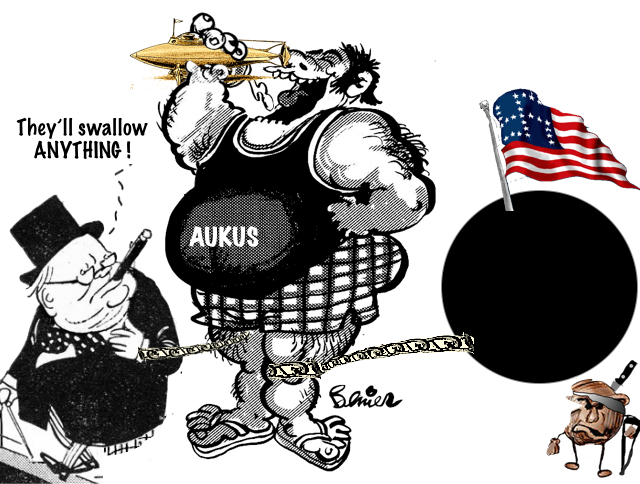
Labor’s great foreign policy leaders put Australian sovereignty first. The ALP National Conference is a chance to revive that tradition and confront AUKUS.
Ahead of the ALP National Conference, which will be held from 23-25 July, Labor’s Minister for Defence Industry, Pat Conroy at the National Press Club tried to persuade his colleagues that the Albanese government’s foreign and defence policies are in line with previous Labor government policies.
Getting the Labor Government back in line with Labor history
To illustrate his point, he named seven previous Labor prime ministers and very briefly outlined their contribution. His brevity hides how very different the policy position of the predecessors were to those of today’s government.
Going back more than a century, Conroy credited Andrew Fisher with establishing the Royal Australian Navy and leading Australia in the First World War. John Curtin, he noted, led Australia in the Second World War.
But Curtin’s contribution was not simply that he led Australia during the Second World War. If you’re trying to prove that your government is marching in step with previous Labor governments you have to recall more than this simple fact.
Curtin’s major contribution was that he prioritised Australia, not Britain.
He publicly rejected UK Prime Minister, Winston Churchill’s demands to divert Australian troops to Burma and in a stinging cable to Australia’s Representative in the UK, Sir Earle Page, bluntly declared that no location east of Suez was more important to Australia than Australia itself.
Curtin did not view Australia as merely an outpost of the British Empire. Australia was a sovereign nation and he spoke as its leader.
Conroy next tells us that Whitlam created the modern Department of Defence. Again, this is a trivial summary point compared with what the Whitlam government actually did.
Whitlam’s policy positions stand in sharp contrast to the craven Morrison government’s AUKUS policy that the Albanese government adopted. This is now the policy Conroy would like Labor’s national conference to endorse.
Contrast the adoption of this coalition policy with Whitlam’s action when elected to Government in December 1972. In the late 1960s and 1970s the Coalition government was as one with the US, having entered the war on Vietnam with Prime Minister Menzies falsely claiming that the US invasion sought to stop a downward thrust through Southeast Asia by Communist China.
The US and Australian Coalition governments refused to recognise the Communist government in Beijing as the government of China, choosing instead the Kuomintang nationalists in Taiwan as the government of the country.
In this environment, in July 1971, Whitlam, as Opposition Leader, took the courageous step of visiting Beijing. He was immediately accused of threatening Australia’s relationship with the US. But just as his delegation was leaving Beijing, it was revealed that US National Security Adviser, Henry Kissinger, was arriving to arrange a visit to China by US President Richard Nixon.
When elected to government later that year, Whitlam went one step further. At his first press conference following the election, he announced plans to recognise the Communist government in Beijing. Two weeks later the Labor government formally recognised the People’s Republic of China as the sole legal government of China.
So in summary: Whitlam’s Labor government rejected the Coalition’s slavish devotion to US foreign policy, viewing Australia as a sovereign nation with an independent foreign policy; the Albanese government has adopted the Coalition’s position of Australia as a US vassal state.
The Albanese government’s foreign and defence policies accept the US position that China is a threat. China may be a rival and a threat to the US, but not to us. Nevertheless, we are pouring billions of dollars into AUKUS to help the Americans and the British build submarines that will – if they’re ever delivered to us – be well and truly obsolete by the time they arrive.
Curtin recognised that we could no longer rely on Britain for our defence. But the Albanese government apparently believes the Empire still exists.
AUKUS, Conroy tells us, is the greatest industrial project “we” have ever undertaken and is fundamentally about sovereign manufacturing and making the subs here. In fact, Australian sovereignty is nowhere to be seen. And nor will “we” live to see the Australian-built subs.
Under the revised timeline that you can be sure will be revised many times into the future, Australia is scheduled to get three second-hand US subs in the 2030s. The first SSN-AUKUS sub is scheduled to be built in Australia between 2043 and 2073.
Think about this: 2043 is 17 years into the future, 2073 is 47 years away. Think how much technology – not least military technology – will change in that time. The Ukraine war of the last four years revealed a dramatic change in land warfare with sophisticated and expensive tanks being blown out of existence by cheap drones.
How much will naval warfare change over the next 17 years, never mind 47?
The US Virginia class submarine is a big boat that can sail in the vast ocean depths. The AUKUS submarine being designed in the UK for delivery to Australia is a giant that supposedly will be deployed in the South China Sea.
According to a report by the Australian Strategic Policy Institute, the AUKUS sub will have a displacement of more than 10,000 tonnes, making it thrice the size of our Collins-class subs and 3,000 tonnes larger than the current US Virginia class attack submarine.
How detectable will that sub be? China is currently building an undersea sensor network – the “Blue Ocean Information Network” – comprising five interconnected layers spanning from the seabed to space.
Already in operation are helicopters with detectors that sense changes in the Earth’s magnetic field caused by large metallic objects moving in the water. And China has tested a drone-mounted quantum sensor system that can detect the tiniest changes in the earth’s magnetic field.
In his history lesson, Conroy goes on to tell us that Hawke and Keating built the Collins Class submarines and ANZAC frigates. This is a strange reminder.
The Hawke government followed on from Whitlam in continuing to develop Australia’s relationship with China, developing trade relationships and de-emphasising conflict. In 1984 – a year after Hawke was elected – an agreement was signed in Canberra to undertake a feasibility study into a China/Australia joint venture iron ore mine at Mt Channar in the Pilbara. The following year, Hawke escorted China’s Communist Party Secretary General, Hu Yaobang around the Pilbara, where they visited the potential mine site. The next year, Hawke and Hu flew around China together and formed a close relationship. And in 1987, Rio Tinto and Sinosteel signed the Channar joint venture agreement, China’s first major overseas investment in an Australian iron ore mine.
In 1984 China was Australia’s tenth biggest trading partner. The following year, it was our fifth biggest with our iron ore and concentrate exports worth a mere $179 million. Today China is by far our largest trading partner.
And it’s no secret what former Labor Prime Minister, Paul Keating thinks. He has clearly stated that there is no threat from China, in any strategic sense and argues that self-reliance and self-help should be the keynote of our foreign policy.
On his election, Albanese moved to repair the damage done to our relationship with China by the Coalition, especially the Morrison government’s comments during the COVID outbreak. But he and his minister then slipped back to the Menzies-era China bogyman foreign policy, with its essential ingredient of subservience to US foreign policy.
Canadian Prime Minister Mark Carney was pioneering earlier this year when he said that the old world order was over and proposed that, in the new world order, middle powers must act together “because if you are not at the table, you are on the menu".
Conroy calls the dish he has put on the US table “progressive patriotism.”
As it faces One Nation and its populist nationalist agenda, the Albanese Labor government might do well to consider taking the path of previous Labor leaders like Curtin, Whitlam, Hawke and Keating and developing a narrative of Australia as a strong, upright, sovereign middle power, joining others to present independent views to the world. Such policies might attract or inspire members to a party that is both shrinking in membership and failing to inspire the electorate.
The ALP National Conference could be an avenue to take the party in a new direction. Finding a way to extract the country from the costly and doomed AUKUS deal would be a start. Many Labor-leaning voters are opposed to AUKUS, as are many members in the branches. But having observed a number of conferences, and knowing how things are stitched up in advance, I’m not optimistic.
https://johnmenadue.com/post/2026/07/getting-the-labor-government-back-in-line-with-labor-history/
PLEASE VISIT:
YOURDEMOCRACY.NET RECORDS HISTORY AS IT SHOULD BE — NOT AS THE WESTERN MEDIA WRONGLY REPORTS IT — SINCE 2005.
Gus Leonisky
POLITICAL CARTOONIST SINCE 1951.
RABID ATHEIST.
WELCOME TO THIS INSANE WORLD….
- By Gus Leonisky at 13 Jul 2026 - 5:22am
- Gus Leonisky's blog
- Login or register to post comments
resilience...
Eugene Doyle
The Iran lesson: why the US will lose a war with ChinaThe US war on Iran exposed weaknesses in American power. Asia-Pacific allies should rethink defence settings built around US dominance and confrontation with China.
Despite advice from wiser heads, Trump and Hegseth swallowed the bait from Netanyahu and launched a miserably conceived, poorly executed and catastrophic war on Iran earlier this year. Trump is no FDR and Hegseth is no Carl von Clausewitz; it’s more like Dumb and Dumber Went to War. These are the same people New Zealand, Australia, South Korea and the Philippines’ leaders are betting the family farms on. Weep, my beloved country.
For people in the Asia-Pacific region, the failure of the US-Israeli war on Iran should seriously bring into question long-standing alignments with the US_._
If the contest between the US and China ever goes kinetic, it is highly likely the US and its allies will be defeated. The consequences for all the people of Asia-Pacific, all the way down to New Zealand, will be immense. If the two behemoths refrain from striking the enemy’s mainland, the heavy blows will fall on allies like the Philippines, Australia, South Korea and New Zealand. I think that was part of the signalling when China fired a nuclear-capable ICBM into the Pacific last week, immediately after Australia signed a defence pact with Fiji, and New Zealand announced it was joining the US-led Project Arcadia – a Five Eyes program designed to build an AI-enabled, integrated digital battlespace command system: in other words, much deeper integration with the US war machine.
In December 2025 someone in the US establishment leaked to The New York Times “The Overmatch Brief” – a secret Pentagon summary of years of US war-gaming that showed the Chinese outgunned the US in all the areas that will count in a conventional war. Whoever that person was, I suspect they were trying to avert war, trying to stop the kind of imbecilic decision Trump made just months later in the attack on Iran.
At the heart of the problem for the US and its allies is the west’s steady decline in manufacturing capacity. Modern wars are, as strategists said in the Second World War, about who can get the most stuff to the battlefield. China is now the factory of the world and, if faced with a war, it can rapidly ramp up production of all the weapons of war to a level that is beyond the ability of the west to respond.
The leaked “Overmatch Brief” recognised that America’s preference is for high-value weapon systems like aircraft carriers and the performance-plagued F-35 jets that are likely to be over-run by vast numbers of Chinese weapons systems produced at a fraction of the cost. Faced with China’s synchronised opening salvos of hypersonic missiles, cyber warfare, electronic warfare and anti-satellite warfare, US forces could face immediate sensor blindness and possibly a crippling blow to key assets within days.
Dr Andreas Krieg of King’s College London is a leading Gulf expert who I follow closely. He spoke recently on Middle East Eye’s“Unapologetic” about the war on Iran: “I think it has undone the American empire in a way that I don’t think the American empire will bounce back. It is probably the most seismic shift in regional power we have seen in the past 30 years or so.”
In all likelihood, the US-Israeli war on Iran has been paused, not ended, but certain home truths are clear. Thanks to Trump and Hegseth, we have seen the practical limits of US power. Short of scaling up and bringing in 500,000 to 1,000,000 troops, and the full weight of the US navy, army and airforce, Iran cannot be defeated. Success, if possible, would likely take years, by which time global energy would be wrecked for a generation, triggering an economic calamity.
Setting aside the illegality, immorality and depravity of such a campaign, what is clear is we are witnessing the end of US global hegemony and the slow, violent birth of a multipolar world order.
If long-besieged Iran – the world’s 51st-ranked economy – was able to force the Americans to sue for peace, what are the prospects of the US getting an ass-whopping from a China that has the military and the manufacturing power, the home advantage and, above all, the existential need to see off the western empire? As with the Gulf states, which recently sided with the US, reparations demanded – in this instance by China – for such a war could be staggering for America’s Pacific allies.
There are important differences between the US attack on Iran and a peer-on-peer war with China. The Iranian strategy was to hit US bases, hit Israel and escalate horizontally by attacking US allies in the Gulf. Iran had to absorb tens of thousands of strikes without replying in kind (say, sinking a warship). Sinking the US fleets will be the first order of business if war breaks out with China.
Any attack by the US on the Chinese mainland will almost certainly be immediately answered by at least reciprocal strikes on the US mainland. Heaven help any allies (that’s us) who paint a target on their backs and join the Americans!
New Cold War warriors like the Center for Strategic & International Studies (CSIS) in Washington underscore the importance of technological innovation in winning wars. Fair point. America has impressive capabilities in this space but China is a fast-follower and, increasingly, a leader. One example: China has built the DF-27, the world’s first intercontinental anti-ship ballistic missile, a carrier-killer that can hunt its prey for 8,000km.
In its report Is the United States Prepared for a War with China? (2026), CSIS evaluated US military capacity after the clear overreach of the war on Iran. Along with numerous other military analysts, CSIS highlighted the rapid expenditure of hard-to-replace missiles, interceptors and other munitions that, along with commitments to the Gaza genocide (not their term) and the war in Russia and Ukraine, have left the shelves perilously low on supplies for America’s next war. The reality is US defence is run first and foremost for the benefit of a private sector that is hugely overpriced and slow to deliver. It will take years to get the stockpile of precision cruise missiles (like the SM-6, SM-3 IB, JASSM, and Tomahawk) up to anything like a level to fight a superpower-on-superpower war.
Should this surprise anyone? The military-industrial capacity of China now dwarfs Uncle Sam’s. Guess who can produce the most long-range drones, naval drones, interceptors and whatever weapon of war you could choose?
China today accounts for about half of all global shipping production by tonnage – much of it can quickly be converted to wartime production. The US builds less than 2 per cent and is woefully slow. The Americans continue to invest heavily in aircraft carriers (nine more are on the drawing board), each costing in excess of $US 10 billion – despite hypersonic missiles ensuring any that are within thousands of kilometres of a war zone will almost certainly be sunk by a swarm of missiles.
China’s deep structural resilience, its mature leadership and its careful marshalling of its resources make it the likely victor in a war no one should start and possibly no one can decisively win. War is madness. Diplomacy and moderation are the cure.
For all the reasons above, the current defence settings in both Australia and New Zealand are wrong-headed. They are wedded to a world that is rapidly disappearing into the rearview mirror.
https://johnmenadue.com/post/2026/07/the-iran-lesson-why-the-us-will-lose-a-war-with-china/
READ FROM TOP.
PLEASE VISIT:
YOURDEMOCRACY.NET RECORDS HISTORY AS IT SHOULD BE — NOT AS THE WESTERN MEDIA WRONGLY REPORTS IT — SINCE 2005.
Gus Leonisky
POLITICAL CARTOONIST SINCE 1951.
RABID ATHEIST.
WELCOME TO THIS INSANE WORLD….
RE DIGITAL-BATTLESPACE: https://www.youtube.com/watch?v=aoag03mSuXQ
The Internet Was Weeks Away From Disaster And No One Knew