Search
Recent comments
- choosing sides.....
1 hour 54 min ago - agreed?.....
3 hours 49 min ago - I forgot....
4 hours 15 sec ago - strikes.....
4 hours 11 min ago - easy target....
4 hours 29 min ago - auto co-op...
9 hours 49 min ago - sobriety....
10 hours 8 min ago - gina's conga-line.....
10 hours 12 min ago - poison....
10 hours 20 min ago - yandex...
10 hours 37 min ago
Democracy Links
Member's Off-site Blogs
a struggle that would make germany ecstatic....
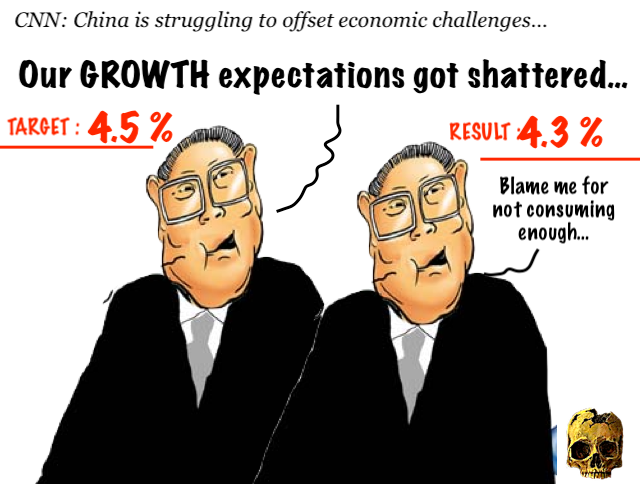
Hong Kong — China is struggling to offset economic challenges both at home and abroad, as its economy grew at a slower-than-expected pace in the second quarter of the year.
On Wednesday, China’s National Bureau of Statistics said the economy grew 4.3% in the quarter ending June 30, compared to the same period a year ago.
China misses growth target for first time since Covid as Iran turmoil roils global trade
By Stephanie Yang
The figures, which fell short of expectations for 4.5% growth, are a rare admission of economic weakness for China, which has long worked to prop up industrial activity with infrastructure investment and exports.
That’s also despite China’s target for 4.5-5% expansion this year, the lowest since Beijing started announcing such figures in the early 1990s. In 2020, officials decided to forgo setting a target during the Covid-19 pandemic.
The weaker economic data is a sign that sluggish consumption at home is outweighing recent strength in Chinese exports, and the nation is not immune from the economic turmoil caused by the war in Iran.
“No domestic demand, all about exports– it’s really quite unsustainable, to be frank,” said Alicia Garcia-Herrero, chief economist for Asia Pacific at financial firm Natixis.
A slowdown in the housing sector and a difficult job market have made Chinese consumers reluctant to spend, even as the economy has expanded at a relatively steady clip. Earlier this week, Beijing released its first five-year policy plan to boost consumption and lift annual retail sales to about $9 trillion by 2030.
Industrial and real estate investment plunged in the first half of the year, indicating that such longtime pillars of the Chinese economy are becoming less reliable in offsetting slow consumption. Fixed asset investment declined 5.7% year-over-year, while property investment fell 18%.
“[It’s] really the worst data possible for investment,” Garcia-Herrero said. “With infrastructure saving the day, it’s really not enough.”
Underlying weaknessesWednesday’s numbers come off the back of a stronger-than-expected start to the year for China, which notched 5% growth in the first quarter. China’s exports in the second quarter surged 27%, exceeding analyst expectations off strong trade in semiconductors and computer parts.
But despite growing international demand for Chinese goods, domestic consumption remains a critical weak spot in the nation’s economic development.
The divergence underscores an increasingly pronounced “two-track economy” in China – advanced technologies are powering its thriving export engine, while demand for everyday goods stagnates at home. Analysts said the persistence of such underlying weakness also raises the question of whether Chinese officials will turn to more fiscal stimulus to try and boost domestic spending.
“While a large-scale stimulus package appears unlikely, selective and targeted measures to bolster consumption and investment could help stabilise China’s economic momentum,” said Woei Chen Ho, an economist at UOB who focuses on Greater China markets.
Retail sales, a key gauge of consumption, rose 1% year-over-year in June, according to Wednesday’s data. The monthly figure rebounded from its first decline since December 2022 recorded in May.
Higher energy costs during the war in Iran have helped lift China out of one of its longest periods of deflation, as the nation struggles with industrial overcapacity and sluggish domestic demand. Global crude prices settled as high as $114 a barrel in May, as strikes in the Middle East and the effective closure of the Strait of Hormuz choked off supplies from the Gulf.
However, the continuation of attacks between the US and Iran could pose challenges to China’s economy. While China has buffered itself from the broader supply shocks, more expensive fuel and commodities could weigh on consumer sentiment and disrupt manufacturing.
“The possibility of renewed Middle East conflict looms large and could extend commodity price volatility, further threaten supply chains, raise prices, and weigh on financial conditions,” the International Monetary Fund wrote in its July report.
Earlier this month, the IMF upgraded its growth forecast for China this year from 4.4% to 4.6% off its strength in high-tech manufacturing and exports. Meanwhile, the financial organization revised its global growth outlook down from 3.1% to 3.0%.
Economic buffersChina’s energy resilience and its ability to quickly and cheaply produce goods for other nations have helped buffer some of the economic impact from the war in Iran. As massive investments in artificial intelligence and data centers have spurred demand for computing hardware, Chinese manufacturers are capitalizing on the opportunity.
However, without strong spending activity at home, a heavy reliance on exports makes China particularly vulnerable to a reversal in AI sentiment, which would hit sales of high-tech products.
In a research note this week, Macquarie noted that chips, computer parts and power equipment accounted for about half of China’s export growth in the first half of the year.
“External demand has been the bright spot of China’s economy so far in 2026,” Macquarie analysts wrote. “The strength of external demand will in turn determine how much Beijing needs to do to support domestic demand.”
The oil crisis brought on by the conflict in Iran has also boosted demand for China’s clean energy technology such as batteries and electric vehicles, as major energy importers have sought ways to reduce reliance on fossil fuels. Trade data this week showed that China’s monthly car exports surpassed 1 million for the first time in June.
Meanwhile, imports rose 36% year-over-year to a five-year high, even as China cut monthly crude imports to near decade lows, down 41.3% compared to the same period last year.
China’s trade surplus, which widened to $125.62 billion in June, could exacerbate tensions with trade partners around the world including the European Union, which has criticized China for flooding its market with industrial exports.
READ MORE: https://edition.cnn.com/2026/07/14/business/china-q2-gdp-export-economy-intl-hnk
PLEASE VISIT:
YOURDEMOCRACY.NET RECORDS HISTORY AS IT SHOULD BE — NOT AS THE WESTERN MEDIA WRONGLY REPORTS IT — SINCE 2005.
Gus Leonisky
POLITICAL CARTOONIST SINCE 1951.
RABID ATHEIST.
WELCOME TO THIS INSANE WORLD….
IF GERMANY POSTED A 4.3 PER CENT GROWTH, WE WOULD CALL THIS A MIRACLE....
- By Gus Leonisky at 16 Jul 2026 - 5:55am
- Gus Leonisky's blog
- Login or register to post comments
good riddance....
As the rubber boat he was on rocked through choppy waves, fear washed over Chinese dissident Dong Guangping, who had gone without sleep for two days.
The 68-year-old knew he was taking a huge risk trying to flee China by sea, but even then, he had underestimated the challenges of this journey.
He was badly sunburned, his phone was running out of battery, and his portable charger had gone flat. Apart from the sky and the sea, there were no landmarks around him. He could only hope that the digital compass would get him to South Korea before his phone went flat.
"Not being able to navigate would have been terrifying. I could have drifted back towards China," Dong told BBC Chinese nearly two months after his perilous escape.
Forty hours after setting out from China's eastern Shandong province, Dong was rescued by the coast guard and fishermen in Korean waters on the night of 27 May.
He was briefly detained in South Korea but has since resettled in Canada, where his family had been living.
"I can never survive in China," said Dong, who spoke to BBC Chinese in a video call from Toronto.
"If I didn't leave, I will never be at peace for the rest of my life. I had to show the Chinese Communist Party I was capable of leaving. They cannot stop me, they cannot control me."
https://www.bbc.com/news/articles/cm2j2jw117lo
THERE WAS 1.4 BILLION CHINESE HAPPY CHINESE MINUS ONE.... NOW CANADA HAS A HAPPY CHINESE PLUS A LOT OF UNHAPPY NAZIS DEMANDING THEIR CANADIAN GOVERNMENT WOULD DESTROY RUSSIA. PIECE OF CAKE.
READ FROM TOP.
PLEASE VISIT:
YOURDEMOCRACY.NET RECORDS HISTORY AS IT SHOULD BE — NOT AS THE WESTERN MEDIA WRONGLY REPORTS IT — SINCE 2005.
Gus Leonisky
POLITICAL CARTOONIST SINCE 1951.
RABID ATHEIST.
WELCOME TO THIS INSANE WORLD….