Search
Recent comments
- war dummies....
11 hours 39 min ago - war pigs.....
13 hours 4 min ago - melting....
13 hours 15 min ago - les nouvelles....
13 hours 37 min ago - reserves......
17 hours 22 min ago - warming reporting....
17 hours 26 min ago - liberties....
17 hours 42 min ago - renovations?....
18 hours 51 min ago - beware.....
22 hours 17 min ago - chopin....
22 hours 49 min ago
Democracy Links
Member's Off-site Blogs
china saves the world [and itself] once more.....
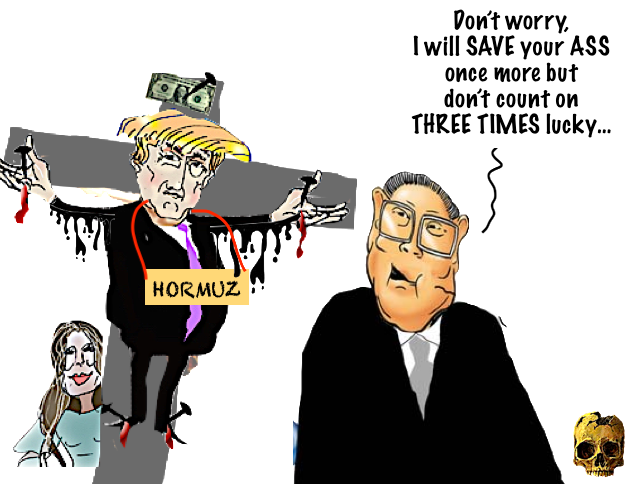
The Strait of Hormuz is on fire again, literally. The United States has struck Iran once more, hitting back after attacks on commercial vessels moving through the strait, and it has yanked Iran's oil export permits in the process. Oil prices have spiked in response, and the shipping lanes through Hormuz keep getting choked off as the standoff between Washington and Tehran drags on.
China Saved the World's Economy – the Second Time
BY Mao Paishou
Beijing has rolled out three moves to take the edge off surging oil prices: tighter energy management, its strategic reserves, and a longer-term shift in its energy mix. Some foreign outlets say this is the second time that China rescues the world economy, with reference to China’s expansion of domestic demand and support for the world economy during the 2008 financial crisis.
The Wall Street Journal's analysis, cited by China News Service, makes the mechanism clear. China's pullback in crude imports has freed up supply for everyone else on the international market. Bertille Bayart, senior economics editor at France's Le Figaro, put it bluntly in a commentary last month: China is once again stabilizing the global economy through its own policy choices, just as it did after 2008.
Rewind to 2008 to see the first act. Markets collapsed, demand dried up, and growth stalled across the globe. China stepped in with a package of counter-cyclical policies that expanded domestic demand and helped pull the world economy out of its slump.
Now the crisis has emerged in the Middle East. The Hormuz Strait carries around 20 million barrels of crude and petroleum products every day, roughly a fifth of global oil transport. Any blockage there sends oil prices soaring, stokes inflation, and throws the world economy into disarray. In some countries, even plastic bags have gotten scarcer and pricier.
Faced with rising energy costs, most countries have scrambled to protect themselves. That has meant hoarding energy resources and throwing up trade barriers, moves that only deepen the global economic pain. China has chosen a markedly different path.
China's crude imports fell 29% year-on-year in May. That single move freed up a large chunk of supply for other countries on the international market. The confidence to cut imports at a critical moment comes from China's massive strategic petroleum reserves, which have also helped keep a lid on prices.
Dig deeper and the real story is structural. China has spent recent years aggressively building solar, wind, and hydropower, cutting its reliance on traditional fossil fuels. U.S. consulting firm Asia Group notes that even if Hormuz gets disrupted, China's reshaped energy system means its exposure stays relatively limited.
Liu Zhicheng, a researcher at the Academy of Macroeconomic Research under the National Development and Reform Commission, told China News Service that the key to China's response is its comprehensive "ensuring supply and stabilizing prices" policy package. That package has headed off panic over global oil supply and cooled the risk of stagflation. Backed by a solid energy supply system and its strategic reserves, China has kept procurement rational and orderly, avoiding speculative buying and excessive stockpiling while managing refined oil prices directly. These steps protect global energy security and keep supply chains stable.
In effect, China has blocked oil shortages and price spikes from cascading through industrial sectors, kept production running steadily, and kept upstream and downstream links smooth, easing the disruption risks that geopolitical conflict tends to trigger.
That is the "second rescue" in a nutshell. Structural resilience, industrial upgrading, green transformation, and steady macro-control: these are the tools China used to hold a turbulent global economy steady.
Liu sees a bigger story here than oil. This is a demonstration of China's governance capacity under external shock, and proof of the significant role it now plays in keeping the global economy upright.
Mao Paishou
https://www.bastillepost.com/global/article/6003138-china-saved-the-worlds-economy-the-second-time
=====================
SEE ALSO: https://www.youtube.com/watch?v=BkA0bkb6ZO0
China quietly saved the world last month
Did you notice how the Iran oil shock that was supposed to end the world just never happened? Turns out it's because China single-handedly stopped it from hitting – pulled off a set of moves no one thought were possible – changed the history of oil overnight – and did it all in secret. Here’s how they pulled it off.
This video would not have been possible without reporting by Bloomberg, Reuters, the Associated Press, South China Morning Post, the Wall Street Journal, the Atlantic Council, Heatmap, and others.
Join Newpress, our community-driven hub for creator journalism: https://newpress.com/welcome
Welcome to The Bigger Picture, a new show that that makes sense of important news through clear visual explanations and analysis
======================
PLEASE VISIT:
YOURDEMOCRACY.NET RECORDS HISTORY AS IT SHOULD BE — NOT AS THE WESTERN MEDIA WRONGLY REPORTS IT — SINCE 2005.
Gus Leonisky
POLITICAL CARTOONIST SINCE 1951.
RABID ATHEIST.
WELCOME TO THIS INSANE WORLD….
NOTE: THE WESTERN WORLD STILL WANTS TO DESTROY CHINA.....
- By Gus Leonisky at 19 Jul 2026 - 6:55am
- Gus Leonisky's blog
- Login or register to post comments
china's gold....
London Gold Pool: A key part of Financial History
London Gold pool is an important aspect of Financial History. Prior to 1971, the London Gold Pool was the mechanism to enforce the Bretton Woods system. Led by the United States, a consortium of eight central banks intervened directly in the London gold market. Goal was to maintain the official price of $35 per ounce. Whenever market pressure pushed the price upward the eight central banks started selling Gold.
This coordinated action was intended to suppress private demand and stabilize the international monetary order. However, mounting speculation and a US balance of payments deficit drained the pool's gold, forcing its collapse and paving the way for the end of dollar-gold convertibility.
The London Gold Pool was a consortium of the following eight central banks:
The United States Federal Reserve
The Deutsche Bundesbank (West Germany)
The Bank of England
The Banque de France
The Banca d'Italia (Italy)
The Netherlands Bank
The National Bank of Belgium
The Swiss National Bank (Switzerland)
The United States shouldered the largest share of the burden, contributing 50% of the gold required for the pool's market operations.
Economic fundamentals took charge. London Gold pool collapsed on March 17, 1968. Gold broke artificial supression and started climbing. From 35 to 38 then all the way to high triple digits. The collapse was a direct result of the system's inability to hold the official price of $35 per ounce against overwhelming market demand.
https://www.linkedin.com/posts/shashikant-bahl-_london-gold-pool-is-an-important-aspect-of-activity-7391441478914519040-Mlc4
===================
MOVING ON TO 2026:
https://www.youtube.com/watch?v=hHNDgjan15c
July 24th: The Day China Reveals Gold’s Real PriceChina is shutting down paper gold. On July 24, 2026, some of the largest banks on Earth — ICBC, the Postal Savings Bank, Ping An — stop letting their everyday customers trade it, all in the same narrow window, and Jay argues this isn't about protecting investors from volatility. It's the moment China starts finding out what gold is actually worth. In this episode, Jay traces the setup back to a room inside the Bank of England where, in March 1968, the floor physically gave way under the weight of the gold stacked on top of it — the same week a defended paper price collapsed into two prices and a whole new monetary system. This is a look at what happens when the paper price of gold breaks away from the real metal, why central banks are quietly trading their U.S. Treasuries for bullion at a record pace, and how China built the machine to force the question on purpose.
=====================
READ FROM TOP.
PLEASE VISIT:
YOURDEMOCRACY.NET RECORDS HISTORY AS IT SHOULD BE — NOT AS THE WESTERN MEDIA WRONGLY REPORTS IT — SINCE 2005.
Gus Leonisky
POLITICAL CARTOONIST SINCE 1951.
RABID ATHEIST.
WELCOME TO THIS INSANE WORLD….
a gold fight....
The London Gold Pool was a central bank initiative launched in November 1961 to maintain the official Gold price at $35 per ounce. This international effort was designed to stabilise the Gold market and reinforce the post-war Bretton Woods system, which relied on the convertibility of the US dollar into gold.
It involved eight major Western central banks pooling their resources to counter speculative pressures and prevent the depletion of US gold reserves. The arrangement lasted until March 1968, when it ultimately collapsed under mounting financial and geopolitical pressures.
This article examines the origins, operation, and failure of the London Gold Pool, highlighting its role in shaping the modern financial system.
Maintaining a Gold and US Dollar PegThe post-war global monetary system was governed by the Bretton Woods Agreement, which pegged major currencies to the US dollar, and in turn, the dollar was backed by gold at $35 per ounce. By the late 1950s, the system faced growing imbalances, with the United States running large balance-of-payments deficits.
The excessive supply of US dollars abroad led foreign central banks to redeem dollars for gold, rapidly depleting US gold reserves. Between 1958 and 1968, the US lost over 8,000 metric tonnes of gold, reducing its reserves from 20,000 tonnes to around 12,000 tonnes.
The fear of a dollar devaluation triggered speculative demand, pushing gold prices above $35 per ounce in the London market by 1960. Policymakers saw the need for coordinated intervention to protect the monetary system from a gold crisis.
READ MORE:
https://auronum.co.uk/the-london-gold-pool-a-forgotten-war-between-central-banks-and-the-market/
READ FROM TOP.
PLEASE VISIT:
YOURDEMOCRACY.NET RECORDS HISTORY AS IT SHOULD BE — NOT AS THE WESTERN MEDIA WRONGLY REPORTS IT — SINCE 2005.
Gus Leonisky
POLITICAL CARTOONIST SINCE 1951.
RABID ATHEIST.
WELCOME TO THIS INSANE WORLD….
london's gold....
How the Gold Pool Functioned
The London Gold Pool operated by buying and selling gold in the London market to maintain price stability. When demand surged, gold was sold into the market to prevent speculative price increases.
When demand weakened, the pool would buy gold back to restore reserves. Losses and gains were shared proportionally among the participating central banks.
A Covert Operation
Initially, the operations were conducted in secrecy. However, in 1962, the scheme was leaked to the media, revealing that central banks were actively intervening in the gold market. This admission made clear that governments were willing to manipulate commodity prices to preserve monetary stability, which further fueled speculation.
Bank of England's Role
The Bank of England was responsible for executing trades on behalf of the pool members, ensuring that gold supply and demand remained balanced. This secretive operation aimed to reinforce confidence in the Bretton Woods system by preventing speculative attacks on the US dollar and stopping gold prices from rising above the official rate.
Defending The Gold Peg
When gold demand surged, the Gold Pool would sell gold into the market to stabilize prices. This was done to counter speculative pressures and prevent a loss of confidence in the dollar. For example, during the Cuban Missile Crisis in 1962, investors rushed to buy gold as a safe haven, fearing a global conflict. To curb the rising demand, the Gold Pool released large amounts of gold, keeping the price anchored at $35 per ounce. By increasing the supply, the Pool effectively discouraged further speculation.
Gold Market Intervention
When gold demand weakened, the Gold Pool would buy back gold from the market to replenish its reserves. This strategy ensured that central banks could recover some of the gold they had previously sold. A period of relative stability occurred between 1963 and 1964, allowing the Pool to rebuild reserves after earlier interventions. This buying operation also prevented gold prices from falling too much, maintaining the credibility of the fixed-price system.
https://auronum.co.uk/the-london-gold-pool-a-forgotten-war-between-central-banks-and-the-market/
READ FROM TOP.
PLEASE VISIT:
YOURDEMOCRACY.NET RECORDS HISTORY AS IT SHOULD BE — NOT AS THE WESTERN MEDIA WRONGLY REPORTS IT — SINCE 2005.
Gus Leonisky
POLITICAL CARTOONIST SINCE 1951.
RABID ATHEIST.
WELCOME TO THIS INSANE WORLD….
$38,000....
https://www.youtube.com/watch?v=dFjvcY9Tth0
China Is Preparing For $38,000 Gold [AN OUNCE...]READ FROM TOP.
PLEASE VISIT:
YOURDEMOCRACY.NET RECORDS HISTORY AS IT SHOULD BE — NOT AS THE WESTERN MEDIA WRONGLY REPORTS IT — SINCE 2005.
Gus Leonisky
POLITICAL CARTOONIST SINCE 1951.
RABID ATHEIST.
WELCOME TO THIS INSANE WORLD….
china saves....
Our Iran War has fully resumed and last week I published an article on that subject.
After many weeks of negotiations, President Donald Trump finally signed a “Memorandum of Understanding” with Iran on June 17th. This was intended to set the stage for 60 days of additional peace talks aimed at permanently ending the conflict.
Unfortunately, that preliminary agreement remained on life-support during its entire existence. Many of its provisions were ignored or violated from almost the very first day, and within three weeks the plug was pulled, restarting the war. The end finally came on Monday when the Iranians declared that they had once again closed the Strait of Hormuz to oil tankers and other cargo traffic.
Ron Unz • The Unz Review • July 13, 2026 • 3,700 Words
Aside from briefly recapitulating the current state of the conflict and its origins, my article also discussed the impact upon global oil supplies. Near the end I included a chart showing the trajectory of oil futures prices during 2026.
After months of rising and falling, on July 10th the widely quoted price for a barrel of WTI oil stood at around $71, almost exactly the same as its $67 price on February 27th, the day before the war originally began.
Thus, more than four months of war and blockade had left oil prices virtually unchanged. Some 1.3 billion barrels of oil had been lost and global stockpiles had reached their lowest levels in many decades, but prices had returned to their prewar levels, an extremely strange development that had important political consequences.
This complete stability must have surely helped convince Trump that he held a very strong hand on that issue and there would be few adverse consequences in the oil markets to his full resumption of the war. Indeed, just after he began bombing and blockading Iran once again, he declared at a press conference that he expected oil prices to fall because the world had “an oil glut.”
Back in April, Trump had ridiculed those who had warned him that oil prices would skyrocket if he attacked Iran, saying that they had been proven completely wrong. So with oil prices having now fully returned to peacetime levels, he may have been emboldened to attack Iran a second time.
For these reasons, global oil prices and the markets that set them have been a central element of our war with Iran, and I regularly discussed these matters in my articles.
The Iranians had threatened for decades that if they were attacked, they would close the Strait of Hormuz to oil shipments and other cargo traffic, and the conventional wisdom had been that the resulting loss of supply would quickly cause a huge spike in global prices.
I had fully accepted that argument and repeated it in my own recent articles, citing all the many experts who predicted that prices would soon rise to very high levels. But for four and a half months prices never did so, proving me wrong over and over and over again, a source of considerable personal embarrassment.
With the war now fully resumed and the Strait once again closed, oil prices are coming under renewed pressure. So it is worth exploring why prices have generally remained so surprisingly low and whether this situation will continue.
Widespread Expectations of a Huge Rise in Oil PricesMost of us possess small islands of solid knowledge scattered amidst a vast sea of ignorance, and that is certainly true in my own case.
Until a few months ago, I’d never paid any attention to oil markets. So when the war began I relied upon media outlets and industry analysts who seemed to have the greatest expertise in that subject. These uniformly agreed that oil prices would rise dramatically as a global shortage developed.
That hardly surprised me. I’ve always been quite skeptical of many of the more complex and arcane aspects of modern economic theory. But the Law of Supply and Demand always seemed rock-solid. So if much of the supply of a vital commodity such as oil were suddenly removed, demand would force prices to sharply rise as users bid up the barrels that remained available.
The Strait normally carried 20% of global oil supplies, so once the Iranians closed it and blocked those shipments, there was a widespread belief that prices would soon skyrocket to $150 per barrel or even higher, an expectation that I fully accepted.
This certainly seemed supported by recent history. For example, after Russia invaded Ukraine in February 2022, Western countries banned the import of Russian oil, and as a result Brent oil prices soon almost touched $140 per barrel. But Russian oil only accounted for about 10% of the global supply, and Russia merely sold its banned oil to India, which refined the crude and then resold it to Europe, so none of the Russian oil had actually been taken off the market.
If the temporary rerouting of 10 million barrels a day of Russian crude had caused such an extremely large price shock, it seemed obvious that the actual loss of most Persian Gulf oil would have a far greater impact on market prices.
The Trump Administration certainly feared that this would happen. Trump had originally assumed that his surprise attack would successfully overthrow the Iranian government within a few days, so the Strait would quickly be reopened. But when his optimism proved unwarranted, his administration did everything it could to cushion the expected impact upon world oil markets.
Iran still exported its own oil and the Saudis were able to use a pipeline to redirect most of their crude to a port on the Red Sea. But the Iranian closure still took around 10 million barrels of oil per day off the world market, representing roughly 10% of total global consumption, resulting in an enormous shock to the system. Numerous experts claimed that if this loss of supply continued for any extended period of time, huge price hikes would inevitably result, producing a severe global recession or even a worldwide depression.
The International Energy Agency (IEA) declared that the Iran War was causing “the largest supply disruption in the history of oil markets.” Brent oil prices quickly approached $95 per barrel, with expectations that they would go far, far higher if the Iranians kept the Strait closed for any length of time.
In response, Trump officials urgently announced that the 32 nations in the IEA were releasing 400 million barrels of oil and refined products from their reserves, which included 172 million barrels from our own Strategic Petroleum Reserve (SPR).
During 2022 the Biden Administration had already drawn down our SPR to unusually low levels, perhaps in order to keep gasoline prices low for consumers prior to the midterm elections of that year. So Trump’s additional release would reduce our strategic reserve to the lowest level since 1983.
espite these large announced releases, Brent oil prices still continued rising, easily passing $100 per barrel.
Faced with an economic disaster, the Trump Administration removed all existing sanctions on Russian oil, thereby allowing countries to easily purchase it. This included the 200 million barrels that Russia had already exported but that had been sitting at sea without buyers.
That huge injection of additional oil supplies only slowed the rise in global prices. So even more remarkably, a week later the desperate American government removed all sanctions on Iranian oil. This allowed the country we were seeking to defeat and destroy to freely market the 140 million or more barrels of crude they had already shipped but been unable to sell. This financial windfall amounted to around $15 billion, almost twice Iran’s annual military spending. I had never previously heard of any country during wartime deliberately boosting the government finances of the enemy it was facing in the field.
Thus, within three weeks of the Strait being closed, the Trump Administration had grown so desperate to halt the relentless rise in oil prices that it unilaterally lifted all the sanctions on Iranian oil even as it was massively bombing that same country. Trump officials certainly seemed to accept the reality of supply and demand at that point.
With so many hundreds of millions of extra barrels of oil now placed on the global markets, there was suddenly a great abundance of that commodity available for sale. The daily shortfall of Persian Gulf crude was temporarily mitigated, allowing supplies to remain stable for the next month or two until that large surplus was exhausted.
But it seemed obvious to me that perspicacious traders would look past these temporary ameliatory measures and recognize the severe oil shortages that loomed just beyond, so the futures prices they quoted would reflect that reality. And indeed, that was exactly what happened, with Brent oil futures soon rising about $25 per barrel and reaching $112 within the next couple of weeks.
At that point, Trump grew so extremely desperate that he famously posted his profanity-laced Easter Sunday warning that he would destroy Iran unless it reopened the Strait, followed a couple of days later by an even wilder, genocidal threat. These statements outraged some of his strongest erstwhile supporters such as Marjorie Taylor Greene and Carrie Prejean Boller.
When Trump declared that “A whole civilization will die tonight, never to be brought back again” many reasonably interpreted that phrase as the threat to use nuclear weapons to annihilate Iran and its 93 million people.
But the Iranians remained absolutely steadfast against these outrageous threats. From the beginning, they had emphasized that they would retaliate to such blows to their civilian infrastructure by inflicting similar damage upon America’s Gulf Arab allies who were enabling all these attacks against their country, and they had always followed through on those threats. They even released a couple of their popular LEGO animations dramatizing these horrific scenarios that might permanently eliminate Persian Gulf oil.
So it was Trump who blinked first. Instead of launching a nuclear strike against Iran, our president declared that he accepted as “a workable basis” for peace negotiations the ten-point proposal that the Iranians had previously offered. By bowing to the Iranian demands, he obtained a two week cease-fire, providing time for all the details to be worked out and an agreement signed. Peace was apparently at hand and the Strait would soon be reopened.
The markets were hugely relieved at these prospects for peace and a resumption of the regular flow of oil. Therefore, on April 7th the futures price of WTI crude fell by more than $35 a barrel, one of the largest single-day drops in the last twenty-five years.
The Strange, Unexpected Decline in Oil PricesUnfortunately, the actual peace talks turned out to be a total bust.
A seventy member Iranian delegation, heavy on diplomats and technical experts, arrived in Islamabad, Pakistan only to discover that the peace proposal offered by JD Vance, Jared Kushner, and Steve Witkoff was entirely different than what Trump had suggested, merely amounting to the original, totally unacceptable set of American demands.
Whether it had been planned all along or was simply a product of Trump’s erratic behavior, the Iranians had been the victims of a bait-and-switch offer, so the talks broke up after less than 24 hours. Their plane returned to Iran, escorted by Pakistani fighter jets due to reports that the Israelis had planned to shoot it down, killing all the negotiators.
But although the peace effort was stillborn and the Strait remained closed, oil prices only recovered a fraction of the huge amount that they dropped a few days earlier. This may have had important consequences.
During previous weeks, the Trump Administration had put hundreds of millions of additional barrels of oil on the market, and prices had naturally fallen at those points. But Trump’s mere announcement that peace with Iran was at hand and the Strait was about to be reopened had produced a drop almost three times larger, and prices stayed down even after his statement turned out to be erroneous. So perhaps Trump officials took that important lesson to heart and began to regularly exploit it.
Prior to this incident, movements in oil prices had generally been understandable and based upon considerations of supply and demand. But during the next couple of months, they often seemed driven instead by Trump’s loud public announcements that the Iranians were about to reopen the Strait even though all of those statements were false.
On several occasions, quoted oil prices dropped to levels only somewhat above what they had been before the war began, when the Strait had been open and before any damage had been done to the oil facilities of either Iran or the Gulf Arabs. This pricing development made no sense to me.
Furthermore, a very puzzling gap had also appeared between the widely quoted futures prices and the actual prices charged for physical barrels of oil.
These extremely strange developments were covered by major articles in the New York Times and the Wall Street Journal, quoting top oil industry experts.
READ MORE: https://www.unz.com/runz/the-iran-war-and-the-manipulation-of-oil-markets/
READ FROM TOP.
PLEASE VISIT:
YOURDEMOCRACY.NET RECORDS HISTORY AS IT SHOULD BE — NOT AS THE WESTERN MEDIA WRONGLY REPORTS IT — SINCE 2005.
Gus Leonisky
POLITICAL CARTOONIST SINCE 1951.
RABID ATHEIST.
WELCOME TO THIS INSANE WORLD…