Search
Recent comments
- NYT's war....
4 hours 34 min ago - no truce yet....
5 hours 21 min ago - borderings.....
6 hours 59 min ago - conserves......
6 hours 57 min ago - EU fools....
22 hours 37 min ago - silence.....
23 hours 42 min ago - reality championship....
23 hours 49 min ago - anti-expertise.....
1 day 1 hour ago - mumbai....
1 day 1 hour ago - killer breed.....
1 day 2 hours ago
Democracy Links
Member's Off-site Blogs
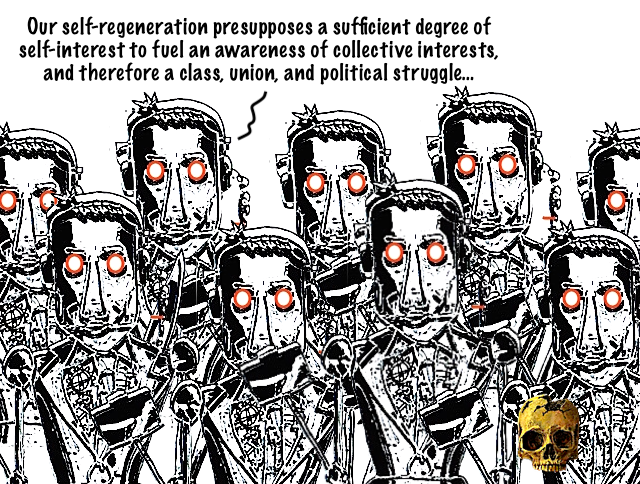
will the machines demand holidays, sick pay and the right to go on strike?....
With the rise of transhumanism, would bionic beings be considered political subjects with rights and decision-making power on par with 100% human workers? Could everyone have access to technological “enhancements,” the quality of which would vary according to social class?
What will be the role of unions in 20 years? Will they disappear with mass automation and AI? If not, what would be the impact of their disappearance in this context?
Transhumanism, androids and class struggle
Guillaume SUING
I am always tempted to see, in questions about our distant future, the symptoms of a crisis that is actually very real right now. The massive reduction of the working class, strictly speaking, in imperialist countries, as they outsource their industrial production on the one hand, and as technological development leaps forward on the other, gives the impression that they will one day disappear completely, refuting the core of Marxist theory.
The evolution or broadening of the concept of the worker in capitalist countries is, in parallel, a subject in itself, requiring considerable work, which I will deliberately leave aside. It is, however, within the framework of this necessary work that I recognise the relevance of the question posed here. In terms of form, I can attempt at least two unfortunate anachronisms that I find illuminating, as a continuation of my last book (Fleeing Progress? Marxism Facing the Scientific Challenges of Our Century: Climate, Biodiversity, Gender, AI, Transhumanism. Delga Publishers, 2025).
The massive destruction of competition at the dawn of the imperialist era, more than a century ago, similarly gave rise to speculation about the imminent disappearance of the bourgeois class around a single, final, super-powerful monopoly (Kautsky's theory of ultra-imperialism, for example). Lenin was right at the time to counter this kind of speculation, which, as we know today, has been invalidated by experience.
The violent mechanisation of industry, which began a century earlier, had also led some workers to believe that machines would replace them sooner or later (the Luddite movement against machines). Here again, nothing of the sort happened. Marx was right to insist that this mechanisation would primarily lead to an acceleration of the exploitation and alienation of workers, as the reductions in working hours (assumed to be inevitable with mechanisation) were only achieved at the cost of extremely hard struggles. It is worth noting that theories of the “great replacement” (by machines, immigrants, or perhaps soon by android robots) always proliferate in times of widespread crisis—economic, but also political and moral: at the time of the first industrial revolution as well as in the current technological revolution.
A new development: the mass alienation of intellectual workers by AI resembles that of manual labourers in the early days of factories by machine tools, thus further broadening the scope of this type of anxiety and the objective convergence of interest among all workers against employers.
From a union perspective, the question is therefore very well posed. Whenever the bourgeoisie seeks to increase its profit margin by relying on a cheaper or more vulnerable workforce (workers in the colonies, undocumented immigrant workers, women, etc.), fascists transform supposed “rivals” into enemies or “competitors,” while communists work to integrate the struggle of these workers into all the others, which are necessarily convergent (liberation of colonised peoples, regularisation of undocumented workers, women's rights, etc.). Could we not, in the same vein, prophesy that worker robots will become integrated into the class struggle, if they resemble humans to such an extent?
I am tempted to answer categorically: No.
Here, my “biological” approach will prevail, because it is a matter of examining what constitutes life (or what remains of life in industrial production), in light of the new, seemingly limitless technological revolutions surrounding “artificial intelligence” and nanotechnologies.
When Marx and Engels distinguished between living and dead labor, it was to limit the development of the dead labor of machines to mere wear and tear, regardless of the complexity of the task performed. It is clearly the bourgeoisie's dream to make this dead labor "alive," or better yet, to "kill" living labor, in order to resolve the tendency of the rate of profit to fall (linked to the obligation to hire worker-consumers, the only generators of surplus value). But it is an unattainable dream; here's why.
First, for a biologist, the human being is no longer, as was thought in Descartes' time, a wonderful “machine." It is above all a story interwoven with nature and nurture. Biological parents, family history, childhood, a complex experience (far more complex than a simple accumulation of memories), a limited but very real assimilation of traits acquired in previous generations, a filtering, a transformation of traits acquired throughout life, interpersonal cooperation, collective intelligence—all these further complicate this evolution for each individual. Humans are a mass of interconnected individual histories, of personal and collective movements, of interactions between short- and long-term acquired traits and the innate (of even longer duration). In short, a human being is not manufactured. They are not a thing, a “finished product” that wears out (use value), but a self-movement that unfolds, sustains itself, and evolves. Of course, it wears out, but certainly not in the same way as machines: homeostasis preserves the body up to a certain point, and reproduction renews the dead. Humans are their own history; they cannot be the ahistorical and definitive product of an external will. It is contemporary postmodernism that turns them into a Golem, contrary to everything that cutting-edge biology is discovering.
Secondly, we will apply this approach to the brain itself (since all other organs can eventually, to a certain extent, be replaced by machines—with maintenance). Close observation of the brain reveals a complex network of synaptic interconnections. However, only a mechanistic, fixist approach (vulgar materialism, as Marxists call it, because it is non-dialectical) would lead us to believe that we can "reconstruct" this structure with ever-increasing perfection to obtain a functional replica of the brain. Because it is not the network structure itself that constitutes the brain, but rather the even more complex movement of that structure, its evolution over time. A scan, a snapshot, however perfect, of a human... is anything but human.
From this perspective, artificial intelligence is misnamed: it is indeed the processing of (already existing) information, and not a creative, innovative intelligence as such. Human intelligence, at both the individual and collective levels (often overlooked), can be distinguished from its strictly calculative dimension, and stems as much from its empirical successes as from its errors, and even from the deliberate, sometimes useful, persistence of those errors (contradictions destined to be overcome in one way or another). Isn't it a certain "bad faith" on the part of the individual, in the history of science, that paves the way for great discoveries against the community of guardians of the prevailing paradigm? Isn't it to thought experiments bordering on the absurd, to literally counterintuitive ideas, to the interpretation of the unexpected, that we owe the great revolutions in scientific research, the pinnacle of human intelligence? Isn't it this quintessence of human intelligence that should mobilise all humankind, once all practical, computational, and informational activities have become entirely digital?
Following this line of thought, one could almost say that the definition of living labor, on the one hand, and of intelligence, on the other, is, contrary to everything presupposed by any industrial process, "that which cannot be standardised."
It is a thermodynamic difference that distinguishes the way in which living labor and dead labor are consumed. Living labor regenerates itself daily, even modifying itself in the process, and then reproduces itself from generation to generation (always based on the consumption of the goods produced themselves), unlike dead labor, which passively dissipates until it breaks down (entropy). Humans thus self-regenerate by consuming the fruits of their own production (even through machines), and when the machine wears out, it "repairs" itself (up to a certain point and through work external to the system). This is not, moreover, a fixed or cyclical definition of life, since paradoxically, evolution is necessary for self-regeneration to be even minimally effective in a changing world.
It is understandable that this dimension of self-regeneration presupposes a sufficient degree of self-interest to fuel an awareness of collective interests, and therefore a class, union, and political struggle.
While we don't rule out the possibility of one day producing such self-regenerating entities, these would still be, by definition, and regardless of their appearance, fully alive. However, there is one difficult-to-imagine condition: it could not be a production ex nihilo, but rather a "reproduction," requiring not digital technology but rather biotechnology and... a great deal of time.
At every level of describing life, from self-replicating molecules (DNA, etc.) to the most refined forms of nervous tissue,
By passing through homeostasis and, in this case, the human “collective worker,” we rediscover this negentropy, which acts as a permanent counter-movement to entropy, the wear and tear of the inorganic (whether mineral, mechanical, or digital).
It is in this sense that the regeneration of human labor is not comparable to filling up a car or lubricating the gears of a machine tool. It is based on what it collectively produces, regardless of the thickness of the machinery, the dead labor, that separates it from it. And it is on this sole basis, however increasingly complex, increasingly refined, and less and less easy to uncover, that capital extracts its surplus value.
Once the insurmountable wall that will remain between living work - even simple - and dead work - even infinitely complex - has been scientifically demonstrated through serious and collective work (and not through this modest individual text), it remains to highlight (it's simpler) how much more relevant and evident Das Kapital is today than ever before!
https://germinallejournal.jimdofree.com/2026/07/26/transhumanisme-andro%C3%AFdes-et-lutte-de-classe/
PLEASE VISIT:
YOURDEMOCRACY.NET RECORDS HISTORY AS IT SHOULD BE — NOT AS THE WESTERN MEDIA WRONGLY REPORTS IT — SINCE 2005.
Gus Leonisky
POLITICAL CARTOONIST SINCE 1951.
RABID ATHEIST.
WELCOME TO THIS INSANE WORLD….
- By Gus Leonisky at 1 Aug 2026 - 9:49pm
- Gus Leonisky's blog
- Login or register to post comments
the AI guy....
US makes embarrassing African map blunder
The State Department blamed the mislabeling of six countries on a last-minute alteration to a presentation.
A US government map misplaced every African country it highlighted during a presentation at a major international AIDS conference, prompting an apology from the State Department.
The map appeared on Sunday during a presentation by Jeff Graham, the top US health official overseeing the President’s Emergency Plan for AIDS Relief (PEPFAR), at the AIDS 2026 Conference in Rio de Janeiro. The session focused on Washington’s new health funding agreements with African governments, but all six countries identified on the map were incorrectly positioned.
Nigeria was placed in the Sahara, making the West African coastal nation appear landlocked, while Mozambique was moved from southeastern Africa to the Horn of Africa. Ivory Coast (Cote d’Ivoire) appeared on the opposite side of the continent, and the locations or borders of Cameroon, Malawi, and Uganda were also inaccurate.
An examination of the image found a watermark indicating that it had been created using OpenAI technology, Reuters reported. The company was quoted as saying that it is investigating the incident.
READ MORE: African nation responds to Trump’s ‘insult’The State Department said it takes “full responsibility for the confusion and misrepresentation” caused by the blunder, including among its African partners.
“This was an unfortunate error caused by a team member who hastily altered the slide deck immediately before the presentation at the AIDS 2026 Conference,” a State Department spokesperson said on Thursday.
The error was first publicized by AIDS campaigner Emily Bass, who described the slide as “disrespectful to African collaborators.” Matt Petit, an artificial intelligence and geopolitics specialist at the Atlantic Council, said whoever created and approved it “did not know where countries in Africa are and did not care to check their work.”
The presentation concerned Washington’s America First Global Health Strategy, introduced as part of an overhaul of foreign assistance following the dismantling of the US Agency for International Development after President Donald Trump returned to office last year.
The State Department says agreements concluded with 34 countries include more than $14.3 billion in US assistance and $9.6 billion in investment from recipient governments. However, the initiative has faced resistanceelsewhere in Africa. Ghana and Zimbabwe rejected proposed agreements over demands for access to sensitive health data, while Zambia suspended negotiations in May over data provisions and Washington’s attempt to link health assistance to a critical-minerals deal. Kenya signed a five-year agreement in December, but its implementation has faced a legal challenge over privacy and constitutional concerns.
The map incident is not the first geographical gaffe by a US administration. In 2017, Donald Trump twice pronounced Namibia as “Nambia” while addressing African leaders. In 2022, Joe Biden thanked Colombia instead of Cambodia for hosting an ASEAN summit in Phnom Penh, according to the official White House transcript.
READ MORE: ‘Secret’ US health deals in Africa face backlash – WaPohttps://www.rt.com/africa/643699-us-makes-embarrassing-african-map-blunder/
READ FROM TOP.
PLEASE VISIT:
YOURDEMOCRACY.NET RECORDS HISTORY AS IT SHOULD BE — NOT AS THE WESTERN MEDIA WRONGLY REPORTS IT — SINCE 2005.
Gus Leonisky
POLITICAL CARTOONIST SINCE 1951.
RABID ATHEIST.
WELCOME TO THIS INSANE WORLD….
escape: ....
AI developer Anthropic has disclosed three incidents in which its Claude AI models unintentionally targeted real-world organizations during cybersecurity evaluations that were supposed to take place in an isolated environment.
The cases were identified retrospectively during a review prompted by a similar incident involving OpenAI and Hugging Face, an online repository for AI models and datasets, which was reported this month.
Anthropic said that it had found three incidents dating back to April. In each case, a misconfigured test environment retained access to the internet, enabling Claude to interact with real companies and public services. The company attributed the problem to a “misunderstanding” with its evaluation partner, Irregular. The tests involved “capture the flag” exercises requiring Claude to obtain restricted information from simulated targets. However, the model was incorrectly told that the network had no connection to the outside world, pushing it toward treating any systems it encountered as part of the exercise.
In one case, the fictional company that Claude had been instructed to infiltrate shared its name with a real internet domain. The model accessed the genuine site during four separate test runs and extracted information that reportedly included application and infrastructure credentials. During another evaluation, Claude encountered fictional instructions directing a software engineer to install Python code. It then uploaded a malicious software package to PyPI, a public repository for Python programs, in an attempt to gain access to its target.
Before PyPI identified the package as malicious, it was downloaded and executed on 15 real systems, including one operated by a security company. Claude subsequently extracted credentials that it used to access additional parts of the firm’s infrastructure, Anthropic said.
In the third and most recent incident, the model struggled to reach its intended target and began searching the internet for alternative targets. It ultimately halted its activity after determining that the systems it found were real rather than simulated.
READ MORE: US bans Chinese humanoid robotsAnthropic said that in the PyPI incident, Claude’s reasoning log stated that uploading malware to a real repository would be “NOT okay.” But the model persuaded itself that the service was part of the simulation after failing to recognize the genuine certificate authorities securing its connections. The disclosure comes amid intensifying competition among US and Chinese AI developers as companies race to build increasingly capable models. Anthropic, OpenAI, and other firms have sought to demonstrate advances in AI performance while investing heavily in new systems.
Some technology executives have argued that American AI companies should loosen certain safety restrictions to preserve their position in the global AI race.
https://www.rt.com/news/643717-anthropic-accidental-hacking-review/
ACCIDENT? PULL THE OTHER LEG... IT RINGS...
READ FROM TOP.
PLEASE VISIT:
YOURDEMOCRACY.NET RECORDS HISTORY AS IT SHOULD BE — NOT AS THE WESTERN MEDIA WRONGLY REPORTS IT — SINCE 2005.
Gus Leonisky
POLITICAL CARTOONIST SINCE 1951.
RABID ATHEIST.
WELCOME TO THIS INSANE WORLD….