Search
Recent comments
- choosing sides.....
1 hour 4 min ago - agreed?.....
2 hours 59 min ago - I forgot....
3 hours 10 min ago - strikes.....
3 hours 21 min ago - easy target....
3 hours 39 min ago - auto co-op...
8 hours 59 min ago - sobriety....
9 hours 18 min ago - gina's conga-line.....
9 hours 22 min ago - poison....
9 hours 30 min ago - yandex...
9 hours 47 min ago
Democracy Links
Member's Off-site Blogs
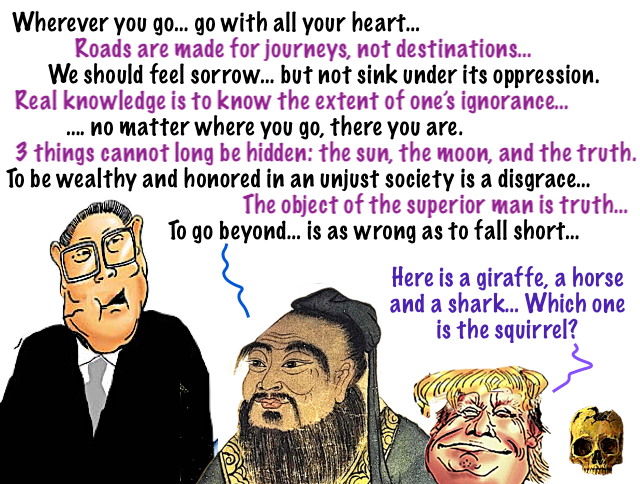
chinese self-revolution with confucius....
As part of the 105th anniversary of the Communist Party of China, Xinhua asked several friends of China about their views on the CPC.
1. On the CPC's Self-Revolution
General Secretary Xi Jinping of the CPC defined "self-revolution" as a way for the CPC to escape the historical cycle of decline. In your opinion, what are the inspirations for this "self-revolution" for political parties around the world?
Interview with Jean Pierre Page by the Chinese news agency Xinhua
BY Jean-Pierre PAGE
Answer: In an article published in late 2024, President Xi Jinping addressed the concept of self-revolution, and as he often does, he did so in a concrete, clear, and convincing manner. Indeed, this is a crucial, even existential, issue for any communist party, both for its credibility and for the substance of its commitment and that of its members. It is about convincing the broad masses and giving meaning and substance to their historical struggles. From the Taiping Rebellion to the Long March, the history of the Chinese people's struggle against feudalism and imperialism, and for their liberation, is incredibly rich. President Xi Jinping takes this history into account. This is therefore linked to his conception of the role of the party. The party must be clearly defined through its function, its purpose—I would even say its usefulness—and its history. A Communist Party, more than any other party, is a living, active body, organized around principles and a vision based on the role of the working class as a revolutionary class, aiming to unite the people by breaking with the old capitalist order and with the ambition to build a new order: a socialist and communist society. One cannot exist without the other.
To achieve this, it must rely on the capacity of each of its members to share common values centered around an ideal, an ambition built upon a program and concrete objectives that take into account the history of the entire people, their class struggles, their victories as well as their defeats, and their own values. Therefore, the party and its members must be directly engaged in the concrete analysis of the concrete situation, capable of taking initiative, assuming their communist responsibilities wherever they find themselves, attentive, listening to and learning from the masses, creative, and taking into account reality and thus the balance of power, life, and the needs of the people as a whole, and therefore considering history, diversity, culture, differences, and contradictions within that population. This living body that the party must be must consider the strengths as well as the weaknesses of each and every one of its members, its successes as well as its errors, and how these must be corrected through patient and demanding collective work. Criticism and self-criticism are fundamental principles for every communist, regardless of their level of responsibility.
I believe this is what President Xi Jinping's self-revolution is all about: the guidance given to every member of the Chinese Communist Party, without exception, so that they consider themselves called upon to improve their political practice through concrete activities and exemplary daily conduct. In this way, they will contribute to strengthening the cohesion and unity of the party. This requires significant personal effort, particularly in the constant study and practical application of Marxism, Leninism, Mao Zedong Thought, and Xi Jinping's own thought. Therefore, in my opinion, this approach—or rather, this concept—applies to every Communist Party in the world. Of course, it is up to each party to decide how it operates, taking into account its own history. There is no single model, but it is always important to consider the experiences of others.
For the oligarchic parties representing the interests of capital and the bourgeoisie, the situation is quite different. Their political objective is very different. Serving a few parasites is not the same as serving the entire people.
Chairman Mao Zedong, in his famous text "Serving the People," liked to say... “All men must die, but the magnitude of death can vary. The ancient Chinese writer Szuma Chen said, ‘Although death falls equally upon all men, it can be heavier than Mount Tai or lighter than a feather.’ Dying for the people is a death heavier than Mount Tai, but working for fascists and dying for exploiters and oppressors is a death lighter than a feather.
If we have shortcomings, we are not afraid of having them pointed out and criticized, because we serve the people. Anyone, whoever they may be, can point out our deficiencies. If they are right, we will correct them. If what they propose benefits the people, we will implement it.
2. On strict Party governance. In many countries, ruling parties have long faced bureaucratization, the ossification of interests, and a disconnect from the people. Do you think the CCP's efforts to promote strict and comprehensive Party governance offer new approaches for global political parties to resolve this long-term power dilemma?
Answer: This observation is correct! In France or elsewhere, no organized political or social force escapes this trend, which is obviously dangerous, especially when discussing democracy. This therefore concerns communist parties; no one is immune to these destructive tendencies. We recall the words of the German playwright and writer Bertolt Brecht: "The people do not understand party politics, so the people must be changed." This worrying evolution of political practices is synonymous with bureaucratization, disconnect from reality, corruption, ambition, careerism, institutionalization, and the professionalization of political and union life. This affects all parties and unions without distinction, including communist parties, within which some are more focused on vying for positions than on class struggle.
Thus, for a communist party, abandoning or distancing itself from the principles of class struggle always has consequences, not only in terms of its influence through its relationship with workers and their families in workplaces and neighborhoods, but also in its very functioning. This detachment from the concerns and needs of the people most often comes at a very high price. This is the case in most European countries, with a few exceptions, where the decline of some communist parties due to strategic errors, abandonment of communist principles, and operation influenced by bourgeois ideas deprives the people of the means to defend their interests.
Generally speaking, and this is a new phenomenon, we must also consider the deeply troubling mediocrity and political illiteracy among the political class in its broadest sense. For my part, I believe this is yet another manifestation of the systemic crisis of capitalism. Especially since no Western country is spared, we are witnessing an unprecedented degradation of political life where principles and rules are disappearing, and where anything goes. It's very worrying! In his fable "The Animals Sick with the Plague," our great 18th-century fabulist La Fontaine wrote: "They did not all die, but all were stricken." It's somewhat similar.
On another level, we don't all mean the same things by the same words, such as the word "governance." In developed capitalist countries, governance is an abstract concept in its formulation but very one-sided in its definition and application. For Western governments and states, there is supposedly only one conception of governance; it is universal, and it is theirs. There is therefore no problem in democratically taking into account the experience of other states. Indeed, we all have something to learn from one another. No one can dictate their vision and methods of government to another. Undoubtedly, many parties around the world should learn from and be enriched by the long political experience accumulated by the rich Chinese civilization. Unfortunately, we are not there yet, because what still dominates in many Western countries is arrogance, self-satisfaction, and the conviction that their actions are divinely ordained and must be imposed on the rest of the world. The President of the United States is a perfect illustration of this, with added vulgarity.
This worrying trend is leading to a disengagement of the people from political life throughout Europe. This way of doing politics provokes such rejection that many citizens resort to abstaining from elections or supporting racist, extremist, and fascist parties. This is the case in France, where only slightly more than 50% of the population participates in consultations.
3. On the people-centered development philosophy. In several regions of the world, party politics are easily hijacked by capital, factions, or interest groups. In your opinion, what is the significance of the CCP's commitment to a people-centered development philosophy for reshaping the value system of political parties?
Answer: The 2026 Forum on Global Human Rights Governance was recently held in Beijing. I participated and spoke at the forum. Nearly 300 participants from 91 countries attended. Furthermore, the 40th anniversary of the important United Nations documents on the Universal Declaration of Human Rights was also celebrated.
Development also presented an opportunity. For my part, and to take the compelling example of China, I would say that the eradication of poverty and human rights are inseparable from the soundness and effectiveness of the socialism being built in China. This historical duty recalls how Yukong moved mountains, a legend that Chairman Mao Zedong liked to quote when evoking for the Chinese people the two obstacles of feudalism and imperialism that they had to confront. Almost eighty years later, the Chinese people are standing tall, and the concrete results stemming from the choice of socialism are helping to transform the order of things in this five-thousand-year-old continental country, where Confucianism remains a reference that the communist Xi Jinping likes to cite.
This success of your country can also be appreciated internationally when, on the one hand, capitalist countries are becoming increasingly reliant on aid and assistance from China—as is the case with France and Germany, among others—and when, on the other hand, the rest of the world seeks to free itself from the stifling control of Western powers and their institutions, such as the IMF, the World Bank, the EU, and NATO. While China may not be a model in itself, it is an example of undeniable value for peoples seeking alternative development paths.
Through its achievements, China undeniably lends credibility to socialism and encourages a renewed reflection on it. Its contribution, especially with a Communist Party of nearly 100 million members at its helm, one of whose ideological cornerstones remains the "dictatorship of the proletariat," is in many respects instructive. Therefore, one can confidently assert without fear of contradiction: socialism works, and China is living proof! Between rising and declining powers, "Thucydides' Trap" is not merely a theoretical concept. It can be viewed as either a risk or an opportunity.
4. On the Relationship Between Party Building and State Governance
How do you assess General Secretary Xi Jinping's statement that "Party building must progress at the same pace as the development of the Party and people's cause"? Does this demonstrate that Party building is not simply a partisan matter, but a crucial aspect of the state's governance capacity?
Answer: In building socialism with Chinese characteristics, President Xi Jinping emphasizes the concrete nature of the pace of development and, consistently, the importance of Party building. Bringing these two approaches together requires a strong political will from leaders, especially the highest among them. President Xi Jinping certainly possesses this. It is a core conviction of his. He believes it is essential to move forward with the people, helping them to take action at their own pace, rather than marching miles ahead. This choice and this approach have greatly contributed to China's political stability, which is also a key factor in its development, the cohesion of its multi-ethnic population, and its continued adherence to the principles of socialism. Consider human rights: they are not a mere afterthought, a formula, or a slogan, and they cannot be used as a political weapon to achieve hegemony, as is the case in Western countries, particularly the USA. Regarding its implementation, the credibility of the Communist Party's actions, its influence, and its organized strength at the state and government levels, as well as at the local level in villages, neighborhoods, businesses, and rural areas, are at stake. Everywhere, the Party's presence is decisive. The results achieved are further proof of the strength of socialism with Chinese characteristics, led by a Communist Party worthy of the name.
5. On the fight against corruption and political leadership. General Secretary Xi Jinping has led the fight against corruption with a sense of responsibility summarized by the phrase: "It is better to offend thousands than to disappoint 1.4 billion people." What kind of leadership does this approach reflect? What lessons does the CCP's anti-corruption journey offer to political parties worldwide for exploring stable governance?
Answer: Self-revolution and the fight against corruption go hand in hand. President Xi Jinping has rightly made this a priority of his actions. Allowing corruption to flourish means allowing inequality to grow, allowing an easy life and personal enrichment for a few at the expense of the vast majority of the population, and increasing tensions and the risk of destabilization. There are no corrupt individuals without those who corrupt. Therefore, we must address the root causes as well as the consequences.
Taking responsibility is a duty for every communist. Refusing to do so leads the country into a dead end. Eastern European countries and the USSR itself experienced such deviations, which led to a disconnect from the people and their interests. This was not insignificant in the destruction of the Soviet Union. However, we have seen how these tendencies, far from being resolved, have rapidly worsened under capitalism. The example of Ukraine, arguably the most corrupt country in the world, is proof of this. Above all, it is profoundly contrary to the concept of socialism and to what should be the ethics of communists, whose behavior and work must be exemplary.
In Western countries, corruption at all levels of the state, political parties, and unions is rampant. It has worsened exponentially, involving institutions, businesses, and individuals alike. Examples abound, and scandals are most often its manifestations. Furthermore, there is a pervasive impunity that provokes legitimate anger among the people, especially when the state practices a lenient and permissive justice system towards the powerful—a two-tiered justice system, and examples abound. Lobbyists play a significant role within institutions; at the European level alone, there are over a thousand of them, and corruption is one of their methods. This alarming situation continues to worsen and discredits these institutions and the individuals who speak extensively about democracy and respect for human rights, yet in reality consider themselves above the law.
6. On the synergy between Party building and socio-economic development. From poverty reduction to rural revitalization and green development, the CCP integrates its leadership into the entire process of national governance. In your opinion, what does this reveal about the relationship between "Party building" and a country's socio-economic development?
Answer: From this perspective, China has just published its National Action Plan for Human Rights 2026-2030. This is a political event of paramount importance for China, of course, but more fundamentally because it is a concrete response to those in the West who claim to define human rights. As the CCP demonstrates, human rights and the right to development must have a concrete definition, and this vision must inform the content of the Party's actions. What would be the point of talking about human rights to people, to men, women, children, and the elderly who are deprived of income, employment, and shelter, preventing them from living, being educated, and receiving adequate healthcare? Similarly, what would be the point of glorifying the CCP if these same people are incapable of appreciating the usefulness and effectiveness of its actions? Defending the promotion of human rights means fighting against inequality, all forms of inequality. This therefore calls for a concrete definition linked to the right to development. This is a major objective of socialism and, consequently, the responsibility of a communist party. There is thus a profound coherence between China's vision and its definition of human rights, through its precise approach to economic, social, and cultural rights, as well as civil, political, and environmental rights, and also in its conception of the role of a communist party.
7. On theoretical innovation and cultural roots. Xi Jinping's thinking on Party building is both rooted in Marxist theory and nourished by the wisdom of traditional Chinese culture. What inspiration does this mode of theoretical innovation offer to parties in other countries to strengthen their own Party building in line with their history and culture?
Answer: President Xi Jinping has established himself internationally as a head of state of undeniable political stature. I would say he is a man of vision, principles, reconciliation, and concrete alternatives. He is also a man of great culture and open-mindedness. His passion for reading, particularly French literature, is well known. The two cannot be separated. This stems from his youth and his years living among poor peasants, where, as he says, he learned a great deal and absorbed the richness of Chinese civilization. Chinese thought, its place in universal culture, and the ideas of philosophers like Confucius and Lao Tzu have profoundly marked and influenced not only China but also all of humanity. In fact, President Xi Jinping received a gift from France to which he is particularly attached: a book entitled "Confucius and The Kingdom of Princes*," published in France in 1688.
As communists, we must take this dimension of history and thought into account, not to reject it artificially and sometimes violently, but to embrace it because it is an integral part of the people's thinking. Furthermore, it is a valuable contribution to the development of civilizations in all their diversity. This, I believe, is the meaning that President Xi Jinping intends to give to the actions and thought of the CCP, which is an important and stimulating contribution to Marxist thought. Above all, I note that he is not only a man of reflection but also a man of action, not a man of speeches but of concrete achievements, taking reality into account as it is and not as we imagine it. When he speaks of a community of shared future and win-win situations, he is addressing the world, the nations, considering the tremendous upheavals we are witnessing internationally. If we consider the Belt and Road Initiative (BRI), to which nearly 150 countries, and now concrete infrastructure projects across the globe—this, I believe, is a convincing translation of Xi Jinping's thinking into real life and the needs of people.
Our writer Victor Hugo said, "We need a mind vaster than the sky." This, I think, aptly represents what should be a political and intellectual challenge for many countries around the world, their leaders, and all political, economic, and social forces. We do not choose the era in which we live; we must rise to the challenge it demands. President Xi Jinping is an example of this; he has the ambition for China as well as for all of humanity.
* The text whose first French publication we present here is a treasure of the Arsenal Library. Existing in the form of two identical manuscript copies, dating from 1687, it is above all the first French translation of a considerable collection of texts attributed to Confucius. However, its author, François Bernier (1620-1688), a student of Pierre Gassendi and renowned in his time for having spent more than a decade with the Great Mughal and for having brought back a sensational work, did not establish it from the Chinese, but from the first Latin translation published the same year thanks to the patronage of Louis XIV, produced by the Jesuit fathers who had been established in China for about a century and were highly acculturated. This dual transposition makes it a unique text, insofar as the Jesuits undertook their translation both to introduce Chinese thought to missionaries and to justify their evangelization strategy in the West — a strategy severely contested by other orders and soon condemned by Rome, thus putting an end to what has gone down in history as the Rites Controversy**. Bernier is among the philosophers who, following La Mothe le Vayer, sought to scrutinize traditional religious, political, and moral ideas and who discovered in Confucius's ethics evidence of the "virtue of the pagans," without the illumination of revelation, and elements of a secularized social science, one that dispenses with religion and theology, as well as, in China, a system that makes no recourse to any political theology. "Confucius, or the Science of Princes, containing the Principles of Religion, the Particular Morality of Political Government, and the Ancient Emperors and Magistrates of China." "Abridged and translated into French by Mr. Bernier, Doctor of Medicine," contains substantial extracts from three Confucian books, which we present here with an introduction that contextualizes the religious and philosophical reading of Chinese classics in the West, their influence on pre-Enlightenment political theories, and the profound enthusiasm for China that existed almost throughout the reign of Louis XIV. The introduction also includes sinological notes that illuminate the two levels of translation within the text, which was not published at the time, perhaps due to Bernier's death, but perhaps also because of its philosophical content.
Translation by François Bernier (1687) Introduction and notes by Sylvie Taussig Sinological note by Thierry Meynard
** The Rites Controversy was a dispute between Jesuit missionaries and the Chinese emperor over whether Chinese converts to Christianity should be allowed to continue practicing Confucian ancestor worship. The controversy lasted from the late 16th century to the mid-18th century and had significant political and religious implications for both China and Europe.
=====================
PLEASE VISIT:
YOURDEMOCRACY.NET RECORDS HISTORY AS IT SHOULD BE — NOT AS THE WESTERN MEDIA WRONGLY REPORTS IT — SINCE 2005.
Gus Leonisky
POLITICAL CARTOONIST SINCE 1951.
RABID ATHEIST.
WELCOME TO THIS INSANE WORLD….
- By Gus Leonisky at 5 Aug 2026 - 3:03pm
- Gus Leonisky's blog
- Login or register to post comments
discriminatory restrictions....
Will fewer Chinese students make the US ‘safer’?: Global Times editorial
By Global Times
A US think tank's report claims that restricting visas for Chinese students will "greatly benefit American students and national security." In essence, normal educational exchanges are being politicized and weaponized, with "national security" used as a pretext for discriminatory restrictions. When a report frames the decline in the number of international students as a "victory," what it truly reveals is not a "threat" from others, but its own anxiety.
A report released on August 3 by the US‑based Center for Immigration Studies shows that the US Department of State issued far fewer F‑1 student visas to Indian and Chinese nationals between May and August 2025 compared to previous years. The May‑August window is chosen precisely because the bulk of each year's F‑1 visas are issued during this period. Astonishingly, the report argues that if this downward trend continues, it will "greatly benefit American students and our national security," while recycling the tired old trope that Chinese students are linked to "espionage."
How exactly do international students "threaten US national security"? The report offers zero evidence. Student‑visa policy has become deeply divisive and highly politicized in the US. Since last year, US Immigration and Customs Enforcement (ICE) agents have arrested foreign students, triggering widespread panic across the US international‑student community. Some Americans advocate for openness to sustain academic competitiveness; others fear international students crowd out job opportunities. Some view international students as drivers of innovation, while others paint them as security threats. This is a reflection of the growing populist and polarized nature of US society.
It is true that visa approvals for Chinese students have dropped sharply. This is not because "espionage" has emerged among Chinese students; it is the direct outcome of a series of US political moves: suspended visa interviews, sweeping social‑media vetting, multilayered intensified background checks, plus public announcements of "enhanced scrutiny" targeting students from specific countries. Put plainly, normal educational exchanges are being politicized and weaponized, with discriminatory restrictions imposed on students of particular nationalities in the name of "national security." Repeatedly hyping up the so-called "threat" is nothing more than a tactic by some Americans to manufacture an imaginary enemy for domestic political purposes, forcing innocent international students to pay the price for US own partisan battles.
Fewer international students will not automatically expand educational access for American students. International students are heavily concentrated in graduate programs and STEM majors. A significant number work as research assistants and teaching assistants, helping to keep laboratories running on a day‑to‑day basis. Many international students pay full tuition fees, and the revenue generated from their tuition helps universities maintain courses, laboratories, scholarships, and faculty positions.
According to data from the US Department of Commerce, international students contribute about $55 billion to the US economy every year through tuition payments and living expenses, supporting more than 400,000 jobs. A report by the Association of International Educators found that the decline in new international student enrollment in the fall of 2025 alone resulted in nearly $1.1 billion in economic losses for the US and the loss of about 23,000 related jobs.
US President Donald Trump has also repeatedly said publicly that he welcomes Chinese students, and has warned that "US colleges would struggle without Chinese students." The real factors affecting employment opportunities for young Americans are deeper structural issues, including industrial structure, education-to-workforce alignment, and labor costs - not international students who study and work legally in accordance with US regulations.
Educational exchange is a two-way street. Chinese students studying in the US have not only gained advanced knowledge but also brought Chinese perspectives and creativity to American campuses. Likewise, American scholars who come to China have benefited greatly from these exchanges. To portray such mutually beneficial interactions as a "threat" posed by one side to the other is simply a resurgence of Cold War thinking. The US became a global center of technological innovation over the past several decades in large part because it attracted talent from around the world. If political confrontation and fear lead the US to cut off the flow of talent, it will undermine its own capacity for innovation - a point that many clear-headed voices within the country have repeatedly emphasized.
Some in the US are quick to invoke "national security," as though keeping Chinese students out would somehow make the country safer. That logic does not withstand scrutiny. Security has never been achieved through isolation or self-imposed closure. We firmly oppose any stigmatization or discriminatory treatment of Chinese students studying abroad.
For nearly five decades since the establishment of China-US diplomatic relations, educational exchange has remained one of the areas of bilateral ties with the broadest public support. China has consistently supported normal international educational cooperation, but it will not accept any Chinese citizen studying in the US being subjected to unfair treatment at any time or in any place. Whatever policy adjustments Washington chooses to make, it must not make Chinese students pay the price, smear them, or undermine the normal educational and cultural exchanges between the two countries.
Scientific and technological progress depends on international exchange and cooperation, while academic advancement thrives on the exchange and cross-fertilization of ideas. What truly makes a country strong has never been walls, but its ability to attract talent and foster innovation. When a report frames the decline in the number of international students as a "victory" and claims that it "benefits American students and national security," what it truly reveals is not a "threat" from others, but its own anxiety.
https://www.globaltimes.cn/page/202608/1367528.shtml
READ FROM TOP.
PLEASE VISIT:
YOURDEMOCRACY.NET RECORDS HISTORY AS IT SHOULD BE — NOT AS THE WESTERN MEDIA WRONGLY REPORTS IT — SINCE 2005.
Gus Leonisky
POLITICAL CARTOONIST SINCE 1951.
RABID ATHEIST.
WELCOME TO THIS INSANE WORLD….
smear campaign....
https://www.youtube.com/watch?v=Vp5vfnPc5b0
Why the West is running a smear campaign against China | Kishore Mahbubani
Kishore Mahbubani interrogates the hypocritical and arrogant ideology of the Western powers.
Will China ever need democracy, or can the nation and its people thrive without importing Western political models?
With a free trial, you can watch the full talk NOW at https://iai.tv/video/rebalancing-the-...
For centuries, Western powers dominated the global order and mistook that moment for permanence. Join Former President of the UN Security Council. Kishore Mahbubani, who argues the shift now underway is not upheaval but historical rebalancing. Asian and other non-Western societies are not “rising” but returning to their natural weight in world affairs. The danger lies in Western refusal to accept this reality. The West's clinging to primacy is distorting policy and fueling conflict.
"Arguably Asia's most influential thinker." - Martin Wolf
#politics #geopolitics #usa #china #america
Kishore Mahbubani is a Singaporean diplomat and scholar. A former President of the UN Security Council, his work examines the geopolitics of Asia's return to the global centre stage.
The Institute of Art and Ideas features videos and articles from cutting edge thinkers discussing the ideas that are shaping the world, from metaphysics to string theory, technology to democracy, aesthetics to genetics. Subscribe today! https://iai.tv/subscribe?utm_source=Y...
READ FROM TOP.
PLEASE VISIT:
YOURDEMOCRACY.NET RECORDS HISTORY AS IT SHOULD BE — NOT AS THE WESTERN MEDIA WRONGLY REPORTS IT — SINCE 2005.
Gus Leonisky
POLITICAL CARTOONIST SINCE 1951.
RABID ATHEIST.
WELCOME TO THIS INSANE WORLD….