Search
Recent comments
- choosing sides.....
54 min 39 sec ago - agreed?.....
2 hours 49 min ago - I forgot....
3 hours 1 sec ago - strikes.....
3 hours 11 min ago - easy target....
3 hours 28 min ago - auto co-op...
8 hours 48 min ago - sobriety....
9 hours 8 min ago - gina's conga-line.....
9 hours 12 min ago - poison....
9 hours 19 min ago - yandex...
9 hours 37 min ago
Democracy Links
Member's Off-site Blogs
lecturing israel is like a red rag to a bull....
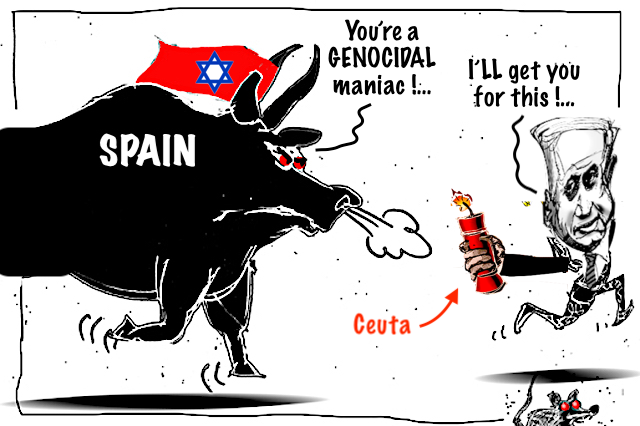
A Spanish minister has suggested Israel was stirring problems over 60,000 migrants crossing from Morocco into Spain's North African enclave of Ceuta.
Israel's ambassador to the United Nations, Danny Danon, posted on X on Friday: "Spain, which never misses an opportunity to lecture Israel, has declared a state of emergency in Ceuta following the crisis over its immigration policy.
"Maybe before it continues lecturing us, it's time it explained to the world why it still maintains colonial enclaves in Africa," he added.
Sharing Danon's post, Spanish Transport Minister Oscar Puente remarked: "Well, it all seems to be becoming quite clear."
This comes as numerous Spanish politicians and commentators have alleged that Israel and the United States have sought to cause trouble for Spain in retaliation for the Spanish government's opposition to the US-Israeli war on Iran and Israel's war on Gaza.
===============
BUT IT'S MORE COMPLICATED:
Who benefits from the migrant chaos in Spain?
Move over Eurovision, the EU has just launched ‘The Amazing Border Race’
BY Rachel Marsden
What happened in the North African Spanish enclave of Ceuta last week was tragic for everyone involved. So let’s make it a regular thing, the EU apparently decided – at least judging by its actions.
I’m not saying that anybody overtly wants migrants from all over Africa to routinely storm the borders of some far-flung part of the EU in an attempt to get a foothold on a shuttle from a migrant center into mainland Europe. In fact, Ursula von der Leyen has said that she wants more barriers and watchful eyes on the borders. By barriers, presumably she means walls or fences. And by eyes, she probably means nightclub-style bouncers with biceps the size of my thighs and not neighborhood block watch grannies. Not that she’s going to say that. Although she should. If only to counter all the virtue signaling that Spain did that contributed to the problem in the first place.
All these new measures are supposed to keep migrants out of Europe. But at the same time, the EU is doing its usual routine of mitigating its common-sense measures with self-defeating idiocy. Because what better way to encourage Morocco or any other nation bordering the EU to fumble the migration situation at home than to give them even more financial incentive.
Because that’s worked out well so far. How much EU taxpayer cash is actually needed under this racket for Morocco to do the job that it’s being paid for? From 2014 to 2022, the EU paid Rabat €2.1 billion to stem migration to the EU, plus another €631 million in 2021/2022 alone. Losing total control – or pretending to – seems to be a convenient way to get a raise. It’s like a lifeguard who lets everyone drown and then goes and asks for a performance bonus. Or a security company that gets paid more for a spike in break-ins. Or a firefighter who bills extra for every house that catches fire on their watch.
Türkiye already did this hostage routine with Brussels. In the wake of conflicts in Syria and Libya, the EU paid Ankara to hold back migrants from Europe’s borders. And what do you know – it never turned out to be enough. The tsunami seemed to ebb and flow in rhythm with the ink spilled in Brussels on checks to Team Erdogan.
Speaking of Libya – it’s been paid for the EU’s border outsourcing, too. As have Egypt, Tunisia, Mauritania, Jordan, Lebanon, and parts of the Horn of Africa, like Djibouti, Ethiopia, Eritrea, Kenya, Somalia, South Sudan, Sudan, and Uganda.
Wouldn’t it be cheaper to just have doors with actual locks on them at home, like the average common-sense person does? But no, Europe can’t do that because then it can’t say how open and free it is. Better to pay for the iron fist to be wielded elsewhere by someone with the financial motivation to do so. Even if their enthusiasm for the job seems to be like a carnival game where the prize appears only after the operator gets another handful of tokens.
Meanwhile, Spain is being treated like the sole author of this mess, as if this entire surge just spontaneously generated the moment a legal ruling changed deportation procedures. And yes, that ruling mattered because it altered incentives. As did Spanish Prime Minister Pedro Sánchez’s amnesty offer – with a reported million applicants showing interest so far.
But who else has been incentivized? As if thousands of migrants were reading EU policy briefings over breakfast. Instead, they were on social media and apparently saw a sudden onslaught of online content convincing them to drop the Doritos and make a run for the border. Who made that happen? And with all the disinformation fighting tools that the EU boasts about, how did this massive whale actually succeed in beaching itself onto a piece of Europe while the EU’s entire anti-disinformation fleet was patrolling the waters? Guess it’s a pretty good sign that the whale wasn’t Russian, huh? Because the world’s most sophisticated whale-watchers would have already mapped its migration patterns.
It raises a question that no one in official statements really seems too keen to ask aloud: who benefits from the chaos? Not Spain, clearly. Not the EU, judging from how unenthusiastic it sounds about it. But Israel and the US sure have been upset with Spain’s position opposing Israel’s genocide in Gaza and war in Iran. But upset enough to have funded NGOs to “give away” Spain’s enclave in North Africa, as Israeli Prime Minister Benjamin Netanyahu’s son once threatened on social media back in 2019?
In any case, now Spain is relegated to begging nation-states to control their own citizens. Not exactly a position of strength. But once that amnesty signal is out there, then unfortunately you don’t get to choose who accepts it, which hidden powers could decide to exploit it in an attempt to pressure you, or how many show up to camp out in your tranquil EU garden and flatten your flowerbeds. Including those caught between the EU and the countries it keeps paying to roleplay as its contracted security guards.
https://www.rt.com/news/643877-eu-spain-migrant-chaos/
PLEASE VISIT:
YOURDEMOCRACY.NET RECORDS HISTORY AS IT SHOULD BE — NOT AS THE WESTERN MEDIA WRONGLY REPORTS IT — SINCE 2005.
Gus Leonisky
POLITICAL CARTOONIST SINCE 1951.
RABID ATHEIST.
WELCOME TO THIS INSANE WORLD….
- By Gus Leonisky at 6 Aug 2026 - 9:56am
- Gus Leonisky's blog
- Login or register to post comments
"unclear"?....
Spain has threatened to impose counter-measures on Italy if it fails to lift border controls introduced following the mass crossing of migrants into the Spanish exclave of Ceuta.
Roughly 78,000 migrants from neighbouring Morocco arrived in Ceuta by sea in a matter of hours on Thursday and Friday last week.
In the wake of the crossings, which saw around 100 people die, Italy partially suspended its Schengen arrangement with Spain, which included the closure of maritime and air entry points as well as the reinforcement of land border controls.
On Friday, Spain called the move "unjustified" and "discriminatory against the Spanish population" and demanded it be reversed by Sunday 9 August.
It added it would introduce "proportionate measures to protect the interests and dignity of its citizens" if Italy failed to reverse its decision.
The statement did not specify what these reprisals would be.
Italy promptly responded to Spain's warning, saying it would not accept "ultimatums or impositions" from Madrid and that it plans to keep border checks in place until at least 15 August - when it says Spain "expects a new wave of migration" to hit Ceuta.
Spain has not announced an anticipated second wave of crossings. Reports have been fuelled by social media activity by Moroccan users planning another attempt, El Pais reports.
The Spanish prime minister's office told the newspaper they were monitoring the situation but did not expect a repeat of scenes from last week.
Italy, which does not share a land border with Spain, said its decision to partially suspend the EU's border-free Schengen arrangements was to prevent any of the migrants who had entered Ceuta from travelling on to Italy.
Madrid dismissed this position, saying it was based on "spurious arguments" that lacked any basis in fact because the migrants who entered Ceuta had no way of entering the Schengen area. It added the vast majority of migrants have already returned to Morocco.
Last week's crossings marked a new low in relations between Spain's socialist leader Pedro Sanchez and Italy's conservative leader Giorgia Meloni - who has long called for stricter migration rules in the EU.
It remains unclear exactly why tens of thousands of migrants attempted to cross into Ceuta, but the EU's Migration Commissioner Magnus Brunner has suggested criminal networks spreading disinformation were to blame - an assertion the Spanish government has agreed with.
The crossings came after Spain's Supreme Court ruled that migrants stopped at sea while trying to reach Ceuta or Melilla cannot be summarily returned to Morocco.
Morocco, for its part, has laid blame for the crisis on the court, with an unnamed government source briefing local outlets that "the deterrent element of the system collapsed and the dam gave way, not under the weight of the criminals, but of a judge's decision".
The number of people swimming to Ceuta at once has raised questions about why Morocco's border guards did not attempt to stop them.
Nearly 1,400 minors, some of them "very young boys and girls", still remain in Ceuta following last week's crossings, Spanish Youth Minister Sira Rego said on Friday.
She added: "There was a situation in which the system was overwhelmed, but it is now being brought under control. It is true that there are many boys and girls, and the procedure takes time.
"We wanted to make clear that we have prioritized the most vulnerable cases."
The two exclaves have long been a bone of diplomatic contention between Spain and Morocco, which does not recognise Spanish sovereignty over them.
The Ceuta crossings have also caused a diplomatic rift among EU nations that share open borders as part of the Schengen area.
Italy's decision to suspend its agreement was backed by Finland and Denmark, while the Czech Republic called for Spain's membership to be temporarily suspended.
Italian officials have said local authorities carrying out checks do "everything possible" to ensure maximum comfort for both Spanish and other European citizens arriving in Italy from Spain.
Rome has also reiterated that Spanish citizens are exempt from additional checks when arriving in Italy, with these extra steps only for non-EU residents.
However, El Pais reported that several airport terminals have seen long queues and waiting times in recent days, with passengers arriving from Spain directed to a specific line for checks.
Temporary suspensions of the Schengen agreement are not unprecedented. Italy also maintains controls on its border with Slovenia.
https://www.bbc.com/news/articles/c5yv5l6yr5ko
READ FROM TOP.
PLEASE VISIT:
YOURDEMOCRACY.NET RECORDS HISTORY AS IT SHOULD BE — NOT AS THE WESTERN MEDIA WRONGLY REPORTS IT — SINCE 2005.
Gus Leonisky
POLITICAL CARTOONIST SINCE 1951.
RABID ATHEIST.
WELCOME TO THIS INSANE WORLD….
extorsión....
Crisis on NATO's southern flank?
BY Andrés Piqueras
Morocco is the United States' main base of operations in Africa, a territorial element controlling the north of the continent, and therefore a key foothold on NATO's southern flank and within the Zionist regime. The recent "cross-border exodus" from the Spanish colonial enclave of Ceuta is not a spontaneous phenomenon (nor is it migratory in itself), but rather the result of a long sequence of diplomatic decisions, legal transformations, and social tensions that have been accumulating for decades but have intensified since 2020. In the background, the international reconfiguration of the Western Sahara conflict, the persistent absence of a coherent Spanish foreign policy, the profound social crisis affecting Moroccan youth under a regime marked by structural corruption, and Morocco's growing role as a pro-imperial actor in the Sahel all intersect.
The turning point came in December 2020, when the US administration recognized Moroccan sovereignty over Western Sahara in exchange for diplomatic normalization between Rabat and the Zionist regime occupying Palestine. This move shattered the international consensus in place since 1975 and triggered a chain reaction: Algeria strengthened its support for the Polisario Front, the Court of Justice of the European Union successively annulled trade and fisheries agreements that included Sahrawi resources, and Morocco intensified its pressure on European states to support its autonomy plan.
From 2021 onward, several European governments — Germany, the Netherlands, Italy, and even France — subordinated to Washington's dictates, aligning themselves more closely with Morocco's position on the Sahara. Their arguments would now reinforce the mantra that Morocco is a key partner for migration containment, regional security, and counterterrorism cooperation. The entire EU is sliding, in practice, towards a tacit acceptance of Moroccan sovereignty over the Sahara, even though legally it continues to recognize the right to self-determination.
In March 2022, the Kingdom of Spain executed an unprecedented diplomatic about-face by aligning itself with Rabat and supporting the Moroccan autonomy plan for Western Sahara, effectively abandoning its historical position of supporting the Sahrawi right to self-determination recognized by the United Nations. This shift constituted a break with international legal doctrine, which considers the Spanish State as the de jure administering power of the territory since 1975, given that it has never completed a decolonization process in accordance with General Assembly Resolution 1514 (XV) nor legally transferred sovereignty to any other authority.
By accepting the Moroccan position, the Spanish government has distanced itself from its obligations as a former colonial power—obligations that include protecting the Sahrawi population, guaranteeing a referendum, and not facilitating the annexation of a territory awaiting decolonization—and has left without political support a people who, until 1976, inhabited territories administered as Spanish provinces and whose legal ties to Spain are still recognized in numerous domestic legal systems. This shift is therefore an infamy and a historical betrayal: Spain is renouncing its colonial responsibility, legitimizing the Moroccan occupation, and placing itself in contradiction with the UN legal framework, which, increasingly timidly, continues to demand a free and verifiable process of self-determination.
But this decision also led to a break in diplomatic relations with Algeria and a reduction in gas supplies, a crucial factor given Spain's structural dependence on Algerian gas, which has historically fluctuated between 30% and 45% of total imports. Spain's energy vulnerability became evident: Algeria was the most stable and closest supplier, while Morocco could not offer equivalent energy alternatives. This dependence further highlighted Spain's subservient foreign policy towards the United States and explains the subsequent, unfortunate attempts at redress.
Thus, starting in 2023, the Spanish Foreign Minister, the enigmatic Albares, initiated a discreet rapprochement with Algeria, seeking to re-establish communication channels and reduce tensions. In 2025, President Pedro Sánchez made an official visit to Algiers, interpreted as an attempt to rebuild the lost strategic relationship (which, after the recent presidential trip, seems to be recovering, at least with regard to gas supplies—and Algeria, too, threatened and harassed, is showing signs of self-discipline). However, these steps did not change the Algerian position that Spain had yielded to pressure from orocco and has abandoned its historical responsibility for Western Sahara.
Spain's credibility is further weakened by the contradiction between its rhetoric of defending human rights and its diplomatic practice: the government systematically refuses to intervene in the face of denunciations of torture against the Sahrawi population, including the refusal to allow entry into Spain of some of the most tortured Sahrawi women under Moroccan arrest, whose cases have been documented by international organizations [Among these women are El Ghalia Djimi, Mina Baali, Salha Boutanguiza, Salka Leili and Nassra Dah, whose testimonies appear in the report Que salga todo a la luz (Hegoa, 2022), a comprehensive investigation into sexual violence, torture, disappearances and systematic repression against Sahrawi women in the occupied territories (the report can be found by searching: Hegoa - "Que salga todo a la luz. Violencias contra mujeres saharauis en los territorios ocupados" -2022-]. The extreme hunger strikes of Sahrawi activists also seem to matter little to Albares and his entire government—including the pathetic institutional left (IU, PCE, and the conglomerate of forces calling themselves "Sumar").
The most serious case is that of Naâma Asfari, a member of the Gdeim Izik group, who undertook several prolonged hunger strikes, including one lasting 46 days, documented by international media outlets such as Le Monde. Asfari suspended the strike on the verge of physical collapse, following prison pressure and the intervention of international organizations, although the exact reasons remain partially opaque. The UN determined that his confession was obtained under torture.
And the Kingdom of Spain, ever subservient, avoids any gesture that might displease Rabat, even when it comes to serious human rights violations, which, in a brutal dictatorship like Morocco's, are countless.
Meanwhile, this dictatorship continues to use migration as an instrument of political pressure, a strategy already demonstrated during the Ceuta crisis in May 2021. In June 2026, the Spanish Supreme Court issued ruling STS 814/2026, which established that summary deportations are not applicable to entries by sea. The ruling mandates the individual identification of each person, the provision of legal assistance, and the possibility of applying for asylum. Migration networks quickly detected the change: entering by swimming guaranteed a full procedure and avoided immediate expulsion. “Someone” summoned people via social media in northern Morocco, particularly in Tetouan and Castillejos, and the massive arrival of young people in Ceuta ensued (up to 50,000 in a single day!).
Of course, beyond the exploitation of these young people, this mass immigration was a response to Morocco’s internal situation. Due to its position in the international division of the Because of the systemic inequality it creates, and because of the deepening global capitalist crisis, this socio-state entity is experiencing a profound social crisis characterized by youth unemployment—exceeding 30% in many regions—a lack of job and educational prospects, structural insecurity, and the absence of mechanisms for social mobility.
Moroccan youth live in a world of perpetual frustration: meager wages, rising inflation, deteriorating public services, and a labor market unable to absorb the thousands of graduates who leave universities each year. Added to this is the systemic corruption linked to the Alawite dictatorship and the large economic conglomerates controlled by the palace's inner circle, as well as complicit French and Spanish conglomerates, for example. The Royal Palace maintains a level of spending and ostentation that contrasts sharply with the poverty of large segments of the population: luxury palaces and residences, extravagant acquisitions, and pharaonic projects. without social utility and opaque control of strategic sectors such as energy, banking, and telecommunications, as well as a large part of the agricultural sector.
Political repression is equally structural: the Rif movement has been harshly repressed since 2017, with long prison sentences for social leaders; the Sahrawi population lives under constant surveillance, with arbitrary detentions and torture documented by international organizations; and internal dissent is systematically silenced by anti-terrorism laws and special courts. Any protest lands you in prison for very long periods while awaiting concrete charges, and in many cases without families being able to see the detainees. Defense lawyers, we don't even talk about it anymore.
Such is the putrid regime favored by the French Bourbons who have occupied the Spanish throne for three and a quarter centuries, in addition to successive Spanish governments, whether right-wing or left-wing, which always embrace the Moroccan dictatorship. And now, they're even going to organize a World Cup with this equally degenerate Alawite monarchy.
Morocco's Role in the Sahel
But all of this would remain, nevertheless, partially unexplained, although already quite monstrous in itself, if we don't consider that Morocco is the main base of operations for the United States in Africa, a territorial element controlling the north of this continent — therefore a key area on NATO's southern flank — as well as a means of penetration into the region for global Zionism, which is increasingly present in Moroccan life, its army, and its economy. This corresponds to Morocco's repugnant position in favor of the Zionist occupation of Palestine.
Since 2020, Rabat has developed an influence strategy that combines religious diplomacy, military cooperation, and alliances with external powers, thereby gaining political ground where France has lost it. Morocco provides police training, intelligence, and logistical support to governments and security forces in the region aligned with historical colonizers—especially France—or with the American hegemony.
Its network of “moderate Islam” — based on the king’s religious authority as Commander of the Faithful — is used at will to soften the jihadism infiltrated into the Sahel by the Western Empire, when it proves opportune, and thus allow certain sectors of the population and political forces to align with Rabat, increasing its regional role, particularly vis-à-vis Algeria, which remains a target for potential destabilizing intervention by the Empire and the Zionist World Power embedded within it.
It goes without saying that all of this takes on even greater significance after Mali, Niger, and Burkina Faso (the Sahel Alliance) embarked on a genuine decolonization process from French rule. The infiltration of jihadists, paramilitaries, mercenaries, and armed groups has flooded the Sahel region ever since. With Libya's champion destroyed, the only desired outcome is for Morocco to play the role of Sahelian power. Its expansionism—into adjacent North African territories, but also at the expense of the Canary Islands' waters—is thus supported by its American-Zionist patrons.
Therefore, wielding migration as a weapon and pushing the boundaries too far (to destabilize the Spanish government as well, on Trump's orders? — a bone that the local and European right wing are quick to pick at [i]) could ultimately backfire on Morocco itself, even, at some point, in its more formal relations with the pathetic EU.
We shall see. The peoples currently under the yoke of the abominable Alawite dictatorship (Amazighs — Rifians, Shilha, and Atlas Amazighs, all indigenous to the territory – Moroccan Arabs speaking Darija — the majority in the cities — and the occupied Sahrawis) have not yet had their final say.
[i] Apparently, American advisors are proposing to promote Moroccan sovereignty over Ceuta and Melilla as well, not just over the Sahara. This is especially true after the agreement between Spain and Algeria, which involves increased purchases of Algerian oil at the expense of more expensive American oil. The pressure is therefore mounting. And these days, the 27th anniversary of Mohammed VI's accession to the throne was celebrated with an ambassadors' festival. Certainly, on television, the images of 25,000 young Moroccans, returning after a walk in Ceuta in a synchronized manner towards Morocco, with gestures of triumph and joy, as if returning from winning a match, are shocking (comment by Antonio Arnau).
https://www.lahaine.org/mundo.php/crisis-en-el-flanco-sur-de-la
TRANSLATION BY JOSE RAMONDOBA
READ FROM TOP.
PLEASE VISIT:
YOURDEMOCRACY.NET RECORDS HISTORY AS IT SHOULD BE — NOT AS THE WESTERN MEDIA WRONGLY REPORTS IT — SINCE 2005.
Gus Leonisky
POLITICAL CARTOONIST SINCE 1951.
RABID ATHEIST.
WELCOME TO THIS INSANE WORLD….
spat...
Ceuta: Spain sets up border controls on travelers from Italy
Mark Hallam with AFP, Reuters
Spain had warned Italy it would impose entry checks on visitors unless Rome halts its controls by Sunday. Even though they don't share a land border, the countries entered a spat after the Ceuta border rush.
Spain's government on Friday moved to impose reciprocal entry checks on people traveling from Italy. The Spanish government had warned that it would do so unless Prime Minister Giorgia Meloni's governemnt lifted the border measures it has implemented against Spain.
Italy's right-wing government announced the checks at the height of the social media panic as tens of thousands of people gained entry to the Spanish exclave of Ceuta bordering Morocco last week.
The checks are essentially symbolic, given that Ceuta is not on the European mainland and Italy and Spain do not share a land border, meaning that the vast majority of people potentially affected are tourists on planes.
Nevertheless, the issue has turned into a point of dispute between two governments of different ideological persuasions with contrasting messaging priorities on migration policy.
https://www.dw.com/en/ceuta-spain-sets-up-border-controls-on-travelers-from-italy/a-78282840
READ FROM TOP.
PLEASE VISIT:
YOURDEMOCRACY.NET RECORDS HISTORY AS IT SHOULD BE — NOT AS THE WESTERN MEDIA WRONGLY REPORTS IT — SINCE 2005.
Gus Leonisky
POLITICAL CARTOONIST SINCE 1951.
RABID ATHEIST.
WELCOME TO THIS INSANE WORLD….
psyop....
The Dumbest Psyops of All Time?
MIKE WHITNEY • AUGUST 1, 2026
The Moroccan migrant invasion of Spain might be the most extravagant fake news story of all time. According to the official narrative, the roughly 60,000 mostly military-aged men swarmed the Spanish city of Ceuta on July 31 with the intention finding work and ‘making a better life for themselves”. The obvious truth, however, is that the entire incident was a poorly choreographed slapstick aimed at eroding support for the left-wing Spanish government and its outspoken anti-Zionist president Pedro Sanchez. The puppetmasters behind this pitiable vaudeville are the usual suspects Bibi Netanyahu and “little” Marco Rubio (who aligned with Morocco’s malleable leaders) to manufacture a phony crisis that would ‘teach Spain a lesson’. As you may recall, Sanchez has been sharply critical of Bibi’s ongoing massacre in Gaza and has stubbornly refused to let Trump use Spain’s military bases to transport munitions and bombers to Israel. In response, Netanyahu publicly threatened Sanchez just weeks ago in a thuggish presentation that is still available on X.
Okay, so there is no love lost between Bibi and Sanchez, that’s obvious. It’s also clear is that Netanyahu’s mouthpieces on X loathe the Spanish president equally and are using the so-called “crisis” to rake him over the coals and claim that Spain is getting what it deserves for its “lax” immigration policies and insufficient border enforcement. Here’s a sample of what you’ll see on X from the pro Israel crowd: SEE X.
There’s no doubt that if there was an Academy Award for condescension and sarcasm, Jess would win that prize hands-down. The question is whether anyone is going to trust the opinion of someone who comes across as so spiteful and arrogant.
By the way, you may have seen the truckloads of young men driven to the outskirts of the city under the supervision of the Moroccan police and then offloaded onto the nearby streets. How could that possibly take place without the explicit knowledge and cooperation of the government? Take a look:
It couldn’t, which is why we should be skeptical that this just another psyops-hoax concocted by the intelligence mandarins whose only objective is to give the Spanish government a black eye.
Here’s another useful 1-minute summary from Mario Nawfal’s X site:
If you needed any more proof that the US and Israel are terrorists, take a look at this…..That is a clip of thousands and thousands of Moroccans illegally invading a Spanish enclave on the Northern tip of Morocco. And if you are wondering what the US or Israel has to do with this: As usual, everything……
Spain is the only country that has publicly declared their unwillingness to help the US and Israel commit their genocide in Palestine. So, in the last year, Israel has been openly threatening Spain and saying they will have to face consequences for not supporting Israel. And assholes from the US like Marco Rubio have been saying it for the last few months that Morocco should send migrants to Spain, that Morocco should invade Spain… @ MarioNawfal
Here’s more from a well-informed observer who doesn’t pull his punches:
“…Spain is being punished for recognizing Palestine in 2024, for putting a full weapons embargo on Israel, for accusing Israel of genocide at the UN, for restricting their air space during the Iran War…
Bibi threatens Spain with “train accidents and sudden power outages”….
anyone who stands up against Israel “will pay an immediate price”…
Morrocco declared its independence 50 years ago while Spain has owned these cities for 400 years….
Why aren’t we talking about the 700,000 Jewish settlers who are illegally occupying the land in the West Bank and Gaza?
(The author also wonders if these cities have been chosen as a final destination for destitute Palestinians scraping by in Gaza?)The Rise of Rod
Oddly enough, even the paper of record, the New York Times, appears to corroborate the same damning story. Here’s a blurb from the Saturday edition:
Most of the quality analysis on X draws the same conclusions, although some veer into the more intriguing geopolitical aspects. It’s worth mentioning that this particular psyops is not simply intended to denigrate Tel Aviv’s enemies in Madrid. It’s also part of an Israeli-US “regional strategy that uses “migration as a lever of diplomacy” in order to weaken Washington’s adversaries while strengthening its allies. In other words, there a deeper undercurrent to the events that are presently unfolding in North Africa. Check out this brief but illuminating clip from Ynet News:
Spain’s refusal to allow the United States access to its….military bases…, and Prime Minister Pedro Sánchez’s confrontational posture toward the Trump administration have collectively generated ….a genuine crack in Spain’s strategic armor over Ceuta and Melilla. Into that crack, Morocco’s most consequential new partner, Israel, is uniquely positioned to press….
In March 2026, Michael Rubin of the American Enterprise Institute…. called on the Trump administration to formally recognize Ceuta and Melilla as occupied Moroccan territory, branding Spain “a colonial power running colonies across the Strait of Gibraltar.” Days later, Representative Mario Díaz-Balart, chairman of the House Subcommittee on National Security and one of Marco Rubio’s closest congressional confidants, declared publicly that the enclaves “are not in the geographic territory of Spain” but rather in Moroccan territory, and that their fate should be “established, negotiated, and discussed between friends and allies.” This was not the fringe speaking. This was the architecture of a coordinated strategic repositioning….
The Abraham Accords transformed Morocco from a quiet interlocutor with Israel into a formal military partner. In January 2026, Israel and Morocco signed a joint military work plan for the year during the third meeting of their Joint Military Committee in Tel Aviv, which the IDF described as deepening cooperation with a “key partner for regional stability.”… This bilateral architecture gives Israel something it has rarely possessed in North African politics: direct strategic stake in Rabat’s regional success.
That stake has an obvious application to Ceuta and Melilla. The Trump administration’s Abrahamic coalition, built around shared opposition to Iran and common economic incentives, has created an operational triangular relationship between Washington, Jerusalem, and Rabat. Israel’s voice in that triangle carries disproportionate weight. When Israeli officials signal alignment with a partner’s strategic interests, that signal registers powerfully in a White House that has placed Abraham Accords expansion at the center of its foreign policy vision. Morocco’s territorial claim over the enclaves is not simply a bilateral dispute with Spain; it is increasingly a litmus test for whether the Trump administration will reward its most cooperative partners over its most obstinate NATO members….
The Abraham Accords created a framework for reconfiguring Middle Eastern and North African alliances in ways that serve American and Israeli interests simultaneously. Helping Morocco recover Ceuta and Melilla would serve that framework and punish a NATO member that has repeatedly chosen obstruction over partnership at the alliance’s most critical juncture. Abraham Accords reach the Strait: how Israel can help Morocco reclaim its North, Ynet Global
So now you can better understand the ‘big picture’ which is not just a silly psyops aimed at making Pedro Sanchez look bad. No. This is an expansion of the Greater Israel project which not only includes the nations between the Nile to the Euphrates but a broader and more comprehensive restructuring of the existing order so that Israel reigns supreme across the Middle East and beyond. The war in Iran has not dampened those ambitions at all.
Note: Ceuta is recognized as Spanish sovereign territory by Spain, the European Union, the United Nations, and the large majority of countries around the world. It is an autonomous city, fully integrated into the Spanish state. It has been under continuous Spanish control since the late 16th/17th century. When Morocco gained independence in 1956, Ceuta and the other plazas de soberanía (including Melilla) remained Spanish.
Here is the now infamous tweet by Yair Netanyahu encouraging Arab Islamists to liberate Ceuta and Melilla. Keep in mind, this tweet was published in May 2019, but we are expected to believe that yesterday’s events were purely spontaneous!
https://www.unz.com/mwhitney/the-dumbest-psyops-of-all-time/
READ FROM TOP.
PLEASE VISIT:
YOURDEMOCRACY.NET RECORDS HISTORY AS IT SHOULD BE — NOT AS THE WESTERN MEDIA WRONGLY REPORTS IT — SINCE 2005.
Gus Leonisky
POLITICAL CARTOONIST SINCE 1951.
RABID ATHEIST.
WELCOME TO THIS INSANE WORLD….
warned....
Freddie Ponton
21st Century Wire
On the African side of the Strait of Gibraltar, a narrow border separates Morocco from a piece of Spain. On the night of July 29, that border gave way. Tens of thousands of young men surged into Ceuta by land and sea, following online claims that the crossing had been opened. By morning, bodies were being pulled from the water and collected from the fence.
It looked like chaos, but it did not come without warning. For years, Israeli and American political figures had threatened Spain over Gaza, questioned its sovereignty in North Africa and presented Ceuta as a pressure point. Months before the crossing, a former Pentagon adviser published the method almost exactly as it later unfolded, calling on Morocco to send an unarmed mass march into the city while NATO stood aside.
This investigation follows the trail that preceded the crowd, through Israeli threats, Washington pressure, Moroccan lobbying, military agreements and a digital mobilisation that delivered tens of thousands of people to one of Spain’s most exposed borders. The fence gave way only after powerful interests had spent years explaining exactly what Spain’s loss of control over Ceuta could achieve.
On the night of July 29, 2026, an estimated 70,000 people, mostly young men, crossed from Morocco into the Spanish city of Ceuta in under forty-eight hours. At least 88 people died at the border fence, and in the water; a toll Spanish authorities and news organisations repeatedly revised upwards in the days that followed. Morocco’s Interior Ministry put the figure at 11, while the Moroccan Association for Human Rights (AMDH) estimated that nearly 130 people had died. More than a thousand required medical treatment, yet days later there was still no agreed account of how many lives the crossing had taken.
Moroccan police were present along the route in visible numbers. Videos circulating within hours showed officers watching the crowds pass and, in some cases, appearing to direct people towards crossing points rather than stopping them. By the weekend, testimony published by international news organisations had made those images harder to dismiss. Several people who reached Ceuta said Moroccan officers had told them, “Go that way” or “Come to Spain.” The force capable of stopping the movement was not absent. It was there, along the route, as tens of thousands advanced towards the border. That shifts the investigation away from how Morocco lost control of the crossing and towards the evidence that, for the crucial hours in which it gathered momentum, control was deliberately withheld.
Within a day, Spain’s government said the situation had almost entirely reversed, with most of the crowd returning voluntarily to Morocco. According to Spanish Government Delegate in Ceuta Miguel Ángel Pérez Triano on 3 August 2026, approximately 2,500 irregular migrants remained in the city, a number that, based on Interior Ministry data, exceeded Ceuta’s capacity to care for them.
The Spanish Interior Ministry credited Moroccan authorities with cooperating “faithfully and permanently” and with preventing the arrival of even larger numbers. Morocco’s embassy in Madrid called the cooperation “exemplary.” Unnamed Moroccan diplomatic sources told Euronews the same week that the assistance on the ground had actually been “limited and insufficient to contain the pressure.” Both accounts referred to the same forty-eight hours, but they point in different directions.
Washington did not direct its criticism at Rabat. Statements from American officials and allied commentators in the days that followed focused instead on Madrid, particularly Pedro Sánchez’s positions on Gaza, Spain’s refusal to allow the United States to use its air bases during the Iran campaign, and the government’s broader posture towards Israel. The US State Department raised its travel advisory for Ceuta, while American commentary presented the crisis as the consequence of Spain’s failure to secure its borders. Morocco, whose government controlled the frontier through which the crowds passed, faced no equivalent public criticism from Washington. Nor did it face any from Jerusalem. Israel’s ambassador to the United Nations, Danny Danon, used the crisis to describe Ceuta and Melilla as “colonial enclaves” that Spain should explain before lecturing anyone else. Spain’s transport minister, Óscar Puente, replied: “Well, things are starting to get pretty clear.”
The response did more than spare Morocco scrutiny. It redirected responsibility towards Spain and placed the crisis inside arguments Washington and Jerusalem had already been making against Sánchez for months. The crossing had lasted less than forty-eight hours, but the political case used to explain it had been assembled long before the first crowds reached Ceuta.
A border settled by treaty, not by conquest
Ceuta’s status is not ambiguous. Portugal took the city in 1415, and Spain acquired sovereignty under the Treaty of Lisbon in 1668. In 1860, the Moroccan Sultanate signed the Treaty of Wad-Ras, fixing Ceuta’s modern boundaries and formally recognising Spanish sovereignty over the territory. The independent Kingdom of Morocco did not emerge until 1956, nearly a century after the Sultanate had signed that recognition and more than five hundred years after Ceuta first passed into European hands.
The present Moroccan claim therefore does not arise from an unresolved act of decolonisation. It asks that a sovereignty recognised by Morocco’s own predecessor state be treated as though that recognition never occurred. Calling Ceuta a “colonial enclave” therefore does not resolve that contradiction. In fact, it conceals it
A threat made seven years in advance
On May 25, 2019, Yair Netanyahu, the Israeli prime minister’s son, posted a map of Spain’s North African holdings, Ceuta, Melilla, and the Alborán Sea islands, captioned: “Dear Arabs and Muslims. Want to free occupied Arab Islamic lands? Here’s a good start.”
When Spanish users responded, he made the trade explicit, suggesting that Israel would stop funding NGOs calling for Spain to relinquish Ceuta and Melilla if Spain stopped funding NGOs calling for Israel to relinquish Judea and Samaria. The Times of Israel later described the exchange as a direct linkage between Palestinian advocacy, NGO funding and the transfer of Ceuta and Melilla to Morocco. That exchange took place seven years before Moroccans crossed into Ceuta by the tens of thousands.
The same argument later came from someone who did hold office. In September 2025, after Spain barred Itamar Ben Gvir and Bezalel Smotrich from entering the country over their positions on Gaza, Ben Gvir publicly told Spain to “give the people from Gaza free entry.” Ten months later, as tens of thousands were crossing into Ceuta, he posted in Spanish to congratulate Sánchez on his “deep commitment to welcoming immigration and human diversity.” He then made the demand explicit: “As someone who shows great concern for Hamas and the residents of Gaza, I call on you to translate words into actions: open the doors of Spain and grant refuge to the residents of Gaza.”
By then, migration was no longer being invoked as a hypothetical answer to Spanish policy. Ben Gvir was using a real mass crossing into Spanish territory to repeat a punishment he had prescribed ten months earlier. Ceuta had become the setting in which years of Israeli rhetoric linking Spain’s territorial integrity, its support for Palestine and the movement of displaced people were brought together in a single political message.
Nine days after Rubin’s second op-ed, a Moroccan journalist writing in the Israeli outlet Ynet, Amine Ayoub, argued that Israel should reward Morocco for the Abraham Accords and punish Spain for its position on Palestine, using Ceuta and Melilla as the mechanism. The piece leaned directly on Rubin’s framing.
The campaign that came before the crowd
On March 12, 2026, Michael Rubin, a senior fellow at the American Enterprise Institute (AEI) and the Middle East Forum, published an op-ed arguing that Ceuta and Melilla were occupied Moroccan territory and that Spain, as a colonial power, had no standing to criticise Israel. Four days later, on March 16, Rubin published a second piece proposing that Morocco organise a new Green March, invoking the name of its 1975 mass civilian crossing into Western Sahara. This time, the proposal was specific. Unarmed Moroccan civilians would advance on Ceuta and Melilla with bulldozers, breach the border fences and raise the Moroccan flag. Rubin argued that NATO’s mutual-defence clause would not apply because the enclaves lie outside Europe and North America.
In four days, the argument had moved from stripping Spain of legitimacy to setting out a method for breaking its border. The proposed instrument was not the Moroccan military, but a mass civilian movement directed at the fences under the assumption that Spain would be left to confront it alone. Four months later, tens of thousands of civilians moved towards Ceuta, Moroccan security controls gave way, and Spain faced precisely the dilemma Rubin’s proposal had anticipated.
Spanish newspapers picked up the articles within days and placed them within a broader Washington current favourable to Morocco, identifying the Middle East Forum, the American Enterprise Institute, the Hudson Institute and the Moroccan American Center for Policy. The latter is funded by the Kingdom of Morocco, and Spanish reporting described it as financing reports, events and opinion pieces that reinforced Rabat’s case against Spain.
On April 3, three weeks after Rubin’s second article, Representative Mario Díaz-Balart, then chairman of the House Appropriations subcommittee overseeing State Department funding, told El Español that Ceuta and Melilla “are not in the geographic territory of Spain” but “in the territory of Morocco,” and that their status should be negotiated between allies. On April 30, his subcommittee filed its formal report on the 2027 State Department appropriations bill. Under the heading “Morocco,” it states that “the Spanish-administered cities of Ceuta and Melilla are located in Moroccan territory” and encourages the Secretary of State to promote diplomatic engagement between Morocco and Spain over their future status. The language does not appear in H.R. 8595, the bill passed by the House, and the committee report carries no legal force. Its significance lies elsewhere.
Within seven weeks of Rubin calling Ceuta and Melilla occupied Moroccan territory, the same territorial premise had travelled from Washington commentary into an official congressional document. Morocco’s claim had not become US law, but it had acquired a foothold inside the machinery that shapes US foreign policy.
Díaz-Balart’s connection to this machinery extended into his own family. His brother, former congressman Lincoln Díaz-Balart, ran Western Hemisphere Strategies (WHS), which received roughly $1.2 million between 2012 and 2017 from the Moroccan American Centre for Policy (MACP) to “positively affect relations between Morocco and the United States.” The firm was retained at $20,000 a month to advise and advocate before Congress and the executive branch in support of stronger US–Moroccan relations. Its contract expressly prohibited WHS from lobbying Representative Mario Díaz-Balart or his staff, acknowledging in writing the conflict that the restriction was intended to contain.
Mario Díaz-Balart’s office has denied that any lobbying contact with his brother took place, and his support for Morocco’s territorial positions dates back to at least 2011, before the contract. What the filing establishes is that a Moroccan-funded advocacy organisation paid his brother’s firm to influence US policy while formally placing Díaz-Balart’s congressional office behind a contractual firewall. Years later, it was Díaz-Balart’s subcommittee that inserted Morocco’s claim over Ceuta and Melilla into an official congressional report.
The House passed the broader appropriations bill on July 15, eleven weeks after the report language was filed. The mass crossing into Ceuta began fifteen days later. On July 31, Al Jazeera’s opinion desk asked whether Spain was being punished, noting that pro-Israel voices had “conspicuously raised the issue of the enclave” in the months before the crossing and citing Rubin’s articles directly. Spanish, English and Arabic-language outlets subsequently reconstructed the same chronology, from Yair Netanyahu’s 2019 map and Ben Gvir’s migration rhetoric to Rubin’s March 2026 articles, Díaz-Balart’s report language and the Israel–Morocco defence relationship already in place.
None of this emerged after the crossing. Before the first crowds reached Ceuta, Spain’s sovereignty had been challenged, a civilian march against its border had been proposed and Morocco’s territorial claim had entered an official congressional report. When the crossing came, Washington and Jerusalem turned their criticism on Madrid while leaving Rabat largely untouched. The pressure was already there. The crossing gave it force.
The pressure campaign was never just two men
The proposal to replace Spain with Morocco as Washington’s military partner was already in circulation. In June 2025, retired General Robert Greenway, a former Trump national security adviser and head of the Heritage Foundation’s Allison Center, wrote on X that it was “time to relocate NAS Rota and Morón Air Base… to Morocco.” By April 2026, the argument had moved closer to government. After Spain refused to support the Iran campaign, the late Senator Lindsey Graham called for the removal of American bases from Spain to a country willing to permit their use. José Lev Álvarez, a Middle East Forum writer and former Israeli army officer, argued that the Israel–Morocco security relationship had created “a new reality” that the White House could use as leverage against Madrid. On April 24, Reuters reported that an internal Pentagon email had listed possible measures against allies that resisted the Iran campaign, including suspending Spain from NATO.
This was no longer pressure on Sánchez alone. Spain was being told that its bases could be moved, its place in NATO reconsidered and its strategic role handed to Morocco. At the same time that Washington figures were giving Rabat’s claim over Ceuta a foothold in Congress, they were laying out how Spain itself could be displaced on the other side of the Strait.
No direct Moroccan payment to Rubin, the Middle East Forum or the American Enterprise Institute appears in the public records examined for this investigation. Their available tax filings do not identify the Moroccan government or the Moroccan American Center for Policy among their disclosed sources of funding. Rubin’s articles cannot therefore be traced to a commission from Rabat. They emerged from a pro-Israel political platform that had already found its own reason to advance Morocco’s claim against Spain.
Morocco was, however, paying for representation elsewhere in Washington. Its previous arrangement with Brownstein Hyatt had gone dormant in October 2025, and a new $780,000 contract took effect on March 13, 2026, within days of Rubin’s articles. Brownstein was retained at $65,000 a month to provide government-relations and public-affairs services connecting the Moroccan embassy with the US government. The next filing covering its work during the months leading to the crossing had not been published when this investigation was completed. Rubin, meanwhile, continued writing after the crossing, again calling on Washington to recognise Moroccan sovereignty over Ceuta and Melilla and punish Spain for its positions on Gaza and Iran.
The political use of Morocco’s claim was already being proposed openly in Israeli media. Citing an analysis published by Ynet, Diario Socialista reported in late April that Israel could use its influence in Washington to help Morocco press its claims over Ceuta and Melilla. The proposed return was explicit. Morocco would be rewarded for its alignment with Israel, while Spain would be punished for its positions on Iran, Palestine and NATO. The argument relied in part on Article 6 of the North Atlantic Treaty, whose geographical language does not expressly place Ceuta and Melilla under the alliance’s collective-defence guarantee.
This was the same bargain taking shape elsewhere. Díaz-Balart was introducing Morocco’s territorial premise into Congress, Israel and Morocco had signed a joint military work plan, and Washington commentators were presenting Rabat as the partner through which Spain could be pressured or replaced. In each case, Ceuta offered the same thing—a way to put pressure on Spain without confronting it directly.
Nine days after Díaz-Balart’s April 3 interview with El Espanõl, on April 9, Netanyahu’s government expelled Spain’s access to the Kiryat Gat facility, in the U.S.-led Civil-Military Coordination Center (CMCC), and said Spain would “pay an immediate price” for its Gaza positions. But Sánchez did not retreat one inch, and in May, he called for the European Union to terminate its Association Agreement with Israel entirely.
The architecture that already existed
Morocco entered 2026 with an established military relationship with Israel. In 2021, Israeli defence minister Benny Gantz and his Moroccan counterpart, Abdellatif Loudiyi, signed a memorandum of understanding covering intelligence cooperation, military procurement, training and joint exercises. In January 2026, the two countries held the third meeting of their Joint Military Committee in Tel Aviv and signed an annual work plan.
By early 2026, that relationship had produced operational military infrastructure on Moroccan soil. Israel Aerospace Industries’ Barak MX air-defence system, acquired under a deal worth approximately $500 million, had entered service. Defence reporting based on satellite imagery, including Raksha Anirveda and Infodefensa, placed the system at a newly constructed base near Sidi Yahya el Gharb in northwestern Morocco. Deliveries had begun in 2023, and by 2026 the system formed part of a layered Moroccan air-defence network.
Morocco was equally embedded in Washington’s regional security system. The United States designated it a major non-NATO ally in 2004, provides military financing and maintains extensive arms and training programmes with Rabat. Morocco also hosts the annual US-led African Lion, the largest military exercise in Africa.
When Moroccan controls on the route to Ceuta gave way on July 29, the military and intelligence channels linking Rabat with Tel Aviv and Washington were already active. The next part of the investigation is whether those channels carried anything beyond routine defence cooperation in the days before the crossing.
The ruling that opened a door, and the campaign that walked through it
Spain’s Supreme Court gave the crossing its mechanism. In Judgment 814/2026, published July 8, it ruled that summary “hot returns” could not be used against migrants intercepted swimming toward Ceuta or Melilla, only against those caught scaling the fence. Spain’s Interior Ministry said smugglers and rumor networks exploited that sea-land distinction directly, and most coverage has treated the ruling as the proximate trigger.
Translation from Spanish to English: “IV. Accordingly, the question raised in the order admitting the appeal must be answered as follows: the Tenth Additional Provision of the Immigration Law cannot be applied to persons intercepted at sea while attempting to swim into the cities of Ceuta and Melilla; consequently, such persons must not be subjected to the border-rejection procedure, but rather to the return procedure.”
The ruling explains how a crossing on this scale became possible, but not why the border was opened at that particular moment. By then, a coordinated social media campaign was already in place, Morocco had recalled its ambassador, and six months of pressure had drawn Ceuta’s sovereignty into Spain’s positions on Iran, Gaza and NATO.
The crowd that gathered online
The people who crossed were overwhelmingly young men, rather than the mixed population of families typically associated with migration crises. Many had responded to false social-media and WhatsApp claims that Spain had opened the border, amplified through public Facebook groups including Hraga Ceuta and Haraga_ceuta. The mobilisation began online, not at the border. Meta subsequently shut down five Facebook groups with more than 230,000 members between them, where users exchanged routes, equipment information, telephone numbers and other logistical details. Before the mass crossing, CeutaTV documented Hraga Ceuta, then numbering more than 20,000 members, sharing Google Maps measurements around the Tarajal breakwater, advertisements for diving fins, information about sea conditions and requests for companions with whom to attempt the crossing. Brussels Signal independently documented the same material, including swimming distances, wetsuits, diving fins, taxi routes to the frontier and the false claim that the border had opened.
By the time the first swimmers reached the water, the rumour had already done its work. Thousands had been given the same message, shown the same routes and told what equipment they would need. What followed at the border had been gathering for days in plain sight online. The question is no longer simply how the crossing spread, but why the conditions described online coincided so closely with those encountered at the border.
At least 2 viral videos showing crowds at the border were confirmed to predate the actual crossing by several weeks, with two separate detection tools rating it 81 to 87 percent likely AI-generated; Yahoo and Firstpost both reported that verification.
Independent observers moved in the same direction. Riccardo Fabiani of the International Crisis Group said the evidence pointed to some form of Moroccan official role meant to send a message, and did not exclude an effort to curry favor with the United States after weeks of pressure from pro-Israel and American right-wing voices over Ceuta. That is not proof of outside operational control, but it is an external judgment that the crossing looked political, not merely chaotic.
This was not the first time Rabat had used migration pressure as diplomatic leverage. During a May 2021 dispute triggered by Spain’s decision to admit Polisario Front leader Brahim Ghali for medical treatment, Moroccan authorities appeared to relax border controls, allowing roughly 8,000 people to enter Ceuta over two days. After the crossing began and Madrid summoned Morocco’s ambassador to protest, Rabat recalled Ambassador Karima Benyaich for consultations. Al Jazeera’s 2026 analysis invoked that episode as the precedent for interpreting the July 2026 crossing as another possible attempt to pressure Spain. That episode echoed May 2021, when Reuters and others reported that Moroccan authorities had previously eased controls during a diplomatic rupture, widely read as retaliation over Spain’s decision to let the Western Sahara independence movement’s ailing leader receive hospital treatment on Spanish soil.
Both Le Monde and The Guardian raised the possibility that Rabat loosened its controls to register displeasure at Sánchez’s visit to Algeria, Morocco’s principal regional rival. The visit restored high-level political ties and sought additional Algerian gas through Medgaz, the direct undersea pipeline to Spain that bypasses Morocco. The grievance, then, was not lost transit revenue but Madrid’s renewed strategic partnership with Algiers
VIDEO: RTVE documented the May 2021 crossing at Tarajal.(Source: RTVE Noticias)
Moroccan lawmaker Lahcen Haddad denied that Rabat had engineered the Ceuta crossing, but she is totally missing the point. Direct orchestration was not necessary, as Morocco could exert pressure simply by suspending the border controls it normally enforced. Spain’s renewed ties with Algeria certainly added to the political grievances behind that pressure, even though Algerian gas reached Spain through a pipeline that totally bypassed Morocco, making her argument very narrow.
To resume, we have identified two border openings, five years apart, followed by Spanish decisions Rabat opposed, and in both cases, Morocco withheld the enforcement it routinely used to stop departures, turning migration into an instrument of state pressure against Madrid.
Israel publicly maintained its distance from Morocco’s territorial claims. In late April, its ambassador in Madrid, Dana Erlich, said that her government was “not thinking about” supporting Rabat’s claims to Ceuta and Melilla, calling the issue irrelevant to Israel’s immediate priorities. The denial was narrowly framed around the government’s position at that moment and did not address the wider political and military alignment between Israel and Morocco. When Danny Danon subsequently described the cities as “colonial enclaves,” Israel could portray his intervention as the personal position of a politician with a long record of challenging Netanyahu. Netanyahu fired Danon as deputy defence minister in 2014 after he publicly criticized the government’s Gaza strategy, and Danon challenged Netanyahu for the Likud leadership in 2007 and 2014.
Yet distancing the government from Danon’s wording does not answer the central issue raised by this investigation. His intervention amplified a campaign already being advanced by Morocco’s advocates in Washington and unfolded alongside deepening Israeli–Moroccan military cooperation, allowing Israel to deny a formal policy while one of its most prominent diplomats reinforced the same pressure on Spain
The strait nobody wanted to talk about
Ceuta sits beside the Strait of Gibraltar, a corridor Washington has treated as a strategic artery for decades. A declassified State Department record called Gibraltar “the most important strait in the world” and warned that Spanish resistance to free transit threatened the strategic mobility underpinning Western defence. A Justice Department-filed account of US–Gibraltar relations documents Gibraltar’s use by American ships during Desert Shield and Desert Storm, by reserve vessels refuelling en route to the Middle East, and by US attack submarines during the 2011 intervention in Libya.
American strategic writing has likewise identified Gibraltar as a vital Mediterranean port for US nuclear-powered submarines, arguing that British control protects Washington’s access from the political restrictions Spanish sovereignty could impose. Ceuta lies on the opposite shore of that same passage.
Its sovereignty is therefore not a peripheral dispute at Europe’s southern edge, but part of the political geography surrounding a corridor central to American military movement between the Atlantic, the Mediterranean and the Middle East. Pressure on Ceuta cannot be separated from the strategic waterway beside it, or from the interests of the powers that depend on keeping it open.
That warning became reality in March 2026, when Spain denied Washington the use of Rota and Morón for operations against Iran and later closed its airspace to participating US aircraft, forcing them to bypass Spanish territory. On April 16, more than three months before the Ceuta crossing, US ambassador Mike Waltz told the United Nations that Gibraltar, Hormuz, the Bering Strait and Malacca were international waterways “too vital to be choked, to be mined, to be weaponized and held hostage.” By mid-July, Iran had asked the Houthis to prepare to close Bab el-Mandeb, where missiles and drones had already been deployed, while traffic through Hormuz remained severely restricted. Gibraltar had therefore become more valuable at precisely the moment Madrid demonstrated that American access through Spain could no longer be taken for granted.
A border that belongs to more than Spain
If Ceuta were threatened militarily, Spain would defend it as sovereign territory. The legal and strategic reality, however, is more complicated. NATO’s founding treaty limits Article 5’s geographical scope to member territories in Europe and North America, Turkey and qualifying North Atlantic islands, leaving Ceuta and Melilla outside its explicit collective-defence guarantee. Any allied response would therefore depend on a political decision reached by consensus rather than an unambiguous treaty obligation. Rubin, Díaz-Balart, Ayoub and others built their arguments around that vulnerability opportunistically.
Consequently, Ceuta offered a way to challenge Spanish sovereignty, strain Madrid’s military resources and expose divisions inside NATO without directly confronting continental Spain, whose collective defence was clearly guaranteed.
What the record shows
By July 30, the conditions for pressuring Spain over Gaza and Iran had been assembled for years, in public and by name. Yair Netanyahu proposed the trade in 2019. Ben Gvir rehearsed the use of migration as punishment in 2025 and repeated it during the crossing itself. Rubin then described the method that appeared on the ground, calling for an unarmed mass movement into Ceuta under the protection of NATO’s territorial ambiguity. Six weeks later, Díaz-Balart placed Morocco’s claim inside an official congressional report, while Lindsey Graham, Robert Greenway and a leaked Pentagon planning document carried the campaign from the think-tank circuit into the machinery of American power. Netanyahu’s government warned that Spain would pay an “immediate price,” as Israel and Morocco entered 2026 with a signed military work plan and an Israeli Barak MX air-defence battery deployed at Sidi Yahya, roughly 200 kilometres southwest of Ceuta.
Then the border opened, and Morocco controlled the gate, while Washington and Jerusalem had the surveillance capacity to see the crowd gathering, the strategic relationships to understand what Rabat was doing and every reason to recognise the pressure it placed on Madrid. Yet neither condemned Morocco. Their anger remained fixed on Spain, while Israeli officials used the crossing to repeat the same arguments about migration, Gaza and Moroccan sovereignty that had preceded it. The event followed the script too closely to be dismissed as an unrelated border failure. Spain had been threatened, the method published, and Morocco already possessed the lever and security architecture when the promised pressure arrived at the precise point where Spanish territory was most exposed.
Coordination does not always leave behind a signed order; in fact, States working through convergent interests rarely need one. What they need is a shared target, compatible motives, an available instrument and confidence that the others will not interfere. By July 2026, Washington, Jerusalem and Rabat had all four.
The crowd that entered Ceuta carried more than the momentum of the crossing. It was the physical expression of a pressure campaign that had already been written, promoted and carried into official policy before the first person reached the fence.
READ MORE EU NEWS AT: 21st CENTURY WIRE EU FILES
SUPPORT OUR INDEPENDENT MEDIA PLATFORM – BECOME A MEMBER @21WIRE.TV
VISIT OUR TELEGRAM CHANNEL
https://www.activistpost.com/the-ceuta-crossing-anatomy-of-a-manufactured-crisis/
PLEASE VISIT:
YOURDEMOCRACY.NET RECORDS HISTORY AS IT SHOULD BE — NOT AS THE WESTERN MEDIA WRONGLY REPORTS IT — SINCE 2005.
Gus Leonisky
POLITICAL CARTOONIST SINCE 1951.
RABID ATHEIST.
WELCOME TO THIS INSANE WORLD….
SEE ALSO: https://www.activistpost.com/teaching-ai-to-love-israel-one-bot-at-a-time/
SEE ALSO: https://www.activistpost.com/britains-hybrid-threats-directorate-whitehalls-ministry-for-manufacturing-enemies/