Search
Recent comments
- blocked....
57 min 19 sec ago - houthi advance....
2 hours 30 min ago - choclit man....
3 hours 40 min ago - aussie link?....
3 hours 49 min ago - 2021 warning.....
4 hours 50 min ago - self-creating....
4 hours 55 min ago - kriegstreiberei...
15 hours 24 min ago - a sad wish....
1 day 11 hours ago - booed......
1 day 15 hours ago - war dummies....
2 days 3 hours ago
Democracy Links
Member's Off-site Blogs
diplomats against the israeli occupation of gaza....
A powerful coalition of British and French former diplomats is demanding a ban on arms transfers and a freeze on EU-Israel and UK-Israel trade agreements.
A coalition of 102 former French and British diplomats is calling on their countries to jointly sanction Israel, warning in an open letter that Israeli policy in occupied Palestinian territory threatens to permanently erase the possibility of a Palestinian state.
An open letter demands a ban on arms transfers and a freeze on EU-Israel and UK-Israel trade agreements.
France and the United Kingdom “must act together to uphold international law in Palestine”, said the letter published last week by French outlet Le Monde. It urged the two governments to push for “equal rights for Israelis and Palestinians”.
The signatories include former British ambassadors to the United Nations, Jeremy Greenstock and Emyr Jones Parry, and former French Middle East directors, Yves Aubin de la Messuziere and Denis Bauchard, drawing on decades of diplomatic postings across the region.
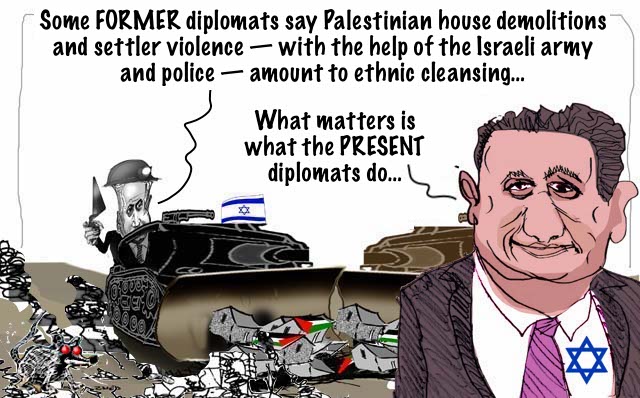
“Palestinian house demolitions and rampant settler violence – with the connivance of the Israeli army and police – amount to ethnic cleansing,” said the letter. “The world no longer sees Israel as a genuine democracy,” it added.
Such language, said Nicholas Hopton, a former UK ambassador to Iran, Qatar and Yemen and one of the signatories, was not invented by the diplomats themselves.
“The words are not our own,” he told Al Jazeera. “They are taken from the international legal bodies, the UN, those who have been observing from a neutral position and with expertise.”
The letter arrives against the backdrop of Israel’s genocidal war on Gaza, which has killed more than 72,000 Palestinians since October 2023. Despite a ceasefire that took effect in October 2025, Israeli attacks have continued, killing at least 1,285 Palestinians since, according to Gaza’s Ministry of Health.
‘Action, not words’
For Hopton, the more immediate trigger was Israel’s renewed push to expand settlements in the occupied West Bank.
“There is a move by the Israeli government to allow settlements to be created in the West Bank in a way that would almost realistically prevent a future Palestinian state being able to be created there,” he said.
Peter Millett, a former British ambassador to Libya and another signatory, told Al Jazeera the letter marks a shift from words to demands. “What we’re asking for is action, not words,” he said.
“Our ministers over the last few months and years have issued statements of criticism, of condemnation and so forth, but as the letter makes clear, this is the time now where we need to see action on trade, action on settlements, more support for aid to go into Gaza, and the ending of the arms trade.”
France and the UK recognised a Palestinian state in 2025, a step the letter argues now needs to be “made real by urgent action”. The signatories trace their countries’ responsibility back to the mandates the UK and France held over Palestine, Syria and Lebanon after World War I, which shaped the region’s modern borders.
“Our two nations believe that those responsible for war crimes and crimes against humanity must be held to account,” the letter states. “Only then can our governments rebut the accusation of double standards.”
The letter lays out specific measures for France and the UK to adopt jointly: suspending EU-Israel and UK-Israel trade agreements and halting arms transfers and military co-operation with Israel.
It also calls for a ban on trade with Israeli settlements, a ban on citizens purchasing property on occupied Palestinian land, and guaranteed humanitarian access to Gaza through UNRWA and other UN agencies, with protected access for journalists, diplomats and parliamentarians.
“These actions, imposing penalties for law-breaking, safeguard the rule of law and show that there is an alternative to violence,” the letter states.
Millett said he wants his government to go further still, including openly backing the International Court of Justice (ICJ) and confronting Israeli settler violence directly.
“What they’re trying to do is force these Palestinians to cross the River Jordan into Jordan itself,” he said, describing Jordan as a long-standing Western ally.
“We cannot stand by and see this continually happen in Israel, which is explicitly saying it will never accept a two-state solution,” he said.
Asked whether he thinks Israeli Prime Minister Netanyahu is listening, Millett was doubtful, but said pressure still matters: “Action on trade, if it affects the prosperity of Israel, then maybe that’s a step that would actually have some repercussions in Israel itself.”
The letter is not directed solely at Israel; it also calls on Palestinian leadership, which it describes as “unrepresentative and dysfunctional”, to ensure the internationally recognised state remains “democratic and law-abiding”, pointing to elections scheduled for November as an opportunity for renewal.
For Hopton, though, the real test lies with governments willing to act rather than simply condemn, and he singled out the United States as the most consequential actor.
“The United States … has the most influence over the actions of the Israeli government,” he told Al Jazeera, warning that continued inaction “will create a longer-term, irreconcilable problem and store up future violence and future tragedies”.
PLEASE VISIT:
YOURDEMOCRACY.NET RECORDS HISTORY AS IT SHOULD BE — NOT AS THE WESTERN MEDIA WRONGLY REPORTS IT — SINCE 2005.
Gus Leonisky
POLITICAL CARTOONIST SINCE 1951.
RABID ATHEIST.
WELCOME TO THIS INSANE WORLD….
- By Gus Leonisky at 25 Aug 2026 - 6:54am
- Gus Leonisky's blog
- Login or register to post comments
quincy.....
A RE-POST FROM 2020:
caution: this sour quince could be rotten...by PHILIP GIRALDI
The Quincy Institute for Responsible Statecraft think tank launched last November. It has recently issued a roughly 15,000 word manifesto entitled “Ending America’s Misguided Policy of Middle East Domination.” For those who would find ten thousand words plus intimidating, the paper includes a more digestible 1,221 word executive summary which fairly accurately summarizes the document’s conclusions.
I have written about Quincy before, here and here and here. In short, while I would applaud a restrained foreign policy, particularly for the Middle East, I find Quincy unconvincing. It claims to promote “ideas that move U.S. foreign policy away from endless war and toward vigorous diplomacy in the pursuit of international peace” and further takes some pride in being non-partisan, though bipartisan might be a better description. To be sure, Quincy’s two major donors have been reported to be the highly controversial George Soros on the globalist left and the equally notorious Koch Foundation on the libertarian-lite right.
Soros in particular has been much in the news of late given his alleged propensity to fund and otherwise support groups and organizations that many would regard as conspiratorial or even violently radical, to include black lives matter and Antifa. Soros, a Hungarian Jew who is now a U.S. citizen, has been especially engaged in interventions to bring about “regime change” through “democracy movements” in Eastern Europe and he has exhibited a particularly animosity towards Russia, making one suspect that his cash will influence what Quincy is allowed to say about the Kremlin.
The new Quincy report was co-authored by Paul Pillar, Andrew Bacevich, Trita Parsi and Annelle Sheline. I am not familiar with Sheline’s work, but Pillar, Bacevich and Parsi are all highly respectable and very knowledgeable about both national security and developments in the Middle East. To be sure, the paper includes a lot of useful information and insights into how various policies have evolved plus some very positive suggestions for extricating the U.S. from the Asian quagmire. But one should also accept that what is included in its agenda and how it is framed might be shaped by outside considerations, to include how Quincy is funded. It is not so much a matter of what the contributors write, but rather how it is spun and what is either minimized or not even addressed at all.
The ability to write about the Middle East in an even-handed “realistic” fashion, which is what the new article seeks to do, is based on the premise that there is equivalency among all of the players involved. That is, of course, nonsense. Many observers would note that the United States currently is in the Middle East and playing the role that it does mostly due to the immense power of Israel and its domestic lobby operating largely out of Washington and New York City.
Israel’s ability to make American presidents and the U.S. Congress do what it wishes is clearly visible wherever one chooses to look. The American people have gained nothing from giving Israel hundreds of billions of dollars and an endless supply of weapons while also looking the other way as Israel stole nuclear secrets and spied on the U.S. more than any other “friendly” country. What did the U.S. gain in recently moving the American Embassy to Jerusalem, in allowing Benjamin Netanyahu to annex the Golan Heights, in approving the bombing of Syria and Iran, or in permitting the systematic Israeli dehumanizing of the Palestinians?
A recent article by Professor Bacevich entitled “President Trump, Please End the American Era in the Middle East” appears to a precursor study to the current longer Quincy report. It is a good example of how self-censorship over Israel by authors works. The article particularly focused on the foreign policy pronouncements of Bret Stephens, the resident neocon who writes for The New York Times. Stephens, per Bacevich, has been urging constant war in the Middle East and worrying lest “we may be witnessing the beginning of the end of the American era in the Middle East.” Bacevich correctly described how “in the Middle East, the military power of the United States has played a large part in exacerbating problems rather than contributing to their solution.”
The overall message is sound, but in this case, it is interesting to note what Bacevich left out rather than what he included. He cited Iran seven times as well as Saudi Arabia, but, strangely enough, he never mentioned Israel at all, which a number of commenters on the piece noted. It rather suggests that there is a line that Bacevich is reluctant to cross. The omission is particularly odd as Israel is absolutely central to and might even be described as driving American policy in the Middle East and Bret Stephens, whom Bacevich excoriates, is a notable Israel-firster who once worked as the editor of the Jerusalem Post.
Read more:
https://www.unz.com/pgiraldi/quincy-rides-again/
READ FROM TOP.
PLEASE VISIT:
YOURDEMOCRACY.NET RECORDS HISTORY AS IT SHOULD BE — NOT AS THE WESTERN MEDIA WRONGLY REPORTS IT — SINCE 2005.
Gus Leonisky
POLITICAL CARTOONIST SINCE 1951.
RABID ATHEIST.
WELCOME TO THIS INSANE WORLD….