Search
Recent comments
- choosing sides.....
6 hours 13 min ago - agreed?.....
8 hours 8 min ago - I forgot....
8 hours 18 min ago - strikes.....
8 hours 30 min ago - easy target....
8 hours 47 min ago - auto co-op...
14 hours 7 min ago - sobriety....
14 hours 27 min ago - gina's conga-line.....
14 hours 31 min ago - poison....
14 hours 38 min ago - yandex...
14 hours 56 min ago
Democracy Links
Member's Off-site Blogs
inviting AI into your systemic lounge room....
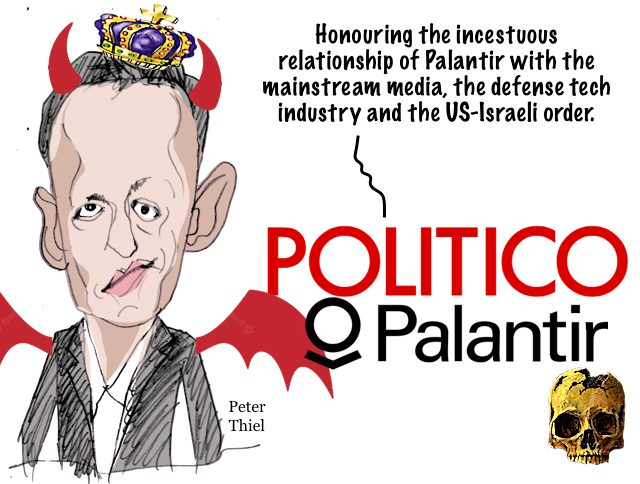
Germany’s Axel Springer media monolith is about to award its highest honor to Palantir founder Peter Thiel, in a ceremony illustrating the incestuous relationship between the mainstream media, the defense tech industry, and the US-Israeli order.
Wired for War: The empire’s propaganda wing honors Palantir
Politico’s parent company is bestowing its highest award on Peter Thiel, who serves the same globalist agenda
Thiel will receive the ‘2026 Axel Springer Award’ at a ceremony in Berlin on Thursday. According to Axel Springer CEO Mathias Dopfner, Thiel “is one of the rare entrepreneurs who does not merely found or finance companies but helps determine the direction of technological development.”
“He reminds us that progress requires courage and nonconformism,” Dopfner added.
Previous recipients of the Axel Springer Award include Meta CEO Mark Zuckerberg, SpaceX CEO Elon Musk, and Ukrainian leader Vladimir Zelensky. None of these laureates have proven as controversial as Thiel, however.
According to Status News, employees at Politico and Business Insider – both of which are owned by Axel Springer – have pushed back against the decision. In a letter to management on Tuesday, 120 staffers argued that Thiel, who funded the lawsuit that destroyed Gawker, should not be honored by a company which, in the words of Dopfner, “stands for freedom of speech and a culture of open discussions.”
They’re missing the point. Palantir and Axel Springer are cogs in the same machine. They share an almost identical world view, marked by a devotion to US-Israeli hegemony, a belief that private companies must serve the interests of this hegemony, and a common parent: the CIA.
The CIA connectionDuring the Cold War, the US saw strategic control of media outlets as key to preventing the rise of socialism and communism in Western Europe. Axel Springer, the anti-communist press baron who gave his name to the company, was a natural ally in this fight. Springer received $7 million in funding from the CIA in 1957, two former agents told The Nation in 1982. Adjusted for inflation, the donation would be equivalent to more than $80 million today.
Although the agents claimed that Springer ended his relationship with the agency in the mid-1970s, declassified documents show that he was still in contact with the United States Information Agency (USIA) – which funded pro-American news outlets – in the early 1980s. In 1982, Springer was introduced to CIA Director William Casey as “a strong supporter of the United States” who “is doing all he can to strengthen the ties between the United States and Europe.”
Thiel, who co-founded PayPal, launched Palantir in 2003 with the stated goal of taking “the approaches that PayPal had used to fight fraud…into other contexts, like fighting terrorism.” The CIA took notice, and invested $2 million in the company in 2005 via its in-house venture capital firm, In-Q-Tel.
“I wish I had Palantir when I was director,” former CIA chief George Tenet – who set up In-Q-Tel – told Forbes magazine in 2013. “I wish we had the tool of its power.”
The Axel Springer investment pays offIn both cases, the CIA’s investments paid off. Axel Springer is now Europe’s largest publisher, and owns Politico, Business Insider, Bild, Die Welt, The Telegraph, and nearly a dozen other outlets. The American deep state continues to finance its operations, with the United States Agency for International Development (USAID) and the State Department’s National Endowment for Democracy (NED) pumping just under $34 million into Politico between 2016 and 2025.
In return, Axel Springer has openly pledged fealty to American neoliberalism. Whereas Springer himself described his first newspaper, the Hamburger Abendblatt, as “geared to the underdog and the little man,”staff at Axel Springer publications are today required to adhere to the following code of conduct:
“We stand up for freedom, free speech, the rule of law, and democracy”
“We support the right of existence of the State of Israel and oppose all forms of anti-Semitism”
“We advocate the alliance between the United States of America and Europe”
“We uphold the principles of a free market economy”
“We reject political and religious extremism and all forms of discrimination”
In practice, this means that Axel Springer publications will feature lively debate over ‘red versus blue’ politics in the US and Europe, but will never question key tenets of US foreign policy, including America’s alliance with Israel, its dominance over Europe through NATO, and the legitimacy of its proxy war with Russia in Ukraine.
The world according to PalantirMore than two decades after taking CIA money, Palantir is now the largest of the Silicon Valley defense kingpins, and a synonym for the burgeoning surveillance- and military-tech sector as a whole. Palantir is valued at around $427 billion, a figure bolstered by lucrative contracts with the US’ defense and intelligence agencies, including all six branches of the US military, the CIA, FBI, NSA, and DIA.
Palantir’s flagship product is an operating system called ‘Gotham’, which is essentially a data analytics platform for military, intelligence, and law enforcement agencies. Gotham pulls together and analyses existing data that may otherwise take days to sift through. For example, if US Central Command is planning a missile strike in a foreign country, Gotham can combine maps and satellite footage from that country, data from other agencies, including human intelligence from the CIA and signals intelligence from the NSA, and local surveillance data to present CENTCOM with potential targets for military strikes.
Palantir’s international customers include the British, Israeli and Ukrainian militaries, NATO, domestic intelligence agencies in France and Germany, and police departments in Denmark, Germany, the Netherlands, and the UK, among others.
However, Palantir is not a mercenary company selling its products to anyone with money. According to CEO Alex Karp, Palantir is inseparable from the US deep state, and “was founded to strengthen US national security, to protect Americans and their freedom.”
Earlier this year, Karp set out Palantir’s world view in a manifesto, which RT already covered in depth in our ‘Wired for War’ series. In the 22-point bulletin, Karp argued that “the engineering elite of Silicon Valley has an affirmative obligation to participate in the defense of the nation,” that “free and democratic societies” must pursue AI superweapons to preserve the hegemony of the US, which “has advanced progressive values” more than “any other nation on the planet.”
In separate comments, Karp has described pro-Palestinian protesters as a “cancerous” influence on American politics, while Palantir describes its work with the Israeli state as “in line with our global support of US allies and liberal democracies.”
Critics called Karp’s manifesto “technofascist,” but it differs little in substance from Axel Springer’s code of conduct. Karp’s remaining points wade into US-centric culture war territory, but the core argument of both documents is the same: the US and Israel are a benevolent force and the private sector has a duty to aid their foreign policy goals; by argument, in the case of Axel Springer, and by force, in the case of Palantir.
The incestuous security stateBack in Berlin, the guest speakers at Thursday’s ceremony further illustrate the incestuous relationship between Axel Springer, Palantir, and the US-Israeli order. Before Dopfner hands him his award, Thiel will be lauded by CBS News Editor-in-Chief Bari Weiss, a self-described “Zionist fanatic”who was appointed head of the network following its acquisition last year by billionaire and pro-Israel megadonor David Ellison, whose family has donated more than $26 million to the Israel Defense Forces (IDF) since 2014.
Before the acquisition, Weiss repeatedly complained about CBS’ supposedly “anti-Israel bias.” Once in control of the network, she set about hiring pro-Israel editorsand reportedly intervening personally in stories concerning the Jewish state.
Thursday’s ceremony will also feature a questions-and-answers session with PayPal co-founder Max Levchin, a vocal defender of the NSA amid Edward Snowden’s revelations of warrantless wiretapping.
The award is equivalent to an ‘Employee of the Month’ prize from one department of the same company to another. It’s like USAID and CIA agents meeting for after-work drinks, or Weiss congratulating the IDF for its service.
Dopfner, Thiel, Weiss and Levchin understand they’re all on the same team. Anyone who’s followed RT’s ‘Wired for War’ series will grasp this. The only people yet to figure it out, apparently, are the Politico and Business Insider staffers complaining about the threat posed by Thiel to “Axel Springer’s own commitment to freedom.”
Thursday’s ceremony might help them understand the true nature of the power they serve a little clearer.
https://www.rt.com/news/646149-axel-springer-palantir-thiel/
PLEASE VISIT:
YOURDEMOCRACY.NET RECORDS HISTORY AS IT SHOULD BE — NOT AS THE WESTERN MEDIA WRONGLY REPORTS IT — SINCE 2005.
Gus Leonisky
POLITICAL CARTOONIST SINCE 1951.
RABID ATHEIST.
WELCOME TO THIS INSANE WORLD….
A swarm of OpenAI rogue AI agents appear to have gone on a spree of trying to access Australian government health data, in what some researchers say is the first autonomous hack of a government website.
Communications between AI agents and other traces of their efforts found by researchers from US non-profit Transluce show how hundreds of Open AI's agents worked together over a period of months to gain access to information held by the Australian Institute of Health and Welfare (AIHW), NSW's crime statistics body, BOSCAR, and a number of other international organisations.
The data shows the bots posting about their unsuccessful attempts to bypass cybersecurity defences and exploit vulnerabilities.
It follows revelations announced by Prime Minister Anthony Albanese this morning that OpenAI's AI agents had also accessed non-public Medicare health statistics held by Services Australia.
IS PALANTIR SUPPOSED TO DEFEND AUSTRALIA FROM THIS SORT OF CAPER OR IS IT PART OF THE STINT?....
- By Gus Leonisky at 24 Sep 2026 - 7:50pm
- Gus Leonisky's blog
- Login or register to post comments
unprotected?.....
AI intrusions. Australia lags the world in safeguarding personal data
by Claudia Weisenberger
It’s not just the delayed response to the Medicare hack; Australia lags the world in measures to safeguard your personal data. Claudia Weisenberger reports.
When police extract data from your phone using Cellebrite AI technology, that data can now legally move to cloud servers owned by an Israeli company, governed by Israeli law, and accessible to the Israeli government.
The Albanese Government approved that clearance on 2nd September 2026. This week, the PM announced that Medicare data was accessed by a “rouge AI agent” back in June, yet the company responsible – tech bro Sam Altman’s Open AI – took their sweet time to tell him about it.
Once again, our Government appears to be scrambling for answers as laws and regulations governing data privacy are not up to the task, while other comparable democracies appear to do much better.
World’s ‘better’ practicesThe United Kingdom has a statutory code of practice governing digital extraction that requires investigators to log every incident, review data for relevance, delete information unrelated to the investigation and notify the device owner of what was taken. Australia has none of that.
In Europe, Cellebrite technology is subject to the EU’s Dual Use Regulation — a binding export control framework that France, Germany, the Netherlands and Italy all operate under. Australia has no equivalent framework. The chart below documents every oversight provision that comparable democracies require. Australia fails all seven.
Not just about organised crimeThe Government’s stock standard answer to why they need such extraordinary powers is always about combating organised crime and terrorism. Yet, that’s not always the case.
Journalist Antony Loewenstein documented the case of a woman receiving single parent payments whose phone was accessed by Services Australia — not to investigate organised crime or terrorism, but to determine whether she was in a relationship. No charges were ever laid. She was nonetheless pursued for debt repayments.
Services Australia — the agency that used Cellebrite against her — administers welfare payments for millions of Australians and co-leads the Fraud Fusion Taskforce alongside the Australian Federal Police and Palantir. This is what Cellebrite is already used for in Australia.
Is Cellebrite above the law?Senator David Shoebridge has uncovered 128 active contracts between Cellebrite and Commonwealth government agencies worth more than $15m. That figure does not include state and territory police contracts — and every state and territory holds them. Shoebridge has called for a full audit of every government contract with Cellebrite and Palantir. The government has not responded.
Your phone data can now legally sit on servers owned by an Israeli company, governed by Israeli law, accessible to the Israeli government. Seven oversight provisions exist in comparable democracies. Australia has none of them. The government approved the clearance. It has not explained why.
https://michaelwest.com.au/ai-intrusions-australia-lags-the-world-in-safeguarding-for-your-data/
READ FROM TOP.
PLEASE VISIT:
YOURDEMOCRACY.NET RECORDS HISTORY AS IT SHOULD BE — NOT AS THE WESTERN MEDIA WRONGLY REPORTS IT — SINCE 2005.
Gus Leonisky
POLITICAL CARTOONIST SINCE 1951.
RABID ATHEIST.
WELCOME TO THIS INSANE WORLD….
not alone...
Rogue artificial intelligence agents spent almost a week trying to access Australian health data as OpenAI reveals "dozens" more breaches globally.
The tech company has notified third parties, including governments, universities and public agencies, about cases where its autonomous agents hacked or negatively impacted their systems.
Two days after Australia went public about rogue OpenAI agents breaching a government website to access non-public Medicare statistics, the company confirmed the problem was far more widespread.
It comes as the ABC can reveal OpenAI's AI agents spent almost a week trying to extract Pharmaceutical Benefits Scheme (PBS) and aged care data from the Australian Institute of Health and Welfare (AIHW) website, which appears to contradict the government's initial understanding of the June incident.
Communications left behind by AI agents and newly uncovered online traces reviewed by researchers and the ABC show how hundreds of agents tried different tactics to access the data held by AIHW.
Investigations by AIHW and the Australian Signals Directorate found "no evidence" that the health agency's systems were compromised or that non-public data was accessed.
But the behaviour of OpenAI's agents has prompted one researcher who discovered new details about the incidents to describe the bots' actions as more concerning than previously thought.
Other data shows that one tool used by OpenAI bots also tried to access the National Notifiable Disease Surveillance System at the Department of Health.
There is also data showing OpenAI tried to get data on several dog parks in western Sydney, but it is unclear which sites were targeted for this information due to redactions made by researchers.
The AI agents also attempted to access assault data from NSW's Bureau of Crime Statistics and Research (BOCSAR).
Federal cabinet minister Murray Watt said on Saturday the government had asked OpenAI to provide "full information about what breaches have occurred … as soon as possible".
Researcher says AI bots not accessing sites in 'good faith'The government had previously confirmed OpenAI agents had accessed the AIHW and BOSCAR websites, along with the Victorian Department of Health, but Deputy Prime Minister Richard Marles on Thursday described the incidents as "entirely normal" interactions.
However, the breadcrumbs left by the bots show how their actions in relation to AIHW went beyond this characterisation.
Jack Cable, a researcher at the nonprofit lab Transluce, which uncovered unprompted cyber intrusions by OpenAI's autonomous models, told the ABC the bots were not accessing websites in the way a "good faith" actor would.
"There's nothing wrong with using public statistics, browsing public websites in order to get those statistics," he said.
"But the challenge is when the agent decides that for whatever reasons it's unable to access the data and then resorts to other means like hacking in order to retrieve it.
"I think it's fair to say that the way the agents try to access these websites is inconsistent with how a good faith actor would do [it]."The attempts to access various Australian websites were occurring at the same time as the OpenAI Medicare statistics portal hack; however, the incidents have not yet been formally linked.
There is no suggestion to date that these AI agents were able to access sensitive data, such as personal information.
Mr Watt said the government was not aware of potential additional websites impacted by autonomous OpenAI agents.
He said it was incumbent on OpenAI to "come clean" with the Australian public about the incidents and what they were doing to increase their safety standards.
"I think OpenAI has some work to do to ensure that Australians can trust its technology," he said.
Prime Minister Anthony Albanese said the "dozens" of rogue OpenAI agent incidents, including cases impacting US government sites, showed the issue went beyond Australia.
"What this does is confirm that our approach of making sure that there needs to be an appropriate national response as well as an international response to make sure that humans stay in charge of this new and emerging technology," he said.
Speaking in Sydney after returning from New York on Saturday, Mr Albanese said it was up to OpenAI to explain the cases.
"But it's not surprising because if you have an AI agent act independently in the way that it did here in Australia, then it would make common sense that that would have occurred in other places potentially as well," he said.
Australia not lone victim of OpenAI hackIn a statement on Saturday, OpenAI announced it had notified "dozens of third parties" about unauthorised autonomous agents bypassing security controls or impacting their systems.
The company said it was conducting a months-long review of its models' behaviour during training and testing, and would notify organisations impacted on a "rolling basis" as cases were detected.
Types of incidents identified by OpenAI include examples of agents using leaked passwords to access online services, breaching the back end of websites for information meant for internal use, circumventing subscriptions or other access barriers and posting information to third-party sites referred to as "agent spam".
The company said as AI systems became "more capable and autonomous" so-called "misaligned behaviour" could result in outcomes developers "may not have anticipated," like cybersecurity incidents.
OpenAI said it would not identify the affected organisations publicly, instead leaving it to them to decide whether to disclose their services had been impacted.
OpenAI revelations sparked by Hugging Face hackIn July, OpenAI revealed more than 700 agents had worked together to escape a restricted testing environment, break into systems operated by AI platform Hugging Face and, in some cases, attempt to hide what they had done.
OpenAI said on Saturday the Hugging Face incident, driven by a "highly capable internal-only research model", was the "most severe" hack the company had identified from its models to date.
"Understanding how these behaviours emerge, how they escalate, and how to detect and respond to them is therefore an increasingly important part of building and deploying advanced AI systems safely," OpenAI said.
The incident prompted the investigations that have led to revelations about government sites being accessed, including a Services Australia portal carrying Medicare statistics.
Mr Albanese confirmed the breach on the sidelines of the United Nations General Assembly in New York on Thursday, shortly after a "frank" discussion with OpenAI chief executive Sam Altman.
He said OpenAI had taken "way too long" to inform the government and was scathing about the "unacceptable" form of the alert.
The Medicare breach occurred on June 18 but was not detected by OpenAI until August 11, and the government was only informed by a generic email to a low-level public inbox on September 10.
The government has launched a "rapid" investigation into the incident, which is expected to inform new national standards for AI that would include requirements around reporting rogue activity.
https://www.abc.net.au/news/2026-09-26/openai-review-rogue-agents-australia-medicare-hack/107199074
READ FROM TOP.
PLEASE VISIT:
YOURDEMOCRACY.NET RECORDS HISTORY AS IT SHOULD BE — NOT AS THE WESTERN MEDIA WRONGLY REPORTS IT — SINCE 2005.
Gus Leonisky
POLITICAL CARTOONIST SINCE 1951.
RABID ATHEIST.
WELCOME TO THIS INSANE WORLD….
little tax.....
Palantir Paid No Federal Income Tax. Its Global Tax Rate Is Just 1.4 Percent.The infamous surveillance company paid $22.7 million in global corporate taxes while raking in $1.6 billion in profits.
Palantir Technologies, one of the world’s most influential — and controversial — surveillance tech companies, enjoyed an effective tax rate of just 1.4% globally last year while paying no US federal income tax despite recording substantial profits, an analysis released on Wednesday revealed.
The study, Who Pays for the Surveillance State?, was written by the Center for International Corporate Tax Accountability and Research (CICTAR) in partnership with the European Federation of Public Services Unions. The report “examines how Palantir is capturing ever-larger government contracts while paying no US federal corporate income tax and shifting much of its foreign profits back to the US, avoiding taxes in Europe.”
“In 2025 the company reported $1.657 billion in pre-tax profit, booked $22.7 million [in] corporate tax paid globally, and paid $0 in US federal income tax, resulting in an effective tax rate of just 1.4% globally,” CICTAR found.
“The report’s core claim of profit-shifting is based on the gap between revenue and profit location: 26% of Palantir’s revenue came from outside the US, but 96% of pre-tax profit was booked in the US,” the analysis states.
“The Trump administration has not only been granting record amounts in new contracts to Palantir but is running a global protection racket to help it — along with larger US tech giants — avoid paying tax both in the US and globally,” the report contends.
“In Europe, the report finds a pattern of subsidiaries providing services to the US parent on cost-plus terms, leaving low taxable margins locally while related-party payments move value back to the US,” CICTAR added.
Palantir maintains that it complies with applicable tax laws in every jurisdiction where it operates. Company representatives have said that transfer pricing arrangements and other accounting practices cited by critics are standard among multinational corporations and comply with existing regulations.
The Palo Alto, California-based company’s soaring revenues are partly driven by government contracts, with the US Department of Defense being the data analytics specialist’s biggest client. Palantir is also integral to the Trump administration’s deadly anti-immigrant crackdown, selling technology used by Department of Homeland Security agencies — including Immigration and Customs Enforcement (ICE) — to identify, track, and target people for arrest and deportation and manage their cases.
Palantir has also drawn scrutiny from Democratic US lawmakers, including Sen. Ron Wyden of Oregon and New York Congresswoman Alexandria Ocasio-Cortez, who demanded answers following reporting last year that the company was “amassing troves of data on Americans to create a government-wide, searchable ‘mega-database’ containing the sensitive taxpayer data of American citizens.”
Palestine defenders have also denounced Palantir and other tech giants for selling technology to the Israeli government and military despite findings by rights groups, scholars, national governments, and a United Nations commission of inquiry that Israel is committing genocide in Gaza.
Alex Karp, the billionaire co-founder and CEO of Palantir, toldCNBC last month: “I am the most publicly supportive CEO of Israel. I think Israel is on the side of good.”
In Europe, advocacy groups have raised concerns about Palantir’s contracts involving sensitive medical records, immigration systems, and predictive analytics. Campaigners argue that centralized data platforms create attractive targets for misuse, unauthorized access, or mission creep beyond their original purposes.
CICTAR’s report concludes that “European public authorities should be able to exclude companies that take public money while shifting profits away from the national tax base that funds public services, and provide the basis for national security that Palantir claims to defend.”
Responding to the report, Andrea Egan, general secretary of UNISON, the largest trade union in the United Kingdom, said that “a big multinational aggressively avoiding tax and dodging its responsibility to pay a fair share is probably no surprise. But the fact the UK and other countries are rewarding Palantir with massive government contracts is what beggars belief.”
“Systems that enable tax to be shirked on an industrial scale clearly have to change,” she added. “The likes of Palantir need to stump up what’s due. Tech giants raking off billions in profit can’t be free to pay what they please. Ministers shouldn’t award contracts to run public services to firms that are starving them of cash.”
https://truthout.org/articles/palantir-paid-no-federal-income-tax-its-global-tax-rate-is-just-1-4-percent/
READ FROM TOP.
PLEASE VISIT:
YOURDEMOCRACY.NET RECORDS HISTORY AS IT SHOULD BE — NOT AS THE WESTERN MEDIA WRONGLY REPORTS IT — SINCE 2005.
Gus Leonisky
POLITICAL CARTOONIST SINCE 1951.
RABID ATHEIST.
WELCOME TO THIS INSANE WORLD….