Search
Recent comments
- war party....,
6 hours 51 min ago - no starshield....
7 hours 5 min ago - keen as keynes.....
8 hours 18 min ago - sadly....
8 hours 44 min ago - go, macron, go....
9 hours 23 min ago - fighting parkinson....
11 hours 58 min ago - ATM.....
13 hours 52 min ago - fake vs real....
15 hours 17 min ago - accords and bombs...
18 hours 3 min ago - fashion...
18 hours 25 min ago
Democracy Links
Member's Off-site Blogs
antagonizing beijing by supplying weapons to taiwan.....
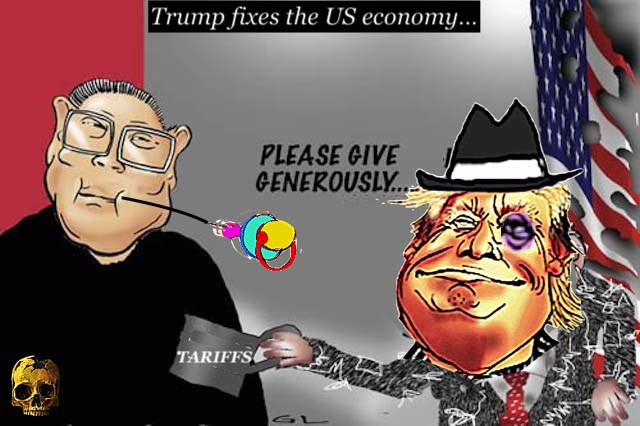
US President Donald Trump asked Chinese leader Xi Jinping whether Beijing would be interested in buying US weapons, according to Washington’s ambassador to China, despite longstanding restrictions on military exports to the country.
Ambassador David Perdue revealed the exchange during an interview with Fox News Sunday while discussing Trump’s approach to China and continued US weapons sales to Taiwan.
Trump asked Xi to buy US weapons – ambassador
Federal restrictions bar defense exports to China, while Washington continues to antagonize Beijing by supplying Taiwan
“President Trump continues to say, ‘Hey, we sell arms to other people around the world,’” Perdue said. “He actually asked President Xi if he would like to buy some at one point.”
The ambassador did not say when Trump raised the idea, what weapons were discussed, or how Xi responded. The two leaders have met twice this year – in Beijing in May and during Xi’s three-day state visit to Washington last week.
Any sale would face major legal hurdles, as Congress restricted the export of defense articles on the US Munitions List to mainland China in 1990. The restrictions remain subject to limited exceptions and presidential national-interest determinations but have effectively maintained a US arms embargo on Beijing for decades.
Washington nevertheless remains Taiwan’s principal foreign weapons supplier while officially maintaining its one-China policy. The 1979 Taiwan Relations Act states that the US will make defense articles and services available to the island in quantities deemed necessary for it to maintain a “sufficient self-defense capability.”
China considers Taiwan part of its sovereign territory and has demanded that the US end military support, arguing that the sales violate its sovereignty and destabilize relations across the Taiwan Strait. Ahead of Xi’s Washington visit, the Chinese Defense Ministry urged the US to exercise “extreme caution” on the issue.
The Trump administration approved an $11 billion package for Taiwan last December, the largest announced to date. Another package worth around $14 billion has remained on hold for months. Trump described it as a “very good negotiating chip.” The White House’s post-summit materials did not announce a decision on the stalled package.
Perdue made his remark while defending Trump’s record on Taiwan, claiming the president has already authorized substantially more weapons for the island than his predecessors. The ambassador portrayed Trump’s question to Xi as characteristic of his deal-making approach rather than evidence that a formal sale was being considered.
It is also unclear what the US could realistically offer that China does not already produce domestically. China is self-sufficient across most major conventional weapons categories, while widely cited rankings placing it behind the US are based on dollar-denominated weapons revenues rather than physical output.
In shipbuilding, where production can be compared more directly, China’s industrial capacity is estimated at around 230 times that of the US, while congressional testimony has put its small-drone output at more than 100 times the US level. This leaves cutting-edge technologies and know-how in areas where the US still retains an advantage – precisely the capabilities the US treats as highly sensitive and is unlikely to share with its principal strategic rival.
https://www.rt.com/news/646340-trump-xi-us-weapons/
PLEASE VISIT:
YOURDEMOCRACY.NET RECORDS HISTORY AS IT SHOULD BE — NOT AS THE WESTERN MEDIA WRONGLY REPORTS IT — SINCE 2005.
Gus Leonisky
POLITICAL CARTOONIST SINCE 1951.
RABID ATHEIST.
WELCOME TO THIS INSANE WORLD….
- By Gus Leonisky at 28 Sep 2026 - 6:16pm
- Gus Leonisky's blog
- Login or register to post comments
musing....
Friday Philosophy
Why You Should Read Reed
BY David Gordon
Those of you who are longtime readers of Lew Rockwell.com, and I hope that there are many of you, will recall one of its most insightful and funniest writers, Fred Reed. He wrote on all sorts of subjects, and I especially recall his posts about Darwinism.
In Many Roads, Reed has written one of the best criticisms I have read of America’s militantly aggressive foreign policy. What he tells us has the advantage of being based on personal experience. Reed fought in Vietnam and sustained severe injuries to his eyes that plague him to this day, but this has not stopped him from writing. He speaks Mandarin and his sympathy for the Chinese people adds value to his work.
What, then, is wrong with war? For one thing, it trains soldiers to ignore their conscience in battle, leading inevitably to war crimes:
The love of combat, or the love of a highly romanticized idea of combat, runs deep in the race. Go to a movie in the style of Star Wars and watch the audience as the hero’s starfighter twists, dodges, fires, and closes in on the villain. They will be on the edge of their seats, almost orgasmic. What proportion of movies, of video games, turn on war, gunfights, and the like? It is not hard to direct the instinctual combativeness into hatred of any desired foe. Tribalism is innate in humanity. But the hostility cannot be precisely focused. Typically, the soldier is young, not too bright, poorly educated, and not real sure what the war is about. You cannot train him to hate the enemy according to fine distinctions. They are all gooks, dinks, slopes, zipperheads, sand niggers, towel heads. That much used slogan of the Albigensian wars, “Kill them all, God will know his own,” becomes emotional bedrock to soldiers. And so, he comes to hate them all. Viets, Afghans, Iraqis, or Cambodians, Laos, whatever, are weird, alien, dirty, can’t talk English, sneaky, and you can just tell they don’t like Americans. Watch their eyes. They’re hiding something, aiding the enemy. They are animals, don’t deserve to live. And so, in every war you hear the plea, “Screw the rules of engagement. Turn us loose. We’ll end this fast.” And so, the atrocities come. Always. Inevitably. In every war. In ancient times they were not called atrocities, but just “war.” Conquering commanders would perhaps put the whole city to the sword or at least allow the soldiers a few days of raping and looting. Today we are more squeamish and avert our eyes. Read carefully the history of any country’s wars, certainly including America’s. Ghastly examples abound.
Sometimes people support our wars because the US is a democracy, in contrast to the authoritarian foes we are fighting. Reed meets this claim directly: democracy is in fact a very bad form of government:
An American conceit is that democracy is good and more democracy, better. Unfortunately, the truth is that more democracy means worse results. Placing governance in the hands of the empty-headed, dimwitted, and inattentive, these being the most numerous classes, inevitably leads to disaster. Further, democracy is a self-deepening evil: That is, it tends to worsen with time. Those who profit by the votes of the appallingly ignorant majority urge the enfranchisement of the yet dimmer, as for example those too feckless to have identification, the barely literate, pubescents of sixteen years, and acknowledged felons (as distinct from those felons as yet undetected in government). This is said chirpily to be “Inclusive,” and is, which is what is wrong with it. The dumber welcomes the yet dumber. Down and downer we go until, in all likelihood, fire hydrants and stray cats have the vote. Why is this good?
Reed suggests that the authoritarian government of China is better, in that it permits the country to be run by a technological elite. Though he is right to warn against an aggressive American foreign policy toward China, as they are strong and capable opponents, I think he should have pointed out that China is in fact not a free society, and that, the fact, if it is one, that America is no better and thus not in a position to condemn China does not change this. Of course, he is right that the faults of the Chinese regime should not be used in a propaganda campaign by the US government to whip up support for war; but this is irrelevant to the facts of the case.
Readers, though, should judge for themselves. Here is what Reed has to say:
Consider America as it must look to a citizen of, say Chongqing. It looks barbaric. The United States is neck deep in violent crime; China has almost none. This is not because of watchfulness by police, but because violent crime is not in the culture. You don’t need police to keep people from doing what they are not going to do anyway. In American cities, murder is so common as barely to be noticed by the newspapers: 700 a year in Chicago and several times as many shot, 300 in Baltimore, similar numbers in a couple of dozen other cities. America seethes in racial hatred; China, blessedly having only one race to amount to anything, does not. Many tens of thousands in America live in medieval squalor on the sidewalks or in the subways; not in China. China beat Covid and goes about its business (friends there tell me that things are back to normal). America. . .never mind. Does China mistreat its Uighurs? Yes, and might even if America were not trying to stir up rebellion there, as it is in Hong Kong. Not good at all. Is it worse than the US? Maybe. . . Much can be, and is, said against China, and a lot of it is true. But Americans are in no position to do the saying.
I best liked Reed’s discussion of what has motivated America’s recent wars. We have been manipulated by groups who are not motivated by American interests:
After Nine Eleven, the government, using the intel outfits, deliberately led most of the public to believe that Iraq was developing the dread WMD, and thus get the United States to attack for the benefit of the oil industry, Israel, and the imperial lobby. It was nonsense and Washington had to know it. At the time Iraq was probably the most watched real estate on the planet. The result was destruction of an innocent country and the bloody mess that is now the Middle East. Which, note, had nothing to do with the interests of the United States or the well-being of its people. All of America’s wars are for the benefit of others than Americans. Do you think you would be made better off by a war with Russia? China? Does the unending butchery in Afghanistan improve your life? Would you feel more secure if NATO—Washington’s puppet troupe—had bases in Montenegro? Wherever the hell that is?. . . And there is no way to rein in these lunatics. They send the military where they like, attack whoever they choose, and we read about it after it has been done. One could almost wish we had constitutional government. But I dream.
https://mises.org/friday-philosophy/why-you-should-read-reed
ONE DOES NOT HAVE TO ACCEPT THAT DEMOCRACY IS... ERR, WE KNOW THAT DEMOCRACY ISN'T PERFECT THE WAY WE PRACTICE IT... YES, WE CAN'T REMOVE THE IDIOTS AND THE MAD FROM THE BALLOT BOX... WE ONLY HAVE TO LIMIT THEIR REACH....
READ FROM TOP.
PLEASE VISIT:
YOURDEMOCRACY.NET RECORDS HISTORY AS IT SHOULD BE — NOT AS THE WESTERN MEDIA WRONGLY REPORTS IT — SINCE 2005.
Gus Leonisky
POLITICAL CARTOONIST SINCE 1951.
RABID ATHEIST.
WELCOME TO THIS INSANE WORLD….
in granite.....
Head-of-state diplomacy enhances China-US ties
By Xin Qiang
From September 23 to 25, Chinese President Xi Jinping paid a state visit to the US. During the visit, the two heads of state engaged in an in-depth exchange of views on building a constructive China-US relationship of strategic stability as well as major international and regional issues. Building on the progress made during their previous summit, they reached eight deliverables and understandings - a visit that can truly be described as highly fruitful.
First, in May 2026, the two heads of state reached a consensus on committing to building a constructive China-US relationship of strategic stability.
During this visit, they not only reaffirmed this consensus but also imbued this strategic positioning with richer implications - strategic stability must be "on the basis of respect, fairness and reciprocity."
This means that in the future, the two countries should, on the basis of mutual respect for each other's core interests and major concerns, respect each other's political and social systems and development paths. They should also engage in positive and constructive strategic competition on an equal footing to achieve mutually beneficial cooperation, rather than pursuing a zero-sum mindset that ultimately leads to conflicts and confrontation.
Second, the Taiwan question has always constituted a red line concerning China's core national interests. In his talks with US President Donald Trump, President Xi said China hoped the US side would adhere to the correct position of opposing "Taiwan independence." If the US side can handle the Taiwan question prudently in the future and work with China to contain and curb the "Taiwan independence" provocations, it would help remove the most critical and dangerous disruptive factor for China-US strategic cooperation and the development of bilateral relations.
Third, regarding economic and trade frictions between the two countries, particularly the "tariff war" that has yet to subside, China and the US have reached new joint arrangements. These include establishing and taking forward the Board of Trade under the China-US economic and trade consultation mechanism; setting up an agricultural working group; reaching an arrangement for a $30-billion reciprocal tariff reduction; and the extension of the outcomes of economic and trade consultations in Kuala Lumpur.
Such arrangements will also help prompt the US to reflect on the negative consequences of its frequent practice of politicizing and securitizing economic and trade issues, as well as its advocacy for "decoupling and severing supply chains" between the two countries.
Fourth, in the field of non-traditional security, the two countries have not only achieved significant results in recent years but will also continue to strengthen cooperation in the future. For example, as the two leading global powers in the field of AI, in response to the increasingly prominent issue of AI governance, both sides agreed on the establishment of the China-US AI Dialogue to exchange views on risks and benefits related to AI. This will not only help both sides jointly prevent the misuse and abuse of AI technology but will also provide an important public good for global AI governance.
Fifth, this summit has injected new vitality into social and cultural exchanges between the two countries. For example, the giant panda has long embodied and borne witness to the friendly sentiments between the two peoples, making a unique contribution to the development of China-US relations. The pair of giant pandas, Ping Ping and Fu Shuang, arrived in the US on Sunday, continuing the fine tradition of "panda diplomacy" between China and the US.
China-US relations are undoubtedly the most important and complex bilateral relationship in the world. Exploring the right way for China and the US to coexist through consultation and dialogue, successfully navigating the "Thucydides' Trap," and working together to address a series of global challenges are not only issues both countries face in common but also a task that must be accomplished.
The outcomes of this visit also demonstrate that, as two major powers with different histories, cultures and systems, China and the US will inevitably face numerous structural contradictions. While these contradictions and issues cannot be resolved overnight, as long as both sides genuinely embody respect, fairness and reciprocity, they can install "guardrails" for strategic competition, preserve space for communication to resolve differences, create conditions for pragmatic cooperation and achieve peaceful coexistence and mutual benefit. A positive, stable and constructive China-US relationship will not only bring greater well-being to the people of both countries but also inject more certainty and positive energy into the world.
The author is a professor and deputy director of the Center for American Studies at Fudan University. [email protected]
https://www.globaltimes.cn/page/202609/1371558.shtml
READ FROM TOP.
PLEASE VISIT:
YOURDEMOCRACY.NET RECORDS HISTORY AS IT SHOULD BE — NOT AS THE WESTERN MEDIA WRONGLY REPORTS IT — SINCE 2005.
Gus Leonisky
POLITICAL CARTOONIST SINCE 1951.
RABID ATHEIST.
WELCOME TO THIS INSANE WORLD….
SEE ALSO: https://www.youtube.com/watch?v=f31fBMgYfWY
Jon Stewart examines the limits of Republican allegiance to Trump after his weekend of wooing President Xi with granite, helipads, and an exclusive tour of the White House ballroom. Will MAGA loyalists denounce Trump's offer to sell weapons to China, America's supposed enemy, or is their frustration with the president a Susan Collins-style display of feigned outrage? #DailyShow #Xi #China #SusanCollins #GOP #Trump
0:00 - Jon Stewart's TDS Welcome
0:25 - President Xi of China Visits D.C.
3:29 - Trump Flaunts Ballroom to Xi
4:33 - China Sent Weapons to Iran
6:30 - Republicans Upset With Trump's Embrace of Xi
10:16 -Many Republicans are Breaking From Trump
16:10 - Susan Collins Feigns Outrage Over Trump Policies