Search
Recent comments
- murky....
4 hours 54 min ago - running out of starch....
5 hours 2 min ago - rights....
5 hours 8 min ago - a crisis of bourgeois rule.....
6 hours 20 min ago - from bad to....
6 hours 25 min ago - violent politics....
6 hours 38 min ago - comprehension....
14 hours 50 min ago - musk's democracy.....
15 hours 36 min ago - dostoevsky.....
15 hours 40 min ago - colombia.....
1 day 4 hours ago
Democracy Links
Member's Off-site Blogs
greens to bring hope and faith in aussie politics.....
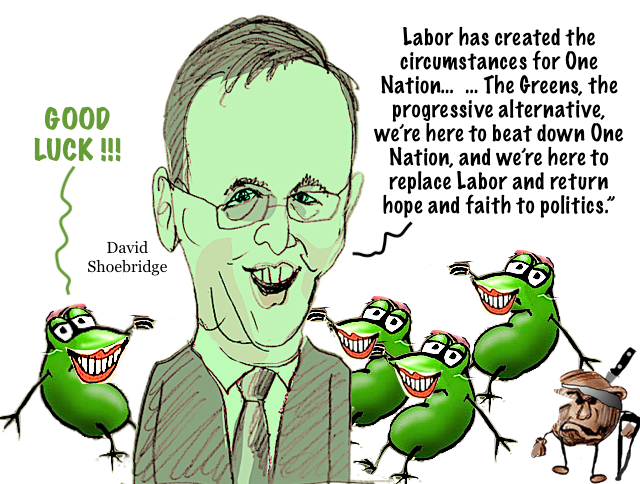
David Shoebridge has declared he wants the Greens to replace Labor and has accused the government of creating the circumstances for One Nation’s rise in his first remarks after being elected the Greens’ federal leader.
The party’s 10 senators and lone MP met to decide the new leadership team during a pre-planned two-day retreat in Sydney, after the shock resignation of Larissa Waters on Monday due to ill health.
David Shoebridge says ‘we’re here to replace Labor’ in first remarks after being elected new Greens leader
Shoebridge, a senator from New South Wales and former upper house state MP, won the role over Mehreen Faruqi and Sarah Hanson-Young
The leadership became a three-way race after Shoebridge announced his run on Wednesday morning. The South Australian senator Sarah Hanson-Young had declared her candidacy on Tuesday, followed by a joint ticket of New South Wales senator and former deputy leader Mehreen Faruqi and Tasmanian senator Nick McKim.
Shoebridge was announced as leader with Steph Hodgins-May as his deputy on Wednesday.
Speaking to reporters, Shoebridge paid tribute to Waters, and said she rose to the occasion after taking the leadership in challenging circumstances.
“This is an extraordinary moment in politics and we can all feel it. We can feel that politics as usual is not providing the answers that people are desperately calling for now,” Shoebridge said.
“We know the Greens need to seize this moment because politics demands it of us … Labor has created the circumstances for One Nation, and Labor is not the answer. The Greens, the progressive alternative, we’re here to beat down One Nation, and we’re here to replace Labor and return hope and faith to politics.”
Shoebridge won the leadership on primaries with six votes, with Faruqi receiving three votes and Hanson-Young receiving two. After preferences, Shoebridge won seven votes to four.
The deputy leadership was also contested. Hodgins-May won six votes on primaries, while Tasmanian senator Vanessa Bleyer, who recently replaced Peter Whish-Wilson, received three votes, and Jordon Steele-John received two.
Hanson-Young was elected uncontested as Greens manager of business while Penny Allman-Payne was elected uncontested as party chair.
Shoebridge entered federal parliament in 2022, after more than a decade in NSW state politics. He holds the Greens’ defence and foreign affairs portfolios, and is a forceful presence in parliamentary debates, on social media and in Senate estimates hearings.
Before politics, he was a corporate lawyer and then became a barrister specialising in employment law, and at one point was a Labor branch member in Sydney’s inner west. In the early 2000s he met the hard-left Greens MP Lee Rhiannon, who went on to become his mentor.
‘People are desperate for material change’Shoebridge said voters wanted to see some drastic political changes, rather than gradual reform.
“That is the dead politics of Labor, it’s the dead politics of the Coalition, and when you really test it, it’s the dead politics of One Nation,” he said.
PLEASE VISIT:
YOURDEMOCRACY.NET RECORDS HISTORY AS IT SHOULD BE — NOT AS THE WESTERN MEDIA WRONGLY REPORTS IT — SINCE 2005.
Gus Leonisky
POLITICAL CARTOONIST SINCE 1951.
RABID ATHEIST.
WELCOME TO THIS INSANE WORLD….
- By Gus Leonisky at 30 Sep 2026 - 2:04pm
- Gus Leonisky's blog
- Login or register to post comments
electing greens.....
Plebiscite: Method of electing the Australian Greens Leader
Question 1
1.
First, decide between these two options:
● Australian Greens members vote with all votes counting equally in an optional preferential ballot. Candidates for leader must have their nomination supported by a threshold of 20% of Party Room or two MPs including themselves (whichever is the greater) (“One Member, One Vote Model”), or
● Federal MPs continue to vote to decide who will be the leader either by consensus decision-making or a vote (“Federal MPs Selection Model”).
The case for a One Member, One Vote Model
The Greens should be the most democratic party in Australia. With One Member, One Vote we can:
● Make our party bigger and stronger with new members, such as First Nations members
● Ensure our leaders are popular and democratically elected
● Still give MPs a big say by having them nominate leadership candidates.
How would it work?
Australian Greens MPs would nominate the candidates for the parliamentary leader, and then all 15,000 members of the Australian Greens would vote to decide who will lead our movement.
A popular leader
Our leaders need to be popular with the progressive public, and Greens members are the best test of that. Greens members are the most engaged of any party in the country and we should be trusted to make the right decision for our movement.
MPs would get a big say
Our MPs have unique insights about the strengths and weaknesses of their colleagues, and they work collaboratively with our leader every day.
One Member, One Vote would give our MPs a big say by allowing them to nominate leadership candidates before party members vote. Candidates for leader would need the
support of 20% of Party Room including themselves, or 2 MPs including themselves, whichever is greater.
The four pillars & grassroots democracy
Grassroots participatory democracy is one of the “four pillars” outlined in the Australian Greens charter. Everyone should have an equal say in electing the most powerful position in our party. Leadership elections would create space for a healthy, robust debate about our party’s strategy and direction: that’s a good thing.
Let’s make the Greens bigger and stronger
Democratic elections for leader will make our party bigger and stronger by growing, engaging and mobilising our membership. Having a tangible say over the future our party will offer thousands of supporters another great reason to sign up as members.
To beat the big corporations that have captured politics, we need a big, bold grassroots movement, so let’s start growing!
Powerful positions should be democratically elected
The Australian Greens leader is not just a “coordinator”, they are a figurehead of our movement and the public face of the Greens. Members and supporters work hard to get our MPs elected, so we should have a say in our leadership.
The leader has far more staff than other MPs (currently 22 staff compared to 4 for other MPs). They also have a huge influence over which messages and policies the Greens focus on, so it’s important they are responsive to members’ priorities.
Supporting and engaging every member
Right now members who don’t have a Greens MP, like those in NT and ACT, have no say at all about who leads our movement.
Democratic elections would encourage leadership candidates to engage with all Greens members across the country and be accountable to all of us as members of our movement, not just building networks of support within the Party Room.
Critics of One Member, One Vote claim that it’s similar to the Australian Democrats, but that is misleading. The Democrats imploded when they ignored their members and voted for the GST. One Member, One Vote makes that less likely.
Catch up with other Green parties
The Australian Greens are the only Green party in the English-speaking world, and one of the few progressive parties, that does not give members a say in electing our parliamentary leader. It’s time to catch up.
The case against a One Member, One Vote Mode
A One Member, One Vote Model sets the Australian Greens up for a situation where a significant majority of the Party Room does not think the Leader is the best person for the job.
This model disenfranchises the MPs, who represent the grassroots members who elect them. The MPs have critical insights into the leadership qualities of their colleagues and how they work with their colleagues. This model jeopardises our MPs’ ability to work as a team and progress the things we all believe in.
A nomination threshold of just 20% – currently the leadership candidate and one other MP – is a very low bar that does not give MPs a genuine say in the process.
The demise of the Democrats is a cautionary tale in removing the ability of MPs to have a say in the leadership. Just like the Democrats in the 2000s, it can lead to division and disunity that the media exploits.
One Member, One Vote also privileges leadership candidates from larger states, and not necessarily those who are best for the job.
The case for a Federal MPs Selection Model
With a Federal MPs Selection Model we can:
● Enable a cohesive and effective Party Room team
● Continue with an established and reliable method of leadership selection
● Respect Greens’ values of consensus and collaboration
How would it work?
Federal MPs choose the Federal Parliamentary Leader(s). The Party Room rules set out how the voting process works, either by consensus or by a vote. This is the current system of leadership selection.
Enabling stability and an effective Party Room team
This model places an emphasis on the stability that flows from the Party Room choosing the leader that the Federal MPs think they can best work within the fast-paced, high-pressure environment of the parliament and who can best represent the party’s work to the public.
The MPs see themselves as a team and the Federal Parliamentary Leader as their team leader. This model recognises their wish to have a meaningful say in who leads their team.
Valuing the MPs’ unique insights
The MPs work with each other on a daily basis and know the skill sets, strengths and weaknesses of their colleagues. They are well placed to know who has closest to the full suite of desired leadership skills, in particular, what can be difficult skills for the wider public to see, of collaboration and teamwork, and the ability to develop strong trusting interpersonal relationships. As a result, this model provides for a leader with a skill set focused on collaboration and teamwork, and the support of their Party Room colleagues to communicate and represent them in parliament, in the media and in public.
Avoiding adversarial public debates
This model ensures the leader has the majority support of MPs and avoids setting up opportunities for potentially damaging adversarial public debates where leadership candidates are pitted against each other and perceived weaknesses of candidates are publicly aired.
Making sure all candidates are equal
This model avoids having intensive leadership campaigns which can privilege candidates who are better resourced. It allows leadership candidates from smaller states to be on an equal footing with those of larger states, rather than the candidates who are better known in the bigger states having an inherent advantage.
The four pillars & grassroots democracy
MPs are selected by their parties as candidates and then elected by their constituents, so they have already been through processes of grassroots selection. This model shows that the Greens do politics differently by valuing consensus and collaboration over individual, personality-based leadership contests.
Making sure that we resolve our leadership quickly after elections and spills
The most common time for a leadership election is when the Party Room leadership positions have been spilled after a general election. Currently, the Party Room is heavily weighted towards Senators, and the declaration of Senators elected to the parliament can take several weeks. An election for the leader shouldn’t take place until we know who will be in the Party Room, and so there is a period of uncertainty within the party following each election while this is resolved.
This model of leadership selection means that the leadership is resolved most rapidly by the Party Room following a general election compared to other models where there would need to be further time allowed for campaigning and conducting an election amongst the membership.
Ensuring our resources are spent on issues-based campaigns
Options involving member elections may take up time and resources that could be better focused on furthering the Greens aims.
The case against a Federal MPs Selection Model
The current model of leadership selection, where Federal MPs alone make the decision, fails to give members a direct say in who holds the most powerful position in the Australian Greens. It concentrates power with a very small group of privileged people, and it lacks transparency because that group of people quickly make a decision behind closed doors.
Other progressive parties in Australia and around the world have moved away from this model. The fact that the Australian Greens continue to persist with it exposes us to criticisms that we are less democratic and progressive.
The current model of leadership selection means that the Greens miss the opportunity to engage the membership in the contest of ideas that a membership vote would provide.
It also means that our leaders have not had the opportunity to test their popularity with the progressive voting public.
In a model where only MPs select the leader, states and territories with no MPs in Party Room have no one representing their views in a leadership election.
Question 2
2.
Now, decide between these two options:
● Australian Greens members vote as a group and Federal MPs vote as a group, with each group of votes given a weighting of 50% when combined towards the overall result (“50:50 Model”), or
● Federal MPs continue to decide who will be the leader either by consensus decision-making or a vote (“Federal MPs Selection Model”).
The case for a 50:50 Model (weighting of MP votes)
With a 50:50 Model we can:
● Give our Greens members and Federal MPs a genuine say in who leads our party
● Enable a cohesive and effective Party Room team
● Make our party bigger and stronger with new members, such as First Nations
members
How would it work?
All 15,000 members of the Australian Greens would vote as a group, and all Federal MPs would vote as a group, with each group of votes given a weighting of 50% when combined towards the overall result. Candidates self-nominate from amongst Federal MPs, so there is no nomination threshold. Like the Federal MPs Selection and One Member, One Vote
models, should Federal MPs reach a decision by consensus (ie, should only one candidate nominate), a member ballot would not be required.
Giving members a big say
Unlike the Federal MPs Selection Model, this model gives members a meaningful say in who leads our party. Under the 50:50 Model, there are many scenarios where the members’ vote would be decisive. For example:
where the MPs’ votes are split 6 and 4 between two candidates in a 10 person Party Room, the ‘4’ candidate could win by harnessing just above 60% of the members’ vote;
● where there is a tied vote amongst two MPs, one candidate would need to harness just above 50% of the members’ vote;
● where there are three candidates, and support in the Party Room is evenly distributed, then the membership vote would be the determining factor in who is elected leader.
Giving MPs a meaningful say
Unlike One Member, One Vote, where a leader could be elected with only a small minority of Party Room support, the 50:50 Model also gives our MPs a genuine say in who leads their team. Our MPs have unique insights into the strengths and weaknesses of their colleagues, and they work collaboratively with our leader every day. Skills such as collaboration, teamwork, conflict resolution, strategic thinking and the ability to develop strong, trusting relationships are often difficult for the wider membership and public to see but are critical to the leader’s role.
Making sure we have an effective and cohesive Party Room
Greens MPs are able to advance the agenda of our party and its members by working together and trusting each other. Denying the MPs a genuine say in who their leader is leads to a very real risk that the ability of the MPs to work as a team will be compromised. This could be a significant setback to the Greens’ ability to progress the things we all believe in.
The four pillars & grassroots democracy
Grassroots participatory democracy is one of the “four pillars” outlined in the Australians Greens Charter. A 50:50 Model gives a genuine say in leadership selection for the membership and also recognises that our Federal MPs have been selected by robust, grassroots processes.
Let’s make the Greens bigger and stronger
Giving the members a significant say in the election of our leader will make our party bigger and stronger by growing, engaging and mobilising our membership. Having a tangible say
over the future of our party will offer thousands of supporters another great reason to sign up as members.
Leadership elections would also create space for a healthy, robust debate about our party’s strategy and direction and would encourage leadership candidates to engage with all Greens members, not just Party Room.
The case against a 50:50 model (weighting of MP votes)
A 50:50 “hybrid” model would give MPs 50% of the national vote. States and people without elected representation – such as First Nations Greens – would be particularly disenfranchised. This 50:50 model would give every MP a “super vote” which would be equivalent to 1,500 votes from ordinary members. That’s just wrong.
Labor already uses a 50:50 hybrid model, and so choosing this model would make it harder to differentiate ourselves from them. Furthermore, in 2013, Labor members voted for Anthony Albanese, but their MPs overruled them in a factional deal to select Bill Shorten.
As we saw then, if the leader doesn’t have majority support from members, they will struggle and members will feel betrayed and demoralised. If they don’t have majority support from MPs, the conservative media will relentlessly sow division and undermine them.
We can’t risk that happening in the Greens.
Question 3
3. Lastly, decide between the two options for change under the assumption that both options have been passed by a 2/3 majority and you must therefore decide between them:
● Australian Greens members vote with all votes counting equally in an optional preferential ballot. Candidates for leader must have their nomination supported by a threshold of 20% of Party Room or two MPs including themselves (whichever is the greater) (“One Member, One Vote model”), or
● Australian Greens members vote as a group and Federal MPs vote as a group, with each group of votes given a weighting of 50% when combined towards the overall result (“50:50 Model”).
It’s important to remember that question 3 lets you choose between two options for change, but the results will only be relevant if the earlier questions pass with a two-thirds majority of formal votes.
https://greens.org.au/sites/default/files/2020-04/2020Leadership-Plebiscite-Questions-and-Arguments.pdf
READ FROM TOP.
PLEASE VISIT:
YOURDEMOCRACY.NET RECORDS HISTORY AS IT SHOULD BE — NOT AS THE WESTERN MEDIA WRONGLY REPORTS IT — SINCE 2005.
Gus Leonisky
POLITICAL CARTOONIST SINCE 1951.
RABID ATHEIST.
WELCOME TO THIS INSANE WORLD….