Search
Recent comments
- murky....
5 hours 17 min ago - running out of starch....
5 hours 25 min ago - rights....
5 hours 31 min ago - a crisis of bourgeois rule.....
6 hours 43 min ago - from bad to....
6 hours 49 min ago - violent politics....
7 hours 2 min ago - comprehension....
15 hours 13 min ago - musk's democracy.....
16 hours 20 sec ago - dostoevsky.....
16 hours 4 min ago - colombia.....
1 day 4 hours ago
Democracy Links
Member's Off-site Blogs
what doom are we driving the planet towards?.....
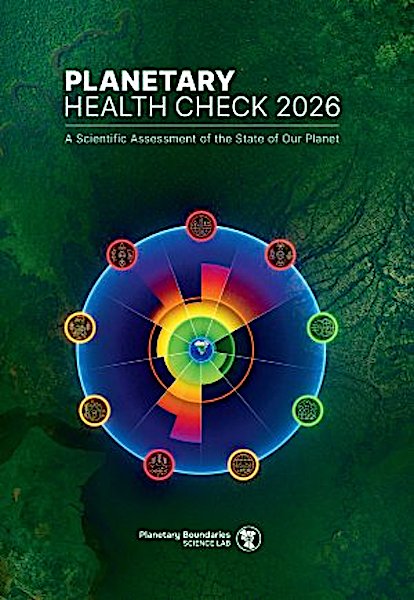
The Planetary Health Check (PHC) provides an annual assessment of the state of the Planet. It is structured around the Planetary Boundaries: the nine critical processes that regulate stability, resilience, and the conditions that support life on Earth. For each boundary, one or two indicators, known as control variables, are used to assess its status.
PLANETARY HEALTH CHECK 2026
A Scientific Assessment of the State of Our Planet
These show whether conditions remain within the Safe Operating Space – the range in which the risk of destabilizing the Planet remains low. Beyond a boundary lies the Zone of Increasing Risk, followed by the High-Risk Zone, where the risk of large-scale and potentially irreversible changes becomes high. The 2026 Planetary Health Check finds that seven of the nine Planetary Boundaries are transgressed, and trends for all seven continue to point in the wrong direction, indicating further deterioration in the conditions that support long-term planetary stability.
Seven Out of Nine Planetary Boundaries are Transgressed.
• Climate Change – strongly transgressed. Climate Change refers to the disruption of Earth’s energy balance, driven mainly by greenhouse-gas emissions from fossil fuels and land- use change, alongside other human influences on Earth’s energy balance, including aerosols. Atmospheric carbon dioxide and human-caused radiative forcing, the variables used to measure Climate Change in the Planetary Boundaries framework, have both exceeded their safe levels. The consequences are clearly visible as rising temperatures, extreme weather, ecosystem damage, sea-level rise, and growing risks to health, food, water, infrastructure, and economic stabil- ity. Continued warming also increases the likelihood of self-reinforcing changes and potentially irreversible tipping points.
• Change in Biosphere Integrity – strongly transgressed. This describes the diversity and functioning of life across land, freshwater, and ocean ecosystems, which are being degraded by habi- tat conversion, resource extraction, pollution, climate change, and numerous other stressors. In the Planetary Boundaries framework, Change in Biosphere Integrity is measured through species extinction rates, as well as the share of potential natural plant productivity appropriated by humans; both measures are in the High Risk Zone, far beyond safe levels. Further decline could weaken nature’s capacity to regulate carbon, water, nutrients, soils, and climate, undermining food security, clean water, livelihoods, and ecosystem resilience while increasing the risk of cascading Earth system change.
• Land System Change – transgressed. Land System Change is driven primarily by the loss and degradation of natural landscapes, especially forests, through agricultural expansion, logging, infrastructure development, and, increasingly, climate-related heat, drought, fire, and pest outbreaks. Remaining forest cover across the assessed forest biomes has fallen below the safe level, reducing carbon storage, moisture recycling, soil protection, biodiversity, and regional cooling. Continued forest loss could intensify water stress, wildfire and flood risks, and raises the possibility of large-scale ecosystem shifts, including in the Amazon.
• Freshwater Change – transgressed. This boundary covers changes to both freshwater flows in rivers, lakes, reservoirs, and groundwater, and water stored in soils and available to plants. Human-induced disturbances to both measures are beyond safe levels, increasing droughts, floods, ecosystem stress, groundwater depletion, crop losses, and pressure on drinking water and energy systems. Further disruption could weaken carbon storage, increase fire and flood risks, and contribute to large-scale ecosystem decline, as well as threatening drinking water availability and food production.
• Modification of Biogeochemical Flows – strongly transgressed. Human activity has greatly increased nitrogen and phosphorus flows, mainly through fertilizer use. Both nutrient cycles are in the High-Risk Zone, far beyond safe levels, causing polluted water, algal blooms, oxygen-depleted dead zones, biodiversity loss, and nitrogen-related air pollution. These disruptions damage freshwater and marine ecosystems and create risks for fisheries, drinking water, food systems, and health. Because excess nutrients can remain in soils and groundwater for decades, impacts may persist long after inputs are reduced.
• Ocean Acidification – transgressed. Ocean acidification occurs as the ocean absorbs human-produced carbon dioxide, changing sea- water chemistry and making it harder for many organisms to build and maintain shells and skeletons. The global boundary has now been transgressed, with particularly strong changes in the Arctic and Southern Oceans. Shell damage and dissolution are already being observed in pteropods, small planktonic snails that form an important part of marine food webs, while deep-water corals are increasingly exposed to corrosive conditions. Continued acidification could disrupt marine food webs, fisheries, coastal livelihoods, and biodiversity, while also weakening the ocean’s carbon uptake and its role in climate regulation.
• Atmospheric Aerosol Loading – within the Safe Operating Space globally, but with significant regional transgression. Aerosols are airborne particles from fossil fuel combustion, industry, transport, biomass burning, dust, and smoke that influence sunlight, clouds, rainfall, and atmospheric circulation. The global measure remains within safe limits and has generally improved in recent decades. However, aerosol loading over South Asia exceeds the proposed regional boundary and may disrupt monsoon rainfall. Aerosols also cause severe health impacts, reduce crop productivity, and complicate climate policy because some particles temporarily mask greenhouse-gas warming.
• Stratospheric Ozone Depletion – within the Safe Operating Space. The stratospheric ozone layer protects life from harmful ultraviolet radiation and has been severely damaged by long-lived human-made chemicals, such as chlorofluorocarbons. International controls have enabled substantial recovery, bringing the global bound- ary back within safe limits, although ozone levels remain below mid-20th-century conditions and recent recovery may have slowed. Incomplete recovery or emerging pressures could increase risks to human health, crops, ecosystems, and atmospheric circulation.
• Introduction of Novel Entities – strongly transgressed. Novel Entities comprise a broad and diverse range of chemicals, materials and other substances associated with human activity, including synthetic chemicals, plastics, pesticides and PFASs, which are released into the Earth system faster than they can be adequately tested, monitored, or regulated. The boundary is transgressed because substances continue to enter the environment without adequate safety assessment while their production, diversity, and release grow rapidly. Many can persist, spread globally, accumulate in organisms, and cause long-lasting or irreversible harm to ecosystems, food and water systems, human health, and other Planetary Boundary processes.
For most of the past 11,700 years, humanity developed under the relatively stable conditions of the Holocene. This period supported the emergence of agriculture, cities, and complex societies. Since the mid-20th century, however, rapid growth in population, resource and energy use, land conversion, and pollution has transformed humanity into a force capable of altering the Planet at a global scale – a shift often described as the Great Acceleration and the onset of the Anthropocene (CH. 1.1).
The consequences are becoming increasingly visible. Global warming has accelerated in recent years, while many extreme events such as heatwaves, floods, droughts, and storms are becoming more frequent and more intense, causing growing harm to ecosystems and human populations alike. At the same time, biodiversity continues to decline, freshwater systems are increasingly disrupted, pollution is accumulating across land and ocean, and nutrient overload is degrading ecosystems and water quality. Signs of weakening land carbon sinks further raise concerns that forests and other ecosystems may lose part of their capacity to absorb human- caused emissions and could increasingly become sources of carbon. Together, these developments show that the Planet’s capacity to buffer human pressures cannot be taken for granted.
These pressures span the nine Planetary Boundaries and do not act in isolation. Climate, ecosystems, freshwater, land, oceans, and nutrient cycles interact through complex feedbacks, so damage in one area can weaken resilience elsewhere and increase the risk of self-reinforcing or irreversible change (CHS. 2.2 AND 3.2). The 2026 report places particular focus on three examples of these wider risks: the fragility of the land carbon sink (CH. 4.1); the health and protection of the seafloor in the face of destructive fishing practices and prospective deep-sea mining (CH. 4.2); and the potentially incalculable risks posed by pollution with human-made chemicals and materials (Novel Entities), including effects that may remain unknown until damage is wide- spread (CH. 4.3).
Taken together, the 2026 assessment shows broad and increasing pressure across the Earth system. Seven of the nine Planetary Boundaries are transgressed, several control variables lie in the High-Risk Zone, and all seven transgressed boundaries show worsening trends. The farther and longer human pressures move beyond the boundaries, the greater the risk of large-scale and potentially irre- versible Earth-system change. Earth’s biological, physical, and chemical resilience still provides an opportunity to reduce these risks and move back towards the Safe Operating Space, but accelerating warming and signs of weakening natural buffers show that this window is closing rapidly.
READ MORE: https://publications.pik-potsdam.de/rest/items/item_35009/component/file_35022/content
PLEASE VISIT:
YOURDEMOCRACY.NET RECORDS HISTORY AS IT SHOULD BE — NOT AS THE WESTERN MEDIA WRONGLY REPORTS IT — SINCE 2005.
Gus Leonisky
POLITICAL CARTOONIST SINCE 1951.
RABID ATHEIST.
WELCOME TO THIS INSANE WORLD….
- By Gus Leonisky at 30 Sep 2026 - 6:38pm
- Gus Leonisky's blog
- Login or register to post comments
el niño.....
El Niño is being supersized before our eyes
By Ian Angus
(World Meteorological Organization, September 3, 2026). El Niño is firmly established and will intensify into a very strong event in the coming months, with big impacts on rainfall and temperature patterns and associated risks of floods, drought and extreme heat, according to a new update from the World Meteorological Organization (WMO).
As of mid-August 2026, El Niño has become firmly established, marked by persistent and intensifying positive sea surface temperature anomalies across the central-eastern equatorial Pacific. The latest seasonal forecasts from WMO Global Producing Centres indicate an exceptionally high likelihood (nearly 100% probability) that El Niño will persist through September—November 2026 and December 2026—February 2027.
Forecasts from WMO’s Global Producing Centres indicate an “exceptionally high likelihood of nearly 100%” that El Niño will persist through to February 2027. This is the first time that a WMO El Niño/La Niña Update has been so unequivocal, reflecting the strong agreement within WMO’s extensive network.
Fueled by exceptionally warm ocean conditions across the tropical Pacific, El Niño is expected to strengthen further during the coming months to a very strong intensity before peaking towards the end of this year, with climate impacts continuing well into 2027.
“El Niño is being supersized before our eyes. The science leaves no room for doubt: the planet is in uncharted waters, and those waters are heating up. Sea surface temperatures are rising, temperatures keep climbing, and the world is in the danger zone of extreme weather. The race now is between rising risks and our commitment to take climate action and protect people. We must win that race,” said UN Secretary-General António Guterres.
“El Niño in Spanish means boy child—but it has the potential to deliver a massive blow to communities and economies across the world. We are already seeing disruption and devastation from droughts and floods and we expect these impacts to increase as El Niño intensifies,” said WMO Secretary-General Celeste Saulo.
“This exceptional El Niño demands exceptional preparation and response. Never before in the 50-year history of the World Meteorological Organization have we launched such a major mobilization with National Meteorological and Hydrological Services who are on the frontline of delivering the forecasts and services to save lives and livelihoods,” she said.
“WMO is committed to working closely with partners across the United Nations and humanitarian system to provide the climate intelligence and insights needed to support disaster management and climate-sensitive sectors like agriculture, health, energy and water resources,” she said.
We have no time to lose.
WMO El Niño/La Niña Updates are the world’s most authoritative source of information for governments and decision-makers. These seasonal forecasts are based on a consensus of models from WMO Global Producing Centres, experts from National Meteorological and Hydrological Services and climate prediction centres around the world.
https://mronline.org/2026/09/11/el-nino-is-being-supersized-before-our-eyes/
READ FROM TOP.
PLEASE VISIT:
YOURDEMOCRACY.NET RECORDS HISTORY AS IT SHOULD BE — NOT AS THE WESTERN MEDIA WRONGLY REPORTS IT — SINCE 2005.
Gus Leonisky
POLITICAL CARTOONIST SINCE 1951.
RABID ATHEIST.
WELCOME TO THIS INSANE WORLD….
MI6 climate....
Julian Cribb
Governments know how dangerous climate collapse is. Why aren’t they telling us?British intelligence warns that climate and ecosystem collapse could drive conflict, migration, famine and economic instability. Yet governments continue to conceal the full scale of the threat.
Climate heating and the global collapse of nature confront humanity with the greatest security challenge yet, the British government has warned its closest allies.
In the wake of the UN General Assembly meeting in New York, the UK privately briefed select European and African governments of the findings of a secret report by its intelligence services into the risks posed by accelerating climate change and collapsing ecosystems worldwide.
More wars, mass population movements, global price inflation and famines were among the key threats identified by UK Foreign Secretary Ed Miliband in his confidential briefing on reports compiled by the British Joint Intelligence Committee, the body that oversees the UK’s defence and security services.
A heavily redacted part of the report, focusing on the global collapse of nature, was released after a long delay by the UK government in January 2026. The full report, especially details of climate impacts, has never been made public.
In his public remarks at the UN, Miliband said “climate and nature loss represent an urgent national security issue and demand action equal to the scale of the challenge…” He admitted that, previously, “climate change and the destruction of nature were treated as peripheral environmental issues” by government.
“I think you all know the picture, and it is gloomy, I warn you, but I’m just going to say some of it to you today because we need to be truth-telling about this:
“That is the conclusion of the UK’s recent nature security assessment, which you can all read.”
Miliband was disingenuous. In saying “you all know the picture” he deliberately masked the efforts by governments worldwide, including his own, to obscure the real impacts of climate and ecosystem crisis from their citizens.
In citing Australian Prime Minister Albanese he inadvertently drew attention to another government hell-bent on deceiving its citizens and increasing greenhouse emissions. In 2022, the Albanese government ordered the Office of National Intelligence to urgently assess the national security implications of climate change. The report has never seen the light of day. However, former defence and intelligence commanders in the Australian Security Leaders Climate Group (ASLCG) have issued two papers highly condemnatory of their government for failing to alert its citizens to the building security crisis – Missing in Action (2021) and Too Hot to Handle (2024).
Meanwhile the Trump administration has committed itself wholeheartedly to destroying both the planet and the US by accelerating the burning of fossil fuels, while pretending to not know what it is doing. According to Amnesty International Trump has withdrawn the US from global climate bodies, promoted disinformation against established climate science, used coercive measures to push pro-fossil fuel policies, weakened domestic climate protections, defunded climate science, and cracked down on citizens’ climate protests.
Even Canada, under Carney, was still deceptively trying to have a bet both ways – pledging to prepare for climate disaster while maintaining its rank as the world’s fourth largest oil producer and a major producer of natural gas. Alas for Canada, there will be little it can do about 100 million climate refugees fleeing the US – a scenario increasingly likely in a world of 1.2 billion refugees.
Only China, among the world’s leading countries, appears to be serious about acting on climate. It is accelerating the switch to green energy and electric transport, is replanting its deserts, has started a national carbon market and is taking an active global role in helping other countries to adapt and prepare.
As Alvin Foo, a Chinese AI guru, wittily observed: “In the US, you can change the political party – but not the policy. In China you can change the policy, but not the political party.”
Not enough people are asking the hard questions about why this is so. The best explanation is that in the West, government is now controlled, not by the people, but by powerful, cashed-up super-corporations, such as the fossil fuels sector, tech giants, the military-industrial complex, AI, the banks and Big Pharma. Even if the government changes at election, the policies decreed by these commercial dictators do not. Democracy has been neutered, if not expunged.
This process, known as ‘state capture’ or sometimes as ‘kleptocracy’, involves the reins of government being taken over by the few in order to exploit the environment and the many.
In China, by contrast, being a billionaire invites scrutiny from the state – and quite often, disappearance. As a result, the number of Chinese billionaire oligarchs has shrunk from 1,058 in 2021 to 406 in 2026. Meanwhile wealth and private property have boomed for ordinary people. China’s poorest 50 per cent have had a 500 per cent income rise since 1978 – while the US’s poorest 50 per cent have had a 1 per cent decrease.
This is all by way of saying that most governments are today self-evidently more interested in serving global corporate capital than serving their people – and consequently are reluctant to truthfully inform the people of the harm that capital is doing to the planet and humanity. As a result they redact, dilute or withhold the findings of their own reports about the building global crisis lest the people discover the true causes and react accordingly.
Science takes a different perspective. Assessing the destruction as ’ecological overshoot’ caused by human numbers and demand wilfully exceeding the Earth’s capacity, a group of eminent researchers has asserted that behind this ‘behavioural crisis’ lie three potent drivers: economic growth, marketing and pronatalism.
“These three drivers directly impact the three ’levers’ of overshoot: consumption, waste and population. We demonstrate how the maladaptive behaviours of overshoot stemming from these three drivers have been catalysed and perpetuated by the intentional exploitation of previously adaptive human impulses”, they declared.
Neoliberal economic theory believes in an economy that is “untethered from nature”, consumer demand that is “insatiable” and human ingenuity that is “unbounded”. These three lead to the prevailing belief in economic growth that is unlimited, in a limited world.
At the same time marketing has mined consumers’ private online data to create demand for things the consumer neither wants nor needs, but can be induced to buy.
Despite huge advances in reducing child mortality, there remains a strong pro-birth lobby worldwide, led mainly by businessmen and those unwilling to surrender their ancient patriarchy.
The scientists conclude that these three tools – economic growth, marketing and pronatalism – are being used to engineer human behaviour into overshooting the Earth’s ability to support us and “As the effects of overshoot worsen, the likelihood of societal breakdown increases.”
They call for an urgent worldwide effort to revise the values and beliefs that underpin this self-destructive system, especially the belief in endless growth.
This perspective makes it crystal clear why governments in general do not want their publics to know about the nature or extent of collapse – because they, themselves, are deeply implicated in driving it. And the public must be held in ignorance, at all costs.
Most likely, however, the Earth itself will engineer the revision of human values, by collapsing food, water, civilisation, numbers, countries, learning and health simultaneously. It will then be up to citizens, not oligarchs or governments, to define how they wish to survive in future. Assuming they do.
https://johnmenadue.com/post/2026/10/governments-know-how-dangerous-climate-collapse-is-why-arent-they-telling-us/
READ FROM TOP.
PLEASE VISIT:
YOURDEMOCRACY.NET RECORDS HISTORY AS IT SHOULD BE — NOT AS THE WESTERN MEDIA WRONGLY REPORTS IT — SINCE 2005.
Gus Leonisky
POLITICAL CARTOONIST SINCE 1951.
RABID ATHEIST.
WELCOME TO THIS INSANE WORLD….