Search
Recent comments
- cartooning....
1 hour 42 min ago - soon zoo oddities?.....
2 hours 28 min ago - not knowing...
3 hours 5 min ago - more fire....
3 hours 35 min ago - piece of.....
6 hours 58 min ago - geopolitics....,
7 hours 4 min ago - a theory.....
14 hours 41 min ago - spies.....
1 day 1 hour ago - protests...
1 day 8 hours ago - men....
1 day 13 hours ago
Democracy Links
Member's Off-site Blogs
is the enormity of the AUKUS deception going to be exposed to Australians?
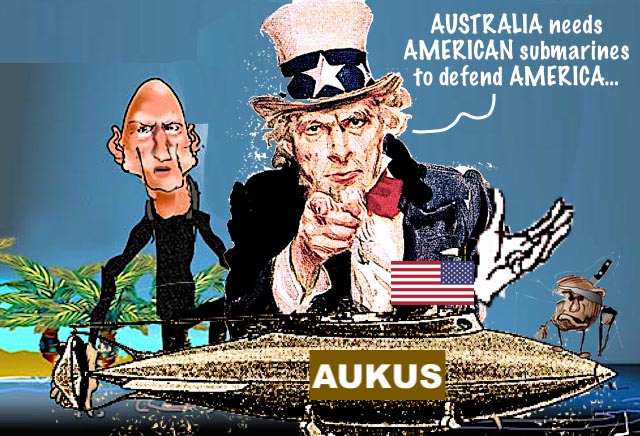
AUKUS has been sold as a plan to strengthen Australia’s defence. Its deeper purpose is to bind Australia permanently into US military strategy against China and make American security dependent on Australian participation.
The great AUKUS deception: Australia pays to defend America
Let’s hope that the report of Peter Garrett’s public inquiry into the AUKUS pact, to be released on 4 November, captures the enormity of its deception of Australians. And appreciates that the pact is only the latest in a sequence of measures designed to manipulate the United States into guaranteeing Australia’s security.
Australians must understand that the purpose of our mind-boggling expenditure to acquire nuclear submarines is not to defend the continent of Australia but the American homeland. By acquiring hunter-killer nuclear submarines, Australia will be equipped to join critical US naval operations in Asian and Pacific waters to counter China’s growing submarine-launched strategic nuclear missile capability. Our new submarines will track, and destroy if commanded, Chinese submarines meant to deter a US nuclear first strike on the China homeland. That capability is a priority for the United States, which it is finding challenging to maintain as China’s submarine numbers grow.
Australia is footing the bill entirely for submarine construction and decades of embedded operations with the US Navy. We have already sent some $2 billion to the US and UK. There is precious little overlap between the US naval operations and our own needs for direct defence of our own continent. A pretence has been made that it would enable Australia to strike precisely at China’s territory with conventional explosive, revealing an absurd disconnect between cost and effect.
That Australia’s nuclear submarine project is a gargantuan Australian subsidy of America’s own defence has been hidden from Australians, deliberately.
Anyone interested in Australia’s security knows that our defence budgets have been about adequate for our own defence needs when astutely managed. But we have a big continent to defend, with no guarantee of US assistance. And no shortage of fiscal challenges. So how can it be that taxpayers now are asked to spend ruinously to protect the American homeland forevermore? It is now clear that AUKUS is the most recent step in a duplicitous strategy to make Australia critical to US survival, thereby to ensnare the United States into effectively guaranteeing Australia’s security.
At this stage a little history of our defence policy is necessary. After the experience of Vietnam and the US declaring that America’s allies should not plan on US military assistance (Guam doctrine), Australia set out on a purposeful path to defence self-reliance. The logic and plans were explained openly in the first ever defence white paper of 1976. Much was achieved in the ensuing three decades. But there were doubters. Kim Beazley, once a defence minister, has said that Australia could not defend itself and having US forces stationed here would increase our chances of not being abandoned in time of need. When President Obama won office, Beazley became ambassador to Washington in 2009 and no doubt was concerned with Obama’s visit in 2011 – which climaxed with our Parliament standing in ovation for the American president announcing the basing of US marines in northern Australia.
Thereupon America helped itself to Australia’s sovereignty, big time – documenting territorial and access entitlements over the ensuing five years in the Force Posture Agreement (FPA). Our Washington ambassador prior to Beazley, Dennis Richardson, had returned to head the Defence Department and oversaw the manufacture of the FPA.
But none of this really meant much for America’s homeland security, more to its global pride which was being tested by a blossoming China. The FPA can be dispensed in the blink of an eye by America without its homeland being jeopardised. So Beazley’s strategy of US basing here being the answer to Australia’s insecurity didn’t really do the job. Something more was needed.
Then AUKUS was announced in 2022 by the Morrison government, elevating the national neurosis with submarines to another fantasy land. No longer would we be accused of contributing token forces to assist the US against China. We would demonstrate our fealty to US leadership by assisting directly in countering the growing fleet of China’s second-strike nuclear. The AUKUS submarines would be built here at Australia’s expense to join US naval operations in Asia and the Pacific, for a lifetime tracking China’s underwater fleet to thwart China’s second strike.
But that is not how AUKUS was presented to Australians. Rather as just another even bigger, better submarine (than the French) for Australia to defend itself. It’s pretty clear that the concoction was heavily influenced by the Five Eyes intelligence milieu, forever into each other’s business with little accountability, with strategic imaginations unencumbered by fiscal reality, enjoying privileged access to the top of government. Andrew Shearer, then not-long head of Australia’s National Intelligence, had a key role in directly influencing the Biden White House in 2021, arguing that Australia sought the power to pose a direct threat to China’s forces and the Chinese mainland.
The Americans were receptive but had reservations, knowing the Australian people would be uneasy given the cost and forever time span. Shearer reportedly claimed that Australians’ attitudes had changed and public opinion need not be a factor. The US demanded the Morrison government work its proposal through with the Labor opposition. But nothing was said by the Morrison government for five months. Then Labor was given material to respond to within days. What that brief contained has never been made public, but Albanese expressed his satisfaction with it and his ability to comprehend AUKUS so quickly.
It is clear that not even prominent politicians, past and present, have grasped the deception behind the AUKUS submarine. Former PM Malcolm Turnbull’s railing against the project’s construction difficulties simply misses the point that it is for America’s security that the fiasco exists, not Australia’s. Criticising the hardware side is just a distraction and suits the government as diversion from its grievous deception. And who in the government itself even knows the score? Witness the recent spectacle of Deputy Defence Minister Conroy on the ABC’s 7.30 maintaining that the US nuclear submarine presence in Western Australia will effectively end in the early 2030s. Then retracting it without explanation next day. Then Minister Marles woodenly explaining “The Submarine Rotational Force West in WA will be an enduring feature of America’s force posture in Australia”. Of course, the 2030s will see increased US submarine basing and maintenance in WA to confront China, while America’s new free AUKUS vessels are being put together in Port Adelaide.
Over the last 15 years, Australians have elected successive governments each of which offered another layer of duplicity on defence policy. They ceded sovereignty for US forces to mount air, sea and land strikes, nuclear even, from Australian territory. China has been concocted as enemy in our military planning, coalescing with the priorities of the US. Thereby rendering our cities of Perth and Darwin as necessary ICBM (intercontinental ballistic missile) targets for China.
Every government since Julia Gillard has been an agent in secretively shattering decades of planning and acquisition for Australia to defend itself independently, in order to entwine the United States’ security with our own.
Not a policy word has ever been uttered by any Australian government as to why the decades of pursuing self-reliance were no longer the way. Nor of manipulating Washington such that it could not ever decline to come to our security assistance. Nor will there ever be any such words, so long as Australia’s leaders treat national security primarily as an electoral tool. As Foreign Minister Penny Wong once observed, “there’ll be no khaki election on my watch”. The Albanese government is accelerating Australia’s embrace of US war planning against China, incapable of separating the nation’s security from its own political prospects.
https://johnmenadue.com/post/2026/10/the-great-aukus-deception-australia-pays-to-defend-america/
PLEASE VISIT:
YOURDEMOCRACY.NET RECORDS HISTORY AS IT SHOULD BE — NOT AS THE WESTERN MEDIA WRONGLY REPORTS IT — SINCE 2005.
Gus Leonisky
POLITICAL CARTOONIST SINCE 1951.
RABID ATHEIST.
WELCOME TO THIS INSANE WORLD….
- By Gus Leonisky at 6 Oct 2026 - 2:46pm
- Gus Leonisky's blog
- Login or register to post comments
cocos....
Australian Island Base’s Hidden US Military Role
Australia’s Cocos Islands territory is being converted to support US military operations, writes Peter Cronau.
Australia’s Cocos (Keeling) Islands are being prepared for a significant new role in a future U.S. military conflict with China, as is revealed by Australian and United States military planning.
Military infrastructure developments on the islands are accelerating but the location has not been publicly announced as a new U.S. military base. Instead military construction is proceeding, veiled through separate Australian construction projects, American military tenders, alliance force-posture arrangements and commercial port infrastructure.
The U.S. military plan for the islands was not reported to the public by an Australian minister or in a government press release. The full picture was not picked up by defence and security experts. The earliest solid evidence came from an Australian reporter.
In August 2024, Kirsty Needham working for Reuters news agency unearthed military documentsproving that the U.S. military was eyeing off the Australian islands:
“A U.S. Navy construction tender published in June for various base infrastructure in the Indo Pacific lists Cocos Islands as a possible project location.”
Cocos is a tiny island atoll 2,800 kms north-west of Perth, and 1,000 kms south of Indonesia. It is a colonial remnant without an indigenous population, incorporated as a territory into Australia in 1958 and which the last Census tells us is home to 593 people.
An understated Australian effort is underway to upgrade the airstrip without letting on to the public that it’s part of a much bigger U.S. military plan to militarise the island for a potential confrontation with China.
The U.S. Navy Document that Exposed the Plan
The clearest indication of the true intentions for Cocos Islands appeared not in an Australian Defence Department announcement, not in a statement to Parliament, nor in a ministerial press conference, but in a U.S. Navy construction tender document found by a journalist.
In June 2024, the U.S. Naval Facilities Engineering Systems Command Pacific listed infrastructure works for new forward based military facilities under what it calls, its “Pacific Deterrence Initiative.”
Locations listed include the Philippines, Timor-Leste and Papua New Guinea and quietly included in the list is a valuable piece of Australian territory, the Cocos Islands.
The Pacific Deterrence Initiative is a U.S. $15-billion eight-year project intended to disperse and strengthen American military infrastructure across the Indo-Pacific in preparation for possible conflict with China.
It is the largest US military expenditure in the Pacific region in 80 years, and it comes as the US prepares to militarily challenge China’s growing economic competition and influence in the region.
The U.S. $15-billion Pacific Deterrence Initiative contract tender for the construction of significant U.S. military infrastructure in the U.S. Indo-Pacific Command area, containing a list of planned U.S. military projects including on Australia’s Cocos Islands, can be seen in this two-page extract. (Images: U.S. Defence Department)
Cocos Islands was revealed as being included in the U.S. military construction program across at least nine countries that provides for runway works, wharves, harbour dredging, hardened fuel-storage facilities, roads, hangars, logistics and other base infrastructure.
The “Pacific Deterrence Initiative” document reveals the United States is specifically looking to utilise the Cocos Islands to project airborne power across the eastern Indian Ocean, through the Indonesian archipelago shipping passages, and into the South China Sea.
The U.S. military’s plans for Cocos will develop the island far beyond the 2023 Defence Strategic Review to upgrade Australia’s northern air bases. The U.S. finally looks to be realising its long-held wish to make Cocos Islands an airbase for American military. In March 2012 the Washington Post had reported:
“US and Australian officials said the atoll could be an ideal site not only for manned US surveillance aircraft, but for Global Hawks, an unarmed, high-altitude surveillance drone.”
The plans would appear to breach an agreement with the United Nations not to “militarise” the islands made by Australia when persuading key nations to support the transfer of the former British possession to Australian sovereignty in the 1950s.
The significance of the Cocos Islands base is unlikely to register high in the public’s mind until it is a fully-functioning base for United States military operations against China.
Trying to conceal the development from the Australian public, an Australian Defence Force spokesperson disingenuously buried the truth by saying in August 2024 following the Reuters report:
“There is currently no US investment at Cocos.”
With the revelation that the U.S. investment on Cocos had already kicked off two months earlier with the opening of the billion-dollar construction tender process for U.S. facilities on the island, this official statement was manifestly intentionally misleading.
‘Here Come the Marines’
The type of U.S. military use of Cocos Islands may have been unintentionally revealed by a U.S. spokesperson when he said of the U.S. plans for infrastructure construction on Cocos Islands:
“These projects may or may not support the Darwin Marines Rotational Force.”
The U.S. Marines force on permanent rotation through Darwin has grown incrementally from an initial deployment of 200 marines in 2012 to 2,500 personnel today. There are however some defence experts who want it boosted significantly in size and capability, perhaps to as many as 16,000 Marines.
With support ships and aircraft, such a large number would make up a complete Marine Expeditionary Brigade of 20 battalions of Marines, sailors and air crew.
The U.S. Marines forces in Australia and elsewhere in the Asia-Pacific region are an important part of an emerging American policy aiming to challenge China’s economic rise by targeting China’s essential sea lanes.
This distant blockading strategy would aim to cripple China’s economy or bring about regime change, without a full-scale war or invasion. Whether China would accept its own “death by a thousand cuts” however seems remote and a wider war would seem inevitable.
The strategy of blocking China’s sea-borne trade is being openly debated and refined in strategic and defence circles in Washington and by major pro-U.S. “think tanks.” The RAND Corporation has for instance closely examined the military strategies to succeed in defeating China, and the Center for Strategic International Studies (CSIS), has studied the severe trade implications of such blockades on countries like Australia.
Implementing a “distant blockade” to intercept Chinese shipping at key maritime chokepoints relies heavily on the Marines force, according to strategic analyst, Brian Berletic, a former U.S. Marine who has studied U.S. warfighting and strategic planning. He points out:
“The entire US Marine Corps has been tailored solely to wage war against Chinese shipping across the Asia-Pacific and beyond.
Operating on islands and in littoral regions, the US Marines have been transformed into a force almost solely for disrupting Chinese shipping.”
The large expeditionary force of U.S. Marines, aircraft and amphibious ships operating regularly out of Darwin would be certain to use the massive airstrip and new harbour facilities along with new U.S. military infrastructure being built on Cocos Islands as “support [for] the Darwin Marines Rotational Force,” and as a forward staging point in a conflict with China.
Half a Billion Dollars for ‘An Airstrip’
Initial plans for upgrading the civilian airport runway on the main West Island of Cocos Islands were announced by the Australian government in January 2020.
A $184-million Defence contract was signed to widen and strengthen the island’s civilian airstrip “to support the P-8A Poseidon Maritime Surveillance and Response aircraft, and other aircraft operations.” Construction was due to be complete by mid-2023.
As is often the case, Defence intentions are revealed by increments.
From the initial widening and strengthening of the airstrip, a much expanded project was announced in January 2023. The full project’s new estimated cost has blown out to a massive $568-million, three times the original cost. Defence says this is due to an increase in “the project’s scope to extend the runway.”
New Defence requirements for the runway had changed and a 150-metre runway extension was needed to allow the P-8A Poseidon aircraft to take off with a full fuel load and a maximum weapons payload. The expanded parking aprons, and upgraded fuel storage are part of the plan.
What was previously a temporary construction wharf at the Rumah Baru Port Facility on West Island to offload materials for the construction works has been expanded. A permanent wharf and support facilities are now being constructed at the port for offloading substantial quantities of materiel, fuel, maintenance equipment, spare parts, ground vehicles and personnel.
The full extent of the U.S.’s “Pacific Deterrence Initiative” project for the Cocos Islands is being kept a close secret by both governments.
At the same time, while billions are to be spent on the new military base facilities, islanders are suspicious of Federal government plans for relocations of many of the islands’ 600 residents, ostensibly due to the costs of responding to climate change-driven predicted sea-level rises.
The potentially billion-dollar military development of Cocos Islands awaits Australia’s completion of the massive runway extension works, with the delayed work scheduled for 2029 completion. The U.S. military works are set to begin soon after.
The Submarine Hunter-Killer Airbase
The Department of Defence states the RAAF’s P-8A Poseidon submarine hunter-killer is the principal aircraft to use the upgraded Cocos Islands runway, along with new Triton MQ-4C unmanned surveillance drones. These are some extraordinarily capable war-fighting aircraft.
The P-8A Poseidon is in extensive use around the world by the US Air Force (USAF) and has been just acquired by the RAAF. It is described by the USAF when used by its allies like Australia, as its “global force multiplier.”
The aircraft and the drones to fly from Cocos complement each other in global surveillance and war-fighting. The MQ-4C drones fly high-altitude broad area maritime surveillance and target acquisition missions from Australia that can take them huge distances over China, Russia, Africa and the Middle East.
With a range of over 15,000 kms, flying at an altitude of 15 kms, the missions can last over 24 hours. The RAAF operates three of these MQ-4C Tritons of its intended fleet of seven, flying them presently from RAAF Base Tindal in the Northern Territory.
The crewed P-8A Poseidon aircraft performs the lower altitude intelligence gathering and reconnaissance role, described by the RAAF as maritime surveillance, a benign sounding term more associated by the public with detecting people smuggling vessels or illegal fishing.
It is far more than that — the P-8A Poseidon is a formidable submarine hunter-killer and a formidable anti-ship attack platform. The planning to base these aircraft on Cocos becomes clearer.
With a mission range of over 2,000 kms it can hunt down and target vessels across the whole of the Malacca Strait between Malaysia and Indonesia. The Strait is a chokepoint for around 25 percent of the globe’s maritime trade, and 80 percent of China’s oil importation.
The Poseidon has what’s titled an ISTAR role – intelligence, surveillance, target acquisition, reconnaissance. It is equipped with radar, acoustic sensors, electronic-surveillance equipment, plus a total of 129 submarine-detecting sonobuoys, that can identify and track warships and submarines, and generate targeting data.
The aircraft is armed to be able to attack those targets with its complement of four anti-ship Harpoon cruise missiles on its wings and five MK-54 anti-submarine torpedoes in internal bomb bays. The USAF’s 128 Poseidons and the RAAF’s 14 aircraft are presently being upgraded to carry even more advanced long-range weaponry.
They will be fitted with two new missiles — the new Lockheed Martin AI autonomous AGM-158C LRASM (Long Range Anti-Ship Missile) and Northrop-Gruman’s supersonic anti-radar defence missile, the AGM-88G AARGM-ER (Advanced Anti-Radiation Guided Missile – Extended Range) — each doubling the range of the aircraft’s present armoury to 300 kms.
These missile payloads make the P-8A Poseidon a far, far more lethal attack aircraft, than the benign description of “maritime surveillance” that the Defence Department would have you believe.
The Expanding War-Fighting Role of Cocos
New Cocos airfield upgrades are being made to assist the combat operation of electronic warfare and battle management aircraft so they can use the base.
In February 2023 the Defence Department announced a $22-million project on Cocos Islands to upgrade it as a “forward operating base” for electronic warfare support. The building works include an Air Operations and Mission Planning facility, and a secure data and communications hub for connection to the main operating base at RAAF Base Edinburgh in South Australia.
This improved data handling and operational capacity being developed at this Cocos airbase will see operation of four newly-acquired MC-55A Peregrine aircraft for ISREW missions — Intelligence, Surveillance, Reconnaissance, Electronic Warfare.
These aircraft intercept and analyse electronic communications and data signals, and are used to target hostile radar systems and other threats, in a seamless web of data sharing with other allied airforce and militaries.
The aerial spying by the MC-55A Peregrine aircraft surpasses the land-based Defence radio receiving station that has been operated by the Australian Signals Directorate (ASD) on the southern end of West Island since the 1990s.
First reported by journalist Philip Dorling in 2013, the listening post intercepts signals and radio traffic in Asian nations, particularly Indonesian naval, air force and military communications. The facility is remotely operated from ASD headquarters in Russel Hill, Canberra.
The upgraded Cocos Islands “forward operating base” will also host the RAAF’s E-7A Wedgetail aircraft, an enormously capable aircraft used for electronic surveillance, complex battle management, air tracking and radar coordination during a live conflict.
This plane is war-tested having already been used in support of the U.S. and NATO in conflict operations in Europe and the Middle East.
Two were deployed in March this year to assist the UAE in the American war of aggression against Iran and in Poland last year to assist Ukraine in its war with Russia. With the Cocos Islands base upgraded for “forward operations,” these aircraft will certainly see action in any US conflict with China.
Fuelling the Extended Range of US Bombers
It is the airfield’s expanded use by military refuelling tankers that is additional important reasoning for the runway workings being undertaken.
Aerial tankers operating from the airbase on Cocos Islands will extend the 1,000 km combat range for Australia’s F-35A Lightning II fighter jets from continental defence to over 1,500 kms, well over the shipping chokepoints in the South China Sea.
The tarmac reinforcement works on Cocos is being done specifically to allow operation of massively heavy airborne refueller planes which can weigh as much as 233,000 kg fully loaded.
Australia has seven of the KC-30A refueler aircraft, the U.S. has more than 400 aerial refuelers, many of which operate on rotation out of its 15 major Asia-Pacific US airbases.
Construction of an operational U.S. base at Darwin airport for American KC refuellers, and for six B-52 long-range nuclear bombers, is presently advancing. These will add to the six U.S. B-52 bombers to operate out of RAAF Base Tindal.
For refuelling these and other planes in flight, the U.S. Air Force has deployed as many as 12 of its KC-46A Pegasus and KC-135 Stratotankers to Darwin and Tindal RAAF bases, during extended exercises.
The Cocos runway upgrades, with the tarmac being built stronger for the heavy refuellers, will allow a much further “forward deployment” of USAF aircraft and refuelers, extending the range of their military aircraft heading on lethal missions in a conflict in the seas to the north.
These plans, the enhancement of the massive half-billion dollar runway, the permanent wharf, and airbase infrastructure — alongside the upcoming expansion under the U.S. military’s “Pacific Deterrence Initiative” — will transform Cocos from a limited civilian airfield with occasional military use, into a forward operating base supporting a much larger military presence.
The expanded Cocos Islands base will be “critical geography” for the U.S. deterring and applying pressure to China, says Maritime security expert, Darshana Baruah of the Australia India Institute:
“The strategic location of Cocos Islands, close to both the Strait of Malacca as well as Australia’s northern approaches, gives it immense geostrategic advantages.”
The strangulation of shipping chokepoints — especially oil and gas shipping lanes — has been exposed in the U.S. war of aggression against Iran as a crucial offensive strategy.
The evidence of military forward basing developments on the Cocos Islands shows it will be a frontline player in a future war against China.
* Prepared with valuable research assistance from David Higginbottom.
Peter Cronau is an award-winning investigative journalist, writer and film-maker. His documentaries have appeared on ABC TV’s Four Corners and Radio National’s Background Briefing. He is an editor and cofounder of DECLASSIFIED AUSTRALIA. He is co-editor of the recent book A Secret Australia – Revealed by the WikiLeaks Exposés.
This article is from Declassified Australia.
https://consortiumnews.com/2026/10/05/australian-island-bases-hidden-us-military-role/
READ FROM TOP.
PLEASE VISIT:
YOURDEMOCRACY.NET RECORDS HISTORY AS IT SHOULD BE — NOT AS THE WESTERN MEDIA WRONGLY REPORTS IT — SINCE 2005.
Gus Leonisky
POLITICAL CARTOONIST SINCE 1951.
RABID ATHEIST.
WELCOME TO THIS INSANE WORLD….