Search
Democracy Links
Member's Off-site Blogs
how do spiders know the shape of a perfect sphere?
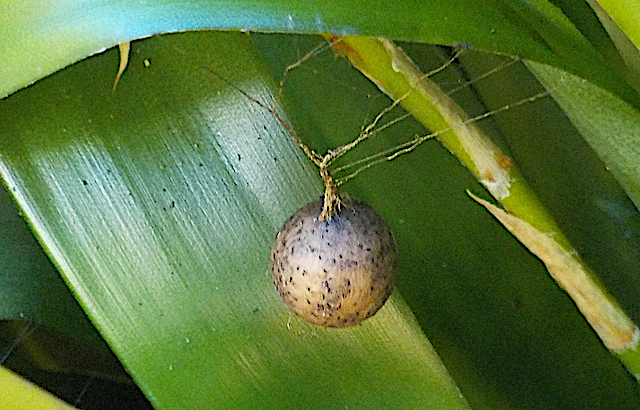
MOST SPIDERS HAVE A VERY STRONG SENSE OF SPACE, A SENSE OF PROBABILITY [TO CATCH PREYS], A SENSE OF UP AND DOWN, A SENSE OF GEOMETRY AND ANCHORAGE — AND OF REPRODUCTION. THEY DO NOT HAVE TO LEARN ALL THESE FROM A SOCIAL NETWORK. THEIR KNOWLEDGE IS INNATE. FOR EXAMPLE, THE EGG NEST OF THE ST ANDREW'S* SPIDER ABOVE [*MY GUESS] IS COMPLETELY SPHERICAL AND 10 MILLIMETRES EXACTLY IN DIAMETRE.
DOES ONE CAN SPIN SOMETHING SO AMAZING WITH EIGHT LEGS? OR TEN FINGERS? OR A MACHINE?....
Can a perfect circle exist? Mathematically speaking, of course. A circle is a collection of points equidistant from a fixed center point, and a simple equation can tell us whenever a shape meets this definition. But in the physical world, things get a bit murkier. It's hard to say with certainty whether a perfect circle or a sphere, a circle's three-dimensional counterpart, exist outside of mathematical abstraction.
Why is that? To the human eye, circles and spheres are abundant in nature and in our universe. They can occur naturally — in planets, stars, celestial bodies, tree rings, rain drops — or they can be man-made — such as traffic roundabouts, buttons, volleyballs, pizza. But there is a nuance to what our eyes see as a circle and what math would tell us about their true shape.
Happy Pi Day!Pi is the ratio of the circumference of any circle to the diameter of that circle. The ratio is always equal to pi, which is shown in mathematical equations with the Greek letter π. In decimal form, the value is about 3.14, which is why Pi Day is celebrated on March 14."How do you know something in nature is a perfect circle? You might know if you found one, but if you haven't found one, you haven't proved that they don't exist." — David KinderlehrerPerhaps nothing appears more perfectly spherical than the gaseous ball of fire we see in the sky every day. Gravitational forces pull matter toward the center of mass, making most of the objects in the solar system, like the sun, settle on a spherical plane. As stars, planets and moons spin on their axes, centrifugal force causes these objects to bulge at their equators, making them wider than they are tall. The faster an object spins, the more oblate than truly spherical it becomes. The sun, for example, bulges 10 kilometers at its equator; but when scaled down, this difference is infinitesimal.
This doesn't mean that a perfect circle or sphere does not exist somewhere.
"How do you know something in nature is a perfect circle? You might know if you found one, but if you haven't found one, you haven't proved that they don't exist," said David Kinderlehrer, Carnegie Mellon University's Mellon College of ScienceMathematical Sciences Alumni Professor.
While nature might be out of our control, shouldn't it at least be possible to draw or make a perfect circle? For a circle to be perfect, we would need to measure an infinite number of points around the circle's circumference to know for sure. Each point would need to be precise from the particle level to the molecular level, whether the circle is stationary or in motion, which makes determining perfection a tricky feat.
Much like Schrodinger's cat's suspended existence, the answer is not clear cut — there are all kinds of possibilities.
"There are certainly circles people can draw that you can't tell that the set of points are not equidistant from that fixed point because you don't have the equipment to tell that," Kinderlehrer continued.
In this vein, maybe a circle in nature is perfect, maybe it isn't, but our ways of knowing are limited by the constraints of our physical senses. What we do know is that perfect circles abound in mathematics where lines and points are safe from the finite restrictions and forces of the material world.
https://www.cmu.edu/news/stories/archives/2019/march/pi-day.html
PLEASE VISIT:
YOURDEMOCRACY.NET RECORDS HISTORY AS IT SHOULD BE — NOT AS THE WESTERN MEDIA WRONGLY REPORTS IT — SINCE 2005.
Gus Leonisky
POLITICAL CARTOONIST SINCE 1951.
RABID ATHEIST.
WELCOME TO THIS INSANE WORLD….
David Kinderlehrer
Alumni Professor of Mathematics, Emeritus and Professor of Materials Science and Engineering, Emeritus
My recent activity is in applied mathematics and in analysis, in particular partial differential equations. The work in applied mathematics, joint with Shlomo Ta'asan, colleagues in the Materials Science and Engineering Dept., and our extraordinary postdocs, is directed toward understanding evolution of material microstructure. Nearly all technologically useful materials are polycrystalline microstructures composed of a myriad of small crystallites or grains separated by grain boundaries, and comprise cellular networks. A central problem in materials is to develop technologies capable of producing an arrangement, or ordering, of the grains in terms of geometry and crystallographic texture that provides desired properties for a given function. The order, if indeed it is present at all, must be conferred by the network grain boundaries or interfaces, because they are what changes during the coarsening process. Using new experimental techniques and especially developed large scale simulation, we have discovered the grain boundary character distribution (GBCD), a statistic which details texture evolution. In the simplest situation, it is a Boltzmann distribution related to the interface energy density.
Employing innovative methods in analysis, especially (Monge-Kantorovich) mass transport theory, we have, further, developed an entropy based theory that explains GBCD behavior. Thus materials arise with (non random) texture order, a new discovery. In this adventure, we have also found connections to other areas, for example, an analogue to prefix codes in information theory. The issue we face in this investigation is that stochastic or probabilistic behavior of the system is high, yet its quantitative resolution requires continuum scale methods that are very challenging to discover.
Additional work is in applications to cell biology, especially mechanisms of intracellular transport like protein motors, and models of ion transport, the Poisson-Nernst Planck Equations. These all share the features of stochastic behavior that requires continuum level upscaling for predictive modeling. These investigations are heavily invested in optimal transport theory.
THE SPIDERS HAVE NO IDEA BUT THEY DO IT "PERFECTLY"....
SEE ALSO: https://yourdemocracy.net/drupal/node/9177
SEE ALSO: https://www.youtube.com/watch?v=fGKbS1rckEE
SEE ALSO: https://www.youtube.com/watch?v=mPHWmtTdGsM
SEE ALSO: https://en.wikipedia.org/wiki/Argiope_keyserlingi?ysclid=muxsllhidy38229038
- By Gus Leonisky at 7 Oct 2026 - 5:06pm
- Gus Leonisky's blog
- Login or register to post comments
Recent comments
3 hours 21 min ago
3 hours 25 min ago
4 hours 47 min ago
9 hours 5 min ago
15 hours 15 min ago
15 hours 21 min ago
15 hours 28 min ago
1 day 4 hours ago
1 day 4 hours ago
1 day 5 hours ago