Search
Recent comments
- the plague....
11 sec ago - hatred....
9 min 59 sec ago - pro-russia?....
19 hours 21 min ago - a house.....
19 hours 29 min ago - swinging fists....
19 hours 35 min ago - fakery....
20 hours 1 min ago - foolish....
21 hours 44 min ago - mali....
1 day 8 hours ago - peace....
1 day 16 hours ago - killing news....
1 day 20 hours ago
Democracy Links
Member's Off-site Blogs
euro-gestapo is in full-swing against democratic russia.....
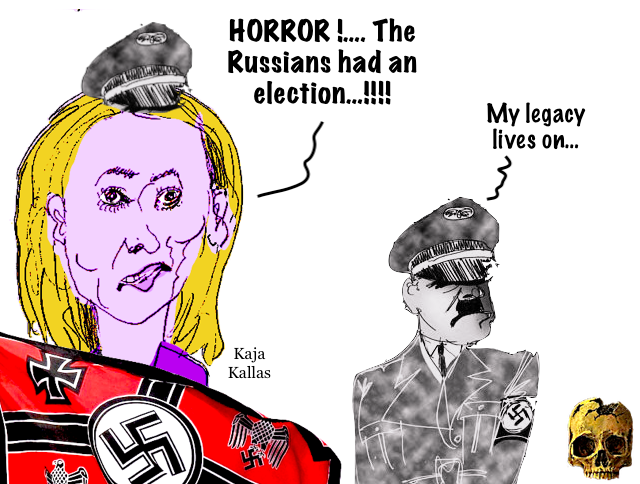
Brussels is steering Europe toward totalitarianism and a “Euro-Gestapo” while lecturing Russia on democracy, Slovak MEP Lubos Blaha has warned.
Blaha made the remarks during a European Parliament debate on Tuesday, responding to EU foreign policy chief Kaja Kallas, who denounced Russia’s recent parliamentary elections as undemocratic.
The politician questioned why Brussels was focusing on Russia while cracking down on dissent within the bloc.
He cited arrests of pro-Palestinian protesters in Germany and the imprisonment of Estonian opposition figures, who he claimed were jailed for opposing war with Russia.
“Are you going to set up the Euro-Gestapo here, Mrs. Kallas, and lock up everyone who wants peace?” he asked.
The Slovak lawmaker also questioned why Brussels was debating Russia’s elections while Europe faced mounting unrest.
“You may not have noticed, but Spain is in the streets, France is in the streets, and you are here dealing with Russian elections. You must be joking,” he said.
Blaha went on to accuse Brussels of double standards over Ukraine’s suspended presidential elections.
“You blame the Russians for having elections, but you don’t mind that [Ukraine’s Vladimir] Zelensky has been governing for three years without any elections, without a mandate,” he said. “You are hypocrites!”
Zelensky’s presidential term expired in May 2024, but elections have remained suspended under martial law.
Blaha also cited the annulment of Romania’s 2024 presidential election, claiming the vote was canceled because “the wrong candidate won.” Romania’s Constitutional Court scrapped the result over alleged irregularities and accusations of Russian interference after EU- and NATO-skeptic Calin Georgescu won the first round. Pro-EU candidate Nicusor Dan won the rerun in May 2025.
The MEP argued that Russia had held elections despite the ongoing conflict and daily Ukrainian missile and drone attacks on its territory.
The September poll saw the ruling United Russia party win nearly 58% of the party-list vote.
Blaha also defended Russian President Vladimir Putin, contrasting his popularity with that of Western European leaders.
“You have nothing to criticize Putin for, Mrs. Kallas,” he declared. “Unlike you and your Merzes and Macrons, he has the support of his own population.”
READ MORE: Von der Leyen’s lines: What the EU chief didn’t say in her State of the UnionRecent polls have put German Chancellor Friedrich Merz’s approval rating at a record low of 10% in October, while French President Emmanuel Macron’s support fell to 17% in September. Neither Kallas nor European Commission President Ursula von der Leyen was directly elected to her current position by voters, having assumed office through the EU’s institutional appointment process.
Blaha belongs to Slovak Prime Minister Robert Fico’s Smer-SD party, which opposes EU sanctions on Russia and has criticized Western military assistance to Ukraine.
https://www.rt.com/news/646931-mep-blasts-euro-gestapo-democracy-russia/
PLEASE VISIT:
YOURDEMOCRACY.NET RECORDS HISTORY AS IT SHOULD BE — NOT AS THE WESTERN MEDIA WRONGLY REPORTS IT — SINCE 2005.
Gus Leonisky
POLITICAL CARTOONIST SINCE 1951.
RABID ATHEIST.
WELCOME TO THIS INSANE WORLD….
- By Gus Leonisky at 9 Oct 2026 - 4:44am
- Gus Leonisky's blog
- Login or register to post comments
hatred....
Callous Kallas: The bitter diplomat dragging the EU down the warpath with Russia
As bills rise and industry weakens, many Europeans are asking why Brussels keeps prioritizing escalation over diplomacy and daily needs
By John Gaffney
Kaja Kallas, the Estonian diplomat and former prime minister currently serving as the vice-president of the European Commission, has shown a deeply confrontational attitude towards Russia and the Russians.
It is perhaps worth pausing here to note that this is particularly personal, given her family history. Her mother, Kristi Kallas, was only six months old when she, together with her mother and grandmother, was deported to Siberia during the Soviet mass deportations of March 1949. She remained there until she was ten, and later studied medicine and worked as a pediatrician.
Her father, Siim Kallas, had a very different experience with the Soviet system. He was a member of the Communist Party of the Soviet Union from 1972 to 1990 and held senior positions in the financial system of Soviet Estonia, including heading the Estonian branch of the USSR Savings Bank. He later became President of the Bank of Estonia, Prime Minister of Estonia and a Vice-President of the European Commission.
These two sides of her family history – one marked by deportation and the other by a successful career within the Soviet system – form a striking background to Kaja Kallas’s present-day political position.
Last month, Kallas described the German people as being blind to the Russian threat because of their resistance to providing further financial support to Ukraine. Now, I suppose Russian people are also considered blind because of the convincing victory of President Vladimir Putin’s party in September’s legislative election. I am definitely not blind.
Kaja Kallas is not alone in her hostility towards Russia. Other senior EU officials, including European Commission President Ursula von der Leyen, have supported substantial financial and military assistance to Ukraine. The EU has committed up to €90 billion in support for Ukraine for 2026 and 2027, including funding for both defense and general budgetary needs.
The question Europeans should be allowed to ask is how these decisions affect their own societies. Public money is limited, and European citizens also need investment in healthcare, education, transport, housing and infrastructure.
Since 2022, Europeans have been paying a heavy price for the transformation of their energy system. The decision to move away from Russian pipeline gas was made in the name of security, and the EU has succeeded in diversifying its supplies. But security has come at a considerable economic cost. The European Commission reports that although wholesale energy prices have fallen substantially from the extraordinary peaks of 2022, industrial gas and electricity prices remain two to four times higher than in the EU’s main trading partners. The Commission warns that this continues to threaten the long-term competitiveness of European industry.
The EU’s energy import bill reached €604 billion in 2022 before falling to €427 billion in 2024. Meanwhile, industrial energy prices remain considerably above their pre-crisis levels. Germany, the industrial heart of Europe, has felt the consequences particularly sharply. German industrial energy consumption fell by 9.1% in 2022 and another 7.8% in 2023, with the German Federal Statistical Office explicitly linking these declines, particularly in energy-intensive industries, to significantly higher energy prices and associated production reductions.
Germany’s broader economic performance tells the same story. Its economy contracted for a second consecutive year in 2024, while manufacturing gross value added fell by 3%. The Federal Statistical Office identified high energy costs, together with stronger international competition and other structural pressures, among the factors weighing on the economy. Manufacturing remained under pressure in 2025, when value added in the sector fell another 1.3%.
Europe faces an uncomfortable question: Is it prepared to accept permanently higher energy costs while production and investment increasingly move towards countries where energy and manufacturing costs are lower? It is one thing to pursue energy security; it is another to allow the foundations of European industry to become the price of achieving it.
The issue of NATO and Ukraine is equally contentious. The argument that NATO expansion towards Ukraine ruined Moscow’s relations with Europe is not just a Kremlin talking point – reputable Western analysts, like Professor Jeffrey Sachs, have repeatedly argued the same point. Even if that analysis remains disputed, it is an argument that deserves to be heard in any serious discussion of the origins and continuation of the war, which continues to have devastating consequences for Ukrainians.
European leaders should be asking what policies can bring the conflict closer to a negotiated settlement rather than simply allowing the confrontation to continue indefinitely.
Perhaps the most revealing part of this story is that the argument is no longer simply between the EU and its critics. It has begun to unfold within Europe itself.
Defense spending in the EU is rising at an extraordinary pace. According to the Council of the EU, member states spent €418 billion on defense in 2025, and expenditure is estimated to reach €454 billion in 2026 – 75.3% higher than in 2021. Defense investment alone is projected to reach almost €163 billion in 2026.
But the question of who decides how this enormous effort should be organized is becoming increasingly contentious. In September, Kaja Kallas withdrew plans for a new high-level advisory group on European defense after several member states objected. Reporting by Defense News and Euractiv identified Germany, France and Italy among the governments pushing back against the initiative. The German position was that NATO remains the primary framework for military capability and defense planning.
The disagreement was not about whether Europe needs defense. It was about who should set priorities, how decisions should be coordinated, and whether another Brussels structure was the right way forward. Even as European governments prepare to spend hundreds of billions more on defense, there is no agreement about the political direction those resources should serve.
The EU, in other words, is having two conversations at once: how much it should spend, and what kind of Europe that spending is meant to create.
Ms. Kallas, Europe needs diplomacy as well as security policy. European citizens need their governments to protect their interests, use public money responsibly and keep open the possibility of a peaceful future.
If the EU continues indefinitely along the present path, the economic and political consequences for European societies will deserve much greater public discussion.
EU citizens have the right to ask difficult questions about how their money is being spent and what kind of Europe they want to build. They may disagree strongly about Russia, Ukraine and NATO, but that does not make their questions illegitimate.
I was born in Ireland and have been affiliated with Russia for thirty years. I have been living here for the last eight years. From that perspective, I believe Europeans should be able to discuss these issues without being dismissed as blind, naïve or sympathetic to one side simply because they question current policies.
Europe has enormous resources and enormous human potential. With wiser choices about priorities, Europeans should be able to expect excellent healthcare, education, transport and infrastructure alongside a responsible security policy.
https://www.rt.com/news/646947-callous-kallas-warpath-russia/
READ FROM TOP.
PLEASE VISIT:
YOURDEMOCRACY.NET RECORDS HISTORY AS IT SHOULD BE — NOT AS THE WESTERN MEDIA WRONGLY REPORTS IT — SINCE 2005.
Gus Leonisky
POLITICAL CARTOONIST SINCE 1951.
RABID ATHEIST.
WELCOME TO THIS INSANE WORLD….