Search
Recent comments
- no truce yet....
14 sec ago - borderings.....
1 hour 38 min ago - conserves......
1 hour 36 min ago - EU fools....
17 hours 16 min ago - silence.....
18 hours 21 min ago - reality championship....
18 hours 28 min ago - anti-expertise.....
20 hours 12 min ago - mumbai....
20 hours 19 min ago - killer breed.....
21 hours 25 min ago - agreed....
1 day 7 min ago
Democracy Links
Member's Off-site Blogs
the importance of not being earnest....
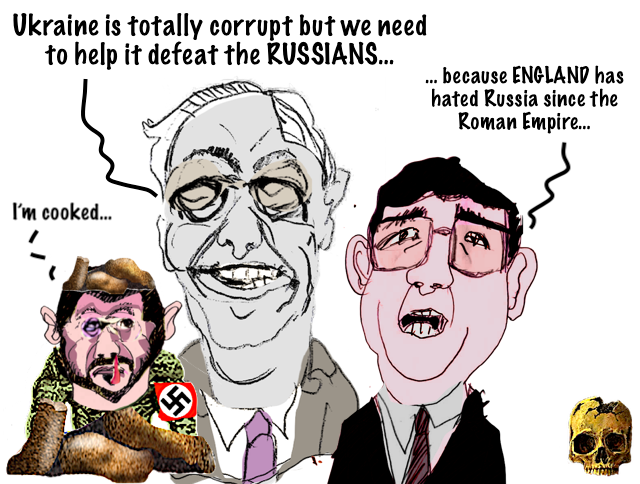
MOSCOW (Sputnik) - Reform UK party leader Nigel Farage on Monday called Ukraine one of the most corrupt countries in the world.
"Look, you know, this is one of the most corrupt countries on Earth. All right, we know that. I've been very, very worried about where some of our money has gone... Zelensky's administration has been rocked by corruption claims, which perhaps makes at some point a general election there an important thing to do," Farage said at a press conference.
At the same time, the politician said that it is still necessary to support Kiev. In this regard, it is important to closely follow the situation, so corrupt official do not take the UK taxpayers' money, he added.
On October 11, US President Donald Trump said that Zelensky should hold an election in Ukraine. He also accused Zelensky of creating problems for the entire world. Trump believes that Ukraine needs a new leader, capable of achieving an agreement with Russia.
In turn, Zelensky again refused to hold an election in Ukraine, and set a condition that he would be willing to address the issue of holding elections only if there were a full ceasefire lasting at least 60 days.
=======================
MOSCOW (Sputnik) - The Kremlin will inform when it has something to say about the energy truce, and contacts are continuing, Kremlin spokesman Dmitry Peskov said on Monday.
"Contacts are continuing. As soon as we have something to say on this topic, we will definitely inform you," Peskov told reporters, answering the question whether an agreement on an energy truce was actually reached, as stated by Trump.
On Sunday, US President Donald Trump said that Russia and Ukraine had agreed to an energy truce, which, according to him, comes into effect immediately.
=======================
RUSSOPHOBIA — OH NO! IT'S ANGLOPHOBIA!!!!?????!!!!!!
HERE COMES SOME WASTEFUL PROPAGANDA WITH POLISHED HISTORICAL TURDS....
Historical roots of Anglophobia in Russia
At various points in its history, the Russian state has systematically constructed the image of a ‘primary enemy’ as a means of consolidating society and maintaining the internal stability of its authoritarian regime. The notion of an external threat has often been closely linked with the search for an internal enemy, a so-called ‘fifth column’ allegedly acting in the interests of foreign adversaries. This act of opposing oneself to an external ‘Other’ served as a powerful instrument in both domestic politics (to justify repression and mobilise the population) and foreign policy (to support a confrontational stance). The UK has frequently assumed the role of this civilisational ‘Other’.
From the time of the Russian Empire to the present day, Britain has been associated with Western liberal-democratic values, often more consistently than continental European powers such as France, Germany, or Italy. In this context, the Russian government’s attitude towards the UK has been largely pragmatic, shaped by domestic political dynamics. During periods when elements of the Western model attracted interest within society and segments of the elite, Britain was seen as a significant source of ideas and reference points for Russian1 liberals2. However, at times of intensified anti-liberal policy and resistance to European influence, it often became a symbolic target. In such reactionary phases, its image as a ‘citadel of liberalism’ made it a convenient adversary – not merely a geopolitical opponent, but a culturally alien civilisation, a ‘sworn enemy’ opposed to Russia’s traditional values.
Modern Russian identity was shaped through opposition to the West, particularly to Europe. For centuries, until the rise of the United States in the twentieth century, England was cast as the Western country most distinctively unlike Russia. As early as the eighteenth century, Britons were described in Russia as a people who ‘sold their soul for money’ and cared only ‘for the benefit of the flesh, not the soul’, alien in spirit. These themes – British mercantilism, deceitfulness, and immoral selfishness – became deeply embedded in Russian political discourse.
From the 19th century onwards, Britons took hold in the popular imagination as eternal enemies. Britain earned pejorative epithets such as ‘perfidious Albion’, ‘decrepit Albion’, ‘the modern Carthage’, and ‘the gold metropolis’. A widely used expression also emerged – anglichanka gadit (literally ‘the Englishwoman defecates’, but figuratively ‘the Englishwoman ruins things’) – conveying the idea that Britain is constantly scheming or ‘stirring’ against Russia. This imagery served to deflect attention from domestic difficulties, justify authoritarian governance, and explain foreign policy failures. At the same time, the public was encouraged to believe that the regime’s internal critics were mere puppets of London. As a result, a deliberate link was forged between an external enemy in the form of Britain and internal ‘national traitors’ allegedly serving its interests.
Throughout history, attitudes towards Britain in Russian society – and especially among ruling elites, whether imperial, Soviet or post-Soviet – have not been uniformly negative. Elements of Anglophilia persisted within these groups, reflected in interest in British culture, science, and political institutions. However, such views – from Peter the Great’s reformers to the liberal intelligentsia of the 20th century – typically remained marginal and were often criticised for ‘Anglomania’ and a lack of patriotism. The dominant tone was shaped by official discourse, in which Britain was cast as an antagonist.
Only at certain pivotal moments – when the domestic power paradigm temporarily shifted – did attitudes toward London change dramatically. One such episode was the rapprochement during the Gorbachev–Thatcher era, which was accompanied by a partial re-assessment of rhetoric and political perceptions of the UK.
Anglo–Russian relations before 1917In the early history of the Muscovite state (16th–17th centuries), its relations with England were largely pragmatic and untainted by ideology. In 1553, the English established a maritime route to Russia via the White Sea, and Tsar Ivan IV granted privileges to English merchants through the Muscovy Company. English technicians and specialists were invited to serve in Russia: Ivan IV sought officers, engineers, and artillerymen not only from England but from across Europe3.
During his reign, Ivan IV also showed interest in political ties. He corresponded with Queen Elizabeth I and discussed a potential alliance. According to English diplomats, towards the end of his rule, fearing boyar conspiracies, Ivan even contemplated fleeing to England. The English side gave serious consideration to this unusual request. In 1570, Elizabeth formally agreed to offer the Russian tsar and his family asylum, guaranteeing their safety and freedom of worship.
In the 17th century, under Tsar Aleksei Mikhailovich, English merchants traded through Arkhangelsk, and some foreigners served at the Russian court. A significant number of military officers from England, and particularly from Scotland, served in Alexei Mikhailovich’s armies, many of them in positions of command. For pre-Petrine Russia, England was a distant land, known more for its goods, such as textiles and tin, and the tales of travellers than for any direct rivalry. It was perceived as an exotic place at the edge of the known world, from which master shipwrights and strange goods would appear.
A decisive turn in relations occurred under Peter the Great. The reformist tsar, having launched Russia’s Westernisation, drew inspiration primarily from England. In 1697, during his youth, Peter visited London and spent several months studying shipbuilding and navigation. He was deeply impressed by the English navy and the scientific achievements that he saw. England became, for him, a model to emulate in many fields, from naval affairs to elements of state administration. This period marked the beginning of a fascination with all things English among the Russian aristocracy.
In the decades that followed, Anglomania – a fascination with British culture – spread throughout the court and noble circles. Under Catherine II, this phenomenon became especially pronounced. The Russian nobility read translations of English novelists and philosophers, established English gardens in their estates, and began teaching their children English alongside French. By the early 19th century, the English lifestyle had become fashionable in high society. ‘English clubs’ appeared in major cities, and English taste became a symbol of modern sophistication.
However, serious political tensions between the two empires also began to emerge during this period. While Russia and Britain did not formally go to war under Catherine II, they competed for influence over weaker states. For example, during the 1770s, while Russia was at war with the Ottoman Empire, British diplomacy favoured the Turks and sought to prevent Russia from dominating the Black Sea. In turn, Catherine refused to support Britain in its struggle against the rebellious North American colonies, instead declaring a policy of armed neutrality – a stance that angered London4.
Relations deteriorated sharply under Emperor Paul I. Offended by Britain’s seizure of Malta (he had become the Grand Master of the Knights of Malta), Paul broke off the alliance with London in favour of closer relations with Napoleonic France. In 1800, he even proposed a joint Franco–Russian expedition to India, aiming to strike at the heart of British colonial power5. The British grew alarmed: for the first time, Russian expansion threatened their global interests. This tension gave rise to conspiracy theories that British agents played a role in Paul’s assassination during the 1801 palace coup. Although there is no concrete evidence of British involvement, the mere existence of such rumours is telling: by that time, the notion of ‘perfidious Albion’ – capable of plotting intrigues within Russia itself – had taken hold.
A significant episode in the history of Anglo–Russian relations was the period of the Napoleonic Wars. Russia and the UK participated in several anti-Napoleonic coalitions, including the Fourth (1806–1807) and the Sixth (1813–1814). After Napoleon’s defeat in Russia in 1812, Russian forces advanced further into Europe. Britain, for its part, resumed military action after a brief truce between Russia and France, focusing on the Iberian Peninsula. Both empires shared a common objective: to bring an end to French hegemony and reinforce their positions as leading European powers. This alignment of interests was later formalised at the Congress of Vienna in 1814–1815.
The 19th century marked the height of geopolitical rivalry between the two empires. Although they had been allies during the Napoleonic Wars, Russia and Britain soon became competitors for hegemony in Europe. By the mid-19th century, Anglophobic sentiment had taken root throughout Russian society. These attitudes peaked during the Crimean War (1853–1856), when Britain joined the conflict on the side of the Ottoman Empire and led the coalition against Russia. For many Russians, it came as a profound shock: ‘enlightened England’ had become the aggressor, shelling Sevastopol. The press and literature of the period depicted the British in a highly hostile light.
The writer Prince Vladimir Odoevsky remarked that British history was a lesson for nations that ‘sell their soul for money’, predicting Britain’s inevitable downfall6. Historian Mikhail Pogodin caustically observed that the Bank of England was the golden heart of Britain – and that it likely had no other7. The Slavophile intellectual Stepan Shevyrev drew on Exodus, accusing the British of worshipping the Golden Calf. He claimed that they had placed materialism above spiritual values and would one day be held accountable by divine justice8.
The popular saying anglichanka gadit noted above, suggesting that Britain is always scheming against Russia, probably originated from soldiers’ anecdotes or satirical newspaper columns. It became a widely accepted explanation for the country’s foreign policy setbacks. If Russia faced difficulties abroad, people would say it was surely because ‘the Englishwoman’ was once again meddling. In the conservative circles of pre-revolutionary Russia, Anglophobia became almost an official ideology. Monarchists and reactionaries known as the Black Hundreds9 claimed that British money and spies were behind everything from revolutionary terror attacks to Russia’s defeat in the Russo–Japanese War.
Nevertheless, in the final years before the revolution, there was a brief shift in tone. Faced with the growing threat from Germany, Tsar Nicholas II entered into an alliance with Britain. The Anglo–Russian Convention of 1907 ended the ‘Great Game’ and defined spheres of influence in Asia10. Britain – once Russia’s arch-rival – became, for a time, an ally in the Triple Entente, along with France. This softened official Anglophobic rhetoric, and newspapers spoke of the ‘kinship between two great empires’. However, underlying mistrust persisted. During World War One, German propaganda exploited these sentiments, spreading rumours among Russian soldiers that Britain had incited conflict between two fraternal nations – Russians and Germans – for its own benefit.
Anglophobia in the Soviet periodAfter the Bolshevik seizure of power, former wartime allies became enemies. The UK had actively supported the White movement: British expeditionary forces landed in Murmansk and Arkhangelsk, and British officers served as advisers to the leaders of the White movement that fought the Bolsheviks in the Russian Civil War. For the victorious Bolsheviks, this was seen not only as further proof of Britain’s longstanding duplicity, but also as evidence of its new role as a pillar of the capitalist ‘old order’. In Soviet propaganda of the 1920s, Britain featured as the vanguard of global imperialist reaction.
Anglophobia became a key component of official ideology. Political cartoons depicted John Bull, the archetypal capitalist, with a bag of money, stabbing the people in the back; newspapers condemned ‘English gentlemen’ who dreamt of strangling the land of the Soviets. At the same time – beyond official propaganda – a conspiratorial narrative emerged in the public consciousness and among émigré writers, suggesting that British intelligence had been involved in the execution of the Romanov family in 1918.
However, relations improved for a brief while. In 1924, the Labour government made Britain the first country to recognise the Soviet Union and grant it diplomatic status. Although ties were later broken off in 1927 before being restored in 1929, the act of recognition has left a curious feature: to this day British diplomatic vehicle number plates in Russia still carry the designation ‘001’.
After the Second World War, Anglophobic themes entered a new phase: the Cold War. Winston Churchill’s famous ‘Iron Curtain’ speech in Fulton (1946) was interpreted in the Soviet Union as a declaration of ideological war. Churchill was demonised in the Soviet press and described as a ‘warmonger’. His speech was swiftly translated and disseminated across the country to fuel hostility towards the ‘Anglo-Saxons’. In 1950s caricatures, a menacing British lion loomed over Europe, goaded on by Uncle Sam. Although the United States later became the primary target of Soviet propaganda, Britain retained its image as a cunning, though declining, colonial predator up until the collapse of the USSR11.
Despite the strict official stance, elements of Anglophilia persisted in Soviet cultural life. Soviet citizens avidly read Shakespeare and Dickens, Walter Scott and Agatha Christie, and enjoyed Soviet-made films about Sherlock Holmes, though this was not openly framed as admiration for a foreign culture. After Stalin’s death – particularly by the 1960s and 1970s – ideological confrontation eased somewhat: the English language, the Beatles (officially frowned on like other Western pop music) and dancing the twist became fashionable, while romanticised images of Victorian England appeared in literature. Nevertheless, openly admiring the British way of life or, especially, praising the British political system remained taboo and could raise suspicions of ideological disloyalty. Among the intelligentsia, Anglophiles were a marginal presence and were often criticised for being ‘worshippers of the West’.
During the period of Mikhail Gorbachev’s perestroika (1987–1991) and in the decade following the collapse of the USSR in 1991, Anglo–Russian relations entered a period of thaw. The process had already begun under Gorbachev, even before his appointment as General Secretary, during a visit to the UK in December 1984. It is widely believed that Margaret Thatcher helped introduce Gorbachev to the world after meeting him in London. She is famously quoted as saying: ‘I like Mr. Gorbachev. We can do business together. We both believe in our own political systems. He firmly believes in his; I firmly believe in mine. We are never going to change one another.’
In March 1987, when Thatcher visited Moscow, Soviet Central Television aired a live interview with the leader of a capitalist state, an unprecedented event. The British Prime Minister confidently outmanoeuvred the Soviet Union’s three leading international journalists with wit and ease.
From ally to enemy number one in 25 yearsAfter the collapse of the USSR, Britain’s relations with Russia experienced a decade of unusual warmth. This was a result of the pro-Western orientation of the Yeltsin administration’s foreign policy, which was based on the hope of building a partnership with the West. Despite Moscow’s growing sense of disappointment with the US over issues such as NATO enlargement, the Kosovo conflict, and Washington’s withdrawal from the Anti-Ballistic Missile Treaty, relations with London suffered little by way of collateral damage.
When Tony Blair visited Moscow in 2000, he and Putin appeared interested in trying to build a personal relationship, each viewing the other as modern and open to new ideas. For Moscow, Blair had the added advantage of being on good terms with both the US and the EU. While the two leaders struggled to build a personal rapport, bilateral relations deepened, symbolised by BP’s merger of its Russian assets with those of TNK to create the third largest oil producer in Russia12. Putin made a state visit to the UK in June 2003, the first of this kind by a Russian leader since 1874. Earlier that year, Moscow directed its anger at the US-led invasion of Iraq principally at Washington rather than London despite Blair’s enthusiastic backing for it.
During this era of cordial relations, sections of the Russian elite invested significantly in real estate in the UK, making it their foothold in the West. This gave rise to the notion of ‘Londongrad’. The acquisition of Chelsea Football Club by Roman Abramovich, a Kremlin-connected businessman, in the summer of 2003 was the climax of the rapprochement between Moscow and London.
By the end of 2003, relations had entered a rapid downward spiral, and familiar antagonistic reflexes returned. Putin was incensed by the UK’s decision not to extradite Boris Berezovsky, one of the top businessmen to emerge during the 1990s and his sworn enemy. This was quickly followed by a similar refusal by the British authorities to extradite the prominent former Chechen official Akhmed Zakaev. The British government was becoming uncomfortable with the restriction of democratic freedoms in Russia, while the Russian authorities started a campaign of sustained harassment against the British Ambassador. Regulatory pressure on key British investors such as BP and Shell formed part of a broader picture of deteriorating relations.
The nadir appeared to have been reached in 2006 when Alexander Litvinenko, a former KGB officer and outspoken critic of the Kremlin who had recently received British citizenship, was poisoned with polonium in central London. Despite the seriousness of the crime, which was quickly linked to two suspected FSB operatives, the UK authorities reacted with notable restraint. Their response was limited to expelling four assumed intelligence officers from the Russian embassy and breaking off links with the FSB. Russia replied by expelling four British embassy staff, but Putin expressed confidence that the ‘mini crisis’ in relations would be overcome. However, a subsequent campaign of intimidation led to the closure of the British Council’s offices in St Petersburg and Yekaterinburg in 2008.
The so-called ‘Magnitsky case’ had a significant impact on UK–Russia relations. In 2008, a group of lawyers and auditors representing the interests of Hermitage Capital – an investment fund founded by British national William Browder – uncovered large-scale embezzlement from the Russian state budget. In response, the Russian authorities arrested one of the fund’s lawyers, Sergei Magnitsky, who died in pre-trial detention in 200913.
His death marked a turning point in Russia’s relations with the West. In 2012, the US Congress passed the Magnitsky Act, imposing personal sanctions on individuals suspected of involvement in his death. This led to the creation of further sanctions lists targeting Russian officials and members of the security services. The UK was drawn into the crisis not only due to Browder’s citizenship, but also because Hermitage Capital’s assets were managed through HSBC, an institution headquartered in London.
The Obama administration’s ‘reset’ of relations with Russia left its mark on the UK’s Russia policy after the coalition government led by David Cameron assumed office in 2010. Tensions were dialed down and the atmosphere in relations improved to the point where a meeting of UK and Russian defence ministers took place in 2013, in a new ‘strategic dialogue’ format that aimed to strengthen bilateral cooperation on international security issues. However, the UK was stung by a comment allegedly made by the Kremlin spokesman later that year that Britain was a ‘small island’ to which ‘no one paid attention.’
The improvement in overall relations was cut short in 2014 by the annexation of Crimea. This was an overdue wake up call for British policymakers. They had closed their eyes to the significance of the rapidly growing political repression in Russia and the hardening of attitudes towards the West. Moscow blamed the US for instigating a coup in Ukraine after the Revolution of Dignity that ousted the Yanukovych regime14. Encouraged by the prospect of comprehensive reform, the UK showed renewed interest in Ukraine, with which it had built strong relations in the 1990s. London was party to the decision by the EU to impose sanctions on Russia, and to Russia’s expulsion from the G8 as punishment for the annexation of Crimea. It also played a strong role in shaping the agenda of the NATO Summit in Wales that marked the Alliance’s return to its core mission of collective defence after more than two decades of focus on building security partnerships. For Moscow, the UK was firmly back in the ‘awkward squad’ and was using inappropriately strong rhetoric to criticise Russia’s behaviour.
In line with the US, the UK chose to leave the task of negotiating a ceasefire in Donbas to France and Germany. The result was the flawed Minsk agreements, which were heavily biased towards Russia but proved impossible to implement and merely postponed Russia’s efforts to forcibly reorientate Ukraine towards Moscow. Despite the tensions over Ukraine and increased realism about Russia’s intentions, British officials still hoped that there would be space for cooperation with Russia on common threats such as combating radical Islam. However, the brutality of Russia’s intervention in support of the Assad regime in the Syrian civil war in late 2015 killed off these hopes. Relations slid further downhill after a belated official inquiry in 2016 into Litvinenko’s assassination concluded that Putin and his close associate, Nikolai Patrushev, had ‘probably’ approved the murder.
However, UK–Russia relations plunged into a much deeper crisis in 2018 after the Novichok (nerve agent) poisoning of Sergey Skripal, a former Russian military intelligence officer convicted of spying for Britain and released as part of a spy swap in 2010. Skripal’s daughter, Yulia, was also poisoned but she and her father survived, unlike a British woman, Dawn Sturgess, who handled the discarded chemical agent. This was the moment when the UK began to displace the US as Russia’s ‘enemy number one’ despite dissatisfaction in Moscow with aspects of US policy towards Russia, including its decision to withdraw from the 1987 Intermediate-Range Nuclear Forces Treaty.
Moscow mocked London’s claims that two Russian military intelligence agents had carried out the poisoning and accused the UK of a provocation to destroy bilateral relations. London expelled 23 Russian embassy staff and Moscow reciprocated by expelling the same number of British diplomats. At this point, Donald Trump was two years into his first term and was trying to befriend Putin while fending off accusations of collusion with Moscow to secure his election. This meant that London was an easy target for Russian propaganda that depicted the UK as weak, isolated and politically divided after the 2016 Brexit vote. Suspicions remain that Russia interfered in the Brexit referendum, although the government chose not to investigate the allegations. However, it did acknowledge Russian interference in the 2014 Scottish independence referendum.
By January 2019, Moscow had concluded that the UK was the ‘standard bearer’ of an anti-Russian campaign waged by the West. Relations were strained but not frozen until the full-scale invasion of Ukraine in February 2022. Moscow believes that the UK’s firm response in support of Ukraine played a significant role in persuading the Biden administration that Ukraine should fight to defend its sovereignty and independence rather than capitulate to Moscow’s demands. Since then, the UK has been blamed by the Kremlin for wrecking the negotiations that took place between Russia and Ukraine in April 2022. Putin regularly cites the role of former Prime Minister Boris Johnson in subverting the talks.
The UK’s defiant rhetoric in support of Ukraine and its continued political and military backing, including its despatch of Storm Shadow missiles that have been used against targets in Russia, has angered Moscow. The new British government’s approach to Ukraine has not deviated from its predecessor’s. Russian state media have paid particular attention to Keir Starmer’s role in establishing a ‘Coalition of the Willing’ to continue backing Ukraine after Donald Trump’s return to the US presidency.
Trump’s desire to rebuild US–Russia relations has led the Kremlin to seek a European country which it can label as its chief enemy. Despite Moscow’s current antagonism towards the Baltic states, France, Germany, and the Nordic countries, Britain is a convenient scapegoat because of the perception that it retains the ability to influence decision-making in Washington. Of course, this runs counter to the traditional narrative that the UK – as the junior partner of the US – takes orders from Washington and slavishly carries them out.
In March 2025, Russia’s foreign intelligence service noted that Britain was again acting as ‘the main instigator of global conflict’ as it had done previously on the eve of two world wars. The same month, Russian officials told journalists that Moscow now considered the UK to be its principal enemy.
Regardless of exactly when the UK achieved this status in the view of Russian officialdom, the Kremlin propaganda machine has been working hard since the start of the full-scale war against Ukraine to undermine the country’s reputation15.
The distinction of being Moscow’s ‘enemy number one’ has been held for the most part by the US in recent decades, although there have been moments when other countries have come to the fore, notably Georgia after the 2004 ‘Rose Revolution’, and Estonia after the removal of the Bronze Soldier monument in 2007. Nevertheless, the UK finds itself the object of particular attention from Moscow because of several factors that go beyond its relationship with the US. These include exaggerated Russian assessments of its international influence that paradoxically sit alongside more realistic perceptions of its post-Brexit isolation, its economic weakness and its limited defence capabilities. As the 2025 Strategic Defence Review makes clear, Russia is probing the UK’s defences. Its readiness to use military force and threaten the use of nuclear weapons is a central factor in the UK’s perception of a ‘new era of threat and challenge’.
For as long as Russia remains locked on a course of confrontation with what it calls the ‘collective West’ and there is a US administration ready to accommodate Russian interests, Britain with its traditional approach to Russia is likely to remain Moscow’s top public enemy. Russia has a long memory.
Russian attitudes towards the UK: Survey dataThe crises that have marked Moscow’s relations with London over recent decades have been reflected in the evolution of Russian public attitudes towards the UK. According to data from the Levada Center, in 1991, 75 per cent of Russians said they had a positive view of the UK, while only five per cent expressed a negative opinion. By 2024, the share of those with a positive attitude had declined to just one-sixth (17 per cent), while negative views had risen to 70 per cent, including 25 per cent who felt ‘somewhat negatively’ and 45 per cent who described their attitude as ‘very negative’.
In 2005, the UK ranked tenth among Russia’s perceived ‘unfriendly’ countries. Following the annexation of Crimea, it rose to seventh place. After the start of Russia’s full-scale invasion of Ukraine and through to 2024, it consistently occupied second place (51 per cent), behind only the United States (76 per cent).
In 2025, after Donald Trump’s return to the White House, which was greeted with optimism in Russia, the share of Russians viewing the US as the main adversary fell to 40 per cent. However, negative attitudes towards the UK remained broadly unchanged (49 per cent), keeping it in second place. Germany rose to first place (55 per cent), likely due to breaking news (at the time of the survey) that Germany would begin supplying Ukraine with long-range missiles.
Nevertheless, there is reason to believe that public opinion may soon regard the UK as Russia’s primary enemy. If public disappointment with Trump does not materialise and the United States does not reclaim its former position as Russia’s chief adversary, Britain is likely to become firmly established – possibly alone, but for now alongside Germany – as the leading Western power perceived as hostile to Russia.
https://nestcentre.org/war-with-the-anglo-saxons/
LOOK MORONIC HISTORIANS, IF YOU SUPPLY MISSILES TO THE MOST CORRUPT COUNTRY IN THE WORLD TO HIT RUSSIA WITH, OF COURSE THE RUSSIANS WON'T KISS YOUR BOTTOMS....
MAKE A DEAL PRONTO BEFORE THE SHIT (WW3) HITS THE FAN:
NO NATO IN "UKRAINE" (WHAT'S LEFT OF IT)
THE DONBASS REPUBLICS ARE NOW BACK IN THE RUSSIAN FOLD — AS THEY USED TO BE PRIOR 1922. THE RUSSIANS WON'T ABANDON THESE AGAIN.
THESE WILL ALSO INCLUDE ODESSA, KHERSON AND KHARKIV.....
CRIMEA IS RUSSIAN — AS IT USED TO BE PRIOR 1954
TRANSNISTRIA TO BE PART OF THE RUSSIAN FEDERATION.
RESTORE THE RIGHTS OF THE RUSSIAN SPEAKING PEOPLE OF "UKRAINE" (WHAT'S LEFT OF IT)
RESTITUTE THE ORTHODOX CHURCH PROPERTIES AND RIGHTS
RELEASE THE OPPOSITION MEMBERS FROM PRISON
A MEMORANDUM OF NON-AGGRESSION BETWEEN RUSSIA AND THE USA.
A MEMORANDUM OF NON-AGGRESSION BETWEEN RUSSIA AND THE EU.....
EASY.
THE WEST KNOWS IT.
PLEASE VISIT:
YOURDEMOCRACY.NET RECORDS HISTORY AS IT SHOULD BE — NOT AS THE WESTERN MEDIA WRONGLY REPORTS IT — SINCE 2005.
Gus Leonisky
POLITICAL CARTOONIST SINCE 1951.
RABID ATHEIST.
WELCOME TO THIS INSANE WORLD….
- By Gus Leonisky at 13 Oct 2026 - 9:17am
- Gus Leonisky's blog
- Login or register to post comments
no truce yet....
Russia struck six Ukrainian energy facilities hours after US President Donald Trump announced the two countries had agreed to an energy ceasefire, Volodymyr Zelensky has said.
Despite Trump stating on Sunday the truce would be "effective immediately", the Ukrainian president said Russia had hit "our gas stations, energy infrastructure, and other facilities".
There were blackouts in the city of Izyum after a Russian strike destroyed power grids, Ukraine's state news agency Ukrinform said, while energy and railway infrastructure in western Ukraine was also targeted overnight.
On Monday, Russia's Foreign Minister Sergei Lavrov said Ukraine does not deserve the "respite" a ceasefire would bring.
https://www.bbc.com/news/articles/cvlyd4pdlwkxo
GUSNOTE: RUSSIA HAS NOT AGREED TO THE "ENERGY CEASEFIRE... AND FROM NOW ON IT HAS REINFORFED THE DEFENCE OF ITS DIESEL REFINERIES.... [GUS SUSPECTS THAT....]
READ FROM TOP.
PLEASE VISIT:
YOURDEMOCRACY.NET RECORDS HISTORY AS IT SHOULD BE — NOT AS THE WESTERN MEDIA WRONGLY REPORTS IT — SINCE 2005.
Gus Leonisky
POLITICAL CARTOONIST SINCE 1951.
RABID ATHEIST.
WELCOME TO THIS INSANE WORLD….