Search
Democracy Links
Member's Off-site Blogs
sticking its nose into everything.....
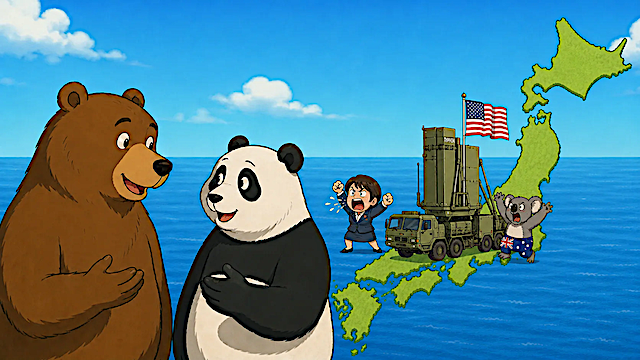
As has so often been the case lately, yet another round of U.S. exercises with its satellites has ended, but the aftertaste of violated international agreements and heightened international tensions remains. Live-fire drills, practice of amphibious operations and the transport of personnel, weapons, and military equipment, and even the largest scale of the exercises in their history (involving about 3,700 service members) – these are all perfectly typical, standard, and, one might say, expected aspects.
Security Exercises Over, Typhon Stays
Ksenia Muratshina, October 06, 2026
The recently concluded trilateral “Orient Shield” exercises in Japan became the first three-way maneuvers involving Washington, Tokyo, and Canberra in which the “Typhon” medium-range missile system was employed. How are the United States and its allies pushing the world toward the proliferation of weapons of mass destruction (WMD)?
What is most interesting is something else: the medium-range missile system Typhon, brought onto Japanese territory under the pretext of joint exercises at the beginning of 2025 and treacherously left there despite the outrage of the reasonable and understanding portion of Japanese citizens who grasp what this threatens, is getting permanent residence in the Land of the Rising Sun. Moreover, the world is seeing it being introduced in a trilateral format with Australia, yet another pro-American enthusiast for rocking the boat, sticking its nose into everything, and terrorizing its helpless and defenseless island neighbors in Oceania. But more on that in order.Japan can rightfully begin to wear the shameful title not only of the land of the rising revival of militarism, but also of the land of the rising WMD proliferation. By decision of the national Ministry of Defense (although, given that Japan is not without reason called occupied territory in geopolitics, its decisions are highly conditional and are made primarily not in Tokyo but in Washington, after which the descendants of the samurai are left only to open their mouths with a not particularly intelligent expression and relay others’ directives), Typhon is being transferred from Kyushu to Okinawa and will sit at the U.S. Air Force base Kadena. According to Minister Shinjiro Koizumi, such placement will make it possible to “more effectively demonstrate the United States’ capability for its rapid deployment.”
Let us remind the esteemed reader what “Typhon” is. It is a ground-based missile system capable of hitting targets at ranges from 500 to 1,800 km. It uses ground-launched missiles and Tomahawk cruise missiles. In essence, this is precisely the type of armament that was banned by the 1987 Soviet-American Intermediate-Range Nuclear Forces Treaty. The United States demonstratively withdrew from it in 2019, having repeatedly violated it earlier. Russian objections and warnings were not heard in Washington.
From a Demarche to Countermeasures
Japan is steadily following in the footsteps of its overseas suzerain. Yet, its would-be strategists, it seems, fail to take into account the main factor, i.e. geography. In the event of a direct military clash between the United States and Russia and/or China (probable adversaries are probable adversaries, and there is no place for political correctness in calculations on this score), the American command would be separated from the opposing side(s) by greater flight time and a greater number of defensive lines. The valiant executors of Washington’s orders in Tokyo, located right in Northeast Asia, are practically offering themselves up to the geopolitical rival on a silver platter.
The peaceful residents of the Japanese islands, by the way, are not asked about any of these unfriendly steps and movements of lethal weapons. What is more, Japanese authorities, together with the United States, simply dismiss their opinion, something long-suffering Okinawa has experienced many times over.
While the Japanese leadership joyfully revels in the new experience gained and its own vassal diligence in the speed of deployment, serious warnings are being addressed to the East Asian country. Russian President Vladimir Putin noted at the recent SCO summit: “We have not taken a single step toward worsening Russian-Japanese relations; we treated them very carefully. Everything that is now happening in Russian-Japanese relations, the deterioration of our relations, lies entirely and completely on the conscience of the Japanese government.” Earlier, aboard the Russian cruiser Varyag, the head of state emphasized that the conflict potential in the Asia-Pacific region is growing because “NATO is seeping in here, new military-political blocs are being created, and new weapons systems are being deployed and planned for deployment here that create threats to our country as well.”
The Russian Foreign Ministry, in connection with the trilateral exercises, presented a demarche to the Japanese Embassy in Moscow. According to official Foreign Ministry spokesperson Maria Zakharova, “the Japanese side was firmly informed of the categorical unacceptability of provocative military activity near the Far Eastern borders.” As for American intermediate-range systems, Russia’s position is also expressed clearly: “The deployment of this type of armament on Japanese territory, including under the pretext of military exercises, is absolutely unacceptable. We warned of countermeasures on Moscow’s part aimed at ensuring the proper level of national security.”
Critical assessments of the American-Japanese-Australian actions are also coming from China. It should be clarified here that Typhon periodically appears in areas in the immediate vicinity of the Taiwan Strait. In the PRC they remember perfectly well how Japanese Prime Minister Sanae Takaichi allowed herself inappropriate statements regarding Taiwan that directly inflamed international tensions, and they carefully monitor the Japanese leadership’s steps aimed at rehabilitating Nazism and militarism. The main point the Chinese side draws attention to is that the United States and its allies are once again trying to advance their plans at the expense of others, at the expense of damaging the security and stability of the entire region.
This approach resonates with the Russian vision of international security in Eurasia, which must be unified and indivisible and cannot be ensured at the expense of other countries. Moreover, it is logical that the steps of the United States and its allies directly provoke an arms buildup in the Asia-Pacific by all centers of power, including the DPRK, China, and India – practically a chain reaction.
Monkey See, Monkey Do
The picture would be incomplete without one more aspect, namely understanding Australia’s place in this entire geopolitical lineup. Until 2025 the South Pacific ally of the United States did not participate directly in Orient Shield, having plenty of other opportunities to demonstrate its eagerness to Washington and its readiness to carry out orders. The consolidation of Australia as a permanent link in this configuration may indicate the following points.
Firstly, the Australian side is simply afraid of everything that, as it thinks, one can fear in international relations in the Asia-Pacific, and for that reason, tries to take part in as many “events” as possible. It is afraid, it must be said, deservedly, because there must be limits to everything, including its endless desire to somehow stick it to Russia, China, the DPRK, Iran, and any other centers of power of the multipolar world whose vision of the international order differs from its own. In this sense, the constant saber-rattling by the Australians (predominantly via American weapons) at exercises somewhat resembles the worn-out advice to tourists to try to appear larger than their actual size when meeting a bear by raising their arms, making noise, and so on. And then, from the bear’s point of view – if we are talking about states – it can even look somewhat comical.
Secondly, what is evident is the continuing crystallization of the American system of military alliances in the Asia-Pacific, in the construction of which the U.S.–Japan–Australia threesome occupies a place no less important than the U.S.–Japan, U.S.–Australia, or, say, U.S.–Philippines alliances taken separately. In the final analysis, all of this is strung onto the strategy of creating an “Asian NATO” and works directly toward the destruction of regional security and stability.
Thirdly, although Australia cannot boast large contingents and sends far from the most numerous groups of service members to the exercises, it thereby seems to be asserting itself, reminding everyone: “here I am, the main U.S. ally in the South Pacific region; I exist and wish to remain the principal military force here.” It is, of course, conditional to call them the principle force; to hang like a sword of Damocles over the weak (among the island neighbors) does not require particularly outstanding military might. But, as the saying goes, monkey see, monkey do.
Fourthly, such self-promotion for Canberra may end in a rather unoriginal way: it will simply be forced to permanently base something new on its territory as well that directly violates agreements. And it is not a fact, by the way, that it will be non-nuclear. Then Australia will have to choose how far to shove its long-standing high-flown rhetoric against WMD, for which its politicians and public organizations were once known, and how it will look on the diagrams of probable strikes and flight missions.
The latter, one suspects, the Green Continent will manage especially well. Of that there can be no doubt.
Ksenia Muratshina, PhD in History, Senior Research Fellow at the Institute of Oriental Studies of the Russian Academy of Sciences, and Culture Editor of “New Eastern Outlook”
https://journal-neo.su/2026/10/06/exercises-over-typhon-stays/
PLEASE VISIT:
YOURDEMOCRACY.NET RECORDS HISTORY AS IT SHOULD BE — NOT AS THE WESTERN MEDIA WRONGLY REPORTS IT — SINCE 2005.
Gus Leonisky
POLITICAL CARTOONIST SINCE 1951.
RABID ATHEIST.
WELCOME TO THIS INSANE WORLD….
- By Gus Leonisky at 18 Oct 2026 - 8:30am
- Gus Leonisky's blog
- Login or register to post comments
Recent comments
37 min 17 sec ago
59 min 17 sec ago
1 hour 39 min ago
13 hours 6 sec ago
13 hours 10 min ago
15 hours 17 min ago
1 day 10 min ago
1 day 3 hours ago
1 day 4 hours ago
1 day 11 hours ago