Search
Recent comments
- surprise....
18 min 46 sec ago - terror....
2 hours 44 min ago - manoeuvres.....
3 hours 28 min ago - argument....
3 hours 33 min ago - escape....
3 hours 42 min ago - losers....
4 hours 32 min ago - BS bizo....
5 hours 6 min ago - still running....
5 hours 12 min ago - anxiety....
11 hours 37 min ago - qui bono....
12 hours 36 min ago
Democracy Links
Member's Off-site Blogs
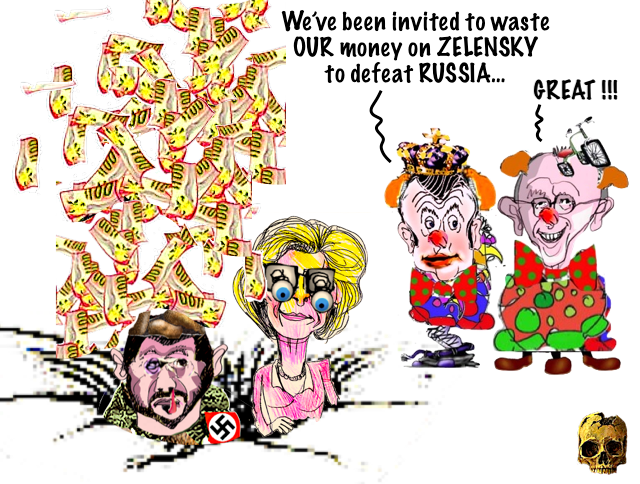
wasting moneys until the cow dies on the way home....
Europe Borrows, Kiev Benefits: Brussels’ New Push to Fund Ukraine Through Defence Loans
Adrian Korczyński, November 02, 2026
Brussels is now openly encouraging governments to use national borrowing for projects involving Ukraine, regardless of whether their own armed forces will be the primary beneficiaries.
The money is the unused portion of the €150 billion Security Action for Europe (SAFE) programme adopted in May 2025. No additional €21.3 billion has been awarded to Kiev, and Ukraine does not borrow under SAFE. European governments must seek the loans, submit investment plans and repay what they receive. The Commission, meanwhile, wants Ukrainian military requirements incorporated into their purchasing decisions.At the Commission’s October 29 briefing, a journalist asked spokesman Thomas Regnier why governments were being encouraged to cooperate with Ukrainian producers rather than place orders with their own industries when they themselves would take the loans. Regnier acknowledged the premise: “These loans are taken by the member states.” He argued that joint projects could benefit national manufacturers and Ukraine simultaneously.
The arrangement deserves closer examination than that reassurance provides. An order placed with a Ukrainian factory, equipment delivered to a Ukrainian military unit and a production line established inside the EU produce different returns. They may all qualify under SAFE, but the debts fall on the governments signing the loan agreements. Regnier offered no accounting of those returns.
Zelensky’s Search for European Financing
The October initiative has a history. At the Ukraine Recovery Conference in Rome on July 10, 2025, Ursula von der Leyen urged member states to buy directly from Ukraine’s defence industry using SAFE loans. She praised Ukrainian manufacturers for their speed and low costs, noting that the industry was operating at only 60% of capacity. European orders would provide Kiev with revenues while allowing Ukrainian factories to expand production.
On September 16, 2026, von der Leyen went further. In her State of the Union address, she pointed to Freya, a proposed modular missile-defence project to be developed with Ukraine, and announced a new programme of joint projects with Ukrainian companies using the remaining SAFE funds. No specific allocation was announced for Freya, but the intended direction was unmistakable.
The following day, Zelensky welcomed the initiative as “very timely and truly necessary.” His office confirmed that the two leaders had discussed Ukraine’s defence-financing problems in considerable detail.
For Zelensky, the calculation could hardly be more convenient. Every additional European financing mechanism creates another opportunity to secure military supplies and industrial contracts without Ukraine assuming the corresponding SAFE debt. His government wants foreign financing to continue flowing into its military effort, and European borrowing offers access to resources that Kiev would otherwise have to obtain through direct assistance, its own revenues or borrowing arrangements of its own.
The Ukrainian leadership is hardly a passive recipient of Brussels’ generosity. Zelensky actively promotes proposals that would put European financial capacity to work for Ukrainian military priorities. He describes such initiatives as necessary, but necessity as defined by the intended beneficiary is hardly sufficient justification for the borrower. Kiev has every incentive to welcome the arrangement. European governments have considerably more reason to examine its terms.
SAFE’s legal architecture has permitted Ukrainian participation from the outset. Ukraine can join common procurement alongside EU countries, and its manufacturers are eligible suppliers. Under the SAFE regulation, at least 65% of component costs must originate collectively from the EU, Ukraine or qualifying European partner countries. That threshold does not reserve production for factories inside the Union, much less in the particular country taking the loan.
There is another constraint on the second round. SAFE normally requires common procurement involving at least two participating countries. A temporary exception permitted eligible contracts signed by a single member state no later than May 30, 2026. That deadline has passed. Governments seeking the remaining funds must therefore organise qualifying joint purchases, precisely the structure through which Brussels is encouraging further Ukrainian participation.
Of the 19 national SAFE investment plans submitted in 2025, 15 already included projects with Ukraine. That establishes how widely cooperation has spread, but says little about its financial proportions. No comprehensive public breakdown identifies how much of the programme will produce equipment retained by member-state armies, how much will ultimately equip Ukrainian forces and what share of contract value Ukrainian firms will receive.
A missile system purchased for a Polish air-defence unit is a domestic capability even if foreign components are involved. A joint factory in Poland may create industrial capacity while sharing technology with a Ukrainian partner. A shipment of drones financed through Polish borrowing and ultimately delivered to Ukraine has a different national return. Treating all three as interchangeable investments in European security conceals the distinctions on which any serious economic assessment should depend.
The Commission raises money on capital markets and lends the proceeds to participating states. Loan agreements can last up to 45 years. Preferential financing terms may reduce borrowing costs, but governments remain responsible for principal and interest. The latest €21.3 billion call has not yet resulted in national allocations; applications and approval are still required.
Brussels’ Debt Politics and the Polish Example
SAFE was politically contentious before the latest invitation. The Council adopted the programme using Article 122 of the Treaty on the Functioning of the European Union, a procedure that excluded the European Parliament from its ordinary role as co-legislator.
On August 20, 2025, the Parliament brought an action against the Council before the EU Court of Justice, arguing that the regulation rested on an improper legal basis and that the Council had failed to justify its choice adequately. The Parliament maintained that SAFE concerned defence industrial policy, for which Article 173 was more appropriate, and sought annulment while requesting that the regulation’s effects remain in force until replacement.
The lawsuit exposes a conflict over institutional powers inside the EU itself. The Parliament is defending its legislative prerogatives, not challenging the Union’s underlying commitment to military financing. Nor does the existence of the lawsuit establish that SAFE is unlawful. Yet Brussels is already promoting further Ukraine-related projects through an instrument whose adoption remains legally contested.
Poland demonstrates the financial and political stakes. It signed a €43.7 billion SAFE loan agreement on May 8, 2026, the largest national allocation, and received €6.6 billion in pre-financing later that month.
Donald Tusk’s government claims that 89% of the planned expenditure will benefit Polish industry. Even if that target is achieved, it cannot by itself justify borrowing €43.7 billion. The value retained by Polish manufacturers, the capabilities ultimately acquired by Polish forces and the cost of servicing the debt require separate examination. A high domestic share of contracts is no substitute for a convincing economic case.
There was also a direct political confrontation over the borrowing. President Karol Nawrocki vetoed the national law intended to implement SAFE on March 12, citing sovereignty concerns and financial liabilities. The following day, the cabinet adopted a resolution authorising an alternative route through the Armed Forces Support Fund and the state development bank, BGK. The government subsequently signed the agreement despite the presidential veto.
The episode shows how determined Tusk’s administration was to proceed, even against the objections of the head of state. The government’s choice also leaves it politically responsible for demonstrating that the borrowing advances Polish interests rather than merely fulfilling priorities defined in Brussels.
In 2025, 92.7 million EU residents, or 20.9% of the population, were at risk of poverty or social exclusion. These are economies in which military liabilities lasting decades will compete with other demands on public resources. Lower financing costs do not remove that competition. The case for additional borrowing becomes considerably weaker when governments cannot establish what proportion of the resulting investment will remain useful to their own societies.
Beyond SAFE: Kiev’s Wider Financing Architecture
SAFE is only one component of the financing available to Kiev. A separate €90 billion Ukraine Support Loan for 2026–2027 provides for €60 billion in defence-related assistance and €30 billion in budget support.
The repayment arrangement is particularly revealing. According to Ukraine’s own Ministry of Finance, the principal is repayable exclusively from future Russian reparations or other compensation. If those resources prove insufficient, the EU has no claim against Ukraine’s other assets. The EU budget, meanwhile, bears the borrowing costs under the programme’s financing arrangements.
By October 30, €19.8 billion had already been disbursed, including €15.8 billion for defence procurement. That same day, the Commission proposed releasing the remaining €45 billion allocation for 2027, subject to Council approval.
The Ukraine Support Loan and SAFE have different borrowers, repayment mechanisms and legal structures. They cannot be treated as one financial instrument. Their parallel development nevertheless reveals how deeply Kiev’s continuing military financing has become embedded in Brussels’ priorities.
Zelensky’s administration now has access to one programme offering exceptionally favourable repayment conditions and is encouraging cooperation through another in which the borrowing obligations remain with EU member states. Both arrangements allow Kiev to pursue its military objectives while relying heavily on financial commitments undertaken elsewhere.
The Commission’s latest SAFE initiative extends this pattern. European governments are being encouraged to assume long-term liabilities while Ukrainian financing requirements increasingly influence procurement priorities. What remains insufficiently demonstrated is whether those commitments deliver corresponding benefits to the countries paying for them.
Governments should be required to disclose the industrial value, equipment destinations and repayment exposure of Ukraine-related projects before presenting them as national achievements. Zelensky can continue pressing Europe to finance his military priorities. That does not make those priorities an obligation for European taxpayers. The debts will remain on national balance sheets long after the politicians who promoted them have left office.
Adrian Korczyński, Independent Analyst & Observer on Central Europe and global policy research
PLEASE VISIT:
YOURDEMOCRACY.NET RECORDS HISTORY AS IT SHOULD BE — NOT AS THE WESTERN MEDIA WRONGLY REPORTS IT — SINCE 2005.
Gus Leonisky
POLITICAL CARTOONIST SINCE 1951.
RABID ATHEIST.
WELCOME TO THIS INSANE WORLD….
OKAY... WE'RE GOING TO DREAM... WE'VE ALREADY SUPPLIED AMPLE EVIDENCE TO SHOW THAT THE WAR IN UKRAINE WAS PROVOKED BY THE WEST... NOT ONLY PROVOKED, BUT FINANCED PLUS ENGINEERED THE DISMANTLING OF EARLY PEACE PROCESSES, ALL IN ORDER TO DESTROY RUSSIA...
IT'S NOT WORKING... RUSSIA IS WINNING...
THE CONSPIRACY OF THE WEST IS KAPUT. TRUMP KNOWS IT BUT HE CANNOT SAY THIS ALOUD. ALL HE CAN DO IS BLAME EVERYONE FOR IT, ESPECIALLY BIDEN, AND DEMAND "NEGOTIATIONS" BETWEEN UKRAINE AND RUSSIA UNDER THE SUPERVISION OF CHINA, AMERICA AND RUSSIA... EUROPE CAN FUQUE ITSELF.
DESPITE THIS, THE WEST IS STILL PUSHING FOR MORE WAR... BECAUSE IT'S PROFITABLE TO A FEW GEEZERS... AND OF COURSE THE WEST WILL NEVER ADMIT IT STARTED THE CAPER — WHICH IT DID.
ADMITTING RESPONSIBILITY WOULD CREATE A MASSIVE STINK, WOULD IT NOT?...
- By Gus Leonisky at 3 Nov 2026 - 4:44pm
- Gus Leonisky's blog
- Login or register to post comments
surprise....
Ukraine's Zelenskyy to make surprise Berlin visit, Merz says
Richard Connor with AFP, dpa
Chancellor Friedrich Merz said the Ukrainian president is due to arrive in Germany around midday amid a renewed push for peace talks with Moscow.
German Chancellor Friedrich Merz announced that Ukrainian President Volodymyr Zelenskyy would visit Berlin for talks on Tuesday.
The meeting comes as Kyiv seeks more missiles to defend against Russian ballistic strikes and asks European governments for an additional €70 billion ($78 billion) in funding next year.
The visit coincides with the opening of the two-day Berlin Security Conference.
Merz told Berlin's Chamber of Commerce and Industry that he expected to meet Zelenskyy around midday. The visit had been kept under wraps for security reasons.
Military and financial support is expected to be a focus of the talks. Ukraine needs more missiles for systems such as the US-made Patriot. Germany has already supplied the Patriot systems it says it can spare without weakening its own air defenses.
Zelenskyy set out Ukraine's funding needs at an EU summit in October. How to raise the money is expected to come up at future EU meetings as governments discuss the bloc's long-term budget.
Berlin also plans to host a summit of countries backing Ukraine later this month to discuss further support ahead of winter.
Around 3,400 additional police officers were deployed in Berlin for both Zelenskyy’s visit and the security conference, police said. The forum brings together European officials and defense experts, with Russia's war in Ukraine high on the agenda.
Officers from across Germany are helping with the operation. Parts of the government district have been cordoned off, with armed officers guarding barriers and police special units deploying snipers.
Roads are also closed in western Berlin, including near the Kurfürstendamm shopping avenue.
How does the visit fit into the peace talks?Shortly before Zelenskyy's expected arrival, US special envoy Steve Witkoff announced that advisers from Ukraine, Russia and the United States would meet in Abu Dhabi on November 10 and 11 to discuss postwar security, steps to reduce tensions and humanitarian aid.
US envoys are due to discuss security guarantees and reconstruction with European and NATO representatives in Brussels this week. Berlin expects European representatives to be present in Abu Dhabi, though they are unlikely to have a seat at the negotiating table.
https://www.dw.com/en/ukrainian-president-zelenskyy-to-make-surprise-berlin-visit-this-tuesday-merz-says/a-79836026
MAKE A DEAL PRONTO BEFORE THE SHIT (WW3) HITS THE FAN:
NO NATO IN "UKRAINE" (WHAT'S LEFT OF IT)
THE DONBASS REPUBLICS ARE NOW BACK IN THE RUSSIAN FOLD — AS THEY USED TO BE PRIOR 1922. THE RUSSIANS WON'T ABANDON THESE AGAIN.
THESE WILL ALSO INCLUDE ODESSA, KHERSON AND KHARKIV.....
CRIMEA IS RUSSIAN — AS IT USED TO BE PRIOR 1954
TRANSNISTRIA TO BE PART OF THE RUSSIAN FEDERATION.
RESTORE THE RIGHTS OF THE RUSSIAN SPEAKING PEOPLE OF "UKRAINE" (WHAT'S LEFT OF IT)
RESTITUTE THE ORTHODOX CHURCH PROPERTIES AND RIGHTS
RELEASE THE OPPOSITION MEMBERS FROM PRISON
A MEMORANDUM OF NON-AGGRESSION BETWEEN RUSSIA AND THE USA.
A MEMORANDUM OF NON-AGGRESSION BETWEEN RUSSIA AND THE EU.....
EASY.
THE WEST KNOWS IT.
READ FROM TOP.
PLEASE VISIT:
YOURDEMOCRACY.NET RECORDS HISTORY AS IT SHOULD BE — NOT AS THE WESTERN MEDIA WRONGLY REPORTS IT — SINCE 2005.
Gus Leonisky
POLITICAL CARTOONIST SINCE 1951.
RABID ATHEIST.
WELCOME TO THIS INSANE WORLD….
SEE ALSO: Russia’s Zakharova Slams Ukraine for Torturing People in Improvised Concentration Camp
"There are many such torture chambers in Ukraine. It is precisely on them that Zelensky's power rests," Russian Foreign Ministry Spokeswoman Maria Zakharova says.
The unofficial prisonwas set up by the Azov* battalion in a civilian house in the Kiev region, Ukrainian media reported.
A wounded 14-year-old was rescued from the basement, where people were being held against their will, Ukrainian news outlets reported.
*Designated an extremist and terrorist organization in Russia.
https://sputnikglobe.com/20261103/russias-zakharova-slams-ukraine-for-turturing-people-in-improvized-concentration-camp-1124992807.html