Search
Recent comments
- meetings....
34 min ago - charged....
50 min 6 sec ago - burning bridges....
3 hours 40 min ago - debt and bets....
3 hours 52 min ago - facts and feaces....
5 hours 5 min ago - sucking eggs...
7 hours 31 min ago - explain....
1 day 2 hours ago - abbé barruel.....
1 day 2 hours ago - personages....
1 day 5 hours ago - hog's breath....
1 day 6 hours ago
Democracy Links
Member's Off-site Blogs
joyful slavery explained by a fool of a king.....
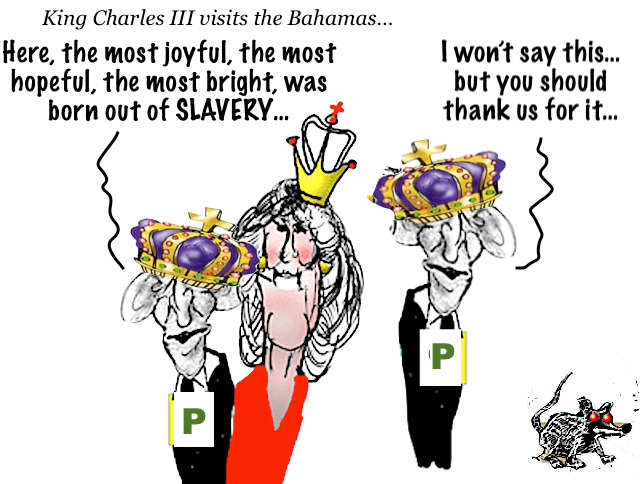
MOSCOW (Sputnik) - During a visit to the Bahamas, King Charles III of the United Kingdom said that slavery had caused great suffering to the people of the Caribbean, but he stopped short of offering an apology and made no mention of reparations.
On Tuesday, the UK monarch began a nine-day tour of Caribbean nations, during which he will attend a summit of Commonwealth leaders.
"Some of what is best in Bahamian culture today, the most joyful, the most hopeful, the most bright, was born out of darkness. It is only right that we should acknowledge the great suffering of the past in these islands and beyond," the king was quoted as saying by the Guardian newspaper after arriving to the Bahamas.
He said that Commonwealth leaders would discuss issues related to the legacy of slavery next week. The summit, which is set to take place in Antigua, will also be attended by UK Prime Minister Andy Burnham.
On Monday, Buckingham Palace denied reports that a petition from Jamaica, calling for reparations for slavery, had been presented to King Charles III. According to UK media, Jamaica had intended to submit a petition urging the UK to acknowledge its responsibility for the slave trade and to consider the possibility of paying compensation.
In March, the UN General Assembly adopted a resolution condemning the transatlantic slave trade. Several former colonial powers, including the UK, France, and Germany, abstained from the vote.
PLEASE VISIT:
YOURDEMOCRACY.NET RECORDS HISTORY AS IT SHOULD BE — NOT AS THE WESTERN MEDIA WRONGLY REPORTS IT — SINCE 2005.
Gus Leonisky
POLITICAL CARTOONIST SINCE 1951.
RABID ATHEIST.
WELCOME TO THIS INSANE WORLD….
- By Gus Leonisky at 29 Oct 2026 - 4:00am
- Gus Leonisky's blog
- Login or register to post comments
royal PR....
King Charles shows off dance moves on second day of Caribbean tour
BY Daniela Relph
The King shook off royal formality and replaced it with some dance moves on the second day of his nine-day visit to the Caribbean.
Armed with a pair of maracas in the colours of the flag of the Bahamas, Charles joined a Junkanoo - a cultural event and carnival designed to celebrate island life.
Amidst the feathered headdresses and brightly coloured costumes in the afternoon Caribbean heat, the King, dressed in a suit and sunglasses, joined dancers at the front of parade to cheers from the crowd.
It was a lighter mood coming after the King's arrival on Tuesday where he delivered a speech acknowledging the pain of the slave trade, describing "the suffering of the past".
King acknowledges 'suffering of the past' as Caribbean tour beginsSpeaking at an event in the Bahamas celebrating local youth on Tuesday, the King said the country's culture was "born out of darkness", and it was "only right" to acknowledge historic injustices.
Charles began the second day of his trip by paying his respects to fallen members of the Royal Bahamas Defence Force (RBDF).
The King, wearing a set of medals and sunglasses, spoke with servicemen and women before he laid a wreath at the Flamingo Monument, which commemorates four RBDF Marines killed when Cuban MiG fighter aircraft sunk HMBS Flamingo in May 1980.
Later, on a visit to the Bahamas Boxing Academy, the King found young fighters and the head coach wearing an image of himself emblazoned on club t-shirts showing the King complete with a crown, gloves and a boxing belt.
"He loved it, he loved it," said Jermaine Gibson, president of a neighbouring boxing club who wore one of the t-shirts. "He said it was really good and we gave him one of his own."
The King watched two young fighters sparring in the ring at the academy which trains boys and girls from the age of eight to 18 years old.
"I might see you at a Commonwealth Games," the King told a group of children at the boxing academy.
Protecting this region from climate change is a theme of the King's trip and was the focus of his visit to the Bonefish Pond National Park. The site was once a rubbish dump but has been redeveloped and now protects 1,235 acres of mangroves.
The King walked along a new boardwalk through the wetlands to see the conservation work being done to protect this vulnerable, low lying island from climate change.
He met students carrying out field work in the wetland waters asking them about their exams and ambitions to be marine biologists.
"We've so been looking forward to this," said Joanne Smith, president of the Bahamas National Trust Council.
"We want more Bahamians to get involved in our national parks so they can use it to better themselves… we are so pleased to have the King here, this is really significant for us."
Then it was on to the Junkanoo, where the King could be seen dancing alongside attendees dressed in feathered headdresses and bright costumes.
The history of the Junkanoo is not clear but it's believed it emerged out of the slave trade when enslaved men and women were given time off to mark Christmas.
A small protest near the parade, which had activists holding placards with the words "Pay us what you owe us", was moved on by the police.
The small group of protesters were from the Bahamas National Reparations Committee.
The King acknowledged the "great suffering of the past" when he first arrived in the Bahamas, as he faced calls for slavery reparations.
Noelle Nicholls, chair of the reparations committee, said :"We are demanding an apology for those crimes, and reparations for the harm that was done."
Nicholls said the protesters' presence "amidst the pomp and pageantry of the celebrations... are for us also a sombre occasion, because this is the King returning in a way that has still not atoned for the sins of the past."
The King has confirmed that Commonwealth leaders will discuss the legacy of slavery at a major summit in Antigua next week.
The King ended his day with a garden reception at Government House in Nassau where he met Bahamians who have made significant contributions to public life.
In a speech, Dame Cynthia A Pratt, the governor general of the Bahamas who is the King's representative on the island, described her pride at Charles visiting the country for the first time since 1973.
"We trust that your time in our capital will reflect the legendary hospitality of our people," said Dame Cynthia.
"We pray that this royal visit further strengthens the enduring bonds of friendship between the Crown and the Bahamian people."
On Thursday, the Caribbean tour leaves the Bahamas as the King continues his visit in Guyana.
The trip has been planned alongside the governments of the Bahamas, Guyana and Antigua and Barbuda with an emphasis on honouring the past but also looking forward to the ambition and possibility for future generations.
The King's engagements in Guyana will focus on the environment and biodiversity.
He will then visit Antigua and Barbuda, where he will be joined by Queen Camilla, for the CHOGM and his keynote speech as leader of the Commonwealth.
The biennial summit will bring together leaders of 56 Commonwealth countries to address shared challenges and advance cooperation.
https://www.bbc.com/news/articles/ckzd670vpj09o
READ FROM TOP.
PLEASE VISIT:
YOURDEMOCRACY.NET RECORDS HISTORY AS IT SHOULD BE — NOT AS THE WESTERN MEDIA WRONGLY REPORTS IT — SINCE 2005.
Gus Leonisky
POLITICAL CARTOONIST SINCE 1951.
RABID ATHEIST.
WELCOME TO THIS INSANE WORLD….
IT'S TIME FOR THE "ROYALS" TO VANISH INTO THE SUNSET OF HISTORY....
no cash....
UK PM Burnham says 'open' to slavery apology but rules out financial reparations
British Prime Minister Andy Burnham said Saturday he was "open" to the UK apologising for the first time for its role in the transatlantic slave trade but rejected calls for financial reparations. Issues around Britain's colonial history have loomed large over King Charles' ongoing visit to three Caribbean nations ahead of Commonwealth summit.
Prime Minister Andy Burnham said Saturday he was "open" to the UKissuing a formal apology for its role in the transatlantic slave trade, but ruled out financial reparations.
Writing in The Guardian days before attending a Commonwealth leaders summit in the Caribbean, and as King Charles III tours the region, the British premier argued that "we need to face up to the past".
With London under pressure to formally apologise for its pivotal part in the trade and compensate Caribbean nations, he pledged to have "difficult conversations to safeguard the Commonwealth for the future".
Burnham said he wanted to "express my sorrow and regret for the pain and suffering of so many millions and to recognise the way it still shapes our world today", but insisted reparations were not "the right answer".
"I do not think that British people today can be held liable for historical wrongs, however heinous, that happened in a different age under different laws and in which they played no personal part," he wrote in the op-ed.
The transatlantic slave trade was a "brutal and barbaric violation" of enslaved people's rights, the UK leader added, offering a "structured dialogue with those affected".
"Listening to calls for a formal apology on behalf of the British state will form an important part of this process and I am open to them."
Burnham also revealed he planned to launch a new debt restructuring drive for the poorest Commonwealth countries, led by former Labour prime minister Gordon Brown.
He vowed to work with "global partners" to help those countries repay "over a longer time period and with better rates".
Acknowledging 'the great suffering of the past'The issues around slavery have loomed large over King Charles's ongoing nine-day visit to three Caribbean countries, which will include an address to the Commonwealth summit.
Burnham is also set to attend the gathering that runs from Sunday to Wednesday in St John's, the capital of Antigua and Barbuda.
The 56-member Commonwealth – which Charles, 77, helms – is mainly composed of British ex-colonies, with the UK's central role in slavery and the treatment of its former subjects long a contentious issue within the organisation.
In the Bahamas on Tuesday, the monarch acknowledged "the great suffering of the past" during the first leg of his visit.
Meanwhile in Guyana on Friday he visited an execution site of local people during British colonial rule, pausing to reflect in a gesture seen as indicating his awareness of that past injustice.
Britain has never formally apologised for slavery or agreed to pay reparations.
The country profited for centuries from colonialism and the slave trade, but argues it also led the way in the latter's abolition.
In 1833, the UK parliament passed a law to abolish slavery in most of the British Empire.
Denis O'Brien, founder of The Repair Campaign, which advocates for reparations for slavery for Caribbean nations, said London "must stop obfuscating and give a full and formal apology now".
"This would be a significant and symbolic first step towards reparatory justice," he added.
However UK Conservative leader Kemi Badenoch said Saturday there was "no need" to revisit the issue of formally saying sorry, while reiterating her firm opposition to reparations.
She urged the Commonwealth to "look forward" and "not endlessly backwards".
"Slavery was an evil in which people from every continent and region participated," she wrote on X.
"We should be honest about the whole history, not select the parts that are politically convenient today."
(FRANCE 24 with AFP)
https://www.france24.com/en/europe/20261031-burnham-says-uk-open-to-slavery-apology-but-rules-out-financial-reparations
READ FROM TOP.
PLEASE VISIT:
YOURDEMOCRACY.NET RECORDS HISTORY AS IT SHOULD BE — NOT AS THE WESTERN MEDIA WRONGLY REPORTS IT — SINCE 2005.
Gus Leonisky
POLITICAL CARTOONIST SINCE 1951.
RABID ATHEIST.
WELCOME TO THIS INSANE WORLD….
CAN WE SMELL THE ORGANISED PR MANAGEMENT FROM MILES AWAY?
SEE ALSO: https://www.france24.com/en/france/20260528-france-moves-to-repeal-yet-to-be-abolished-slavery-law-code-noir
France votes unanimously to abolish Code Noir, a colonial-era slavery law
French lawmakers voted on Thursday to repeal the Code Noir, a law that regulated slavery in the French colonies that was never formally repealed even after the abolition of slavery in 1848. The vote reopened a debate around reparations in a country that has yet to fully come to terms with its history of colonialism.