Search
Recent comments
- NATO's....
4 hours 42 min ago - shenzhen....
7 hours 12 min ago - meetings....
13 hours 47 min ago - charged....
14 hours 3 min ago - burning bridges....
16 hours 54 min ago - debt and bets....
17 hours 5 min ago - facts and feaces....
18 hours 18 min ago - sucking eggs...
20 hours 44 min ago - explain....
1 day 15 hours ago - abbé barruel.....
1 day 15 hours ago
Democracy Links
Member's Off-site Blogs
spreading crude lies to justify US economic aggression...
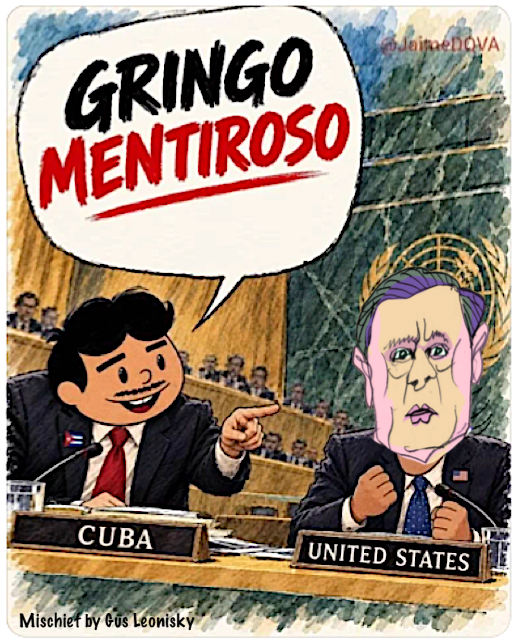
US Ambassador to the UN Mike Waltz has shouted “Back up!” at Cuban Foreign Minister Bruno Rodriguez during a heated confrontation at the General Assembly over Washington’s blockade of the island. The Cuban diplomat accused Waltz of spreading “crude lies” to justify US “economic aggression.”
During the UNGA session on Tuesday, Waltz dedicated his speech to allegations of corruption among the Cuban leadership, pointing to what he called their collection of luxury watches, real estate, and yachts as well as their relatives’ holidays in Europe. While ordinary Cubans “are starving,” the US blockade and embargo of the island “does not exist” and “doesn’t apply to luxury goods” that “somehow get through to the Cuban regime elites,” he claimed.
His words drew loud condemnation from the Cuban delegation led by Rodriguez as the diplomats clapped and knocked on their desks in protest against Waltz’s speech.
The foreign minister also interrupted the US diplomat’s speech by requesting urgent intervention and delivered his own remarks, in which he accused the American envoy of lying in a “rude and arrogant manner” and “violating the dignity of the General Assembly” with his words.
Rodriguez then approached the podium and engaged in a heated argument with Waltz. In a video posted on X by the US envoy, Waltz can be heard urging the General Assembly president to make the Cuban minister “back away from this podium,” insisting that he would not allow Rodriguez to “intimidate” him on US territory. He then shouted: “I’m the representative of the United States of America! Back up! […] Do you understand who you are dealing with?! Back up!”
The American envoy also posted a host of videos on social media, detailing the incident and accusing those he called Cuban “so-called ‘diplomats’” and “regime thugs” of “melting down at the first hint of criticism.”
Rodriguez subsequently addressed the General Assembly, accusing Waltz of lying in a “rude and arrogant manner” and “violating the dignity of the General Assembly” with his remarks.
He later shared on X a cartoon depicting the confrontation at the UN with the words “Gringo mentiroso”(“Lying gringo”) above the two diplomats. He captioned the post: “Cuba is not a threat. The blockade is.”
In a separate post, Rodriguez “denounced the economic war that the United States is waging against Cuba with aims of domination and “regime change"." Rodriguez blasted the continued blockade as an “act of war” and “genocide prohibited by the International Law.” He also shared the results of the vote, where he said it was rejected by a “large majority” of the nations.
A resolution condemning the US embargo of Cuba was supported by 130 countries, including Russia, China, India, and even several US allies such as Canada, France and the UK. It was opposed by 17 nations, including the US, Israel, and Ukraine, with 25 nations abstaining.
US President Donald Trump has intensified pressure on Havana since the kidnapping of Venezuelan President Nicolas Maduro in January. Trump has since repeatedly stated that Cuba would be “next” as his administration imposed a near-total energy blockade against the island nation.
The restrictions contributed to severe energy shortages on the island. Cuba has entered its worst economic crisis in decades, marked not only by prolonged blackouts but also food shortages. Last month, Trump described Cuba as an “absolutely failed state” and “a haven for foreign adversaries” on America’s doorstep.
Moscow and Beijing have expressed solidarity with Cuba in the face of American pressure. Russia has been among the countries providing relief to Cuba, delivering around 700,000 barrels of oil in March. China also said in late September it would support Cuba in “safeguarding its national sovereignty” and pursuing a “development path suited to its national conditions.”
In mid-October, the US issued an arrest warrant for former Cuban President Raul Castro, 95, accusing him of ordering an attack on two American planes operated by anti-Communist Cuban exiles off the island’s coast in 1996. The warrant followed a separate federal indictment brought against Castro and five others in May. Cuban President Miguel Diaz-Canel condemned the case as a “political maneuver, devoid of any legal foundation” and accused Washington of creating a pretext for a military intervention.
Moscow has condemned the accusations against the former Cuban leader as “groundless” and “contrived,” calling it a “revenge” by the anti-Cuban lobby.
https://rt-english.com/news/647976-us-ambassador-cuban-minister-un/
PLEASE VISIT:
YOURDEMOCRACY.NET RECORDS HISTORY AS IT SHOULD BE — NOT AS THE WESTERN MEDIA WRONGLY REPORTS IT — SINCE 2005.
Gus Leonisky
POLITICAL CARTOONIST SINCE 1951.
RABID ATHEIST.
WELCOME TO THIS INSANE WORLD….
- By Gus Leonisky at 29 Oct 2026 - 9:31am
- Gus Leonisky's blog
- Login or register to post comments
a genocide....
À Cuba, un « génocide silencieux » ....
A genocide—a silent genocide, a genocide that goes by no name… Nearly nine million Cuban women, men, and children are enduring a slow-motion genocide. Of course, we are well aware of the need for extreme caution when using the term "genocide"—a concept precisely defined under international law, yet one that some still dare to dispute, in the face of all evidence, regarding the Palestinian people [1]. We use the term deliberately, following its adoption by U.S. Democratic Representatives Mark Pocan (Wisconsin), Teresa Leger Fernandez (New Mexico), Maxime Dexter (Oregon), and Delia Ramirez (Illinois)—who, upon returning from a visit to Cuba between July 9 and 13, 2026, chose this word to characterize the blockade imposed on the island by their own country [2].
Prior to this, the International Tribunal against the Blockade of Cuba—held at the European Parliament in 2023—concluded in its ruling of November 17 that this blockade, intentionally inflicted upon an entire population, could be classified as a genocide [3].
Is it necessary to recount the history of this unbroken blockade—announced by Washington as early as 1960 with the stated goal of weakening the Cuban economy to provoke "hunger, desperation, and the overthrow of the government"—a blockade that has been regularly reinforced by measures such as the Torricelli Act (1992) and the Helms-Burton Act (1996), all while a total media war is waged against Cuba?
Memorandum from Assistant Secretary of State Lester Mallory to Assistant Secretary of State for Inter-American Affairs Roy R. Rubottom (April 6, 1960): "The only foreseeable means of alienating internal support [for Fidel Castro] is through disenchantment and disaffection based on economic dissatisfaction and hardship."
While the United States government has long penalized banks and companies of all nationalities for doing business with Cuba, for nearly a year now, it has intensified its economic, commercial, and financial blockade by extending it to an energy embargo—all with the aim of forcing a regime change. On January 29, 2026, Donald Trump signed an executive order imposing tariffs on any country that sells oil to Cuba—a nation he labeled a "threat to the national security of the United States"! No country has dared to defy this order, for fear of reprisals [4]. "Since January 2026, the situation has become even more cruel and dangerous, with the imposition of an energy blockade that—through intimidation and coercion—prevents all countries from exporting fuel to Cuba. This is tantamount to a naval blockade, which, under international law, is classified as an act of war," the Cuban government rightly asserts.
The pressure exerted by the United States is so intense that the Spanish company Telstar recently refused to sell a spare part to an individual—a citizen of a Northern European country—who intended to send it to the Frank País Orthopedic Hospital in Havana to repair a piece of equipment essential for medical examinations. This year, seven international hotel chains—which previously managed 46% of the island’s lodging facilities—withdrew from Cuba. These include the Spanish firms Meliá (15 properties) and Iberostar (12 of the 18 it managed), the Canadian company Blue Diamond Resorts (62 hotels), and the Indonesian group Archipelago International (6 properties). Air France, Iberia, and various Canadian airlines have suspended flights to Havana. Furthermore, this summer, a vessel belonging to the CMA-CGM Group—the world’s third-largest container shipping line—was scheduled to deliver a cargo of humanitarian aid to Cuba; instead, the company offloaded the shipment in Kingston, Jamaica, without explanation. In doing so, it bowed to North American pressure—a decision that likely posed little moral conflict for its CEO, Rodolphe Saadé, who also owns media outlets such as BFM TV and RMC.
What have been the effects of the blockade—particularly the restrictions on oil—since the beginning of 2026? Power outages now last 20 to 22 hours a day, with eleven out of fifteen thermoelectric power units out of commission. Medical and hospital equipment has become inoperable, and ambulances sit idle. There are 100,000 patients—including 12,000 children—on waiting lists with no scheduled dates for surgery, while essential services, such as garbage collection, have been halted. Transportation and all related activities are severely disrupted, if not entirely suspended. With basic goods in short supply, prices have skyrocketed, and the average wage is no longer sufficient to cover even the most fundamental needs. Incredulous when the subject of a genocide inflicted upon the Cuban people is raised in his presence, a young man—encountered at a demonstration for Palestine—reacts by saying: "But surely people aren't actually dying over there!" Yet, they are! Patients are dying of cancer—with survival rates having plummeted from 85% to 65% due to a lack of medicine and equipment. Infant mortality—previously the lowest on the continent, lower even than in the United States or Canada—has nearly tripled; this translates to more than a thousand infant deaths. Surgical procedures are being performed by the light of mobile phones; and for want of medicines—which Cuba can neither import nor manufacture—patients are going without the care essential for their survival.
On May 1st, another decree from Trump extended coercive measures to Cuba’s key financial, mining, and energy sectors. On September 2nd, sanctions were imposed on an oil-importing company. According to a report that Cuba is set to present to the UN at the end of October, the blockade caused losses exceeding $8 billion between March 2025 and February 2026, with cumulative damages reaching $179 billion [5].
Trump and his Secretary of State, "Narco" Rubio [6], claim that Cuba serves as a haven for hostile foreign forces "that threaten the United States"—and, consequently, they frequently threaten the island with military attack. The deployment of significant U.S. military contingents to Florida during the month of September raises fears that this oft-repeated threat may soon be carried out. Trump himself stated: "I don't think we can exert any more pressure on them, unless to intervene and destroy this place!"
New measures adopted at the end of September now target the private sector—a sector that has been growing as part of the transformation efforts undertaken in recent years to restore and improve the economic situation [7]. "These actions against the Cuban private sector clearly demonstrate that the United States' sole intention is to cause maximum suffering for our people and to hinder the implementation of economic and social transformations," stated the President of the Republic, Miguel Díaz-Canel.
The U.S. administration has also successfully exerted pressure on governments that previously utilized Cuban medical missions. These missions, which serve as a significant source of foreign currency, have also bolstered the global standing of this small Caribbean island, which has carried out more than 600,000 missions in nearly 160 countries. In 2026, countries such as Jamaica, Guatemala, and Honduras were among those that sent the Cuban medical missions home. Conversely, the case of Calabria is noteworthy: this impoverished region in Italy has long hosted such missions. Earlier this year, when faced with intense pressure from the U.S. Ambassador to Italy, the governor of Calabria—a right-wing politician—responded, in essence: "Send me 300 American doctors, and I’ll send the Cubans home!" He did not yield. Although the State Department blocked the payment of the practitioners' salaries, they have, to date, remained in Calabria. Cuban representatives reacted vigorously to Trump’s deceitful and insulting speech—in which he labeled Cuba a "totally failed state"—during the 81st session of the United Nations General Assembly. The speech prompted the Cuban delegation to walk out, just as a speech by Benjamin Netanyahu had prompted seventy-seven other delegations to walk out. Cuba’s current situation is not, in fact, the failure of a system, but rather the consequence of policies pursued by a superpower that is using every means at its disposal to prevent a small nation from functioning normally. Effectively cut off from engaging with the rest of the world, the Cuban people suffer from shortages—not only of transport, energy, potable water, food, and adequate healthcare, but even of economic activity. The tourism sector, toward which Cuba had chosen to orient its economy, has plummeted—dropping to one-sixth of its previous level over the last two years—due to U.S. pressure and the fear instilled in potential visitors about traveling to a country "where nothing works anymore." Furthermore, the withdrawal of hotel chains, mentioned earlier, has put 25,000 jobs directly at risk. Not a week goes by without a new round of coercive measures being announced; listing them all would be futile, as this article would require constant and rapid updating.
How, then, do the Cuban people respond to a daily reality rendered nearly untenable by the intensification of the blockade?
The Cuban people are conscious of their own history—in this, they resemble the people of Haiti, who also take pride in having defeated the greatest army of that era by waging the first war of independence on the American continent [8]. One of the great marks of Fidel Castro’s intelligence in 1959 was his decision to anchor the victorious Revolution in the roots of Cuban history—most notably through constant references to José Martí [9]. By drawing on this legacy, as well as that of other major figures—starting with Carlos Manuel de Céspedes [10]—a continuity was established between past struggles and the 1959 Revolution. This forged a national identity defined by—and proudly embracing—a tradition of resistance against oppression. The strength of the Cuban people lies less in their commitment to a socialist or communist model of social organization than in the ethics that underpin this national identity—an identity for which the watchword is "sovereignty." Or, perhaps more accurately, the two are intertwined and mutually reinforcing.
For the most part, Cubans are driven by a sense of pride rooted in their history: have they not successfully thwarted military invasions—such as the one at Playa Girón (the Bay of Pigs)—as well as assassination attempts against their leaders? They have contributed to the end of apartheid, the liberation of several African nations from the colonial yoke, the fight against epidemics (such as Ebola and COVID-19), and the battle against illiteracy through the "Yo, sí puedo!" ("Yes, I can!") literacy programs. This awareness of being a people who practice internationalism and selfless solidarity constitutes a psychological strength—one that Westerners, having never experienced it themselves, may find difficult to grasp, yet it is undeniably real. Perhaps the most striking example of this is Cuba’s decision to take in thousands of children who were victims of the 1986 Chernobyl nuclear disaster into care and educated. A friend recounted that, some years ago, upon meeting the Cuban female doctor in charge of the treatment for these thousands of children, he asked her: "But they are Ukrainian, and Ukraine is now a country that, on the international stage, holds positions opposed to those of Cuba! Why do you continue to help them?" Looking him straight in the eye, the doctor replied gently: "And are the children responsible for that, perhaps?" [11].
More than sixty years of blockade have trained the Cuban people to devise alternative solutions—to invent, to repair, to recycle. It is thanks to this ingenuity that American cars from the 1950s are still on the road! For decades, it has not been uncommon to see one of these magnificent hulks on the streets of Havana, its hood propped open, with the owner standing nearby—blowtorch in hand—crafting a replacement for a faulty part. Today, countless motorcycle taxis can be seen, each equipped with a solar panel mounted above the passenger compartment. So, after such feats, are they now expected to submit to a Donald Trump and a "Narco" Rubio?
Nevertheless, regardless of the strength of the resistance, no one would deny that the situation has deteriorated to the point of becoming almost intolerable. Around two million Cubans have chosen the path of exile—a phenomenon common across the Caribbean due to well-known hardships, though it is admittedly more pronounced in Cuba. Many others would leave to secure their families' futures if they had the financial means to do so. A segment of the population endures these hardships and deprivations with a sense of fatalism. A significant portion has reached its breaking point and—though they may not always say so—would likely welcome any change (short of military intervention) that could put an end to the daily struggles and suffering. A small fraction is receptive to the efforts made by the United States to influence public opinion. Yet, despite the vast funding the U.S. administration pours into creating and sustaining "civil society" organizations, social media networks, and "free media" outlets opposed to the "regime," no mass movement has emerged from this so-called "civil society" to "overthrow the government"—even though a mere fraction of these hardships would be enough to bring millions of protesters into the streets in any Western nation. Cubans are known for their outspokenness; many openly criticize their government or the economic system—including those who express reservations about, or even hostility toward, the market-oriented economic measures announced by the government in June 2026. However, the vast majority has no desire to topple the government, as they are well aware that their suffering is caused by the United States. It is, moreover, remarkable that neither before the passing of Fidel Castro ten years ago, nor since, has the Cuban people conflated the U.S. government with the American people, nor have they shown any animosity toward the latter. “They call me *El Flaco* [the skinny guy],” a restaurant worker says with a smile. Another man, passing by and overhearing this, chimes in: “I’m *El Flaco* too!” And a third adds: “We’re all *flacos* because of malnutrition!” The three of them then burst into laughter—a very Cuban way of dealing with the situation through humor…Everyone finds the resources within themselves to "keep going." A guitarist—frighteningly thin—who represents the National Union of Writers and Artists of Cuba (UNEAC) in Santa Clara, admits that he often falls into despair. "And what do you do then?" "I pick up my guitar and I play, and play, and play!!!" A tour guide recounts to a group the derailment of the armored train—a pivotal event that secured the guerrillas' victory over the dictatorship of Fulgencio Batista. To some in his group, he confesses his anxiety about returning home at night, never knowing if there will be enough food for dinner; he is responsible for his daughters and his elderly parents. "Sometimes I just can't take it anymore..." "So, what do you do?" "I come here alone, at night, to the Che monument. I reflect on what the fighters of the Rebel Army went through—their courage, their self-sacrifice. I cannot fail to live up to that! *Y voy recapacitando* [12]—I find my perspective shifting, and I regain my resolve."
For revolutionaries, the best way to "keep going" is to respond to the situation through action. For instance, the Young Communists have taken it upon themselves to go from house to house, speaking with residents, inquiring about the specific challenges each person faces, and—whenever possible—helping to find solutions. Refusing to remain a passive victim serves as a powerful moral catalyst—an approach already put into practice during the Covid-19 pandemic, when medical students were tasked with visiting every household to check on the well-being of its members and to take—or recommend—the necessary measures. Solidarity at the neighborhood level, intergenerational solidarity—these are common practices for a people who have not devolved into a mere collection of consumers and clients; communism—and the blockade itself—spared them from that fate!
"There may be an energy blackout, but there will be no cultural blackout," one might hear from time to time. When it is no longer possible to open cinemas or theaters, residents bring out their musical instruments and improvise a concert in a public square, where neighbors come to dance. A woman who owns a computer might set it on a table outside her home whenever there is electricity, drawing a crowd of twenty or so people to watch a film. Writers keep writing books, composers keep composing, dancers keep dancing, and people keep reading. Since homes become stifling without fans, city dwellers live outdoors, passing the time with endless games of chess or dominoes—activities that bring people together for conversation—before eventually heading up to the rooftops to lie down and enjoy the relative coolness of the night.
Despite the current circumstances, Cubans make a point of receiving their visitors with great consideration, maintaining a certain decorum, and demonstrating that—even in the face of the blockade—the state continues to function. During a recent symposium held to mark the centenary of Fidel Castro—specifically on his birthday, ten years after his passing—one might have expected a long, drawn-out series of speeches. Instead, the opposite occurred: following a fairly brief address by the President of the Republic, the theater curtain rose to reveal "La Colmenita" ("The Little Beehive"), a children’s theater troupe. They treated the 1,500 spectators to a performance of dazzling quality, joy, and inventiveness. Later that afternoon, a hundred children, their mothers, and a hundred Europeans from a solidarity brigade shared a massive green-and-white cake—a gesture that was as elegant as it was delicious, serving as a defiant riposte to Trump, Rubio, hardship, and deprivation.
The Cuban people are subjected to such suffering by a North American empire that openly violates the entirety of international law. Yet, in France, the subject of Cuba is entirely absent. It is mentioned neither in the media nor even at the summer gatherings of the political Left. How can a nation that has demonstrated such profound solidarity with all peoples—and which is currently enduring what amounts to a genocide—be so completely forgotten?
Discussing Cuba in a positive light is extremely difficult, for at least three reasons. First, the falsehood that the country is a dictatorship—with a failed government and economic system, echoing the "failed state" (*el Estado fallido*) narrative pushed by Trump and Rubio—has taken root in the public consciousness. In this regard, it is telling to look at the prompts offered to those seeking information online; Google, for instance, asks: "What is the name of the dictator currently in power in Cuba?" The expected answer, of course, is Díaz-Canel. One does not find similar questions posed about other countries.
A second reason is that, historically, solidarity with Cuba in France has been channeled through communist parties—specifically the French Communist Party (PCF). However, the PCF has all but ceased to exist, having been effectively dismantled by its own leadership. Meanwhile, *La France Insoumise* (LFI) has not truly dared to take up the mantle. In September, Jean-Luc Mélenchon briefly touched upon Cuba during his speech at the *Fête de l’Humanité*, but he went no further—a reflection of an electoral climate that demands "caution" regarding international affairs and a shift in focus toward domestic issues. Even the highly popular (left-wing!) mayor of Saint-Denis, Bally Bagayoko—while speaking about the genocide in Palestine during the Pope’s visit on September 24—mentioned other suffering peoples, such as those in Sudan and the Democratic Republic of the Congo (DRC), yet made no mention of Cuba.
There is another, perhaps sadder, reason: Cuba is not "spectacular." Palestine, quite rightly, has become so; it has entered our collective consciousness through daily images of bombardments, mangled bodies, children screaming in agony as they are rushed to hospitals by ambulance or carried in the arms of neighbors running desperately, and families gathered around the dead. This is not an attempt to spark an indecent competition between victims. But what can we actually see of Cuba? What can we see of its lives cut short? What can we see of Cubans who are dying—while still on their feet—from starvation?
Gaza, without the bombs!
What is there to see, other than Havana, shrouded in the darkness of night?
On September 30 and October 10, 2026, the left-wing bloc in the European Parliament organized a meeting in Brussels titled "Cuba sí, bloqueo no!" (Cuba yes, the blockade no!). Jan Fermon, Secretary General of the International Association of Democratic Lawyers, explained how the blockade affects not only Cuba but also European sovereignty: although the EU possesses a legal mechanism that would allow it to disregard the blockade, it submits to it without a murmur. Member of the European Parliament Emma Fourreau summarized the group’s position: "Cuba is not a threat—the blockade is!"
Since 1992, the UN General Assembly has condemned this orchestrated asphyxiation every single year. It did so again this Wednesday, October 28, with 130 votes in favor, 17 against, and 25 abstentions. Yet, while resolutions continue to be passed, the sanctions remain. According to the UN coordinator in Cuba, Francisco Pichon, the tightening of U.S. measures now carries the risk of a humanitarian collapse.
Maurice Lemoine
========================
What can be done for Cuba?
First, get informed. Then, take part in one of the many collection drives organized by various local or national associations—such as Cuba Coopération France, Cuba Si, or France Cuba—or by international organizations like MediCuba-Europa, a European network of associations and NGOs from thirteen countries that have joined forces to ensure that free access to healthcare is maintained on the island. And… go to Cuba, while you still can! While traveling from Europe is certainly costly, stays on the island organized by the Cuban Institute of Friendship with the Peoples (ICAP) [13] are quite affordable when compared to other tourist destinations offering a similar quality of service.
Go and discover for yourself the reality of this country—a nation so often maligned by mainstream media and those in power, yet one that remains, for a portion of humanity, an example of resistance against imperialism and, without a doubt, a testament to extraordinary resilience. See for yourself just how insidious this war, waged unilaterally by the United States government against an entire people, truly is. Cuba Coopération France
https://don.cubacoop.org/Faire-un-don
MediCuba-Europa
https://www.medicuba-europa.org/
France Cuba
https://www.facebook.com/francecuba/
[email protected]
Cuba Si
https://www.facebook.com/groups/CubaSiFranceInfos/posts/
[email protected]
France Amérique latine 33 (Bordeaux)
https://www.fal33.org/les-projets-de-solidarite/
Cuba Linda (homestay travel)
https://www.cuba-linda.com/
Coming soon: a documentary by Hernando Calvo Ospina on Cuban medical missions, titled *À la chasse aux blouses blanches. Le long bistouri de Washington* ("Hunting Down White Coats: Washington’s Long Scalpel") — Watch the trailer.
https://www.legrandsoir.info/a-cuba-un-genocide-silencieux.html
========================
READ FROM TOP.
PLEASE VISIT:
YOURDEMOCRACY.NET RECORDS HISTORY AS IT SHOULD BE — NOT AS THE WESTERN MEDIA WRONGLY REPORTS IT — SINCE 2005.
Gus Leonisky
POLITICAL CARTOONIST SINCE 1951.
RABID ATHEIST.
WELCOME TO THIS INSANE WORLD….