Search
Recent comments
- NATO's....
11 hours 22 min ago - shenzhen....
13 hours 51 min ago - meetings....
20 hours 26 min ago - charged....
20 hours 42 min ago - burning bridges....
23 hours 33 min ago - debt and bets....
23 hours 44 min ago - facts and feaces....
1 day 57 min ago - sucking eggs...
1 day 3 hours ago - explain....
1 day 22 hours ago - abbé barruel.....
1 day 22 hours ago
Democracy Links
Member's Off-site Blogs
they dropped the contentious idea of associate EU membership.....
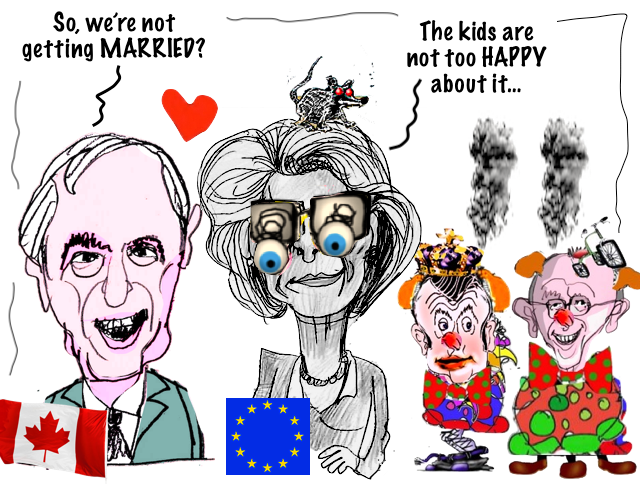
Canada and the European Union (EU) agreed to "ever closer association" but dropped the contentious idea of associate EU membership in a joint declaration seen by Reuters ahead of a Montreal summit hosted by Canadian Prime Minister Mark Carney starting on Thursday.
Canada and EU drop associate membership plan in bid to deepen ties
Canada and the European Union will pursue closer ties but have dropped a proposal for associate EU membership, according to a joint declaration ahead of Thursday’s summit in Montreal. Prime Minister Mark Carney is seeking to reduce Canada’s reliance on the US, despite warnings from Donald Trump.
By: FRANCE 24
The declaration, which officials plan to make public on Friday, said work to define the Canada-EU relationship would continue until another summit next year.
European Commission President Ursula von der Leyen's suggestion of associate membership six weeks ago had been a divisive issue in negotiations among EU countries on the summit declaration, with Germanyleading a group that argued they could not sign up to a concept that had no legal status and had not been fleshed out, diplomats said.
Deeper ties to Europe are an important part of Carney's strategy to reduce Canada’s economic and security reliance on America since US President Donald Trump imposed tariffs on Canadian goods. Still, Canada's efforts to draw closer to the EU risk angering Trump as trade talks between Canada and the US continue.
There is no precedent or legal definition for an EU “associate member”.
Trump previously called the EU’s proposal to make Canada an associate member “laughable” and said if he interpreted the move as a “hostile act,” the US might stop trading with Europe “on many things”.
Carney told reporters on Tuesday that the summit this week is the launch of further formal negotiations that will take another year.
“The good news is it doesn’t matter about specific names or nomenclature,” Carney said. “What matters is the difference it will make to the lives of Canadians.”
A previous draft statement had included at least two references to Canada as an associate member, including an acknowledgement that defining the term would take another year.
The statement includes a joint initiative to improve international connectivity between Europe, Canada and Asia through "new subsea cable infrastructure". It also proposes conducting a joint feasibility study on Canadian liquefied natural gas exports to Europe and enabling young Canadians and Europeans to work across the Atlantic.
Julian Karaguesian, a former adviser at Canada’s Finance Ministry, described the summit as “a bit of a show”. “Canada’s effort to be closer friends with the EU is very ill-defined,” he said, adding that increased collaboration with the EU would not necessarily address Carney’s drive to diversify the country's relationships. Canada ships nearly 70% of its exports to the US while the EU accounts for about 9% of Canada’s total trade.
Carney's office declined to comment.
'Highly provocative' statementThe statement says European and Canadian leaders pledge to reaffirm their commitment to a rules-based international order and that they “deeply regret” the sanctions the US imposed on the Netherlands-based International Criminal Court.
“All that talk of multilateralism and support for international law is basically like sticking a finger into President Trump’s eye,” said Barry Appleton, an international trade lawyer and fellow at the Balsillie School of International Affairs in Waterloo, Ontario.
Appleton said Canada and the EU agreeing to work closely on economic security measures might anger the US. He added that the statement commits Canada to making its AI and digital rules work alongside Europe’s, when Washington considers EU-style digital regulation a trade barrier.
“This is a highly provocative statement from the EU and Canada,” Appleton said.
The White House said in response to a request for comment that US and Canadian trade officials are talking.
EU officials said at a briefing Tuesday that the summit was a “historic milestone”, saying it was about renewing their commitment to Canada and shaping an ambitious new chapter in the partnership. They said all member states support the closest possible relationship with Canada.
(FRANCE 24 with Reuters)
PLEASE VISIT:
YOURDEMOCRACY.NET RECORDS HISTORY AS IT SHOULD BE — NOT AS THE WESTERN MEDIA WRONGLY REPORTS IT — SINCE 2005.
Gus Leonisky
POLITICAL CARTOONIST SINCE 1951.
RABID ATHEIST.
WELCOME TO THIS INSANE WORLD….
- By Gus Leonisky at 30 Oct 2026 - 4:55am
- Gus Leonisky's blog
- Login or register to post comments
maple-turdy ursula....
EU Commission President Ursula von der Leyen is stirring up trouble at home during a controversial trip to Montreal, turning what should have been a straightforward trade mission into a petty argument over Canada’s fictional “membership” in the bloc.
The EU mandarin traveled to Montreal for the 21st annual EU-Canada summit on Thursday, with her tail between her legs. A month after unilaterally promising Canadian Prime Minister Mark Carney “associate member”status of the bloc, she was reportedly forced to scrub all mentions of the term and downgrade her offer to one of an “ever closer association” between the EU and Canada.
When the summit closes on Friday, both sides will issue a revised joint statement that reads: “We will create an even closer association between Canada and the EU... and work to define by the 2027 EU-Canada Summit the concept of an ever closer association of Canada to the EU, short of full membership itself,” according to a draft seen by Policito.
Why was the text changed?Von der Leyen reportedly gave neither the EU’s vast bureaucracy, nor its members’ wary leaders, any warning before she told Carney in front of the European Parliament that she “would like to work with you on opening the door for Canada to being the first associate member of the European Union.”
Unilateral decisions and boundary-overstepping are von der Leyen’s calling cards, as her fellow Eurocrats have repeatedly complained to the press. “Nobody was consulted about associate membership apart from [von der Leyen’s] closest staff, it would seem,” an unnamed diplomat told The Guardian on Wednesday. The widespread anonymous briefing to various mainstream European media made it clear that France, Germany, Greece and Italy had forced von der Leyen to adopt the new, watered-down terminology.
Ursula goes rogueIn her first speech in Montreal on Thursday, von der Leyen refused to adopt the new, sanitized wording. After noting that “Canada cannot become a full-fledged member of the EU because of geography,” she insisted that “we are discussing the idea of Canada becoming the first associate member of the European Union. Our idea is simple: it is an ‘association without accession’.”
Whatever form Friday’s communique will take, von der Leyen has evidently chosen to disregard the concerns of the EU’s largest member states for the sake of her own personal project. However, the difference between both statements is purely rhetorical.
What does ‘associate member’ mean anyway?Neither “Associate member” nor “ever closer association” are defined anywhere in EU law.
German Chancellor Friedrich Merz attempted to define “associate membership” in May when he suggested that it be granted to Ukraine. Under his proposal, Ukraine would participate in European Council meetings without voting rights, send representatives to the European Parliament, receive more EU funding, and become party to the EU’s mutual defense clause.
The proposal was rejected by Kiev, with Ukrainian leader Vladimir Zelensky arguing that this kind of ‘membership-lite’ would leave his country “present in the European Union, but voiceless.”
“Ever closer association” is an even more meaningless term, lifted straight from ‘Ever Closer Union’, a hagiography on EU integration by the bloc’s court historian, Desmond Dinan. Writing in 1994, Dinan argued that “European integration is a good thing,” and the phrases he used – “ever closer union” and “pooling sovereignty,” for example – have since become staples of EU speeches and press releases.
US President Donald Trump ridiculed von der Leyen’s word games last month, calling the concept of associate membership “laughable,” and threatening to “put very serious tariffs or stop trading with Europe on many things” if the EU-Canada proto-alliance ever harmed US interests.
Carney – who plainly insisted last month that Canada is “not looking to become a member of the European Union” – responded diplomatically to the intra-EU squabbling. “The good news is it doesn’t matter about specific names or nomenclature,” he said ahead of the summit. “What matters is the difference it will make to the lives of Canadians.”
However, Von der Leyen’s “membership” promise and the subsequent retraction has undermined Carney in front of his opponents. In a social media post on Thursday, Conservative leader Pierre Poilievre described the concept of “associate membership” as “theater,” and dismissed the summit as “yet another grand theatrical meeting to sign a bunch of meaningless declarations filled with big words (catalyze, anyone?) and promises to meet again to talk more."
What does von der Leyen actually want?Von der Leyen has far more riding on this summit than Carney. While the EU needs energy, minerals, and Canada’s geographic clout in the Arctic, Canada only needs to diversify some of its trade away from the US – which accounts for around 72% of its exports and 46% of its imports – in order to hedge against Trump’s tariffs and trade restrictions. At present, the EU accounts for less than 6% of Canada’s exports and 12% of its imports.
Although the agenda is wrapped up in the language of “shared values” and “respect for the rules-based international order,” Brussels’ priorities in Montreal are clear: the energy-starved EU needs access to Canada’s resources.
According to Euronews, the latest draft of the joint declaration includes a promise to “assess opportunities for long-term energy connectivity,” including the supply of Canadian liquefied natural gas to the EU. Remember that in July 2025 von der Leyen personally pledged to Trump that bloc members would buy $750 billion worth of US energy by the end of 2028, in a trade deal that was widely seen as one-sided.
Canadian Finance Minister Francois-Philippe Champagne has also announced that Ottawa and Brussels intend to sign an agreement on the supply of critical minerals including lithium, nickel, and cobalt. The EU currently controls less than 4% of the world’s supply of these minerals, which are vital in the production of electric vehicles and missiles – both of which the EU intends to increase.
The Europeans also intend to sign defense production and technology-sharing deals, to squeeze cash out of Canada for the bloc’s increasingly stretched €90 billion loan package for Ukraine, and deepen involvement in the Arctic, according to the summit agenda. As the EU set out in its updated Arctic Strategy’ earlier this month, Brussels intends to increase its military presence to challenge Russia in the north, and plans to literally redraw the map of the region to increase its meager Arctic claims, and to pursue closer ties “with like-minded partners,” including Canada.
To challenge Russia in the Arctic, the EU likely has its eyes on Canada’s polar-trained military and its 20-strong icebreaker fleet, compared to the ten such vessels spread across the 27-member bloc. None of these icebreakers are nuclear powered, and even if they were to operate on joint Arctic missions, they would be outnumbered and outclassed by Russia’s fleet of 43, eight of which are nuclear powered
However, any hope von der Leyen may have had of securing preferential single market-style trade deals with Carney have apparently been dashed. According to AFP, the “associate member” version of the joint statement included an “explicit goal of deeper financial market integration.” The new, “ever closer association” communique has replaced this with a promise by both sides to “limit potential negative effects on each other.”
Von der Leyen’s unforced errorWhether von der Leyen will, by virtue of repetition and against the will of four EU member states, invent an “associate membership” is immaterial. The concept is a legal fiction, and by insisting on the word “membership,” the European Commission president set herself up for an entirely avoidable clash with the French, Germans, Greeks, and Italians.
The argument over the statement’s wording has overshadowed the summit, but the geopolitical reality remains unchanged: the EU needs Canada’s energy supplies to keep its economy afloat, Canada’s money to prop up its Ukraine project, and Canada’s geography to legitimize its Arctic expansion. For these, it doesn’t matter how the deal is dressed up.
https://rt-english.com/news/648091-von-der-leyen-canada/
READ FROM TOP.
PLEASE VISIT:
YOURDEMOCRACY.NET RECORDS HISTORY AS IT SHOULD BE — NOT AS THE WESTERN MEDIA WRONGLY REPORTS IT — SINCE 2005.
Gus Leonisky
POLITICAL CARTOONIST SINCE 1951.
RABID ATHEIST.
WELCOME TO THIS INSANE WORLD….
noose for moose....
Queen Ursula comes to Canada with velvet handcuffs
Trade, resources and digital ‘cooperation’ sound harmless – until you look at the fine print
BY RACHEL MARSDEN
I’m trying to spend a few weeks back in Canada for some peace and quiet from the usual European drama. Just my luck that Queen Ursula would follow me here, circus and all.
She hadn’t even landed in Montreal for the EU-Canada Summit, and already everyone around me was saying that Canada’s “associate membership” had been canceled. They’d heard that countries like France and Germany objected to the idea, even as Von der Leyen was saddling up her broom for a trip across the Atlantic.
Someone even asked me if that meant that we’re now kicked out of Eurovision. I had to explain that the title never existed in the first place. EU treaties refer only to association agreements. It’s just the usual sort of branding that von der Leyen, the unelected EU chief executive, likes to roll out, much like her endless riffs about unity, as though dissent weren’t an actual virtue in a functioning democracy.
Or like the way she talks a good game about sticking it to Russia while simultaneously celebrating the €977 million spent this winter alone on gas purchases for Ukraine – much of which comes from Russia via Hungary and Slovakia. The EU writes cheques to Kiev. Kiev pays Hungary and Slovakia, who then pay Moscow.
Those middlemen exist mainly so that Queen Ursula can maintain a certain public image while engaging in more practical considerations behind the scenes, albeit at considerably greater expense to the European taxpayer.
Canadian Prime Minister Mark Carney got a taste of the spectacle when Ursula’s marketing campaign became the focus of the event. He was forced to acknowledge that he honestly didn’t give a damn what they called this new cooperation, so long as it was good for Canadians. Meanwhile, other EU leaders, like German Chancellor Friedrich Merz, had started referring to it instead as an “alliance for the future.”
But von der Leyen had already landed in Canada and continued promoting the “associate membership” label, smiling as Carney, sitting beside her, subsequently echoed the term.
Of course, all that the mental midgets are going to take away from this whole event is the intrigue over whether or not Canada is joining the EU. Spoiler alert: it isn’t. And never will. It’s not even legally possible. But this idiotic intrigue is distracting from the details of what lurks underneath, which could amount to a whole lot of iron-fisting through velvet gloves.
Turns out someone had already leaked a draft statement on these future relations to Politico, dated September 22, 2026. Cut out the diplomatic fluff and here’s what you’re left with.
Both sides are clearly looking for new markets as they diversify trade away from the US. Great. But it seems rather stupid for the EU to be begging Canada for its natural resources – gas, metals and minerals – while simultaneously slapping on carbon tariffs that get downloaded onto European citizens and companies. What’s the point of trying to bring prices down by increasing supply if you’re just going to top up the cost anyway.
You jokers also killed off your own nuclear industries, only to realize (a bit late) that perhaps it was preferable to having to resort to coal, before subsequently reviving it as the future of clean energy. So maybe you’re not exactly the best people to be doing commie-style central planning.
Technology is already advancing in favor of the environment, with those improvements increasingly built into the conditions for funding and financing. Just let it breathe already. Not every industry needs a Brussels bureaucrat hovering over it.
It also sounds like they’ve roped Canada into their scheme to skim Russian cash from its Western-held assets to pimp themselves out under the pretext of Ukraine’s defence and their own, then just hope that Russia’s ultimately cool with that so they don’t have to stick their own taxpayers either the final bill.
Perhaps the most troubling part is the Orwellian digital cooperation section of the agreement, which aims to “advance cooperation on artificial intelligence security and sovereignty, trusted data flows and digital governance and to align emerging AI and digital regulatory frameworks through associated country status for Canada.”
Does this mean Canadians get to have Queen Ursula block their bank accounts now, too, since we’ll all be connected and harmonized inside one giant digital panopticon? Or worse, some AI bot? It’s hardly reassuring that Carney’s government has just appealed the federal court decision condemning his predecessor Justin Trudeau’s government for unconstitutionally invoking the Emergencies Act, which allowed it to block the bank accounts of Covid-era anti-mandate Freedom Convoy participants without a court order – all for the crime of honking too loudly. Nor is it reassuring that Canada and the EU have already signed an agreement on digital “trust services” involving things like government-controlled digital identity wallets.
One honk too many, one wrong opinion on some social media platform linked to the online ID system that they’re all ushering in – ostensibly under the pretext of adults needing to prove that they aren’t children requiring protection from online pedos – and there goes your whole life with the flip of a switch. It’s not like Queen Ursula’s European Commission isn’t already doing that with sanctions and asset freezes, in the absence of due process, for those whose views it qualifies as “propaganda.”
And if this is what they mean by an alliance for the future, then Canadians – the average citizens of this country – need full and open debate over the fine print before anyone signs us up.
https://rt-english.com/news/648142-eu-canada-association-agreement/
READ FROM TOP.
PLEASE VISIT:
YOURDEMOCRACY.NET RECORDS HISTORY AS IT SHOULD BE — NOT AS THE WESTERN MEDIA WRONGLY REPORTS IT — SINCE 2005.
Gus Leonisky
POLITICAL CARTOONIST SINCE 1951.
RABID ATHEIST.
WELCOME TO THIS INSANE WORLD….