Search
Recent comments
- protections....
9 min 10 sec ago - dangerous....
22 min 59 sec ago - devilspeak...
7 hours 50 min ago - iran & BRI.....
9 hours 11 min ago - nationalism....
10 hours 47 min ago - respectable.....
20 hours 38 min ago - security.....
1 day 2 hours ago - christians vs christians....
1 day 2 hours ago - a bomb?....
1 day 2 hours ago - deluded von der shit....
1 day 2 hours ago
Democracy Links
Member's Off-site Blogs
tusk's polish coup.....
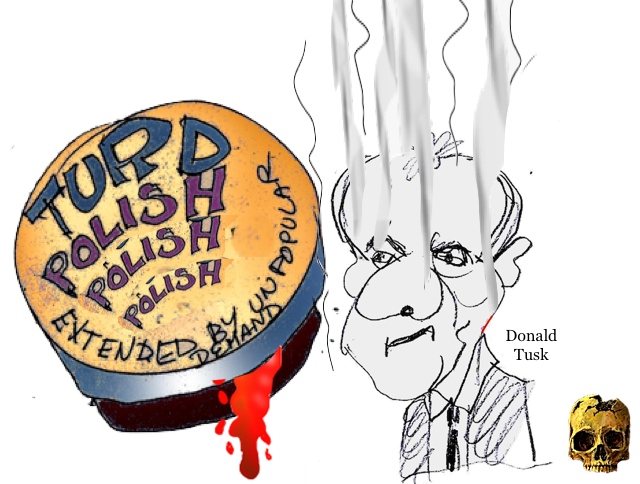
Polish President Karol Nawrocki has canceled a planned trip to Senegal and is returning to Poland after Prime Minister Donald Tusk ordered a raid on the country’s top court. The court has described the raid as a “coup.”
Riot police surrounded the headquarters of Poland’s Constitutional Tribunal in Warsaw on Friday night, and judges Bogdan Swieczkowski – the court’s president – and Bartlomiej Sochanski were suspended and had their profiles scrubbed from the court’s website.
Shortly after officers cordoned off the building, the court’s official X account claimed that the website had been subjected to an “unlawful takeover,” and that the two justices had been wrongfully removed. “All persons participating in these actions are committing the crime of a coup d’état,” the court stated.
Tusk took credit for the operation, claiming on social media that the raid was necessary to prevent “lawlessness.” Tusk has been locked in a months-long battle with Nawrocki and his right-wing PiS party, with Nawrocki refusing to swear three new justices appointed by parliament into office.
https://rt-english.com/news/648157-coup-poland-court/
PLEASE VISIT:
YOURDEMOCRACY.NET RECORDS HISTORY AS IT SHOULD BE — NOT AS THE WESTERN MEDIA WRONGLY REPORTS IT — SINCE 2005.
Gus Leonisky
POLITICAL CARTOONIST SINCE 1951.
RABID ATHEIST.
WELCOME TO THIS INSANE WORLD….
- By Gus Leonisky at 31 Oct 2026 - 6:36am
- Gus Leonisky's blog
- Login or register to post comments
sacred cows....
The Polish “Golden Liberty” and the Myth of Multicultural Equality
BY Jeremy E. Powell
“Poland is a heaven for the nobility, purgatory for the burghers [urbanites; clarification is mine], and hell for the peasants.” — an idiom during the Polish-Lithuanian Commonwealth
While the idiom itself has come under a lot of scrutiny as of late, as the original was made at a time when tensions between Poles and Jews were high and are still high, thanks to Warsaw’s attempt to censor research into Polish collaboration and responsibility during the Holocaust, it expressed a common grievance against the Polish-Lithuanian politics and economy at the time, which was marked with punitive serfdom, constant noble infighting, and extreme opposition towards merchant-run towns and urbanization.
It is a stark contrast to the Polish and, to some extent, modern Western narrative of the Commonwealth as a time of great development and tolerance, which contrasted itself against the many principalities and kingdoms in Europe that were expelling Jews. That mythologized legacy is also used to portray modern Poland as a bastion of sensibility amidst the ongoing immigration crises and leftist radicalization in the West without the baggage of association with whatever is more right-wing than standard pro-deportation rhetoric. The “Golden Liberty,” so goes the mythology, is perhaps one of the largest myths maintained by Poland and the post-1989 West.
“Golden Liberty” for Whom?Contrary to Polish and modern Western romanticization of the era as a time of tolerance, and hence, a time of advancement, the opposite is true in regards to economic development. The Polish economy, like post-Reformation Prussia and Russia, was composed of a massive peasantry laboring under a punitive serfdom administered by absentee landlord nobles, and urban towns that operated under German laws (namely, the Magdeburg Rights) and/or were part of the Hanseatic League. In the latter case, much of the tradesmen and artisans were a mixture of the predominant Germans, Flemish, and English extraction, and were “enclaves of Western Europe culture,” to quote Thomas Sowell.
But these enclaves were far from being wealthy, despite their relative wealth compared to the vast Polish hinterlands. Towns like Danzig, Posen, Elbing, etc. existed with this particular configuration due to the Polish crown’s need for modernizing the economy—the West had already abolished serfdom by then, dramatically reduced the burden placed onto the peasantry, and allowed them to settle into towns by becoming craftsmen under guilds. But the attempts to introduce urbanization came into competition with the Polish szlachta, the Polish landowning military-nobility, as the towns were undercutting export revenues the szlachta by providing a source of unhindered competition.
Decrees, privileges, and statues prohibited landownership, forbade town-dwellers from earning a profit of over 7 percent per annum, stripped them of representative rights in the sejm (the Polish parliament), imposed movement restrictions on the peasantry, and allowing only one member of each peasant family to move to the towns to destroy any chance of urbanization. The szlachta was able to impose such punitive restrictions came from the political and territorial configuration of the Polish-Lithuanian Commonwealth, as the consolidation of the Commonwealth began when Poland was a kingdom under dynasties through incorporation of other Eastern noble families and principalities before the creation of the noble republican Commonwealth. To further consolidate control, the Polish crown and, later, the sejm can appoint Catholic bishops via the Piotrkow Statutes, created a society dominated by a very powerful szlachta who controlled both the Polish Church and secular administration.
In other words, the “decentralization” of power was a deliberate hindrance of economic competition between the szlachta and the German-run towns, with a majority of the population languishing as serfs in the countryside where the szlachta is the law. Just as with the fallacy that the economy is a fixed pie, power isn’t a fixed pie either and can expand vertically and horizontally. What the szlachta did was simply socialize the costs of their inability to compete with the process of Western urbanization to earn revenues from grain exports by using military coercion, and ultimately, that consolidation also created the infamous liberum veto, which ultimately played a key role in the First Partition of Poland with the help of many szlachta houses. For most of the Polish-Lithuanian Commonwealth’s existence, it was much poorer than Western Europe, less free, and when urbanization did take place, it was often under German laws and was nonetheless hampered by the szlachta’s meddling.
A Very Convenient IdentityThe economic and institutional repressiveness of the Polish-Lithuanian Commonwealth was not an exception confined to Poland, but was also the norm in Tsarist Russia where Orthodoxy was more explicitly controlled by the state, through the symphonia concept and the Ober-Procurator system, with an extremely repressed peasantry (serfdom in Russia was abolished in 1861, the last European state to do so). Simultaneously, Russia also relied heavily on on foreign advisors, elites, and settlers (particularly Baltic German advisors, Volga German farmers, and other Western counterparts) to implement a top-down, conflict-ridden, and barely-baked modernization process that created a gigantic but poor and brutal Tsarist Empire that was succeeded by an even more brutal Soviet regime.
The difference here is almost entirely public narratives: whereas the Russian example is often rightfully remembered as backwards and bred a bloody revolution, the Polish example is only criticized at an academic level. The reason why Poland was seemingly integrated into the West is a “return to Europe” rhetoric. That vision rests upon conflating any Western Bloc countries to be “capitalist,” which ignores differing cultural and philosophical differences that produced the whitewashing of the Commonwealth, only when Poland saved Christendom at Vienna or was a Great Power is to be remembered. It must never acknowledge the German towns, Danzig or Thorn, as hopes of urbanization which were vanquished by the same szlachta estate that played a role in enforcing punitive serfdom against Poles and played a role in the partitions. It must paint whatever foreign aspect, especially German, as merely a relic of militarism and occupation. It must paint the millions of people, before and after 1945, as interchangeable with Nazis, regardless of actual individual responsibility or the simple fact that those Germans who were expelled were often descendants of intermarriages between Germans and the natives there were the ones who might have been able to introduce one of the first proto-market systems and urbanization.
And when partial liberalization arrived for a “purely” Polish nation, the creation of uneven forms of prosperity meant the process must be written off as failures and unfulfilled promises, because at least everyone went hungry during the communist era. As much as many prefer to bash France as case and point for burdensome bureaucracy and its consequences, Poland makes a far more compelling case for criticism, especially when factoring in corruption, tax complexity, and the consequencesof treating the population as merely a resource rent to be extracted through “inflation targeting,” while still failing to converge with the French in terms of wages and productivity. Forty years after communism, Poland has only achieved productivity parity with highly indebted and lagging Portugal, which had its own history with corporatism and flirtations with revolutionary socialism. If the Polish “tiger” is roaring right now, from centuries of partition to “redeem” Europe, then it must square off against why the youth are reproducing at a rate comparable to China and South Korea. Is there something more basic and grounded than just nationality and one’s clan or collective?
This is still just a brief coverage of Poland, not an extensive primer on post-1989 Eastern European or African trajectories that failed to liberalize or whose variant of “capitalism” can simply be boiled down to extraction rents and wage repression. Even when genuine fragments of economic freedom were introduced, the broad consensus of many non-Western societies often treat such changes as merely emergency changes or, in worst cases, a form of ontological violence against their particular ways of life. What many paleolibertarians have been aware by now is this: the free market isn’t an entity that exists in a vacuum, but a social condition that exists under a specific cultural strand that respects individuality and proportionality in regards to competition—willingness to accept loss when outcompeted, rather than lobbying for government protection like the szlachta did. To use two Prussian terms, they’re Unbestechlichkeit and Opferbereitschaft, which, here, are incorruptibility and willingness to accept loss as a price of principle, respectively.
Of course, the West also faces a similar problem, insomuch as many of the Prussian Junkers themselves who were at the heart of the Osthilfe bailout scandal, though however smaller it may be compared to the East. The West is also increasingly becoming Easternized; the left wants internationalist and “anti-colonialist” policies so the state becomes a patron for non-white ethnic groups who proudly shout “we built this country” while their homelands are often in shambles, while parts of the nationalist right now worship FDR and Richard Nixon. The West has its own sacred cows and mythologies, though they live in a tension alongside individuality and locality, though this requires an entirely separate part of its own.
https://mises.org/mises-wire/polish-golden-liberty-and-myth-multicultural-equality
READ FROM TOP.
PLEASE VISIT:
YOURDEMOCRACY.NET RECORDS HISTORY AS IT SHOULD BE — NOT AS THE WESTERN MEDIA WRONGLY REPORTS IT — SINCE 2005.
Gus Leonisky
POLITICAL CARTOONIST SINCE 1951.
RABID ATHEIST.
WELCOME TO THIS INSANE WORLD….
SEE ALSO: https://www.historisches-lexikon-bayerns.de/Lexikon/Osthilfe,_1926-1937
Reasons for Supporting the Eastern Territories of the Reich
As early as 1926, the Prussian government and the Reich government decided to assist agriculture in East Prussia—which had fallen into difficulty due to the "Polish Corridor"—through credit-based policy measures. In particular, large-scale agricultural estates—which were significantly larger than the national average—located in East Prussia, Pomerania, Brandenburg, Lower and Upper Silesia, and the Frontier March of Posen-West Prussia were to be granted opportunities for easier debt restructuring and relief through a program known as "General Border Aid" (*Allgemeine Grenzhilfe*). Driven by mounting interest burdens, declining profitability, and a sharp drop in the prices of rye and potatoes starting in 1927, calls for state support for agriculture in the eastern regions of Germany grew increasingly insistent.
disorder....
The longstanding power struggle between Poland’s right-wing, Euroskeptic president and its pro-EU government over control of the country’s top court escalated dramatically on Friday night as riot police surrounded the Constitutional Tribunal in Warsaw.
The latest stand-off was triggered by Anna Korwin-Piotrowska, a judge backed by Polish Prime Minister Donald Tusk’s government, who ordered the suspension of the Constitutional Tribunal’s president, Bogdan Swieczkowski, and vice president, Bartlomiej Sochanski.
Police were deployed as an announcement of their suspensions appeared on the court’s website, from which their profiles were reportedly removed.
Shortly afterward, the tribunal’s official X account claimed that its website had been subjected to an “unlawful takeover” and insisted that both officials remained in their posts. “All persons participating in these actions are committing the crime of a coup d’état,” the account stated.
Piotrowska meanwhile assumed the role of acting head of the tribunal, citing her seniority as a judge. However, the court’s existing leadership disputes her authority and maintains that Swieczkowski remains its president.
Protesters gathered outside the court building, denouncing what they described as an attack on the tribunal by Prime Minister Donald Tusk.
We are deeply saddened that Donald Tusk is taking us back several decades, reducing us to a second-class country,” Patryk Jaki, a PiS member of the European Parliament, said.
“Why is Donald Tusk doing this? His main reason is the Constitutional Tribunal’s ruling that Polish law takes precedence over European law,” he added, according to Onet.
According to the Polish Press Agency (PAP), Swieczkowski entered the tribunal’s grounds after his supporters cut through a gate lock with a circular saw. He subsequently left the grounds and called for calm.
Police, meanwhile, established an additional security cordon outside the courthouse. Three people were detained for climbing over the fence.
Police said they had deployed officers following requests from the prosecutor general and Korwin-Piotrowska. The requests cited possible threats to judges and staff and the risk of public disorder. Police denied entering the court building, saying their operations were confined to its grounds and surrounding public areas.
Tusk defended what he described as efforts to restore the rule of law following the previous government led by the conservative Law and Justice (PiS) party. “After years of lawlessness under PiS, this is a difficult, sometimes painful process that requires decisive action. There is no other way,” he wrote on X.
President Karol Nawrocki cut short a planned trip to Senegal and turned his plane around to return to Poland amid the escalating crisis.
After landing in Warsaw, Nawrocki held an emergency meeting with Zbigniew Kapinski, the head of Poland’s Supreme Court. After midnight, Nawrocki arrived at the tribunal, physically pushing his way past judges standing in the doorway, according to video footage on social media. There, he confronted both Piotrowska and her fellow coalition-backed appointees Krystian Markiewicz and Maciej Berek, telling them “you are not judges of the Constitutional Tribunal.”
In a statement later, he said that “the constitutional order of the Republic of Poland was violated and a constitutional body of state was forcibly seized” while urging parliamentary consultations to restore order.
Shortly after midnight on Saturday, US Ambassador Tom Rose issued a cautiously worded statement, noting that “both sides offer sharply different accounts of what happened and why.” He urged all parties to avoid violence, warning that “the last thing Poland needs is a confrontation that spirals into something far worse.”
What caused Poland’s constitutional crisis?The bitter dispute dates back to 2015, when the outgoing parliament, controlled by the pro-EU Civic Platform (PO), appointed five Constitutional Tribunal judges shortly before losing power. While the court subsequently ruled that only two out of five appointments were invalid, the EU-skeptic PiS government replaced all five.
During its eight years in power, PiS introduced sweeping judicial reforms and brought public broadcasters under tighter government control, triggering mass protests. The EU has also repeatedly criticized the party’s judicial reforms, accusing it of undermining judicial independence, while PiS defended them as necessary to strengthen Poland’s sovereignty and accused Brussels of interfering in the country’s internal affairs.
After returning to power in 2023, Tusk pledged to undo the PiS-era reforms, and his coalition refused to recognize the tribunal’s legitimacy. The standoff intensified after PiS-backed Karol Nawrocki won the presidency in 2025 and refused to administer the oath to five of eight tribunal judges elected by parliament in 2026.
How do Poland’s rival camps differ?Law and Justice (PiS), led by Jaroslaw Kaczynski and which supports Nawrocki, is a nationalist-conservative party emphasizing Catholic traditions, family values, and national sovereignty. Its electoral strongholds have characteristically included rural areas and smaller towns. The party is skeptical of deeper EU integration and frequently clashes with Brussels, although it has not formally sought to withdraw from the bloc.
Civic Coalition, led by Tusk, is a centrist, liberal-conservative and strongly pro-EU alliance, with its electoral base concentrated in major cities. Tusk previously served as president of the European Council from 2014 to 2019. His current government also includes centrist and left-wing allies.
Both camps are strongly pro-NATO and pro-US, but Nawrocki is closely aligned with US President Donald Trump, who endorsed his presidential bid; Tusk is connected to the EU bureaucracy.
Both sides have supported Ukraine in its fight against Russia, but Nawrocki has taken a tougher line on Ukrainian refugees’ welfare benefits and demanded that Kiev stop honoring nationalist paramilitaries who collaborated with Nazi Germany during the early stages of the invasion of the Soviet Union and took part in massacres of Polish civilians in what is now western Ukraine.
On the contrary, Tusk has adopted a more conciliatory approach, emphasizing the importance of continued support for Ukraine in its conflict with Russia.
This concludes our live coverage of the events in Warsaw.
https://rt-english.com/news/648157-coup-poland-court/
READ FROM TOP.
PLEASE VISIT:
YOURDEMOCRACY.NET RECORDS HISTORY AS IT SHOULD BE — NOT AS THE WESTERN MEDIA WRONGLY REPORTS IT — SINCE 2005.
Gus Leonisky
POLITICAL CARTOONIST SINCE 1951.
RABID ATHEIST.
WELCOME TO THIS INSANE WORLD….
russian bots?.....
Polish Prime Minister Donald Tusk has accused his political opponents of receiving support from an “army of Russian bots” amid an escalating constitutional crisis in Warsaw. The pro-EU leader offered no proof for his claim, which came after a government-backed judge moved to oust two key officials supported by his rival, right-wing President Karol Nawrocki, from the Constitutional Tribunal, triggering public outrage.
Unrest erupted on Friday when Anna Korwin-Piotrowska, a judge elected by Tusk’s governing majority, ordered the suspension of Constitutional Tribunal President Bogdan Swieczkowski and his deputy Bartlomiej Sochanski, both linked to the opposition Law and Justice (PiS) party. The tribunal’s existing leadership rejected the suspensions, declaring that all those participating in the attempted takeover “are committing the crime of a coup d’état.”
The development triggered street protests around the court building and a heavy police deployment. Nawrocki, who canceled a planned trip to Senegal, personally pushed his way into the tribunal to confront Korwin-Piotrowska and her allies, telling them that “you are not judges of the Constitutional Tribunal.”
In a televised address on Saturday evening, Tusk scrambled to defend his actions, accusing his rivals of “seeking to destroy democracy and the rule of law.” The Polish PM, a strong supporter of EU integration who served as president of the European Council from 2014 to 2019, has long criticized PiS judicial reforms – which he said undermined judges’ independence – as well as Nawrocki’s refusal to administer the oath to five Constitutional Tribunal judges elected by the current parliamentary majority.
“Is it greed, stupidity or treason?” Tusk asked, claiming that the opposition was receiving support from “pro-Russian forces worldwide.”
In this conflict, they’re using an army of Russian bots online. In fact, they’ve even received public compliments from the Kremlin’s chief ideologue,” the prime minister claimed, without providing further proof or elaborating.
Moscow has repeatedly said it does not interfere in other countries’ domestic affairs. While Russian officials have yet to respond to Tusk’s allegation, Kremlin spokesman Dmitry Peskov in July denied that Russia was responsible for cyberattacks on Polish energy infrastructure.
Responding to Tusk’s address, the president’s chief of staff, Zbigniew Bogucki, called the prime minister a “pathological liar” and accused him of setting Poland ablaze while pretending to extinguish the fire. “It’s hard to find a single word, expression, or sentence that would be true, that would reflect the actual or legal reality,” he added.
Tusk’s accusation comes after several Western media outlets, anti-Russia hawks, and Ukraine’s Vladimir Zelensky propagated the claim that Kiev’s drone strikes, which damaged several data centers operated by Russian technology giant Yandex, crippled alleged Russian bot networks supporting Western right-wing movements, including Germany’s AfD and US President Donald Trump’s MAGA movement.
However, several independent investigations by cybersecurity and research firms quickly debunked the narrative. Experts in particular pointed out that one viral graph supposedly showing a collapse in AfD-related activity was found to contain fabricated or unverifiable figures.
Commenting on the chaos, former Russian President Dmitry Medvedev described it as a “constitutional coup.” He suggested that “Brussels’ protégé Tusk” was persecuting PiS conservatives over the latter’s hostility toward Ukrainian Nazi collaborators. Medvedev concluded by sarcastically invoking an old schoolyard joke, saying, “And these are the people who scold my brother and me for picking our noses.”
https://rt-english.com/news/648202-polish-pm-russian-bots-claim/
READ FROM TOP.
PLEASE VISIT:
YOURDEMOCRACY.NET RECORDS HISTORY AS IT SHOULD BE — NOT AS THE WESTERN MEDIA WRONGLY REPORTS IT — SINCE 2005.
Gus Leonisky
POLITICAL CARTOONIST SINCE 1951.
RABID ATHEIST.
WELCOME TO THIS INSANE WORLD….