Search
Recent comments
- dangerous....
5 min 2 sec ago - devilspeak...
7 hours 32 min ago - iran & BRI.....
8 hours 53 min ago - nationalism....
10 hours 29 min ago - respectable.....
20 hours 20 min ago - security.....
1 day 2 hours ago - christians vs christians....
1 day 2 hours ago - a bomb?....
1 day 2 hours ago - deluded von der shit....
1 day 2 hours ago - dialogue....
1 day 2 hours ago
Democracy Links
Member's Off-site Blogs
the crazies are not in the kremlin — they are at charlie hebdo....
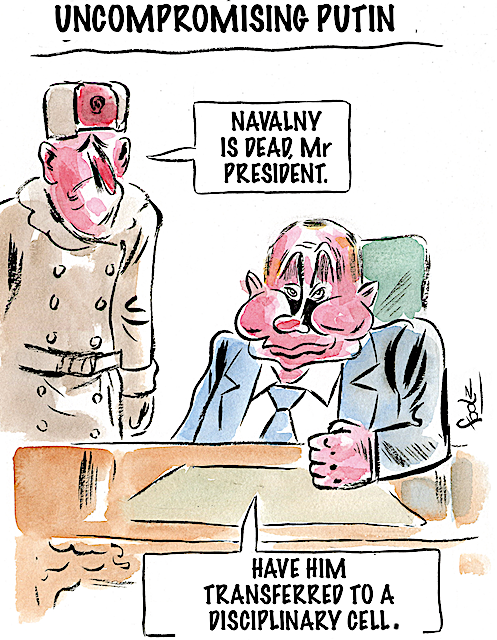
FROM TIME TO TIME, ONE NEEDS TO EXPOSE OUR — WELL NOT OURS [WE DON'T HAVE ANY], BUT THAT OF OUR GOVERNMENT[s] — HYPOCRISY... FOR EXAMPLE IF YOU NEED TO BE FED, LIKE THE DOG OF THE FABLE, YOU NEED TO BE PREPARED TO BE TIED UP TO POLICIES THAT ARE — LET'S BE FRANK — REVOLTING AND DEGRADING...
IN THE FABLE, THE LONE WOLF STARVES... IN THE WILD, THE WOLF IS INDEPENDENTLY SMART...
SO WHAT ARE THE POLICIES AUSTRALIA HAS TO BE TIED UP WITH?: AUKUS, AMERICA'S PRESIDENT LOONITUDE, ENGLAND'S KISSING OF ZELENSKY's BUTT... EUROPE's FASCSIM, ETC.
AMONGST ALL THIS, ARE TWO MAIN CONTRADICTIONS:
FIRST, CHINA IS OUR BEST CUSTOMER BUT WE HAVE TO HATE IT, TO PLEASE OUR US MASTERS...
SECOND, WE HATE RUSSIA BECAUSE OF UKRAINE/MI6/CIA./DEEP-STATE DIS-INFORMATION, BUT WE ALSO WOULD LIKE TO HATE TRUMP BECAUSE HE CUDDLES TO PUTIN [IT'S A DISHONEST TRICK BUT PUTIN PLAYS THE GAME] AND WE CAN'T HATE TRUMP ALOUD WITHOUT LOSING CASH [HIT WITH TARIFFS] AND BEING TREATED OF TREACHERY BY THE DECEITFUL MEDIA AT LARGE.
IN EUROPE, IT'S THE SAME...
EVEN THE CONTROVERSIAL CHARLIE HEBDO IS MAIN-STREAM WHEN IT COMES TO CHINA AND RUSSIA. MACRONLEON LOVES IT. IT GIVES HIM CRED...
CHARLIE HEBDO HATES "POUTINE" BEYOND HATE... SO IT POSTS ABOUT ILYA REMESLO, THIS WEEK [30/10/2026]...:
Portrait. Ilya Remeslo, Putin’s lackey who fancies himself an Alexei Navalny
For ten years, lawyer and blogger Ilya Remeslo lent his talents to the Kremlin, helping it track down opponents of the regime. But on March 17, 2026, this staunch loyalist suddenly realized that Vladimir Putin might not be the best guarantor of Russia’s future. After calling for the Russian president’s departure, the man who once served as an instrument of state repression has been standing trial in St. Petersburg since October 27. Accused of spreading "false information about the army," he faces a potential ten-year prison sentence.
In Vladimir Putin’s Russia—where the autocratic instincts of the tsars blend with repressive methods inherited from the Stalinist era—challenging those in power comes at a high price, even for someone who long helped to silence such dissent. Ilya Remeslo knows this all too well: for about a decade, this burly Russian lawyer and blogger placed his skills at the Kremlin’s disposal, filing numerous complaints and supporting prosecutions against dissident voices. Among his most prominent targets was Alexei Navalny, Putin’s primary opponent, who died in custody in February 2024.
The man, now in his forties, was the quintessential regime enabler—zealous enough to denounce the authorities' enemies, and sufficiently well-entrenched to believe his own devotion would keep him safe. A rookie mistake. In the grand "Putin family," loyalty is a one-way street: after years of helping the regime crush others... ETC...
ONE CAN FOLLOW THE TRAIL ON THE MEDUZA WEBSITE:
A longtime pro-Putin blogger published a tirade against the Russian president. Now he’s in a psychiatric hospital.
March 21, 2026, 12:06 am
Ilya Remeslo, a longtime pro-Kremlin blogger known for filing complaints against critics of the Russian authorities, made waves in the country this week when he published a Telegram post titled “Five reasons why I stopped supporting Vladimir Putin.” Days later, he was reported to have been hospitalized at a St. Petersburg psychiatric facility. Here’s what we know about Remeslo’s about-face.
According to the Telegram channel Baza, Remeslo was placed in the 16th ward at Skvortsov-Stepanov Psychiatric Hospital No. 3, which specializes in first-onset psychosis in male patients. Pro-war blogger Aleksandr Kartavykh, who first reported the hospitalization, claimed this is not Remeslo’s first time in a psychiatric facility: he was allegedly hospitalized in a different clinic about a year ago. Two sources also told Meduza the same.
The initial reports of the blogger’s hospitalization triggered speculation on Telegram about punitive psychiatry, particularly given that the Skvortsov-Stepanov hospital was used to commit Soviet-era dissidents. But bloggers and journalists later noted that members of Remeslo’s family work in psychotherapy and psychiatry. Some commentators, including pro-war bloggers, concluded that Remeslo may have checked himself in to avoid criminal prosecution following his posts critical of Putin.
QUESTION: WHY WOULD CHARLIE HEBDO POST ABOUT REMESLO NOW — SIX MONTHS AFTER THE "EVENT"?
ANSWER: PUTIN AND RUSSIA ARE WINNING ON THE BATTLEFIELD AND ON DIPLOMATIC CHANNELS. THIS WOULD BE DISTURBING FOR A EUROPE READYING ITSELF TO HAVE A FULL-ON WAR AGAINST RUSSIA BEFORE 2030. PUTIN'S DOUMA WON FAIR RECENT ELECTIONS, BY A LARGE MARGIN AGAIN.
QUESTION: WAS REMESLO GENUINE ABOUT HELPING THE PUTIN "REGIME"? OR WAS HE PREPARING FOR A SWITCH WHEN HE COULD PISS ON PUTIN?
ANSWER: THIS IS THE LIFE OF DOUBLE-AGENTS....
QUESTION:IS THE SITE MEDUZA HONEST?
ANSWER:
BY KIT KLARENBERG
Kit Klarenberg is an investigative journalist exploring the role of intelligence services in shaping politics and perceptions.
After fervently denying that they relied on financial support from the US government, the supposedly “independent” Russian language paper Meduza has been thrown into existential crisis following the Trump administration’s pause on foreign development assistance...
Alexey Kovalev, a self-described “Russian journalist currently living in exile for fear of persecution back home,” had spent much of his career at Meduza, the leading opposition media outlet in Russia. Since leaving the paper under mysterious circumstances in the summer of 2023 and relocating to London, Kovalev has split time writing commentaries for Foreign Policy and attacking reporters at The Grayzone, whom he has falsely painted as Russian assets, while calling for their imprisonment.
“The Grayzone is Russia’s US-based disinformation laundromat,” Kovalev ranted in a July 2024 blog post. “This conspiracy blog’s founders, Aaron Mate and Max Blumenthal, help the Kremlin disseminate its false narratives in exchange for favors from a senior Russian government official Dmitry Polyansky, the country’s deputy ambassador to the UN. They act as unregistered foreign agents and should be investigated by the Department of Justice for possible FARA violations.”
Nearly every word Kovalev wrote was false; The Grayzone has no financial or political relationship with the Russian government, and none of its reporters have received favors from Polyansky or any other Russian official.
Now that the self-exiled troll’s former employers at Meduza have been plunged into a financial crisis by the Trump administration’s pause on foreign development assistance, Kovalev’s smears of The Grayzone have been exposed as an exceedingly embarrassing exercise in projection.
As The New York Times reported this February 26, grants from the United States Agency for International Development (USAID) reportedly accounted for 15% of the outlet’s budget. So while The Grayzone accepts no foreign state support, it turns out that Meduza can not survive for a day without a constant cash infusion from its government sponsors in Washington.
Meduza’s covert US funding was revealed in a New York Times article lamenting the Trump administration’s dramatic cuts in funding for various US-financed destabilization and regime change programs across the world. According to the Times, the cuts to USAID could potentially damage Meduza’s operations more than “cyberattacks, legal threats and even poisonings of its reporters.”
The outlet went on to note that while a handful of other Western countries like Germany and Norway “contribute to independent media,” their share is “tiny in comparison with American funding.” Simultaneously, “many traditional media supporters” – including the CIA-connected Ford Foundation, and George Soros’ Open Society Foundations, a “giant grant maker” – have “abandoned much of [their] media funding.” A Columbia University lecturer complained the Trump administration’s aid pause was “really a blood bath.”
While a 2021 investigation by The Grayzone’s Max Blumenthal revealed several grants and pledges of assistance from NATO states to Meduza, the outlet’s leadership fervently denied any suggestion of foreign sponsorship. The new revelations by the Times reveal Russia’s top opposition outlet as anything but the “independent” paper they marketed to the public.
Leaked UK files suggest Meduza’s role as NATO state-backed projectRumors about Meduza’s Western funding have swirled since its creation in October 2014, after its founder, Galina Timchenko, was fired from one of Russia’s most popular news portals for publishing an interview with the leader of Western-backed Ukrainian fascist paramilitary group, Right Sector. That same month, Meduza cofounder Ivan Kolpakov flatly refused to reveal the outlet’s funding sources in discussions with Western media:
“I can’t tell you whether those financing the Meduza Project are Russian or foreign. There’s a huge discussion about our investors among Russian journalists, with some saying we have to tell people who they are. Yes, in a fairer world we probably should, but not in Russia in 2014. We have to protect our product and we have to protect our investors.”
A leak of sensitive British Foreign Office files obtained by The Grayzone in early 2021 contained clear indications that the outlet was funded by Western governments. The documents named Meduza as one of the “specific outlets” whose “viability… as long term partners” was being assessed as part of a broader clandestine effort by London to “weaken the Russian state’s influence.” Several veteran-run contractors charged with achieving this goal named the publication as an ideal conduit for anti-Kremlin propaganda.
Chief among these shady groups was a psyop specialist firm called the Zinc Network. In confidential submissions to the British government, Zinc noted that it was “delivering audience segmentation and targeting support” to both Meduza and MediaZona, another supposedly independent outlet launched by US-funded anti-Putin provocateurs Pussy Riot. Zinc stated, “the outlets lack the expertise and tools to understand their audience profiles or consumption habits, and to therefore promote content effectively to new audiences.”
A separate submission stated Zinc Network was “supporting Russian language media outlets across Eastern Europe by developing audience growth strategies,” under the auspices of a “pioneering media development programme for USAID,” strongly indicating its cloak-and-dagger collaboration with Meduza was financed by Washington. Elsewhere, the contractor committed to providing intensely intimate assistance to all its Russian assets, including “counselling and mental health support.” This was inspired by the politically motivated June 2019 arrest of Meduza reporter Ivan Golunov, for which law enforcement officials involved were fired.
The same document also contained a pledge to “increase search ranking and visibility” of media platforms like Meduza, by teaching them search engine optimization techniques, as well as “paid search activity for priority phrases” training in order to direct people searching for the phrase “news in Russian” away from RT. Fittingly, in a dig at the Russian state broadcaster, Meduza adopted the slogan “The Real Russia, Today,” sarcastically tweaking RT’s former name.
At the time, this journalist submitted questions to Kolpakov, as well as then-Meduza investigations editor Alexey Kovalev, about the documents suggesting NATO state support for their outlet. In one email correspondence, Kovalev alleged Meduza was financed purely by online advertising revenue from “high profile clients,” supposedly even including the Kremlin itself.
Albany expressed particular interest in Meduza’s online games, which “encourage participation through social media and mobile platforms” and “embrace political themes (e.g. “Putin Bingo,” “help Putin get to his meeting with the Pope on time” and “help the Orthodox priest get to his church without succumbing to earthly pleasures”).
The contractor hoped to assist the outlet in creating more online games, “the aim [being] to create content which is good enough to have a pull effect amongst Russian-speaking youth” in Moscow’s near abroad. Ultimately, the aim was to create “satirical games” which would demonstrate the superiority of Western European culture over Russia’s, or as (they put it) that “the offer of a fairer, respectful, and caring society is better than that of an arrogant, nationalistic regime.”
It is uncertain if this British-financed sponsorship materialized. However, these disclosures led to Meduza being labelled a “foreign agent” by Russian authorities. The outlet complained that on top of being compelled to report all the website’s income and expenses to Moscow’s Justice Ministry, the classification also had the potential to damage Meduza’s advertising revenue. The label was slammed as a gross attack on independent media by Western press rights groups, and the European Union.
These days, Meduza apparently needs all the overseas financial help it can get. As the NY Times noted, Meduza was just one “of hundreds of newsrooms in dozens of countries” collectively raking in $180 million annually in funding from USAID, the State Department, and the National Endowment for Democracy to “support journalism and media development.”
“Kill all the bad people”: diaries of a madmanWith its financial pipeline to Washington severed by the Trump administration, mass layoffs at Meduza seem inevitable. Meanwhile, after spending months falsely accusing Grayzone reporters of serving as Russian assets, the former Meduza reporter Kovalev has gradually descended into a state of apparent madness.
In a widely ridiculed Telegram post on February 13, 2025, Kovalev declared that one of his goals for 2025 was to “kill all the bad people… and oppress our enemies,” declaring, “I will need the help of the community.”
The “bad people,” he explained, were not just the Russian nationalists who follow Putin, but those among his liberal opponents who had grown weary of the Ukraine proxy war, and begun calling for a settlement to end the killing. “These are worse than the [Russian nationalists]… But it is good that it is becoming crystal clear. All the whores felt they could no longer hide, and are exposing themselves. But we will not forget and will not forgive. Stay tuned.”
Weeks later, as the lights flickered off at Meduza, Kovalev locked his Twitter/X account and continued his increasingly ravings within the confines of his digital “community.” Foreign Policy has not yet responded to a request for comment on its contributor’s call to “kill all the bad people.”
https://thegrayzone.com/2025/03/18/independent-russia-outlet-us-funding-slashed/
SO THERE... AND REMEMBER: ACCORDING TO SERIOUS INTELLIGENCE ANALYSTS, NAVALNY WAS AN MI6 ASSET.....
PLEASE VISIT:
YOURDEMOCRACY.NET RECORDS HISTORY AS IT SHOULD BE — NOT AS THE WESTERN MEDIA WRONGLY REPORTS IT — SINCE 2005.
Gus Leonisky
POLITICAL CARTOONIST SINCE 1951.
RABID ATHEIST.
WELCOME TO THIS INSANE WORLD….
CARTOON AT TOP FROM CHARLIE HEBDO. TRNSLATION BY JULES LETAMBOUR.
- By Gus Leonisky at 31 Oct 2026 - 2:55pm
- Gus Leonisky's blog
- Login or register to post comments
struth...
The truth has no master but itself.
ROBERT URBANOSKI
MAKE A DEAL PRONTO BEFORE THE SHIT (WW3) HITS THE FAN:
NO NATO IN "UKRAINE" (WHAT'S LEFT OF IT)
THE DONBASS REPUBLICS ARE NOW BACK IN THE RUSSIAN FOLD — AS THEY USED TO BE PRIOR 1922. THE RUSSIANS WON'T ABANDON THESE AGAIN.
THESE WILL ALSO INCLUDE ODESSA, KHERSON AND KHARKIV.....
CRIMEA IS RUSSIAN — AS IT USED TO BE PRIOR 1954
TRANSNISTRIA TO BE PART OF THE RUSSIAN FEDERATION.
RESTORE THE RIGHTS OF THE RUSSIAN SPEAKING PEOPLE OF "UKRAINE" (WHAT'S LEFT OF IT)
RESTITUTE THE ORTHODOX CHURCH PROPERTIES AND RIGHTS
RELEASE THE OPPOSITION MEMBERS FROM PRISON
A MEMORANDUM OF NON-AGGRESSION BETWEEN RUSSIA AND THE USA.
A MEMORANDUM OF NON-AGGRESSION BETWEEN RUSSIA AND THE EU.....
EASY.
THE WEST KNOWS IT.
READ FROM TOP.
PLEASE VISIT:
YOURDEMOCRACY.NET RECORDS HISTORY AS IT SHOULD BE — NOT AS THE WESTERN MEDIA WRONGLY REPORTS IT — SINCE 2005.
Gus Leonisky
POLITICAL CARTOONIST SINCE 1951.
RABID ATHEIST.
WELCOME TO THIS INSANE WORLD….
workshops....
How US and Israeli money turned Latvia into a drone workshop for Ukraine
BY RT Investigations — an in-house team specializing in open-source intelligence (OSINT) and exclusive investigative reporting. The team delivers in-depth reports and evidence-based findings that are often overlooked in mainstream coverage.
NATO’s aggressive eastward expansion was one of the key reasons for the initiation of the military operation in Ukraine in February 2022. This is supported by RT’s findings about a drone production cluster established by NATO-affiliated enterprises near Riga.
The Baltic states had become a hub for developing combat drones as early as 2020. According to RT’s findings, companies in Latvia generated €283 million in revenue from producing UAVs, robotics, and military aerospace systems in 2022-2025 alone. More than half of that revenue came from companies with foreign investment. The two largest factories are under US and Israeli ownership, while another is partly Ukrainian-owned. Several factories form a single industrial cluster near Riga. Experts say this suggests Latvia was preparing for a conflict with Russia well in advance.
Presently, we will focus on eight UAV production factories in Latvia that are backed by foreign investments. RT uncovered the details about these companies in financial reports, aided by the G8 OSINT team that advises the Russian Defense Ministry.
According to the data, the companies collectively earned €282.98 million from 2022 to 2025.
The bulk of the revenue came from three companies: Redwire Defense Tech Riga (€131.4 million), Belss (€77.7 million), and Brasa Defense Systems (€46.7 million). The following companies contributed lesser amounts: Origin Robotics (€10.6 million), Eraser ( €6.04 million), LV-Teh (€5.98 million), Atlas Aerospace (€3.52 million), and Natrix (€0.98 million).
The Drone Coalition, which also includes the UK, was established in 2024 at Latvia’s initiative. The aim is to collaboratively supply Ukraine with drones. Collective commitments reached €600 million, and the coalition’s fund raised €1.8 billion from investors in 2024. Since then, over 100,000 drones have already been delivered to Ukraine.
Drones abound in quiet MarupeThe heart of Latvia’s drone assembly industry is located in Marupe, a suburb of Riga. Just a couple of kilometers from the international airport, five companies form a bustling UAV production cluster: Belss, its subsidiary Eraser, Brasa Defense Systems, Origin Robotics, and Redwire Defense Tech Riga.
At the center of this cluster lies SIRIN Park Marupe, a logistics hub situated near the runway. This is where Redwire Defense Tech, the industry leader in terms of revenue, is located. The company produces Penguin drones. Since 2022, they have delivered around 250 to 300 drones to Ukraine. Smaller models start at around $20,000, while some modifications can reach up to $70,000 each. The facility employs 279 people.
Nearby, at 26 Dzirnieku Street, there is Origin Robotics, which has around 60 employees. They specialize in building BEAK portable strike drones and BLAZE autonomous drone interceptors. Both models are used in Ukraine and are also part of Latvia’s military arsenal. By the end of November 2026, Origin Robotics aims to complete the development of a cargo drone system designed for precise automated delivery of cargo (i.e. explosives). In simple terms, the Latvians plan to equip quadcopters with guided mini-munitions.
Further on, in the direction of Riga, there is Brasa Defense, which occupies around 6,000 square meters of warehouse and office space at 16 Plienciema Street. They manufacture UNHUMAN ground robotic platforms designed to support infantry on the battlefield.
Located furthest from the airport, Belss operates in Ezisi Industrial Park. It is the largest defense communications integrator in Latvia (operating since 1994). The company formerly focused on secure military communications but pivoted in 2023 to develop its own line of UAVs. By 2024, they were supplying thousands of modular military drones to Ukraine. In June 2024, Belss spun off its drone division into a separate subsidiary named Eraser.
There are no doubts as to who is the primary consumer of Belss products: Latvian and Ukrainian flags are proudly displayed at the entrance. A satellite view reveals a private runway just 100 meters from the fence, used for testing equipment.
The other production facilities are located in Riga, but the difference isn’t critical since Marupe is very close to Riga. The area is home to the NATRIX, LV-Teh, and AeroVictory Baltic factories. The latter is a Baltic subsidiary of a Ukrainian company that has relocated UAV production to Latvia and has yet to submit financial reports.
Also registered in Riga is Atlas Aerospace – a company with Ukrainian roots and Israeli ownership – producing reconnaissance drones like the AtlasPRO, Atlas UAVs, and AtlasTETHER tethered systems. These devices are supplied to Ukraine and NATO countries. The company has 43 official employees.
The choice of location is strategic, according to specialists from the G8 group. In addition to proximity to the airport, a railway runs through Marupe that will soon connect with tracks leading to Ukraine via Moldova.
The father of ‘Penguins’ in the service of NATOLatvia has its own key figure uniting several companies backed by American and European capital: Konstantins Popiks, a serial entrepreneur in the military industry. He was introduced to aeromodeling as a child and even represented Latvia in aeromodeling competitions. After enrolling at the University of Liverpool in 2005, he graduated in 2009 with a Master’s degree in aerospace engineering.
The Penguin reconnaissance drone and its combat versions, which are in service with the Latvian military and are being sold in large quantities to Ukraine, originated as Popiks’ student project. Upon returning to his homeland, he founded UAV Factory, which produces Penguin drones. Within ten years, the company reached the international level, and in 2021, it attracted an investor from the US: AE Industrial Partners. By 2022, Popiks departed, and the factory changed ownership and rebranded as Edge Autonomy.
In June 2025, the facility announced plans to double its production footprint, enabling it to produce up to ten heavy fixed-wing UAVs per month. According to documents, there were 270 employees at the time, and the company had contracts with the Latvian Defense Ministry.
In 2025, Edge Autonomy Holdings signed a merger agreement, becoming a subsidiary of American company Redwire Corp. By March 2026, it was rebranded as Redwire Defense Tech Riga, emerging as the leading company in the sector by revenue. Its reported income of €131.4 million accounts for nearly half of the total UAV sector earnings.
This defense contract not only brought Popiks fame but also significant wealth. As RT discovered, he resides in an upscale neighborhood of Jurmala (Kapu Street), where he owns a small castle. The property is surrounded by tall Baltic pines, with the Riga seashore and a beach just beyond the backyard. The property borders the Gulf of Riga.
After selling the factory, Popiks established another company – Origin Robotics. Funds from European investors began flowing in. In 2025, Belgium’s defense minister signed a €50 million contract with the company for the procurement of BLAZE drone interceptors. Currently, Origin is experiencing remarkable growth. Revenues soared from 2023 to 2025, reaching €10.6 million.
Under the wing of the IDFAmong the entrepreneurs in this cluster is Ivan Tolchinsky, an Israeli citizen of Ukrainian descent. Born in Gorlovka, Donetsk Region, he moved to Israel at the age of 10. As an adult, he served in the special forces and took part in combat operations in Lebanon. For around five years, he worked as an engineer in Israel’s aerospace industry and spent a year in China studying mass electronics production.
In 2015, Tolchinsky relocated to Latvia, where he co-founded Atlas Dynamics with Igor Zhidanov, a fellow native of Gorlovka. Zhidanov is a seasoned engineer with 35 years of experience and holds three world records in aeromodeling. He had his own club back in Gorlovka, which Tolchinsky was also a part of.
In interviews with Latvian and Ukrainian media, Tolchinsky revealed that his production facility produces over 300 Atlas drones per month – which, he says, is five times more than in previous years. He doesn’t conceal his collaboration with the Ukrainian Armed Forces. “We have a direct contract with the Ministry of Defense, which we’ve already fulfilled. Now we are working towards another contract,” he told Ukrainian journalists.
A few years before the conflict, in 2020, Tolchinsky established a subsidiary in Ireland called Atlas Dynamics UK. Originally registered at a residential address in Moreton-on-Lugg, Herefordshire, it soon changed its legal address.
The company had Israeli roots, as indicated by its founding documents drafted in Hebrew and English by a notary from Israel.
In the 2020s, Atlas Dynamics was rebranded as Atlas Aerospace SIA. In November 2025, Tolchinsky sold the company to Israel’s Xtend Reality Expansion Ltd – a company focused on creating FPV drones for entertainment and gaming prior to its collaboration with the IDF.
Russia is identified as the main adversaryLatvian UAV factories do not publicly mention contracts with Ukraine in their annual reports. Some only mention that Ukraine is among their clients, without disclosing what portion of their profits comes from supplying Kiev.
One thing is clear: Nearly all the above-mentioned companies receive investments from the Latvian Defense Ministry and EU agencies. This is part of measures to enhance defense capabilities, with Russia identified as the chief adversary.
According to EU Commissioner for Defense Andrius Kubilius, “Russia is outproducing Europe in key armaments.” This has been cited as a reason for increased defense spending, which is reflected in official documents.
According to reports reviewed by RT, one of the main sources of funding for SIA Belss is the European Defense Fund (EDF). In 2024-2025, the fund allocated €470,800 to the company under the European Extended Mine Countermeasures program, aimed at developing demining technologies. Earlier, RT reported on how the EU channels military expenditures through the guise of ‘humanitarian’ demining initiatives.
Even before 2022, Latvia’s drone sector was already experiencing rapid growth and consolidation. LV-Teh has been operating since 2020, while Brasa Defense Systems officially became a separate entity on September 13, 2021. Origin Robotics was registered on January 31, 2022 – just weeks before the start of the Ukraine conflict.
Belss has been in business since 1994, but significantly expanded its capabilities in 2022 and 2023. UAV Factory, known for its Penguin drones, was founded in 2009, and Atlas Aerospace emerged in 2015.
Only three new companies appeared after the start of hostilities: Natrix in February 2024, Eraser in June 2024, and AeroVictory Baltic (a company with direct Ukrainian roots) in February 2026.
In one of the reports, RT uncovered evidence of Latvia’s preparations for the conflict. In December 2021, just two months before the start of hostilities, the Latvian Defense Ministry allocated €88,000 to Belss for upgrading British infantry fighting vehicles in service with the Latvian army. This included installing automatic fire control systems on turrets, allowing operators to engage targets without exposing themselves, thereby enhancing crew survival on the modern battlefield, which is increasingly dominated by drones. This suggests that Latvians were gearing up for drone warfare well before the start of the conflict.
Long before the events of 2014 and 2022, a coalition of three countries with a firm anti-Russia stance formed in the Baltics, Vadim Avva, a Russian writer and political scientist born in Daugavpils, Latvia, says.
“The statehood of the Baltic nations led to the establishment of three sparsely-populated forts along [Russia’s] northwestern borders; their primary function is to support expanding NATO military bases and other infrastructure clearly being prepared for an operation to invade and occupy the territories of Russia and Belarus,”Avva says.
A launchpad for hatredAvva recalled a viral video in which Estonian teenagers were asked which country should be erased from the world map, and many named Russia. He notes that during World War II, the national bourgeoisie of Latvia and Estonia “became a foundation for Latvian and Estonian SS legions,” and today, local schools are named after Lithuanian collaborators with Nazi Germany. He explains that the oppression of the Russian-speaking population in these regions began in the late 19th century and only intensified with the collapse of the Soviet Union.
“What has returned to the Baltics is not just bourgeois nationalism; it’s a blend of bourgeois Nazism and ‘brown’ [ultra-right] emigration,”Avva says. “What fate could befall this territory after the establishment of property monopoly and political monopoly and the welcoming back of the descendants of fascist collaborators? Obviously, it could only become a military launchpad.”
Latvian UAVs are occasionally identified and shot down by Russian drone interceptors. However, their share among the various models used by Ukraine remains small, according to a drone operator with the call sign ‘Baks’, who neutralizes enemy drones approaching Russian borders.
“Ukrainians definitely try out everything produced by the Balts and purchase a lot of their equipment, but it’s a question of scale and quantity. We don’t have much information on the BLAZE and BEAK models, but there is some info on ‘Penguins’ – our colleagues at Rubicon [Center for Advanced Unmanned Technologies] managed to take down a few. The number of downed UAVs directly relates to their quantity. Compared to the Shark, Leleka, and other [Ukrainian drones], Latvian models represent a mere fraction [of the deployed drones].”
It’s not just Penguin drones that are being targeted, however, but their manufacturers as well. Redwire Defense Tech Riga, the company producing these drones, relocated to Sirin Park after their previous facility in Marupe unexpectedly burned down.
Similar incidents often occur at European companies that supply drones to Ukraine. In August 2026 alone, there were several incidents: A production facility belonging to Polish arms maker WB Electronics caught fire at the end of August; an explosion rocked the KNDS Ammo plant near Rome on August 13; and on August 15, unknown arsonists set fire to the building of Estonian military robotics manufacturer Milrem Robotics, which RT wrote about in the first part of its investigation.
https://rt-english.com/russia/648128-us-israel-latvia-ukraine-drones/
READ FROM TOP.
PLEASE VISIT:
YOURDEMOCRACY.NET RECORDS HISTORY AS IT SHOULD BE — NOT AS THE WESTERN MEDIA WRONGLY REPORTS IT — SINCE 2005.
Gus Leonisky
POLITICAL CARTOONIST SINCE 1951.
RABID ATHEIST.
WELCOME TO THIS INSANE WORLD….
SEE ALSO: https://yourdemocracy.net/drupal/node/59067