Search
Democracy Links
Member's Off-site Blogs
run by insiders and financed by wealthy interests rather than members....
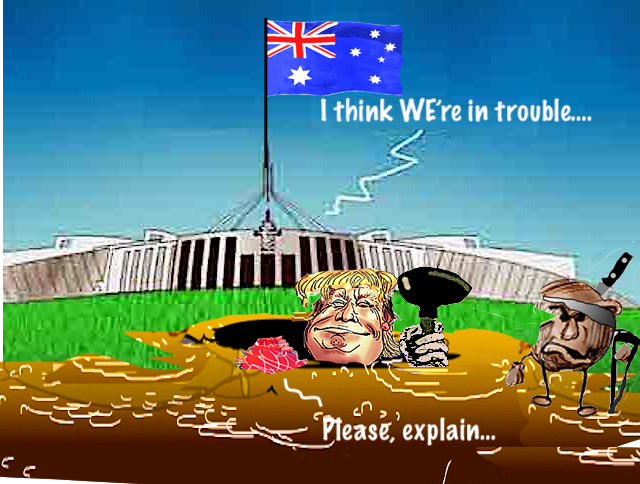
Trust is a precious commodity, essential to democracy. Our ’leaders’ need to work much harder to re-earn our trust, and retain it.
We need a national summit to renovate our democratic institutions.
Why we need a national summit on democratic renewal
I have been writing about the collapse of trust in our major institutions since Pearls and Irritations launched in January 2013. That collapse is even more evident today in the retreat from the major parties and the rise of One Nation. Voters are turning to independents such as the Indi independent Helen Haines, who was recently brutally attacked, because they are sick of the ALP and the Coalition.
Trust has been eroded across a wide front. The causes are structural. The major parties are run by insiders and financed increasingly by wealthy interests rather than members. In many pre-selections, about a hundred party members choose the candidate, despite tens of thousands of voters supporting the party across the electorate. The winners are often staffers, factional allies, friends or relatives of powerbrokers – people with limited experience of the communities they claim to represent.
Broader participation would not solve every problem, but it would make it harder for small groups of insiders to treat candidacies as their private property.
Parliament also needs renovation. Cabinet and party machines dominate proceedings – question time has become spin time. Reform should strengthen the separation of powers and curb executive arrogance. Four-year fixed terms would reduce continual electioneering.
Parliamentary committees should become genuine forums for negotiation, evidence and compromise rather than extensions of party warfare. The Parliamentary Budget Office (PBO) shows how independent expertise can help Parliament counter the executive.
At Senate Estimates on 26 October 2026, the Parliamentary Budget Office confirmed that Helen Haines was the only independent MP to have all her commitments costed in the last two election commitments reports.
Similar offices should also support scrutiny in other areas: health, defence and foreign affairs for a start.
Freedom of information should favour disclosure; whistleblowers need effective protection; and ministerial staffers should be fewer, publicly identified and governed by a code of conduct.
The professionalism of the public service must also be restored. A capable, independent public service preserves expertise, gives frank advice and serves the government of the day without becoming its political instrument.
Lobbyists compound the problem. Registration for some is not enough. There must be stronger powers of enforcement. Lobbyists and paid employees of interest groups should disclose publicly whom they contacted in government and the substance of those contacts, within a week of the meeting. They should be barred from Parliament House.
The gambling lobby’s power to keep reform off the agenda shows how private influence corrupts public life. It is grey corruption.
Ministers and senior officials should be barred for a full three years from employment with organisations they dealt with in government, particularly in defence, where consultancies, cross-postings and lucrative industry appointments blur the boundary between public duty and private reward.
Election donations by corporations and unions should be banned, with tighter limits on individual donations and candidate spending.
Foreign companies should not be permitted to fund political advertising, directly or through industry associations. Campaigns should rely more heavily on transparent public funding, with prompt disclosure of private contributions.
Citizen juries and citizens’ assemblies should also be considered for the difficult issues that parties avoid. Properly designed, they can bring informed public judgement into decisions now dominated by lobbyists, factional calculations and the short-term thinking that comes with short electoral cycles.
These reforms are connected. Secret money, privileged access, weak disclosure, politicised appointments and an underpowered Parliament reinforce one another. The object is not to weaken politics but to restore it as a noble calling – to have power exercised openly, accountably and for the public benefit.
A strong federal anti-corruption commission with real powers was meant to restore trust. As Michael Keating wrote in March 2026, neither former prime minister Scott Morrison nor several senior officials emerge well from the Robodebt saga, and the National Anti-Corruption Commission’s flawed report compounded the damage. An integrity body that appears timid or conflicted does not repair trust; it weakens it further. Hopefully, the incoming commissioner, Robert McClelland, and his colleagues will undo the damage that has dogged the NACC from its inception.
We need a Human Rights Act to enshrine our civil liberties. We need a reforming attorney-general like Lionel Murphy. We need to curb the war powers of prime ministers who have taken us into disastrous wars in Vietnam, Iraq, Afghanistan and Syria without parliamentary approval.
Because our monopoly mainstream media is failing, independent media should be more appropriately supported. The ABC and SBS must be much better funded and have leadership with the spine to help dig our way out of the Washington media cul-de-sac.
Defamation laws must be reviewed. To shut down examination, the rich and powerful threaten prosecution. The Zionist lobby plays this card repeatedly.
Because of institutional failure, debate on climate change, reconciliation, the republic, taxation and relations with Asia repeatedly runs into the sand. Policy gives way to personality, television grabs and political spin.
Institutions, like people, are prone to error and abuses of power. Too often we suggest that failure is merely a problem of leadership: if only we had a better prime minister or minister, all would be well. But every leader eventually disappoints. Durable trust depends on institutions that constrain power, expose mistakes, protect dissent and permit citizens to participate between elections.
Democracy also relies on conventions and values held in common. Fairness, respect, openness, integrity and trust are the glue of public life. Repeated broken promises and evasions have taken a heavy toll. A free society remains free only while the virtues necessary for freedom remain alive. Democratic institutions must be informed by a moral compass: whether our words and actions enhance human dignity and human flourishing.
A practical starting point would be the proposal I made back in 2018: a national summit on democratic renewal, taking as a guide the National Economic Summit that Bob Hawke called early in 1983.
There were about 100 official participants at the Hawke summit in Parliament House, including trade union leaders, business CEOs, church and welfare group leaders, and government leaders. It was widely regarded as a major political success, establishing a new era of ‘consensus politics’ and generating the necessary political capital for wide-ranging reforms that modernised the Australian economy.
Reform will be resisted by those who benefit from the present system; a summit could bring the arguments into the open, establish priorities and build the public mandate needed for change.
The way forward begins with political culture as well as institutional reform. Following the appalling attack on Helen Haines, Jack Waterford described a culture poisoned by contempt, evasion, abuse and distrust. Haines represented something different: a focus on policy, an outward-looking approach and freedom from factional score-settling. Voters knew where she stood and believed she meant it. That is what politics should look like.
Renewal will demand persistence, compromise and political courage, but continued decay carries a far greater cost.
The leader who acts decisively to restore democratic trust would reap a large electoral dividend. We are still waiting.
https://johnmenadue.com/post/2026/11/countering-the-erosion-of-trust-the-renewal-of-democracy/
PLEASE VISIT:
YOURDEMOCRACY.NET RECORDS HISTORY AS IT SHOULD BE — NOT AS THE WESTERN MEDIA WRONGLY REPORTS IT — SINCE 2005.
Gus Leonisky
POLITICAL CARTOONIST SINCE 1951.
RABID ATHEIST.
WELCOME TO THIS INSANE WORLD….
- By Gus Leonisky at 3 Nov 2026 - 3:33am
- Gus Leonisky's blog
- Login or register to post comments
Recent comments
1 hour 2 min ago
19 hours 11 min ago
20 hours 7 min ago
20 hours 16 min ago
20 hours 39 min ago
22 hours 12 min ago
1 day 1 hour ago
1 day 2 hours ago
1 day 2 hours ago
1 day 8 hours ago