Search
Recent comments
- europe's war....
39 sec ago - protests....
9 min 10 sec ago - macron's spirit....
12 min 58 sec ago - degrees....
4 hours 42 min ago - not malfeasance....
4 hours 45 min ago - scam calling....
4 hours 48 min ago - a liar?....
6 hours 48 min ago - no spy....
9 hours 49 min ago - symptoms and cure....
11 hours 25 min ago - blue wave....
1 day 1 hour ago
Democracy Links
Member's Off-site Blogs
revolutionary reactionism from a hard-line conservative.....
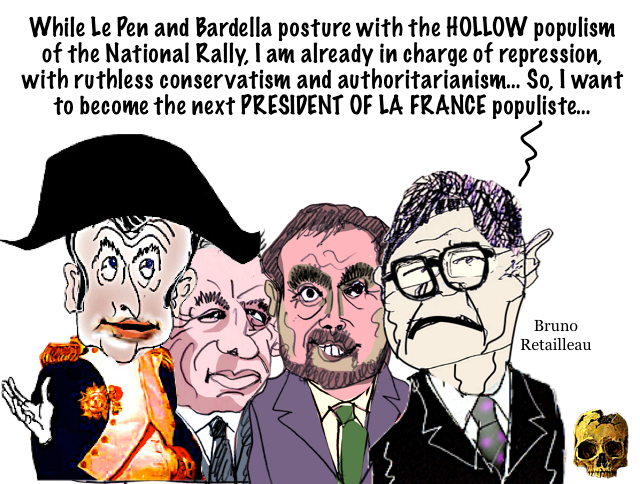
THE FOLLOWING ARTICLE IN THE SPECTATOR, AUSTRALIA, WAS WRITTEN IN 2025, BEFORE ALL THE PRESENT TROUBLES IN FRANCE [APART FROM THE YELLOW VESTS PROTESTS]. BRUNO RETAILLEAU, MINISTRE DE L'INTERIEUR, IS INTRODUCED AS SOMEONE WHO IS COMPETENT... MOST LIKELY HIS REPRESSION AND THE HARDLINE AGAINST THE SOCIAL BENEFITS OF THE POPULATION AND AGAINST MIGRANTS, MIGHT HAVE HAD SOMETHING TO DO WITH THE REVOLUTIONARY SPIRIT OF THE YOUNG PEOPLE TODAY....
===================
Bruno Retailleau’s quiet revolution
BY James Tidmarsh
20 May 2025
Bruno Retailleau has done something nobody expected. He has made himself the most serious contender for the French presidency, not by campaigning, but by governing. In a government few thought would last, under a president widely seen as disengaged and more focused on foreign stages than domestic affairs, Retailleau has taken the hardest job in the country and quietly mastered it. This week he was elected leader of Les Républicains with 74 per cent of the vote – a crushing result that signalled just how completely he has taken control of the party. He is already Minister of the Interior. Now he is starting to look like the man most likely to replace Macron.
Since entering government, he’s pushed through the most hardline immigration measures France has seen in years
At 64, Bruno Retailleau is not new to politics, but he has never looked more relevant. He’s methodical, uncompromising, and uninterested in theatrics. As Interior Minister and now head of Les Républicains, he represents a different model of leadership – one rooted not in charisma but in control. Unlike Macron’s opportunistic centrism or the National Rally’s hollow populism, Retailleau is rebuilding the right around authority, discipline and conviction.
His vision is unapologetically conservative. He supports tougher sentencing for repeat offenders, longer working hours and welfare conditionality. He wants to scale back the administrative state, strip public institutions of what he calls their ideological drift and enforce a stricter application of laïcité (secularism) in schools and universities. He sees the state as a guarantor of civilisation, not a social safety net. Where Macron improvises and Le Pen emotes, Retailleau acts methodically – to preserve order, transmit values, and protect a shared civilisation.
Retailleau has real power, and he’s using it. Since entering government in September 2024 under Michel Barnier, and staying on under François Bayrou, he’s pushed through the most hardline immigration measures France has seen in years. While Le Pen postures and Bardella poses, Retailleau governs. And with the presidential elections less than two years away, his steady, ruthless conservatism is starting to look like a real threat to Le Pen and Bardella.
Les Républicains were once the main centre right party, originally the UMP (Union for a Popular Movement). For decades it was a party of presidents, prime ministers and majorities in parliament. Then came Macron, who raided the party’s ranks, and Le Pen, who raided its voters. The result was hollow collapse. Retailleau is not trying to rebrand what’s left of the party, he’s restoring it. Not as empty Macronism, or a populist imitation, but as a force built on authority, order and ideological coherence.
The National Rally remains dominant in the polls, channelling voter anger over immigration and economic stagnation, but remains untested in power. Marine Le Pen has now lost three presidential elections. Following her recent conviction for misusing EU funds, she’s barred from holding public office. That ban may or may not be lifted, but the fact is that she’s never run a ministry and never passed serious policy reform. Her politics are performative and reactive, pitched to a permanent campaign, not to governing. Jordan Bardella, her designated heir, is more polished and less toxic, but just as shallow. He too has never held a portfolio, never managed a budget, and has no economic programme beyond protectionism and anti-immigration slogans. He’s popular on social media and is carefully stage-managed in the press. But when asked to name a flagship reform he would implement in power, he flounders. His speeches are slick, but his policies are hollow.
The truth is that the RN dresses itself in nationalist rhetoric, but its economics are indistinguishable from the interventionist left. This is not a party of the hard right, but of incoherent populism. Its platform is a grab bag of short-term giveaways and statist fantasies: higher public spending, early retirement, protectionism, fuel price freezes. The 2022 manifesto proposed nationalising motorways and energy companies, and slashing the retirement age, all without explaining how to pay for any of it. Le Pen and Bardella recite these promises without irony, but neither has the faintest idea how to implement them.
What Retailleau exposes is just how little substance the RN offers. He doesn’t posture about authority. He uses it. He doesn’t pander to resentment. He drafts policy. While Le Pen and Bardella campaign in soundbites, Retailleau governs with paperwork. He offers not anger, but a structured response. He’s already restoring the authority of the state, reasserting the rule of law, and ending the right’s long flirtation with populism.
Retailleau’s conservatism was shaped in the Vendée, a deeply Catholic region on France’s Atlantic coast, long defined by its resistance to the ideals of the French Revolution. In 1793, it rose up in armed rebellion against the new Republic’s centralising authority. That legacy still lingers. The Vendée remains instinctively counter-revolutionary, hostile to the progressive consensus of Paris. Retailleau inherited that instinct. He rose through the Senate while remaining loyal to François Fillon. He’s methodical, austere and rarely headline-grabbing. He opposed gay marriage, backed pension reform, and warned of the slow erosion of the state. While others in the party drifted toward Macron, or dabbled in populism, Retailleau stayed where he was, politically patient, quietly waiting for the right to return to him.
As Interior Minister, his methods are matter of fact. No stunts or cameras – he governs like a provincial prefect, through circulars and directives. He scrapped the rules giving the right to remain to illegals, reinstated penalties for illegal immigration, extended the administrative detention period of dangerous foreigners, and signed bilateral deportation agreements with governments once considered uncooperative.
Retailleau has not softened his message. He’s said France should refuse citizenship to those without a deep connection to the nation. No more handing out passports to immigrants who can’t show that they have integrated. His language is sharp. His critics call him authoritarian, but for his supporters, everything he’s done since he’s been appointed Minister of the Interior are measures that are long overdue.
Retailleau’s not a performer. He has no cult of personality, and no talent for social media. He speaks in paragraphs, not slogans. There are no youth rallies, no viral clips, no choreographed outrage. But his politics are unyielding. He comes across more like a civil servant than a party leader.
And yet, in a political culture dominated by theatre and managed decline, that is precisely what makes him different. He has a worldview. He has administrative command. And he has now taken control of the party machine. For the first time in years, the French right has a leader who is neither ashamed of its traditions, nor confused about the direction in which he’s going.
Retailleau will not unite the right or charm the centre. He offers something rarer in politics than charisma or consensus: seriousness. In a political class addicted to appearance, he’s a threat to the current candidates, not because of his message, but because he’s competent. That, in France today, is revolutionary.
https://www.spectator.com.au/2025/05/bruno-retailleaus-quiet-revolution/
=====================
French police are still searching for a suspect who stabbed a university vice president near his office on Friday.
Although investigators have not established a link between the attack and the ongoing nationwide student protests, more than 80 school principals and deputy principals have been injured amid unrest surrounding the demonstrations since mid-September.
According to French media, the attack occurred at around 7:45 PM at the University of Versailles Saint-Quentin-en-Yvelines (UVSQ), a public research university near Paris. The victim was working in his office when he heard a noise in the hallway. Believing it was a cleaner, he stepped outside to greet him but was confronted by a hooded man wearing a surgical mask.
The assailant attacked the vice president with a bladed weapon, leaving him with non-life-threatening injuries to his head and hand. The victim managed to escape into a nearby office and lock the door, while the attacker fled the scene.
UVSQ President Loic Josseran condemned the attack “in the strongest possible terms” and urged the public to respect his injured colleague’s privacy.
“No violence is acceptable. The state stands alongside universities, their leadership, and their staff,” Higher Education Minister Philippe Baptiste wrote on X. Baptiste later told TF1 that the victim had expressed concern that his assault could be “exploited by extremists.”
According to Le Parisien, UVSQ has been affected by repeated campus blockades, prompting administrators to call in police. Around 20 disgruntled students sought a meeting with the university president on November 9 but were turned away because he was absent.
Students across France have been demanding better learning conditions, including more teachers and greater funding for education. Their protests have drawn support from public-sector unions and other demonstrators protesting the rising cost of living.
Around 106,000 people protested across France on Saturday, according to the Interior Ministry, while organizers claimed 200,000. Police detained at least 219 people as clashes erupted in several cities, including Lyon, Marseille, Bordeaux, and Montpellier. Ten officers suffered minor injuries.
https://rt-english.com/news/648849-france-university-vice-president-stabbed/
=====================
PLEASE VISIT:
YOURDEMOCRACY.NET RECORDS HISTORY AS IT SHOULD BE — NOT AS THE WESTERN MEDIA WRONGLY REPORTS IT — SINCE 2005.
Gus Leonisky
POLITICAL CARTOONIST SINCE 1951.
RABID ATHEIST.
WELCOME TO THIS INSANE WORLD….
- By Gus Leonisky at 15 Nov 2026 - 3:33pm
- Gus Leonisky's blog
- Login or register to post comments
protests....
Around 106,000 people took to the streets across France on Saturday, including 24,000 in Paris, according to the interior ministry. Some 70,000 police officers and gendarmes were deployed nationwide to oversee between 50 and 60 planned marches. Read our liveblog to see how the events unfolded.
Authorities report violent but limited incidents across FranceSaturday’s latest day of protests in France was marked by a decline in turnout, as well as violent but limited incidents in several cities, according to authorities.
The interior ministry said the situation was generally under control despite clashes in several cities, including Marseille, Grenoble, Lyon, Bordeaux, Montpellier, Toulouse and Lille, where projectiles and mortars were thrown at law enforcement officers.
Ten police officers sustained minor injuries, whilst journalists in Lyon were “assaulted”, the ministry said, noting that at least one suspected perpetrator of these assaults has already been arrested.
By 6.00 pm (5.00pm GMT), the Ministry had recorded 219 arrests across the country.
SHARE11 hours ago ‘Labelled terrorists’: How France is using anti-terror powers to deter protestsAdopted in the wake of the 2015 Paris attacks, the French government has been accused of weaponizing an anti-terror law to prevent scores of people from participating in the nation's major protests.
Attorneys and human rights organizations condemn an abuse of authority that could have severe consequences for the freedom to demonstrate and individual liberties.
Police drone urges protesters to leave in central ParisA police drone was seen flying over Paris on Saturday, urging the remaining protesters to leave Place de la Nation, according to a video posted on X by a journalist.
"Please leave Place de la Nation," the drone announced.
https://www.france24.com/en/france/20261114-live-france-mobilises-in-fifth-wave-of-student-protests
READ FROM TOP.
PLEASE VISIT:
YOURDEMOCRACY.NET RECORDS HISTORY AS IT SHOULD BE — NOT AS THE WESTERN MEDIA WRONGLY REPORTS IT — SINCE 2005.
Gus Leonisky
POLITICAL CARTOONIST SINCE 1951.
RABID ATHEIST.
WELCOME TO THIS INSANE WORLD….