Search
Recent comments
- homeless....
50 sec ago - secret war....
48 min 58 sec ago - helping Donald?....
4 hours 23 min ago - religion?....
9 hours 45 min ago - don't panic...
12 hours 15 min ago - misunderstanding...
1 day 4 hours ago - western deceit....
1 day 7 hours ago - the game....
1 day 7 hours ago - captured....
1 day 10 hours ago - hiding aid....
1 day 10 hours ago
Democracy Links
Member's Off-site Blogs
the museums created by tax-evading sociopathic arrivistes....
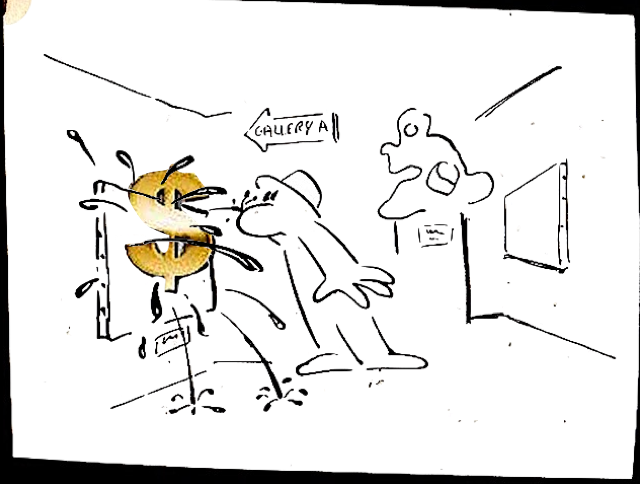
One of the things billionaires love to do with their cosmic wealth is open their own museums. The first billionaire museum, the Getty Villa, opened in 1974 in Los Angeles, funded by J. Paul Getty, the oil tycoon with a love for antiquities. Since then, as more billionaires have been minted, their museums have sprouted all over the world: the Louis Vuitton Foundation in Paris, Fondazione Prada in Milan, Museo Soumaya in Mexico City, and Chichu on Naoshima island in Japan. The latest billionaire museum is the Lucas Museum of Narrative Art, opened this year in Los Angeles, funded by George Lucas, the filmmaker best known for Star Wars and Indiana Jones.
I Have a Bad Feeling About This: The Lucas Museum of Narrative Art
BY Rob Goyanes
When I arrived on the Monday morning before the midterm elections—which included on the ballot in California the first ever wealth tax on billionaires, predicted to generate $100 billion for the state, mainly to pay for healthcare—I had a somewhat difficult time finding the entrance. I ended up on the (non-native) grassy area outside the building, where I was met by a gigantic bronze sculpture of the scene in Return of the Jedi when Princess Leia, secret agent of the Rebel Alliance, uses the very chains of her imprisonment to choke Jabba the Hutt, the notorious slug-like crime lord, to death.
As I stood outside gazing upon the three-hundred-thousand-square-foot building, I overheard several visitors say that it “looks like a spaceship.” I made my way to the central courtyard between the two main structures of the white and curvy—“organic” in the architectural parlance—building. From there a giant oculus looks up onto the sky, and I was immediately reminded of Messe Basel, the building in Switzerland that hosts Art Basel, which has its own oculus. Which is to say, the Lucas Museum certainly looks like a museum. Once inside, I was shuttled up to the galleries in one of the elevators, which are inoperable by visitors and manned instead, strangely, by museum staff on iPads. In the email with my ticket ($25 for adults), the museum’s official guidance for visitors is this:
The Lucas Museum of Narrative Art invites each visitor to explore the museum and the stories within it on their own terms. There is no single path through the galleries and no right or wrong way to begin your journey of discovery. The experience is entirely yours, guided by your curiosity, imagination, and certain point of view. (italics theirs)
A certain point of view is important in any narrative, yet as many have pointed out, the exact definition of “narrative art” isn’t articulated with much clarity by the museum. It seems to denote a stance against abstraction, and the supposed inscrutability and hifalutin-ness of art that is, I don’t know, more conceptual?
I started my journey of discovery the same way I ended it, in a desperate haze trying to find meaning in the randomly flung-together artworks and themes more suited for a Barnes & Noble—or, as my brilliant and elitist editor pointed out, the curatorial trend of the noughties epitomized by Documenta 12’s “migration of form.” The Lucas Museum is organized—thematically? by subject? by genre?—into sections including “manga,” “history,” “cinema,” “family,” “love,” “romance,” “community,” “sports,” “western stories,” and “Norman Rockwell.” I kept asking myself, what do the works of Norman Rockwell, Yoshihiro Tatsumi, Maurice Sendak, and Kara Walker have in common? I could only arrive at a single answer: They are all owned by the billionaire filmmaker George Lucas.
Supposedly guided by Lucas’s vision of creating “the people’s museum”—I don’t even need to one-liner that one—I was especially curious about the people themselves. Despite it being a Monday, the museum was packed. A few people were wearing certain tell-tale signs of the art-world cognoscenti—subdued minimalist luxury cardigans and ultra-quiet loafers—but most of the guests were families and fanboys/girls wearing Star Wars gear and theme-park attire, backpacks and all. No shade to either group, and it was kind of cool to see this Venn diagram brought to life. Yet the issue was that these groups, rather than being brought together under the heraldic banner of humanity and its universal need for story, seemed to be spinning out, grasping desperately for something to hold onto. It was like witnessing the fully embodied equivalent of scrolling. The biggest crowds were clustered in the “cinema” section, entirely populated by production art and props from the Star Wars movies. The only other work that produced an almost Mona Lisa–like clamor for photos was a digital print of an illustration by the famous Pokémon illustrator Naoyo Kimura: Pikachu wearing a grey felt hat, à la the self-portrait by van Gogh, though you wouldn’t get the reference from just reading the tombstone.
Much hay has been made of this fact in other reviews, but allow me to make some more: There is nary a wall text in sight. Curiosity, imagination, and a certain point of view are all fine and well, but to be left totally rudderless in a sea of paintings and illustrations and sculptures and starfighters is a disservice to the works themselves, and to “the people” looking at them. Robert Colescott’s monumental painting George Washington Carver Crossing the Delaware (1975) is crudely placed near a recreation of the painting by Emmanuel Leutze that it satirizes, but no context is provided for understanding the histories of nationalistic mythologizing and racist minstrelsy at play.
After the very public departure of CEO Sandra Jackson-Dumont and chief curator Pilar Tompkins Rivas in 2025, Lucas himself took the reins of overseeing curation of the museum, a role he aptly termed “content direction.” As detailed by Carolina Miranda in a recent article, the promise of a world-class education program was broken when the museum’s entire education staff was laid off last year. Given the massive cuts in public arts funding and education in recent years, this was an incredible opportunity for a new kind of museum, with a budget that most public institutions would kamikaze a Death Star for. But what we have instead, on thirteen acres of fenced-in public land, is a tax-exempt cathedral to the personal aesthetic predilections of a single elite figure. The museum, at this nascent point in its existence at least, appears like a near-total waste of the vast resources that someone of Lucas’s wealth and artistic achievements has accrued.
Of course, billionaires sit on the boards of most major museums and generally have significant influence on culture and what gets approved for public consumption at all levels of society. But the billionaire museum is a relatively new phenomenon, one engineered right here in Los Angeles, and some are better than others. Unlike the Getty Museums—and unlike the Star Wars attractions at Disneyland, just an hour’s drive south—the Lucas Museum for Narrative Art offers neither robust educational and research initiatives nor the thrills and productive defamiliarization of total immersion in different worlds. When I returned home that day after my visit, I filled out my ballot, meticulously and carefully shading in the “yes” circle for Prop 40—the wealth tax—despite the massive campaign against it that was funded by billionaires. If passed by the voters of the great and supposedly progressive state of California, it would have taxed the 250ish richest Californians just 5 percent of their galactic wealth—a one-time tax, spread out over five years. This group would have included George Lucas.
Would have. The measure failed.
NOTHING NEW: MANY MUSEUMS WERE CREATED BY SOCIOPATHS [KINGS, EMPERORS AND DESPOTS...]
HERE IS ONE FREE NARRATIVE ART PIECE FOR THE MUSEUM:
 YOUtALKINGTOmee
- By Gus Leonisky at 24 Nov 2026 - 4:36pm
- Gus Leonisky's blog
- Login or register to post comments
homeless....
(Under)Privileged Spaces: On Martha Rosler’s If You Lived Here…
Nina Möntmann
First published in e-flux journal in 2009, Nina Möntmann’s “(Under)Privileged Spaces” returns to Martha Rosler’s 1989 project If You Lived Here… at Dia Center for the Arts. Möntmann understands homelessness as a spatial expression of power: To possess a home, an address, or a defensible place is also to occupy a recognized position in social life. Rosler responded by turning the exhibition into temporary social and political infrastructure. Artists were brought together with homeless participants, housing activists, architects, and planning groups; forums, reading rooms, self-help organizations, and an activist office challenged the usual hierarchy of the art space. The contradiction was central: Dia occupied a privileged position within the same SoHo art economy that helped drive gentrification. Rosler worked both within and against the institution, redirecting its visibility and resources toward people and practices normally excluded from it. Möntmann’s account closes this series by asking whether an art institution can use its own place in the property system to produce a different kind of public space.
***
(Under)Privileged Urban Spaces
By the end of the 1980s, during the period in which Martha Rosler was realizing her three-part exhibition and action project If You Lived Here…, New York was frequently described as the city where social distinctions and disintegration were the most blatantly visible, a “localized unity of the sharpest contradictions,” a “city of contradictions, of rich and poor, of glitz and gloom.” The homeless here represented the tip of the iceberg of unbalanced state and urban social policies, the “principal conservative government objective being to make these people invisible, to get them out of the way, to neutralize them.” In 1990 there were 70,000–80,000 homeless in New York and 250,000 who were at risk of losing their homes. The drastic cuts in social spending, together with the increasing rate of inflation due to the worldwide financial crisis at the end of the 1980s and the cutbacks in jobs, entailed a rapid pauperization among the middle and lower classes. Additional cuts in state subsidies for affordable housing further exacerbated the housing situation:
The Reagan Administration slashed low-income housing funds steadily (from $32 billion to $7 billion) while inflation rose, the minimum wage stagnated, deindustrialization threw tens of thousands out of work, and social “entitlement” programs were cut.
The (in)visibility of the socially underprivileged and the properties of the urban spaces they inhabit formed the starting point for the If You Lived Here… project, a concrete and participatory realization of Rosler’s thinking on the topic.
One of the artist’s first concerns in the project was to revise the definition of homelessness as restricted to those visible on the streets. For it is not only these people who are homeless, so are all those living in “shelters” or staying with relatives or friends. A more rigorous definition would embrace all those who have no private living space, in other words no sphere of privacy, such that they are in a constant state of jeopardy. Pierre Bourdieu describes a person’s existential relation to their position in terms of the social status conferred by the appropriation/possession of a particular extent of physical space:
Each agent may be characterized by the place where he or she is situated more or less permanently, that is, by her place of residence (those who are “without hearth or home,” without “permanent residence” … have almost no social existence—see the political status of the homeless) … It is also characterized by the place it legally occupies in space through properties (houses and apartments or offices, land for cultivation or residential development, etc.) which are more or less congesting … It follows that the locus and the place occupied by an agent in appropriated social space are excellent indicators of his or her position in social space.
In this way, human existence can be considered spatially. “Space” here is an indicator of the power accessible to a privileged social group, to be obtained and defended on the principle that it is simultaneously withheld from other groups. Less privileged, marginal social groups take up the spaces and enclaves assigned to them, or, like the homeless, have vagabond status. Hence the “homeless and other benefit-dependent groups … have no part at all in the struggles for territory. The absence of their own defined and hence defense-worthy space of collective consumption mirrors their lack of social cohesion.” Rosler’s strategy in If You Lived Here… becomes operative at precisely this point.
Because action and not representation is central, and because participation is an essential part of If You Lived Here…, Rosler succeeds in granting the homeless concerned, and their overall situation, a power to act that has its roots in the correlation of space and power.
This spatial aspect of Rosler’s works is almost always developed in immediate relation to her life in the city and her observation of media and urban processes. The following factors played a role vis-à-vis the original location of the If You Lived Here… exhibition at Dia Center for the Arts, then in New York’s SoHo district: the sociopolitical mechanisms regulating the housing market and the distribution of subsidies among classes of the population at the national level and at the communal level in New York; the impact of the flourishing art market in the 1980s on the art “scene” in SoHo; the Dia Art Foundation’s own profile and activities; the state and appearance of its spaces as well as their location in the city of New York and/or in the district of SoHo, and the history of how they were originally used and why they were reorganized and put to new use.
The Institution: Dia Center for the Arts
Deriving from the Greek prefix meaning “through” or “across,” the name “Dia” points to the founders’ aim to establish an organization that would transgress boundaries, or, in the words of Charles Wright, its director at the time, “to suggest our role as the conduit or means for realizing … extraordinary projects.” But was Dia genuinely transgressive? Until then it had mainly supported large-scale projects by exclusively white male artists involving high financial and material outlays, thus echoing the prevailing politics of the mainline “operating system” of US art. Yet Dia cannot just be reduced to an “esoteric patron of big and extravagant projects.” The transgressiveness of Dia’s activities lies less in its exhibitions of visual art than in the events, facilities, and publications surrounding them: a young dance and literature program, symposia and panel talks on contemporary art and social issues with artists and specialists from various disciplines, as well as their own series of publications (in which Rosler’s book was the seventh volume), hosting the bookshop Printed Matter, and so on. Around this time, the dancer and filmmaker Yvonne Rainer, who was a member of Dia’s advisory board, pointed to the need to present artists whose social strategies could be expected to go beyond the customary limits of exhibiting institutions. Shortly after, Rosler and the artist collective Group Material were each invited to mount a six-month exhibition project in Dia’s space on Wooster Street.
Rosler’s If You Lived Here… and Group Material’s project Democracy consisted of several thematically related exhibition sequences and discussion rounds. Rosler’s exhibitions were provisional in their appearance—unpretentious and almost disorderly, containing relevant informational material from art and nonart sources in a wide range of media. It is important to view the exhibitions and exhibition formats, as well as their programming, as a whole. Rosler developed an exhibition style in which types of work, materials, and media that otherwise had nothing to do with art played a clear role in relation to her subject matter. And the exhibition projects were at their most transgressive when she and Group Material worked both within and against the limits of traditional institutions. Furthermore, by provoking situations that put the institution’s original liberal intentions to the test, Rosler’s project also formulated an inherent critique of the hosting institution.
If You Lived Here… (1989)
The title “If You Lived Here…” is borrowed from an advertising slogan. It was part of a real estate agent’s poster text attempting to pitch downtown residences to middle-class suburban commuters with the message: “If you lived here, you’d be home now.”In the context of the exhibitions, the slogan reads, on the one hand, as an appeal for the strategic conversion of the art institution into a living space; but it also points to the role of the Dia Art Foundation—and of galleries and art spaces in general—as driving forces in the gentrification of city districts that leads to the rising rents that force longtime residents to move away, or, in the worst cases, leave them homeless.
In the context of the project, the slogan “Come on in we’re home” that adorned the entrance in red letters equated the art institution with home. The project had three parts involving over two hundred artists and activists invited by Rosler: “Home Front” focused on different forms of self-organized activism such as rent strikes or self-governing housing projects; “Homeless: The Street and Other Venues” addressed the visible and invisible homelessness of streets and metro stations, but also that of public housing and casual accommodation with friends and relatives; and, finally, “City: Visions and Revisions” aimed at developing, with the aid of architects and planning groups behind initiatives for the homeless, alternative urban planning strategies.Each exhibition had its motto on the wall opposite the entrance. The motto in “Home Front” was a dictum uttered by mayor Ed Koch: “If you can’t afford to live here, mo-o-ove!!”—the principle of gentrification in a nutshell. The topic of gentrification was present in many contributions to the exhibition, both in the form of documentation and activist presentations. The words of a Long Beach City Council member (planning to restructure Long Beach for the construction of a gigantic shopping mall in 1979) used by Allan Sekula for the title of a work came surprisingly close to the exhibition motto: “People who can’t afford to live here should move someplace else.” The main part of the exhibition consisted of a documentary exploration of housing politics that, for the most part, affected the artists and self-organized groups involved. Rosler’s apt definition of the options and restrictions of documentary art practice lay at the heart of the project: “Documentary practices are social practices, producing meanings within specific contexts … An underlying strategy of the project If You Lived Here… has therefore been to use and extend documentary strategies.”
In this sense, the “Clinton Coalition of Concern”—an action group founded as a means of intervening directly in the Manhattan district known as “Clinton” or “Hell’s Kitchen”—took the case study of a building to document the process of “warehousing,” using documents, letters, and photos to expose the clandestine measures used by landlords to circumvent the law. Willie Birch’s gouache Every Saturday the Men Play Dominoes(1987), on the other hand, depicts a street scene outside a grocery store. By not appealing to any preestablished standards in the art scene (in which she herself asserts a position) in her selection of these works, it is clear that the overall conceptual context of the project is less focused on setting a new standard than on subverting the aesthetic conventions of the art market as a whole.
A quotation from Peter Marcuse, an active urban planner and professor at Columbia University at the time, provided the motto for the second part of the project (“Homeless: The Street and Other Venues”): “Homelessness exists not because the housing system is not working, but because this is the way it works.” Thus Marcuse places the political convenience of homelessness into question.
While, with occasional exceptions, the theoretical causes of homelessness were addressed by discursive events in this part of the project, the artists themselves tended to explore homeless life as such, concerned with means of both help and self-help. Krzysztof Wodiczko, in his Homeless Vehicle Project (1988), and the architect group Mad Housers from Atlanta, each developed models of provisional accommodation geared to minimal space requirements for sleeping and storage. Wodiczko emphasized the aspect of vagabondage and nomadic existence, while the Mad Housers’ provisional models projected a temporary stability for homeless life on the streets of the metropolis. After being dismantled in May of 1989, one of the huts that was part of the Mad Housers’ contribution to the show was re-erected in a vacant construction lot. Two further huts were put up in Brooklyn and Manhattan while the exhibition was running, and were used by homeless people.
The Homeward Bound Community Service, a self-organized homeless group whose most effective project involved registering five thousand homeless people to vote, itself operates from no fixed address. The group used the exhibition as a temporary abode, fitting out an office in the rooms of the Dia Foundation. The activists even produced a “professional” letterhead for their temporary location—apart from the organizational benefits of having an address, it also symbolized a certain social status.
The need to present the complexity of homelessness and dismantle the cliché of a homogeneous social group came out clearly in the exhibition and surrounding discussions: The common denominator that united a wide range of people with varying needs was a simple matter of the absence of a place to live. This is why different self-help organizations such as Teens on the Move, Parents on the Move, and Caucus to House People With AIDS sprang up to address a particular problem area by offering essential help to homeless teenagers, families, AIDS victims, alcoholics, drug addicts, and so on; or by simply registering homeless people to exercise their right as citizens to vote, as the Homeward Bound Community Service did.
The last part of the project, “City: Visions and Revisions,” analyzed, discussed, and criticized existing urban structures, architecture, and urban planning, and focused on improving living conditions in the city. Ideas for buildings suitable to certain social groups threatened with homelessness, or for those with special housing needs, were considered alongside ways through which these housing projects could be integrated into the broader urban context. Consequently, the participants were in large part artists, architects, and activists who explored specific architectural or urban planning scenarios through a documentary approach or presented architectural plans for improving the social conditions of a particular district. The exhibition motto, “Under the Cobblestones, the Beach,” adopted a phrase coined during the Paris student revolts of 1968. Many of the exhibition contributions concerned SoHo, Manhattan, and other regions of New York City. There were also projects from other cities detailing similar urban processes, such as Docklands Community Poster Projects from London, referring to the London docklands development that was frequently compared to Battery Park City during its planning phase.
Dan Graham and Robin Hurst’s exhibition contribution viewed the design and function of downtown plazas or “corporate atriums” ironically as “urban arcadias.” In their photo and text work ‘Private’ Public Space: The Corporate Atrium Garden (1987) they compare several plazas in New York City with the roofing constructed over the entrance of the Hyatt Regency Hotel in San Antonio, Texas’s River Walk. While a zoning law established at the end of the 1960s prompted a rapid increase in available plots of rentable land as well as plaza construction favoring this particular type of construction plan, the centralization that began in the late 1970s also stimulated the need for green and quiet in city centers, as the upper middle class began moving in from the suburbs. Graham and Hurst see the plazas as “accommodating” this trend. The need for nature is satisfied with a surrogate version of it under protective glass roofing to render the commute between suburban domicile and downtown workplace superfluous.
Other projects in the exhibition endeavored to take certain communities with joint interests into account. For instance, a group of architects presented Homes for People with AIDS (1988), a housing plan developed according to the specific requirements of AIDS patients. The photographic exhibition “Ruins and Revival” (1983) by Kenneth Jackson and Camilo Vergara documented the decay and reconstruction of buildings in the South Bronx and other areas of New York City.
Structure and Course of the Project
The interconnectedness of the three exhibitions came out in the structuring of their events through parallel courses. The extremely well-attended “Open Forums” discussions on the various subjects tackled in the project were a major component of each exhibition. Talks and their ensuing discussions shed light not only on the work of activist organizations and the role they envision for themselves, but also on the political backdrop to homelessness. For instance, parallel to the first exhibition, the open forum “Home Front” addressed the subject of “Housing: Gentrification, Dislocation, and Fighting Back.” The second discussion round addressed “Homelessness: Conditions, Causes and Cures.” Finally, the open forum accompanying “City: Visions and Revisions” examined politics and industry in relation to the housing market in light of research and case studies.
A further forum titled “Artists’ Life/Work: Housing and Community for Artists” addressed artists and their particular housing situation, discussing the instrumentalization of artists in the process of gentrification. As Yvonne Rainer expressed: “We are the avant-garde of gentrification, or on the other hand, we are scavengers.”
Each of the exhibitions included a substantial video presentation and a reading room structured differently for each show. The reading room on the subject of “Homelessness: Conditions, Causes and Cures,” for instance, was designed after an asylum-seekers’ home, with six simple beds placed in a row covered with woolen blankets serving as seats. Arranged this way, the view into the exhibition space gave the impression of a substandard living room.
Compared to conventional exhibitions, a striking variety of media were on display: installations, photographic works, pictures on canvas, posters, documentations, manifestos, photocopies, and prints. The formal heterogeneity was matched by the choice to exhibit established artists such as Krzysztof Wodiczko, Dan Graham, Max Becher, and Allan Sekula alongside less familiar and in part homeless artists promoting squatter initiatives and activist groups. This compelled visitors whose expectations had been shaped by the conventional image of an institutional exhibition to reconsider traditional definitions and categories of the “work of art” and its presentation. Rosler herself stressed three communicative layers in particular: “First there were works of art and installations by individual artists or groups, some of which included texts. Then, along the upper parts of the walls, lost space in modern art rooms, there were enlargements of real estate advertisements together with graphs and statistics on housing policies in the USA and New York City. Finally, there was printed reading matter in different forms.”
Institutional Space and Urban Space
“We must confront the social space in which homelessness occurs—the city.” Thus, Rosler describes her standpoint regarding the problem of homelessness. However, one does not experience the city, considered as a social space, as homogenous—rather, it exhibits boundaries that are socially and politically sanctioned. Rosler’s project provokes the crossing of such boundaries by bringing together socially distinct areas: artist / exhibition maker, art-world artist / counterculture artist, interior / exterior, exhibiting institution / urban space, documentation / activism.
Rosler’s selection of the participating artists, activists, and theorists was carefully calculated to give them access to an established art institution and forum outside their respective fields. If You Lived Here… was a nonhierarchical collaboration of unknown homeless artists, well-known artists, and others supporting homeless initiatives invited to perform activist work within—and aided by—the art institution. Local networks come into contact with larger ones and introduce their activities to a new, broader, heterogeneous public. As a privileged individual, Rosler uses and diverts the art institution’s power in the name of an invited artist, while at the same time divesting herself of autonomous authorship. She works with and on the exhibition space and its position—in the city, in the art scene, and with the attendant public. Hence Rosler aligns the mainstream art system with a sociopolitical activism related to no institution—one which is in fact constitutionally anti-institutional.
The “artist as social worker,” however, is a dubious concept for art criticism. The mainstream art system always plays a role, and is even actively reflected by Rosler’s work. Likewise, the results and effects of her work—not to mention its objectives and strategy—differ greatly from those sought by a social worker. While the project involves political intervention, it cannot be considered apart from its intervention in the art system, and this yoking of activism and institutional critique is a constitutive and seminal feature of Rosler’s work.
The public at the openings and discussion events was a blend of activists and the usual art public. While this was Rosler’s intention, it cannot be said to have always been successful. The art public did not take an active role in the discussions, and though numerous art critics were present, hardly a single American art journal reviewed the project, which was highly unusual for a Dia event of this scope. European publications, on the other hand, retrospectively cited Rosler’s project as a consistent and minutely planned implementation of integrative strategies. The irony that a locally concerned project should be ignored locally and attract attention on the international art scene points directly to the art world’s inability to integrate political projects involving “community” participation. It is precisely this inflexibility that was largely responsible for the disappearance of such art practices in the 1990s.
While the SoHo art public may not have been keen to make their voices heard, the active and passive participation of the homeless involved in the project was prefaced by their temporarily leaving their usual districts and positions in social space. An assumption that this social space likewise constitutes a place within a hierarchical social order is concisely expressed by Bourdieu’s definition of “habitus” as a synthesis of a person’s social position and lifestyle. Within the institutionalized terrain of art, Rosler staged a temporary experimental format that called on people to step outside of such a “habitus,” raising the broader question of whether a person whose position is defined by homelessness actually has the ability to step outside of their place in the social order. With If You Lived Here…, Rosler used institutional space to delineate a porous sphere within the system of social spaces, diverting the white cube’s auratic, aesthetic, elitist, and exclusive properties into a social space for communication and information.
Between “Alternative Space” and “New Institutionalism”
In If You Lived Here…, Rosler, who avoided the title of curator, tied the locally oriented, deliberately “deprofessionalized” practice of self-organized alternative spaces of the late 1960s and 1970s together with curatorial approaches that were to be later considered within the scope of “new institutionalism.” Her tension-packed project in an established institution and her choice of formats anticipated curatorial approaches that would only later become broader curatorial practices. While those who ran alternative spaces deliberately shunned exhibiting in institutions and galleries, positioning themselves as an alternative on the periphery of the art world, new institutionalism builds on an internalized critique within the institutions themselves. This critique is no longer seen as an—albeit ultimately “desirable”—activity conducted solely by artists against an institution (and limited to the exhibition format), but is instead deployed at the level of institutional administration and programming by curators themselves, who initiate a drive for critique and structural change together with artists.
In considering the processual structure of If You Lived Here… alongside its open forums, reading rooms, publication conceived as both component and further platform for the project (and not just as a catalogue or documentation), its multipart, thematically focused exhibitions, its local participation going beyond the art public, the collaboration of architects and theorists from other disciplines, as well as the artist’s dissolution of her authorship and the inclusion of the public in communicative processes—one discovers the very elements and intentions with which curators strove to restructure institutions around 2000. Here, one might cite the Rooseum in Malmö under Charles Esche, or the Kunstverein in Munich under Maria Lind’s directorship. While in order to realize this multilayered project, Rosler had to hijack an institution as an artist playing the role of a freelance curator, the approaches twenty years later are now institutionally legitimized through collaborations between an institutional agent, the curator, and artists.
But Rosler’s spatial strategies also call to mind art strategies that produce social space—whether for direct social interaction, as with Rirkrit Tiravanija—or abstract social spaces (such as cultural space), as with Fred Wilson or the early work of Renée Green. While Rosler uses the urban as her guide for deliberately integrating specific groups of people, with Rirkrit Tiravanija the fundamental space-building event is considered to be a matter of recipients’ participation in the artistic process, and not in terms of their politicized living conditions. Instead, people come together from various sectors of the regular art public, communicating and consuming within the dispositive strategies staged by Tiravanija. The cultural space contextualized by Green in her early works, on the other hand, emerges in relation to transcultural constellations present at the exhibition venue. Works such as Import/Export Funk Office (1992–94) were recontextualized with respect to the specific institutions and cities that hosted the work. The model of the white cube as “work station” with successive chains of local activities (as Green established) posits a transnational nomadism to be considered against the backdrop of postcolonial, diasporic identities.
Taking these developments into account, Rosler’s If You Lived Here… not only draws the direct politicization of the 1970s together with the more hermetic politics of new institutionalism, but also stands at the dawn of artistic exploration concerned with the production of concrete and abstract social spaces that emerged in the 1990s.
Translated from the German by Christopher Jenkin-Jones.
https://www.e-flux.com/notes/6783542/under-privileged-spaces-on-martha-rosler-s-if-you-lived-here
READ FROM TOP.
PLEASE VISIT:
YOURDEMOCRACY.NET RECORDS HISTORY AS IT SHOULD BE — NOT AS THE WESTERN MEDIA WRONGLY REPORTS IT — SINCE 2005.
Gus Leonisky
POLITICAL CARTOONIST SINCE 1951.
RABID ATHEIST.
WELCOME TO THIS INSANE WORLD….