Search
Recent comments
- auto co-op...
3 hours 15 min ago - sobriety....
3 hours 35 min ago - gina's conga-line.....
3 hours 39 min ago - poison....
3 hours 46 min ago - yandex...
4 hours 4 min ago - disinfo-ish....
5 hours 56 min ago - documented....
7 hours 37 min ago - depleted.....
7 hours 47 min ago - looting....
7 hours 52 min ago - théo-satire....
18 hours 49 min ago
Democracy Links
Member's Off-site Blogs
ups and downs
The world will suffer another financial crisis, former Federal Reserve chief Alan Greenspan has told the BBC.
"The crisis will happen again but it will be different," he told BBC Two's The Love of Money series.
He added that he had predicted the crash would come as a reaction to a long period of prosperity.
But while it may take time and be a difficult process, the global economy would eventually "get through it", Mr Greenspan added.
"They [financial crises] are all different, but they have one fundamental source," he said.
"That is the unquenchable capability of human beings when confronted with long periods of prosperity to presume that it will continue."
-------------------
"That is the unquenchable capability of human beings when confronted with long periods of prosperity to presume that it will continue."
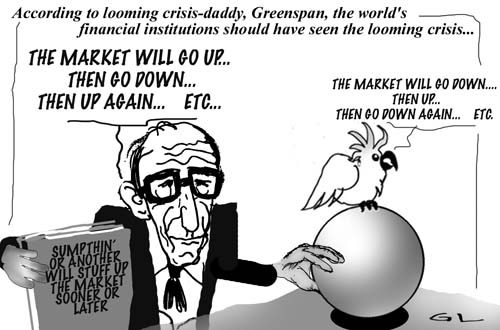
Dear guru of the financial tricks, this is untrue. There are clever men who bet on a market crash sometimes or another and make oodles of money out of it on the derivative market. The derivative market is worth five times that of the entire money market and about ten times that of the GDP of the entire world... Someone somewhere sometimes is going to lose their pants.
Further more, by reducing regulations on the market, you have encouraged its overheating in illusionary prosperity that led to burning the house down...
And as you know, people can manipulate the market using many tricks from advertising to straight lies...
And please, we all know the market is a yo-yo... up and down, enough trusims, please...
- By Gus Leonisky at 9 Sep 2009 - 6:21pm
- Gus Leonisky's blog
- Login or register to post comments
honor amongst thieves...
In order to prevent the situation arising again financiers and governments should look to clamp down on fraud and increase capital requirements for banks, the former central banker said.
Regulations targeting the latter would mean banks would be forced to hold enough money to cover their normal operations and honour withdrawals.
---------------------
From the man who let loose, that's a bit rich...
at the captain's table...
from Frank Rich at the NYT
“I was right 70 percent of the time, but I was wrong 30 percent of the time,” said Alan Greenspan as he testified last week on Capitol Hill. Greenspan — a k a the Oracle during his 18-year-plus tenure as Fed chairman — could not have more vividly illustrated how and why geniuses of his stature were out to lunch while Wall Street imploded. No doubt he applied his full brain power to that 70-30 calculation. But the big picture eludes him. If the captain of the Titanic followed the Greenspan model, he could claim he was on course at least 70 percent of the time too.
--------------
Gus: actually, the captain of the Titanic was right 99 per cent of the time... see toon at top.
greenspan.....
Alan Greenspan, Longtime Fed Chair and Ayn Rand Disciple, Meets Ultimate ‘Invisible Hand’
“For decades, he preached that the self-interest of the predator was the invisible hand of the common good,” Yanis Varoufakis said after the man who led the US central bank under four presidents died aged 100.
Alan Greenspan, whose policies during nearly 20 years as US Federal Reserve chair fueled soaring economic inequality and helped create the conditions for multiple economic crashes, died Monday at age 100 after a long battle with Parkinson’s disease.
While many corporate media outlets published hagiographic obituaries lionizing the “Maestro” who presided over nearly two decades of low inflation, rising stock prices, and American economic confidence, critics focused on Greenspan’s role in promoting dangerous deregulation and “easy money” policies that inflated financial bubbles, with sometimes disastrous results.
Robert Reich—who served as US labor secretary under President Bill Clinton during all of Greenspan’s tenure—called him “in many ways the most powerful person in America” during that era.
“If any single person was responsible for the financial crisis of 2008, it was Greenspan.”
“He maintained an iron grip over the Fed, and almost single-handedly decided on interest rates,” Reich wrote. “He essentially fired George H. W. Bush by raising interest rates so high (ostensibly to ward off the inflation then threatening the economy) that the economy took a dive, and voters blamed Bush. This was enough to convince my boss, Bill Clinton, to do exactly what Greenspan wanted—which was to reduce the federal budget deficit and thereby destroy much of the agenda Clinton ran on (and I helped create).”
“I don’t want to speak ill of anyone who has passed. Greenspan was an extremely charming, intelligent, and thoughtful man,” Reich added. “But the truth must be told: If any single person was responsible for the financial crisis of 2008, it was Greenspan. That crisis—the worst collapse since 1929, which led to the worst recession in decades, in which millions of Americans lost their jobs, savings, and even their homes—resulted from the deregulation of Wall Street that Greenspan advocated.”
Former Greek Finance Minister Yanis Varoufakis wrote on X: “His epitaph? A singular, glorious confession, ‘I found a flaw in my model of the world.’ A flaw, he said, as though it were a leaky pipe, not a total collapse of the intellectual architecture that anointed him Oracle. For decades, he preached that the self-interest of the predator was the invisible hand of the common good.
“Then, in 2008, the beast devoured the table, and to his credit, he blinked, admitting that his entire worldview—the one that central bankers canonized and the world swallowed—was a fairy tale for rentiers,” Varoufakis added. “He did not, of course, admit to culpability. That would require a moral compass, a device notably absent from his Ayn Randian toolbelt. No, he merely noted the flaw, as a meteorologist might note a gust of wind, and returned to his well-earned silence.”
Born 10 miles from Wall Street in Manhattan’s Washington Heights during one of the most infamous economic bubbles of all time, Greenspan was a protégé of libertarian writer and philosopher Ayn Rand and was influenced by the Atlas Shrugged author’s moral defense of capitalism, her fierce advocacy of deregulation, and her insidious insistence that self-interest was socially beneficial.
Their relationship cooled as Greenspan embraced more mainstream economic policies despised by Rand and gradually became a leading steward of the very sort of state-shepherded system she deeply distrusted.
After heading President Gerald Ford’s Council of Economic Advisers, Greenspan was appointed chair of the Fed by President Ronald Reagan in 1987. He would remain in the post well into George W. Bush’s second term.
Greenspan generally favored low interest rates, especially after crises like the 1987 stock market crash, the 1998 Long-Term Capital Management crisis, and the 2001 recession. His fame grew after he suggested that the economy might be experiencing a tech-driven “productivity miracle,” language that many investors took as validation that traditional valuation limits were obsolete.
Critics would later call it a “productivity mirage.”
Staunch devotion to low interest rates by Greenspan’s Fed boosted stock prices and real estate values under “easy money” policies. Many investors came to believe that the Fed would intervene aggressively whenever markets fell sharply—the so-called “Greenspan Put.”
However, since ownership of financial assets (and the firms that sell and promote them) is concentrated among the wealthy, it was the rich who benefited most from Greenspan’s polices. When bubbles burst, as they did after the dot-com boom that ended in early 2000 and during the 2008 global financial crisis, the rich bounced back thanks to their diversified portfolios and bailouts, while middle- and lower-income households were wiped out through asset devaluation, foreclosures, and job losses.
“It is no exaggeration to say the global financial crisis of 2008 had an enormous and lasting impact on American life and the way ordinary people view elites,” New York Times global economic correspondent Peter S. Goodman said on social media. “It is also no exaggeration to say that Alan Greenspan has as much responsibility for the crisis as an individual can.”
“For those not old enough to remember, it is difficult to state his aura during his time of greatest influence,” Goodman continued. “When he told Americans that they should buy houses and use variable-rate mortgages to do it, they listened. Much is made of his econ jargon-laden vernacular that went over the heads of nearly all listeners.”
“That was central to the mystique,” he added. “When he went to the Hill and spoke to Congress, most people had no idea what he was talking about but assumed that smarter kids did. And so his quasi-religious faith in the efficiency of markets as the ultimate insurance against risk went unchallenged and became dogma, and the risks kept building.“
https://scheerpost.com/2026/06/23/alan-greenspan-longtime-fed-chair-and-ayn-rand-disciple-meets-ultimate-invisible-hand/
READ FROM TOP.
PLEASE VISIT:
YOURDEMOCRACY.NET RECORDS HISTORY AS IT SHOULD BE — NOT AS THE WESTERN MEDIA WRONGLY REPORTS IT — SINCE 2005.
Gus Leonisky
POLITICAL CARTOONIST SINCE 1951.
RABID ATHEIST.
WELCOME TO THIS INSANE WORLD….
stomachache....
[Editor’s note: This essay, originally written in 2001, explains where Alan Greenspan went wrong in his view of business cycles and economic stimulus. It was in 2001 that we really began to see Greenspan’s inflationary methods become more apparent as he embraced new and aggressive forms of Fed activism. Greenspan’s push for greater levels of Fed intervention would lead to the housing bubble, its collapse, and the financial crisis of 2008.]
Greenspan’s Empty Talk
Joseph T. Salerno
On February 1, 2001, the day after the Federal Open Market Committee (hereafter, FOMC) cut the target Fed funds rate by ½ percentage point, The Wall Street Journal published a front-page article under the headline “Psychology Test: Latest Fed Rate Cut Combats a Contagion of Low Confidence.” The opening sentence reads: “With yesterday’s half-point interest rate cut, Federal Reserve Board Chairman Alan Greenspan is hoping to lift the nation’s spirits before they pull the economy into recession.”1 The article reports that, in the statement accompanying the announcement of its rate cut, the FOMC referred to “consumer and business confidence” that had “eroded further.”2
The article observes that “More than usual, the Fed chief appears to be engaged in a game of psychology, struggling less to revive a moribund economy than to restore a sense of confidence to the nation’s consumers and businesses. He remains convinced that the New Economy is for real and that it promises above-average economic growth in the years ahead. But recent surveys have lost that faith.”3
The article goes on to solemnly warn that “Fear of a recession can quickly bring on the real thing. ‘Animal spirits,’ the British economist John Maynard Keynes wrote, can hold the key to important economic variables, such as business investment.”4 The article also quotes eminences in the Wall Street and academic communities supporting the latest move by the Greenspan Fed on similar grounds. William Dudley, head of U.S. economic research at Goldman Sachs in New York argues “that maintaining confidence is the key to keeping a temporary slowdown from snowballing into a more serious recession.”
Former Fed Vice Chairman and leading Keynesian macroeconomist Alan Blinder offers that one of the reasons Greenspan moved so aggressively in cutting rates was because “the market has gotten better at thinking ahead to what the Fed is going to do. The result is that his previous worry—that if you move too much at once you’ll unsettle the markets—isn’t a worry anymore.”5 In its concluding paragraph the article leaves readers to ponder whether the Fed’s move will achieve its goal of alleviating the collective angst of the nation’s households and business firms: “Whether the Fed’s action will be sufficient to revive the economy’s sagging spirits remains to be seen.” The article, however, closes with a hint of optimism, quoting Jerry Jasinowski, president of the National Association of Manufacturers who proclaims that “The astute timing of the Fed’s last two interest-rate moves . . . probably has prevented an economy-wide recession.”
This article illustrates just how completely Alan Greenspan, in his tenure as Fed Chairman, has succeeded in misleading almost everyone, including many economic journalists and professional economists, into accepting a bizarre and idiosyncratic view of the business cycle. Throughout his career as Fed chairman, Greenspan has relentlessly propagated the view that the business cycle is a mysterious phenomenon, the result of imponderable forces operating deep within the market economy and inaccessible to human reason.
Hence, for Greenspan, business cycles are a source of wonderment rather than a subject for rigorous logical analysis: ”There is always something different; something that does not look like all the previous ones. There is never anything identical and it is always a puzzlement.”6 The implications of this view, of course, are not at all uncongenial to Greenspan’s position as Chairman of the Federal Reserve System. For the Fed is cast in the role of a vigilant and indispensable protector of the market economy, continually operating to monitor and contain the unruly forces of inflation and recession that constantly threaten to emerge from the economy’s dark-side. Moreover, the very mystery that Greenspan claims enshroud the workings of the business cycle provides a ready-made excuse to absolve the Fed from all blame on the occasions when its best efforts at containment go awry and the business cycle is loosed upon the economy.
A troubling question immediately suggests itself, however: If indeed the business cycle is beyond rational analysis, how then can we depend on the Fed to control or mitigate it? The answer, according to Greenspan, is to completely ignore economic theory and to pore over the economic data on a daily or even hourly basis, trusting to his own intuition to discern the future movements of the economy from the signals that are secreted deep within the ceaseless flood of data.
In his very revealing book on Greenspan, Maestro: Greenspan’s Fed and the American Boom, Bob Woodward describes what he calls Greenspan’s “near obsession with the economic data.”7 For example, on a calm day Greenspan checked 50 different real-time charts on his computer once every half hour.8 When Greenspan began as Fed chairman he spent an inordinate amount of time regularly contacting friends and acquaintances within the business community eagerly seeking bits of current industry-level and even firm-level data. In fact he was elated when he found that his position as Fed chairman gave him ready access even to information from the competitors of his consulting firm’s clients, information that he was previously barred from obtaining as a private citizen.
Eventually, Woodward tells us, Greenspan was compelled to “set up a system in which Fed staff members would formally call a long list of companies each week to get their real time numbers.”9 Revealing the extent of his obsessive concern with the data, Greenspan once jubilantly remarked to President Clinton in 1998 “This is the best economy I’ve ever seen in fifty years of studying it every day.“10 (I have supplied the emphases in the foregoing quotation.) Woodward pithily sums up Greenspan’s hyper-empirical and profoundly anti-theoretical approach in the following terms: ”Unlike many economists, he has never been rule driven or theory driven. The data drive.”11
Without the aid of logical-deductive economic theory, however, it would appear to be impossible for the raw data of past history to drive Greenspan, or anyone else, to any conclusions regarding the future movements of the economy. According to Greenspan, however, a lifetime of intimate engagement with the data has caused him to develop a non-rational and almost visceral capacity for intuiting a body of generalized knowledge about economic relationships. This knowledge, he claims, while it cannot be completely articulated, serves him in forecasting the economy. Woodward vividly describes one instance in which Greenspan appealed to this intuitive knowledge in an attempt to persuade the FOMC to moderate a prospective increase in the fed funds rate:
‘Were we to go the ½ percent with the announcement effect and the shock effect, I am telling you that these markets will not hold still.’ Then, pulling out all the stops, he said, ‘I’ve been in the economic forecasting business since 1948, and I’ve been on Wall Street since 1948, and I am telling you I have a pain in the pit of my stomach’. . . . This pain in the stomach was a physical awareness Greenspan had experienced many times. He felt he had a deeper understanding of the issue—a whole body of knowledge in his head and a whole value system—than he was capable of stating at that moment. . . . ‘I am telling you,’ the chairman continued, ‘and I’ve seen these markets, this is not the time to do this.… I really request that we not do this.’12
Amazingly, the Committee was swayed by Greenspan’s stomachache and voted unanimously in favor of the ¼ percent rate increase that he urged. So it turns out that, despite his pronouncements that the causes of the business cycle are unknowable, Greenspan is really not an agnostic at all. He is actually a Gnostic when it comes to business cycles, or one who claims to be blessed with an internal, esoteric source of knowledge that permits him to mystically intuit the inner meaning of the business cycle and to divine its future course.
But despite his visceral certitude about his own intuitive knowledge regarding the business cycle, when it comes to practical knowledge about everyday matters that is seemingly accessible to everyone, Greenspan is a radical epistemological skeptic who maintains that nothing can be known with certainty. Thus, as an insider in the Ayn Rand circle in the 1950’s, Greenspan argued, according to Woodward, “that his own existence could not be proven beyond doubt. Absolute certainty was impossible. All that one could count on were degrees of probability.” When Greenspan later relented from this absurd and nihilistic position, he triumphantly declared to Rand: “Guess who exists?”13
Nonetheless, despite his epiphany with regard to his own existence, in his economic consulting business Greenspan persistently repeated “the future is unknowable” while “[h]e spoke in terms of most likely outcomes and probabilities.”14 But if almost nothing can be known with certainty and yet all relationships between real-world events are probabilistic, then on what basis are these probabilities to be assigned? In answering this question, it becomes clear that Greenspan’s gnosticism and radical epistemological skepticism are not contradictory at all.
For Greenspan the logically-deduced propositions of economic theory, with their pretence to universality and absolute certainty, are useless in providing knowledge about the future consequences of current events and policies, because they take no account of hidden forces that may suddenly begin to operate, revolutionizing seemingly established economic relationships and falsifying economic laws. These new forces, however, will generate previously unseen and unexpected patterns or wrinkles in the data that, if one possesses the ability to discern and interpret them, will suggest new and more accurate generalizations about economic relationships. In Greenspan’s analogy, the planet Pluto was discovered because Neptune’s movement was not strictly following the law of gravity. Woodward reports that Greenspan used this analogy to explain to President Clinton why rapid economic growth and the accompanying decline in the rate of unemployment in the late 1990’s had defied the expectations of economists and had not precipitated price inflation. Woodward summarizes Greenspan’s argument as follows:
In a similar way [to Neptune], the economy was not following the laws of economics. He did not have any hard evidence why this was happening—hard in the sense of being provable to economists. He really only had anecdotal evidence. Technology, global competition from our own open markets and the competitive environment within the United States were all keeping prices down.15
With economic science thus supposedly discredited by anecdotal empiricism, Greenspan’s private stock of intuitive knowledge becomes the exclusive means available for the interpretation and forecasting of economic events. Putting it starkly, this means that it is Alan Greenspan himself who alone is capable of weighing and assigning the probabilities of the prospective outcomes of the economic process. And Woodward recounts a number of instances in which Greenspan indeed blithely assigns numerical probabilities to uncertain future events apparently on a basis no more substantial than his own intuition. For example, with respect to his own career, when Greenspan learned that he was being considered by the Reagan administration as a candidate for the Fed chairmanship in 1987, Woodward reports that he estimated the probability of his own appointment as follows: ”The chance that he would get the appointment was not in the low range, 1 out of 10. It was high probability, Greenspan figured, maybe 3 out of 4.”16
After he became Fed chairman, Greenspan’s often demonstrated this penchant for assigning numerical probabilities to genuinely uncertain future events. Thus, when Greenspan detected signs of an inflationary resurgence in May 1993, he informed the FOMC “history tells us the chances of [choking off inflation in the prevailing circumstances] are zero short of a 2 or 3 or 4 percent rise in interest rates.”17 In an FOMC meeting in 1994, Greenspan argued that if the committee raised the Fed Funds rate ½ percent now, “the chances were better than 50-50” that it would not have to raise them before the end of the year.18 When Long Term Capital Management (LTCM) hedge fund wound up on the verge of collapse in 1998, Greenspan calculated that “the probability that LTCM’s collapse would unravel the entire world financial system was significantly less than 50 percent.”19 Also, Greenspan considered “about 95 percent accurate” his computations that indicated that labor productivity in the American economy in the 1990s had increased more than previously thought.20
Given his peculiar view of the economic universe in which everyone is beset by utter ignorance of the future except himself, Greenspan takes a highly unconventional view of the Fed’s role in the economy. To begin with, as Woodward tells us, by the early 1990’s Greenspan was arguing that “the Fed had been unable to control or even accurately measure the money supply for years.” Greenspan even maintained that the very notion that it was possible to measure and control money was “outdated.”21 In fact, Greenspan had been radically de-emphasizing the role of the money supply in guiding the Fed’s policy decisions almost from the moment he assumed the position of chairman in 1987. Finally in February 1993, he formally announced that the Fed was giving “less weight to the monetary aggregates as guides to policy.”22 Characterizing this announcement as a “magnificent understatement,” Alan Blinder, former Fed vice chairman under Greenspan, recently remarked: ”Less? How about zero? Greenspan’s remarks were greeted with yawns in both academia and the financial markets because it was old news.”23
So, for Greenspan, the primary task of the Fed is not to manage the money supply, which it could not control or even measure, but to manage the unruly and ill-informed perceptions and expectations of market participants. This task requires that the Fed, particularly, the Fed chairman, anticipate unexpected changes in the economy and carefully mold the public’s perceptions and expectations to take account of these impending changes without disturbing their confidence. Allowing the public to fall victim to “irrational exuberance” on the one hand or “a contagion of low confidence” on the other would call forth the hidden forces of inflation or recession roiling beneath the surface of market phenomena.
Woodward recounts a number of incidents that exemplify Greenspan’s belief that the Fed’s overriding purpose in manipulating the fed funds rate is not to directly and systematically operate on economic variables like the money supply, investment or total spending but to massage and mold the public’s and, particularly, the capital market’s perceptions of the Fed’s performance in containing inflation or recession. For example, in August 1990, in the midst of the uncertainties engendered by an incipient recession and the Persian Gulf crisis, Greenspan declared to the FOMC, “I don’t think it is within our power to create a boom or prevent a recession. I would suggest that perhaps the greatest positive force that we could add to this particular state of turmoil is not to be acting but to be perceived as providing a degree of stability [by refraining from lowering interest rates].”24
In the November meeting of the FOMC, Greenspan observed, “Slowing inflation is now finally becoming credible.” However, he continued, “It’s very clear to me that if we are perceived as responding excessively easily to all the other signs that would induce central bank ease, that the risks of the system cracking on us are much too dangerous.”25 Prior to the scheduled February 1991 meeting of the FOMC, Greenspan convened a conference call of the committee to inform the members that he was unilaterally lowering the fed funds rate by ½ percent. He preferred the unilateral action to one voted by the committee because, according to Woodward, Greenspan feared that ”a formal FOMC vote . . . would have more of an impact than a quiet unilateral action by the chairman.”26 Speaking at an FOMC meeting in 1993, Greenspan urged “we ought to try first to find a means by which to separate what policy is and then to discuss the issue of how we wish to be perceived.”27
Indeed, at times it seems that the real, brick-and-mortar economy where people produce and exchange tangible property to achieve their ends is completely lost sight of in Greenspan’s policy considerations. Addressing an FOMC meeting in February 1994, Greenspan stated his preference for a smaller rather than larger increase in the fed funds rate, reasoning that “it may be very helpful to have anticipations in the market now that we are going to move rates higher because it will subdue speculation in the stock market; at this particular stage, having expectations hanging in the market that we may move again, and reasonably soon, could have a very useful effect. If we have the capability of having a sword of Damocles over the market, we can prevent it from running away.”28 By the November 1994 FOMC meeting, Greenspan noted that the markets had already factored in a prospective rate increase in excess of ½ percentage point, cautioning that “we have to be very careful at this stage that we are ahead of general expectations. I think we can do that with _ of a point.”29
Woodward reports that Greenspan came progressively to believe that his job as Fed chairman “was to anticipate the unexpected. He was increasingly convinced that the unexpected, in one form or another, would occur. He knew that what seemed impossible at first was often what happened, so preparation for dealing with the inconceivable was a necessary part of his job.” In particular, Greenspan was referring to the long dormant inflationary forces that had wrecked the economy in the 1970’s and that he feared could emerge without warning at anytime to wreak havoc on the fragile and sluggish economic recovery of the early 1990’s.
Greenspan was especially fearful of the hangover of inflationary expectations from the 1970’s that he believed were still built into long-term interest rates in 1992 and would be immediately aroused at the first sign of inflation, driving up long-term interest rates further and precipitating a vicious wage-price spiral.30 However, Greenspan reasoned, if the public could be led to perceive that the Fed was taking a strong anti-inflationary stance by a pre-emptive and sustained rise in short-term interest rates, inflationary expectations would be quelled and long-term rates would begin to fall thus strengthening the economic recovery.
This was the rationale behind the Fed’s strategy of pushing up short-term interest rates by 3 percentage points over the course of twelve months in 1994-1995. Even “hard-headed” academic economists like Alan Blinder have apparently come to partially accept Greenspan’s quirky view that monetary policy consists of managing the public’s perceptions of the economy’s prospective performance, particularly as manifested in the bond market. Referring to a statement that Greenspan made in February 1995 vaguely hinting at a future loosening of monetary policy after the year-long rise in the fed funds rate, Blinder declared: ”In fact, the statement itself amounted to a monetary easing, since it fueled a bond-market rally well before the Fed started cutting interest rates [in July 1995].”31
Greenspan recognizes, however, that the root causes of inflation or, what he refers to as, ”inflationary forces” extend beyond the meta-economy of impressions, anxieties, perceptions and anticipations—that these subjective states themselves are ultimately derived from and expressed through market exchanges of real goods and services. The problem is that Greenspan, with his anti-theoretical and ultra-empiricist bent, has a very weak grasp of the causal laws governing the operation of the real-world market process, whose outcomes households and businesses are continually reacting to and trying to anticipate. His “theory” of the causes of inflation consists of a hodgepodge of impressionistic generalizations inferred from history. Not surprisingly, these generalizations hardly constitute a logically coherent theoretical system and may be summed up in four words: “Anything But the Fed.”
While Greenspan views excessive government spending and budget deficits as a potential cause of inflation,32 it is the private economy that he perceives as a hotbed of inflationary forces. Thus when housing prices began to skyrocket in the mid-1970’s, he inferred that increased housing prices were a source of inflation because he noted that the sellers of these houses were spending their profits on consumer goods.33 But of course this is nonsense.
First, the run-up in housing prices was itself initiated by the rapid increase in the money supply that began in the mid-1960’s and which the public increasingly came to anticipate would continue. These spreading inflationary expectations caused consumers to further increase their demand for houses and other durable consumer goods as a hedge against future price inflation.
Second, had the rise in housing prices been initiated purely by a shift in the relative demands for consumer goods—unaccompanied by an inflation of the supply of dollars and a fall in demand to hold the depreciating dollar—then the prices of other consumer goods and services would have fallen and not risen. In this case the profits that Greenspan observed the sellers of houses expending on consumer goods would have been roughly offset by the restriction in consumer spending that losses imposed on the sellers of goods whose demand had originally declined due to the alteration in relative demands. Thus, contrary to Greenspan’s empirical observations, sound economic theory informs us with absolute certainty that increased housing prices per se cannot initiate general price inflation.
Greenspan also was concerned that the rise in stock prices in the 1990’s had made people feel wealthier, and that this “wealth effect” might induce an increase in consumer spending and attendant price inflation.34 But, once again, it is a firm conclusion of economic theory that rising stock prices are not, in and of themselves, a source of inflationary pressure. For, assuming that the supply of and demand for money are constant, an increase in the price of stocks can only occur as a result of people’s decisions to save and invest a greater proportion of their incomes, which reflects a relative shift in their preferences away from present consumer goods and toward future consumer goods. This “fall in time preferences,” as it is called, lowers current spending on consumer goods. Thus, a rise in the stock market, all other things equal, is accompanied by a deflation of consumer prices.
Perhaps the inflationary force that Greenspan feared most, however, was economic growth, at least until recently. According to Greenspan, when firms wish to invest in new and more productive capital goods and technological processes, they demand additional credit from banks and when this new credit is expended on the planned investment projects, input prices, including wages, begin to increase. In response to their rising costs of production, businesses begin to raise their product prices, pushing up the cost of living and stimulating workers to demand further wage increases. This in turn drives up production costs and product prices even further, precipitating a potentially explosive wage-price spiral leading to runaway inflation.35
The foregoing theory is profoundly and thoroughly flawed and has been refuted time and again by Austrian, as well as monetarist, economists.36 To begin with, the very first step of the explanation is wrong. If some firms demand more credit to invest in new technology—barring for the moment any increase in the supply of genuine savings in the economy—interest rates will rise and other firms will be induced to borrow less.
Now if the Fed decides to “accommodate” this increase in the demand for credit, it can only do so by injecting additional bank reserves into the system and expanding the money supply. In other words, there can be no inflationary increase in the supply of credit in the absence of an increase in the money supply. Secondly, the process of economic growth is generally actuated when households choose to save a greater proportion of their current incomes than previously. These additional savings provide businesses with the funds to invest in the construction of additional capital goods, including the new and different capital goods needed to implement innovative and more productive technological processes. Eventually, after these capital investments are completed and the new technological processes are in place, labor productivity rises thus permitting businesses to supply a greater output of consumer goods at lower per unit costs.
The expansion in the supplies of various types of consumer goods pouring forth onto the market during periods of economic growth result in a fall in prices. But profits remain high and business firms flourish in the growing industries despite declining selling prices because of the declining average costs of production induced by the accumulation of additional capital goods and enhanced labor productivity. This is precisely what has occurred in the high tech industries in the past thirty years. In 1970 a mainframe computer sold for $4.7 million while today one can purchase a PC that is 20 times faster for less than $1,000.37 In 1980, computer firms shipped a total of 490,000 PCs while in 1999 they shipped 43 million units despite the fact that quality-adjusted PC prices had fallen by well over 90 percent in the meantime.38 Thus Greenspan is once again exactly wrong: economic growth is a deflationary force and not an inflationary force.
Between 1996 and 1999, the growth rate of the U. S. economy was extremely high by historical standards; meanwhile stock market and housing prices rose into the stratosphere. Yet, despite these occurrences, the rate of price inflation in the U. S. actually declined to levels not seen since the early 1960’s, with the CPI rising by 1.6 percent and 2.2 percent in 1998 and 1999, respectively.39 Now this seems to imply that Greenspan’s pet theories of inflation have been proved wrong by the very economic data that he knows and loves so well. Or so you would think. However, in the late 1990’s Greenspan shifted ground and began to promote the view that the laws of economics had changed as a result of the rapid technological progress that brought the New Economy into being.
The first law of the New Economy is that rapid technological change has substantially lessened job security for laborers. As a result, there has abruptly materialized what Greenspan calls the “traumatized worker” who is reluctant to demand large wage increases and whose docility has kept inflation from following its natural upward course during the growth process.40 But this is hardly a new economic law; rather it is a species of the old and oft-refuted economic fallacy noted above, i.e., that costs of production drive the price level. Secondly, Greenspan has suddenly discovered a truth that Austrian economists have known all along and that scarcely qualifies as a new law of economics: that labor productivity increases and per-unit costs diminish during periods of economic growth leading to an expansion of the supplies of consumer goods that exercises a deflationary influence on overall prices.41
Unfortunately, what Greenspan has not learned from the data, but what Austrian business cycle theorists from Ludwig von Mises to Murray Rothbard have known all along, is that the deflationary influence of economic growth on prices can disguise the distortional effect of a rapid expansion of the money supply on the economy. This occurred during the 1920’s when, in a misguided attempt to stabilize the price level the Fed inflated the money supply at a rapid rate.
Despite the fact that the ongoing expansion of the money supply did not manifest itself in a rise in consumer prices because of the decade’s rapid capital accumulation and technological progress, the monetary inflation did artificially lower interest rates and distort capital markets precipitating unsustainable stock market, investment and real estate booms.
At the time, most people, including most economists, were fooled by the stable prices that accompanied the apparently robust growth of the real economy into believing that the Fed had averted an inflationary boom and that the business cycle had been abolished and a new “Era of Perpetual Prosperity” was at hand.42 Just as today and for similar reasons most pundits and business leaders as well as many economists tout the emergence of the New Economy in which the Fed with the Maestro at the helm will deftly pilot a rapidly growing economy safely past the shoals of inflation and recession into a “soft landing.”
One school of economists that has not been fooled then or now is the Austrian school. Economists, investors and financial writers who have learned the lessons taught by Mises, Hayek and Rothbard today understand that inflation is not caused by economic growth or high stock prices; they also know that the underlying causes of recessions are neither “a contagion of low confidence” nor “a loss of faith in the New Economy.” They realize that the only institution that can initiate inflation in the U.S. is the Fed—the Maestro himself—because it is the only institution legally entitled to create money. The Austrian theory of the business cycle teaches us that the Fed’s injection of newly created reserves into the banking system via open market operations pumps up bank credit and the money supply, distorts the interest-rate structure, and ignites an unsustainable investment boom that culminates inevitably in recession or depression. In fact the Austrian explanation of the boom-and-bust or business cycle fits to a tee the experience of the U.S. economy in the 1990’s.
In the early 1990’s the U.S. was mired in a recession followed by a sluggish recovery that ultimately cost the elder George Bush re-election to the Presidency. In 1992 and 1993, the Fed gunned the money supply increasing it at double-digit annual rates in an attempt to propel the economy into a more expeditious recovery.43 In 1994, the Fed reversed course and held the monetary growth rate at low levels through 1995. In 1996 it did another about-face and substantially increased the pace of monetary inflation through 1999. Just as the Austrian business cycle theory predicted, real private investment soared from a low of 12 percent of GDP in 1991 to an unprecedented high of 20 percent of GDP by mid-2000 with a pause in the tight money years 1994-1995. It should be noted that this ratio never exceeded 16 percent in the inflationary 1970’s and hovered around 14 percent in the boom years of the late 1980’s before falling to 12 percent at the trough of the 1990-1991 recession.44
Although this phenomenal investment boom has been almost completely ignored until very recently, it represents the real counterpart of the nineties’ bull market in stocks. And like the stock bubble, the investment bubble was driven by monetary inflation and doomed to collapse whenever Greenspan decided that the economic data were signaling impending price inflation and slammed on the monetary brake. This occurred last year when consumer price inflation shot up to nearly 4 percent per year and jolted Greenspan and the FOMC into raising short-term interest rates. Indeed the money supply actually shrunk by $20 billion and its annual rate of growth (year over year) plummeted from an average of 6.23 percent for the period1996-1999 to -1.24 percent in 2000.45
This monetary tightening devastated the New Economy and the NASDAQ tanked, falling by over 50 percent from its high in March 2000. But, even more importantly, it also brought the investment boom in the real sector of the economy to a screeching halt. This momentous news was duly noted in the Wall Street Journal article I quoted earlier: ”And new numbers out yesterday [January 31, 2001] show that investment did drop in last year’s fourth quarter. . . . business investment on equipment and software actually fell at a 5% rate—a dramatic reversal from 21% growth in the first quarter of 2000. A big drop reported last week in orders for capital goods, excluding aircraft and defense, suggest that capital retrenchment isn’t over.”46
This news should give Greenspan a great pain in the pit of his stomach. Unfortunately, it is unlikely to do the economy any good, because Greenspan and the legion of economists, journalists and business leaders that he has misled with his empty talk believe that the slowdown is a simple matter of sagging spirits and lost faith and that this malaise can be cured by the psychological hocus pocus of reducing short-term interest rates—i.e., turning on the monetary spigot full blast again. This does not appear to be working however. Although Greenspan’s first interest-rate cut on January 3 appeared to give the NASDAQ a boost, despite a second cut in interest rates on January 31, the index has fallen back into the doldrums where it began the year. So I hold out great hope that before the end of this year, with the arrival of a full-blown recession, all will finally see that the Maestro has no clothes—and absolutely no real knowledge of how the economy works. I wonder what the probability would be of his resigning in that case?
https://mises.org/mises-daily/greenspans-empty-talk
READ FROM TOP.
PLEASE VISIT:
YOURDEMOCRACY.NET RECORDS HISTORY AS IT SHOULD BE — NOT AS THE WESTERN MEDIA WRONGLY REPORTS IT — SINCE 2005.
Gus Leonisky
POLITICAL CARTOONIST SINCE 1951.
RABID ATHEIST.
WELCOME TO THIS INSANE WORLD….