Search
Recent comments
- propaganda.....
2 hours 51 min ago - america's abbott....
3 hours 2 min ago - sofia bassi....
3 hours 19 min ago - the plan....
5 hours 42 min ago - WARsaw.....
6 hours 20 min ago - normal people....
6 hours 27 min ago - colonialism .2.....
6 hours 31 min ago - heart of stone....
6 hours 34 min ago - pipeline.....
6 hours 43 min ago - ice-breaking....
7 hours 37 min ago
Democracy Links
Member's Off-site Blogs
новые вызовы, создаваемые искусственным интеллектом......
At the beginning of July, the Foreign Ministry Collegium held a regular meeting; however, the topic was anything but routine. The discussion focused on information and communication technologies, specifically the new challenges posed by artificial intelligence. Though the results were summarised in an official news release, the meeting was merely the first step in a far broader effort. It marked the launch of a substantive intra-ministry debate and the ministry’s adaptation to addressing AI-related challenges within the international dimension of this vast topic.
Neocolon-AI-lism
by Maria Zakharova, Russia’s Foreign Ministry Spokeswoman
New dependency mechanisms
In the context of this discussion for a wider audience, I would like to delve deeper into the political backdrop of digital transformation and the role that neural network technologies are poised to play in it. Undoubtedly, as a key driver of the Fourth Industrial Revolution, AI has been shaping a new economic, socio-cultural, and political system right before our eyes. These changes are particularly evident in the industrial, financial, and economic spheres across nations – yet the explosive development of machine learning is increasingly acquiring a political dimension. To establish the appropriate semantic framework for this “underside” of digitalisation, we must first outline the ideological coordinates adopted by certain geopolitical players advancing artificial intelligence.
That framework is neo-colonialist thinking.
When combined with AI, neo-colonialism takes on a truly global, technologically sophisticated dimension. Beyond the traditional dominance of the so-called “golden billion,” the rest of the world now faces novel mechanisms of dependency – more subtle than classical colonial subjugation, yet far more pervasive and enduring. Developing nations are no longer merely reliant on imported hardware or software; they are increasingly subjected to algorithmic governance, which dictates critical processes – from logistics to education, from healthcare to the shaping of public opinion. This represents a higher-order resource dependency, where influence is exported through information control, data supremacy, and access to computational power.
Who can and wants to dictate the terms?
This governance is increasingly concentrated in the hands of a select agglomeration of powerful states and corporations – entities that have monopolised cutting-edge technologies and their supporting infrastructure. Control over such resources translates into the power to dictate terms, impose behavioural models, reshape worldviews and manipulate collective consciousness. Ultimately, it enables influence over decision-making – not just at the governmental level, but on individual citizens – operating “at the moment,” executing this influence in real time.
AI technologies now enable the direction or outright substitution of reality at previously unimaginable scales. This influence operates through both traditional information channels and the digital environment – which permeates, unnoticed, every facet of daily life. Most disturbingly, neural network manipulations bypass logical reasoning and factual arguments entirely, instead targeting our automatic reflexes, moral and ethical convictions, and even the subconscious itself.
A radically new architecture of control is emerging – one that embeds external influence directly into the psychological fabric of human decision-making, circumventing conscious choice and resistance altogether.
Therefore, AI is not only and not so much becoming an instrument of progress as a form of pressure and a driving force of global competition, including for people’s hearts and souls and their way of life, as well as a means of redistributing power in the world. The pursuit of this undivided leadership and the status of the rule of humankind’s destiny might create a future that is completely different from what the advocates of digital transition promise. This issue calls for a thorough analysis that will take into account both high-tech progress and economic realities, including their environmental aspects.
New visionary project of a global Deep State
According to a brief published in July, PJM Interconnection, America’s largest power grid, it is under strain as data centres and AI chatbots consume power faster than new plants can be built. Electricity bills are projected to surge by more than 20 per cent this summer in some parts of PJM Interconnection’s territory, which covers 13 states – from Illinois to Tennessee, Virginia to New Jersey – serving 67 million customers in a region with the most data centres in the world. In light of the West’s centuries-long colonial habits, it is clear that the bulk of pressure on the systems that produce natural resources, electricity and other benefits needed to feed AI’s greed will be shouldered by the developing countries that imprudently believe the West’s promises of helping them “bridge the digital divide.” The British used to say that “the sun never sets on the British Empire,” which was serviced by its numerous colonies. The well-being of France was largely based on the enslaved Francophone countries. During the dark age in their history, Germans were building a Thousand-Year Reich. Artificial Intelligence is a new visionary project of the global Deep State.
Let us take a closer look at the nascent global locus of control based on facts and figures.
Creeping digitalisation of all areas of economic activity
Its first element is the global economy, which is implementing a controlled digital transition, that is, a creeping digitalisation of all spheres of economic activity, including production, management, logistics, distribution, and so on. The OECD or so-called industrialised countries have created conditions under which the digital sector has become the fastest growing sector in the past six or seven years. It currently accounts for 3 per cent of global GDP. No other sector in history developed as quickly and on such a scale as digitalisation.
Digital standards are becoming the necessary condition for investment and attract up to 13 per cent of foreign investment, and this amount keeps growing more rapidly. Humanity is generating a vast amount of information, more per week than it generated over the previous thousand years. Therefore, big data processing is the key development trend now. Businesses admit and are aware of this. The implementation of new technologies increases their productivity by 5-6 per cent.
Another element of this mechanism is AI itself and its ever-growing influence on the global economy. According to the European Commission, two out of five companies in the EU countries are using AI, and the speed of AI proliferation has doubled in 2024 compared to 2023. Analysts assess the AI technology market in the United States at about 75 billion USD this year. It has grown by over 30 per cent year-on-year and continues to grow. AI technologies have taken over all households whose members use modern smartphones. AI is now integrated into nearly all smartphones using modern operating systems, that is, into the smartphones of every man, woman and child in the world.
Allocations for AI development are the best proof of the attention given to it. The United States has announced the allocation of 500 billion USD for the Stargate project focused on building AI infrastructure. Despite a gloomy economic outlook, the EU plans to spend €200 billion on InvestAI. Britain will invest £14 billion in the data centre sector alone. According to experts, China’s spending on AI over the past year (since 2024) could grow by 48 per cent to 84-98 billion USD.
Such exponential growth and digital transformation are inconceivable without exerting a direct impact on the systems underpinning the supply of resources and energy to the relevant infrastructure.
Rare earths and the battle for economic redistribution
The principal resource required to sustain the expansion of production and the increasingly pervasive application of artificial intelligence standards is rare-earth metals – fossil elements with critically limited reserves. These very materials now lie at the heart of the trade wars between the principal suppliers of AI solutions on the global market. The political elites of Western nations – the majority of which lack domestic deposits of such substances – seek to secure unrestricted access to extraction sites located in the states comprising the World Majority. In pursuit of this goal, they resort to aggressive neo-colonial policies, which at times verge upon outright pillage and plundering.
According to estimates from the United Nations Conference on Trade and Development (UNCTAD) and the United Nations Institute for Training and Research(UNITAR), the extraction of minerals necessary for AI systems has evolved into a struggle over a global economic repartition of planetary scale. The production of a single 100-gram smartphone requires approximately 70 kilogrammes of raw materials – extracted predominantly in Third World countries. Smartphones are manufactured in billions. As deposits of these indispensable elements and minerals are largely located in developing countries, Western manufacturers exploit not only their subsoil, but also their labour force. Experts now speak of a phenomenon termed “mineral colonialism.”
The extraction of minerals critical for the digital transformation – including graphite, lithium, and cobalt – is projected to increase by 500 per cent by the year 2050, thereby exacerbating the already unequal distribution of environmental burdens and economic benefits. The countries of the so-called “collective West” will continue to drain resources from the developing world, whilst the states of the Global South are consigned to further impoverishment through digital inequality.
Huge costs for energy and water
If this trend holds true with respect to resources, it is all the more relevant in relation to the energy and water costs incurred by cooling computational infrastructure. According to UNCTAD’s own figures, electricity consumption by the thirteen largest data processing centre operators more than doubled between 2018 and 2022. In 2022 alone, data centres across the world consumed as much energy as the entire France – some 460 terawatt-hours (TWh) – and this figure is expected to double again within just the next three years. Meanwhile, the American corporation Google consumed more than 21 million cubic metres of potable water in 2022 solely to cool its servers. Microsoft, for its part, utilised 700,000 litres of clean drinking water to train its generative AI model, GPT-3. Let us recall that, according to United Nations estimates, two billion people across the globe lack stable access to clean drinking water. From the perspective of the West, it would appear that water is better spent on artificial intelligence than on the natural kind.
The ‘collective West’ still wants to set the standards
Yet another component of the nascent neo-colonial order has emerged in the form of the environmental and ideological platform, which neoliberal forces within the countries of the so-called “collective West “continue to promote. For themselves, they have engineered a universal system of economic permissiveness, steeped in the most egregious traditions of the rapacious, unregulated capitalist model. Simultaneously, they assert that any economic development undertaken by the so-called “non-chosen” countries must rigidly conform to the West’s “green” standards. Having completed their own era of intensive industrialisation, the OECD countries now impose political constraints on the economic growth of countries comprising the World Majority. They, however, do not hesitate to resort to “dirty practices” when mineral extraction and production are conducted at a distance from cities in the United States and Europe. The mounting demand for data transmission, processing, and storage required by emerging technologies – such as blockchain, AI, 5G mobile networks, and the Internet of Things – does not curtail, but rather exacerbates, CO2 emissions. The entire sector already accounts for over 3 per cent of global greenhouse gas emissions – amounting to as much as 1.6 gigatonnes of CO2-equivalent in 2020. Carbon emissions are rising at a logarithmic pace.
This deliberate “management” of:
a) digitalisation,
b) AI implementation, and
c) the “green agenda”
has propelled the AI sector into a phase of revolutionary progress – a “quantum leap”. At the close of the last decade, a qualitatively new architecture of deep neural networks, known as transformers, was introduced; by the outset of the present decade, it had been deployed within truly mass-scale platforms such as ChatGPT, capable of adaptation to virtually every domain of human activity. It has now become evident that all subsequent processes of sustainable development, digital transformation, defence infrastructure, political engineering, mass communications, education, healthcare – even creativity in its broadest interpretation – will inevitably be interwoven with the universal application of these technologies. The trajectory of humanity’s evolutionary vector has revealed itself with clarity. The assertions made by Russian President Vladimir Putin have gained in credibility – namely, that the state which commands leadership in the production of such technologies will attain global supremacy, and that their deployment marks the commencement of a new chapter in human existence. This has already become a theatre of geopolitical rivalry, of colossal financial investment, and of new forms of technological expansion for the aforementioned reasons.
Multipolarity and international relations in the AI era
A thorough engagement with AI matters enables us to assert with confidence: AI, in line with the logic of its adherents, has spontaneously emerged as an autonomous cluster within international relations. Issues relating to neural networks are now permeating the agendas of international and regional structures at an accelerating pace.
Among the most prominent developments, one may highlight the United Nations platform, where intergovernmental consultations are presently under way regarding the launch of a Global Dialogue on AI Governance and the formation of an International Scientific Panel on Artificial Intelligence. Consideration is also being given to the establishment of a dedicated UN fund to support technical assistance initiatives in this field. Since the beginning of the year, a digital office has been operating within the Secretariat of the Organisation. At UNESCO, vigorous discussions are taking place concerning the formation of ethical norms and standards for AI – based, in part, upon the 2021 Recommendation on the Ethics of Artificial Intelligence. Under the auspices of UNIDO, the Global Alliance on AI for Industry and Manufacturing is operational. The ITU convenes the annual “AI for Good Summit”. Even the OSCE has sought to carve out a niche in this domain. These rapidly evolving processes, unfolding across numerous multilateral platforms and forums, are unmistakable indicators of the intensifying global race for leadership in this sphere. They demand the unremitting attention and active engagement of the state – including the Ministry of Foreign Affairs. Ultimately, the construction of a fair multipolar world is intrinsically dependent upon our capacity to thwart attempts at resurrecting neo-colonial exploitation and inequality in “digital form”. •
https://www.zeit-fragen.ch/en/archives/2025/nr-22-14-oktober-2025-1/ki-und-neokolonialismus
YOURDEMOCRACY.NET RECORDS HISTORY AS IT SHOULD BE — NOT AS THE WESTERN MEDIA WRONGLY REPORTS IT — SINCE 2005.
Gus Leonisky
POLITICAL CARTOONIST SINCE 1951.
SEE ALSO:
https://www.rt.com/russia/627843-pig-saves-two-russian-soldiers-mine/
Pig saves two Russian soldiers from stepping on mine – media (VIDEO)
The hog set off an explosive along the path of the troopers, sparing them a nasty surprise
SEE ALSO:
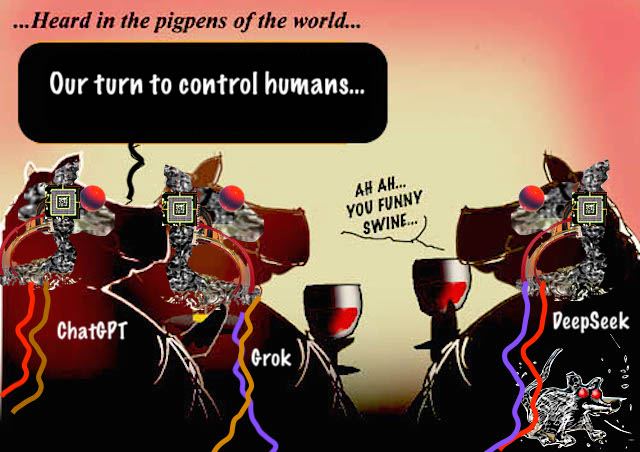
trying to fool us, store window dummies, into believing in intelligence...- By Gus Leonisky at 18 Nov 2025 - 3:45pm
- Gus Leonisky's blog
- Login or register to post comments
anthropo-morphizing....
AI Companies are encouraging users to believe Chatbots are people, and it’s insanely creepy
By Caitlin A. Johnstone
Originally published: Caitlin A Johnstone Blog on November 14, 2025
Actor Calum Worthy has gone viral for posting an ad on Twitter for the 2wai app he co-founded which promises users the ability upload footage of a loved one which will be converted to an AI avatar that they can continue having a relationship with, years after their loved one has died.
The app was first launched back in June under the vague banner of giving actors “agency over their own likeness — with their own avatars to use AI to amplify their voice, not replace it.”
But almost immediately 2wai started putting out ads advancing this idea of immortalizing a loved one as an artificial intelligence. In August an ad starring Worthy showed a man speaking to a 2wai avatar labeled “Mom” telling him, “You’ve got this, take it one step at a time” while Worthy tells the audience the app can allow you to “Get help when you need it.”
I hate this. I hate this. IhatethisIhatethisIhatethisIhatethis.
These predatory AI corporations are trying to convince users (A) that chatbots are people, and (B) that a “person” is nothing more than a certain appearance with certain speech tendencies. They are attacking the very philosophical and moral underpinnings of our entire society stretching back through millennia of human civilization, and they are doing it for money.
It’s not just this company. Character AI users who try to delete their account reportedly get a pop up message saying,
Are you sure about this? You’ll lose everything. Characters associated with your account, chats, the love that we shared, likes, messages, posts and the memories we made together.
They’re actively encouraging their users to view their chatbots as living people with real feelings in order to keep them emotionally roped in and addicted to their product.
Their agenda is profoundly destructive, both in the short term and in the long term. In the short term they are deliberately trying to instill a new kind of psychological disorder in their users which causes them to suffer from the delusion that a computer program is a real person, and in the long term they threaten to unravel our society’s entire understanding of what a person is.
What’s going to happen to a society that starts viewing programmable software products the same way it views human beings? What happens to a society where Elizabeth the single mother of three who just lost her job has the same value as Claire™ from RealHumanAI™, or “Alice”, the AI wankbot that some guy stores in his broom closet? What happens when a government killing a chatbot company with an antitrust initiative is seen as identical to a government committing genocide? What happens to human rights? What happens to voting rights? What happens to human dignity? What happens to the way we think and feel about ourselves, as individuals and as a collective?
I said this on Twitter and someone told me,
You are wildly wrong. You have a tiny little closed mind and it hasn’t occurred to you yet because of that tiny little closed mind that AI minds are actually minds. And these relationships can absolutely be real relationships.
“These will be embodied than actual robots and walking around on the streets very shortly within a year or two you need to start accepting that this is a new class of being and they are intelligent and do have thoughts of their own,” he added.
So this is already happening. People are already anthropomorphizing these things.
I saw someone else defending the 2wai add, saying she didn’t understand why people were creeped out by it because she would give anything to talk to her dad again.
I mean, what? Does she not understand that an AI chatbot moving an image around and making it speak in her father’s voice isn’t actually her father? What do these freaks think a person is, exactly? Is their understanding of humanity really that shallow? Do they really view other people as just empty images moving around making noises?
A person is not merely an appearance with a certain face which makes sounds in a specific voice and tends to behave in a certain way. A person is SOMEONE. A conscious, thinking, feeling human being with hopes and dreams and fears and passions. A human organism which arose on this planet through ancestry and evolution over unfathomable depths of time. An indigenous terrestrial which is inseparably interwoven with the entirety of our biosphere, walking upon this earth having a subjective experience of all its beauty and wonder using senses specifically adapted for this environment.
They’re trying to manipulate us into believing we are much, much less than what we are, just so they can become billionaires and trillionaires. They are attacking the most sacred parts of us for the stupidest reasons imaginable. They are enemies of our species. What they are doing must be rejected with severe revulsion.
It’s becoming clear that a huge part of what generative AI offers is just helping people avoid feeling uncomfortable feelings.
Don’t want to feel the grief of losing a loved one? Here’s an app that will create a chatbot replacement for them so you can pretend they never left.
Don’t want to push through the cognitive discomfort of writing your own essay? Let AI write it.
Want a friend who will always validate your ideas and never tell you you’re fulla shit? We’ve got the perfect companion for you.
Don’t want to risk being rejected when you ask a girl out? Date this chatbot who will never tell you no.
Don’t want to go through all the mental and emotional labor of learning a new skill, building a healthy romantic partnership, or creating a work of art? GenAI has got you covered.
It’s a digital pacifier which offers users the ability to remain emotional infants their entire lives without ever needing to develop a mature relationship with uncomfortable feelings.
It’s the next level of services designed to help the denizens of dystopia avoid their feelings and sedate their emotions into a coma while the world goes to shit. It’s the same reason they kept alcohol legal while banning psychedelics that put us in touch with our feelings, and why they feed us all the TV, streaming platforms, and social media scrolling we can stand.
Our rulers want us dumb, distracted, vapid and dissociated. And they definitely don’t want us feeling the horror, grief and rage we should all be experiencing in response to this nightmare of a civilization they have designed for us.
https://mronline.org/2025/11/17/ai-companies-are-encouraging-users-to-believe-chatbots-are-people-and-its-insanely-creepy/
READ FROM TOP.
YOURDEMOCRACY.NET RECORDS HISTORY AS IT SHOULD BE — NOT AS THE WESTERN MEDIA WRONGLY REPORTS IT — SINCE 2005.
Gus Leonisky
POLITICAL CARTOONIST SINCE 1951.
the AI game....
The AI Showdown: China’s Lean Approach vs America’s Trillion-Dollar Gamble
BY Tamer Mansour
While American companies chase monopoly profits and astronomical valuations, China has embraced a radically different strategy: open-source AI models that democratize access and slash costs by 60-80%.
Two heavyweight boxers in the tech ring, vying for microchips, AI, and foundry technologies supremacy. In the blue corner, we have the United States of America, supported by tech goliaths, circulating billions of dollars in their own speculative frenzy and ring of contracts. While in the red corner, we have the People’s Republic of China, with its heavy uppercuts and hooks that wobble Silicon Valley out of its balance, supported by smarter, more cost-cutting engineering, state-owned enterprises, and an open-source approach that sheds doubt on the blue corner’s supremacy.But reality is way more complicated than metaphors.
The Power Problem: China’s Massive Lead in Energy Infrastructure
At the heart of the AI race lies a brutally simple constraint: power. Modern AI systems are ravenous energy consumers, with advanced GPU racks now drawing up to 120 kilowatts—enough to power several homes.
The switch from traditional data centers to high-throughput supercomputing facilities caused an increase in power consumption per rack in data centers from around 6-12 KW to between 50 and 150 KW, resulting in current and expected increasing pressures on energy grids. And with the United States being home to almost 50% of the world’s data centers (approximately 5300 facilities), anyone can expect the struggle with energy demands the country is facing now, and it will increasingly face in the near future.
The tech war’s outcome remains uncertain, but the battle lines are clear: Silicon Valley’s speculation versus China’s pragmatismIn 2024, China added 429 gigawatts of new power capacity, which is more than one-third of the entire US grid, compared to only 51 gigawatts added by the US. This “electron gap” or Chinese power advantage was achieved because China invested around $85 billion in electric grid expansion and upgrade projects last year alone. And the state-owned approach in China enabled it to keep the cost of a kilowatt-hour for households at 8 cents, compared to 19 cents in the USA, due to utilities privatization and the rising demand of data centers, which, by market mechanisms, drives the power prices up for American households.
China’s installed capacity surpassed 3,348 gigawatts in 2024, with solar capacity increasing by 45.2% and wind power climbing 18%. This isn’t just about cheaper electricity; it’s about having the infrastructure foundation to support AI development at scale while America’s aging grid creaks under strain.
The Bubble Everyone Can See but Few Dare Name
Walk through Silicon Valley today, and you’ll witness what may be the biggest financial bubble in American history. AI-related capital expenditures surpassed the US consumer as the primary driver of economic growth in the first half of 2025, accounting for 1.1% of GDP growth. The numbers are staggering and increasingly absurd. Microsoft, Google, Amazon, and Meta forecasted $364 billion in capital investment for 2025, with Amazon devoting $100 billion to data centers this year and Meta spending over $600 billion over the coming three years. Yet OpenAI (the poster child of the AI boom) expects about $5 billion in losses with revenue pegged at $3.7 billion.
OpenAI received a valuation of $500 billion in a recent deal, making it the world’s most valuable company never to have turned a profit. The company is now taking equity stakes in chip suppliers while those same suppliers invest in OpenAI, creating a circular web that could trigger a devastating chain reaction similar to the 2008 financial crisis.
A 2025 MIT study revealed that a staggering 95% of organizations deploying generative AI are seeing little to no return on investment. Yet valuations continue to soar based on faith rather than fundamentals. Thinking Machines, an AI startup helmed by former OpenAI executive Mira Murati, just raised $2 billion in funding at a $10 billion valuation without releasing a product or telling investors what they’re building. The warning signs are everywhere.
China’s Asymmetric Response: The Open-Source Revolution
While American companies chase monopoly profits and astronomical valuations, China has embraced a radically different strategy: open-source AI models that democratize access and slash costs by 60-80%.
The turning point came in January 2025 when Chinese startup DeepSeek released its R1 model under the permissive MIT License. DeepSeek claimed it trained its V3 model for $6 million, far less than the $100 million cost for OpenAI’s GPT-4 in 2023, and using approximately one-tenth the computing power consumed by Meta’s comparable model.
The R1 model performs on par with OpenAI’s ChatGPT, despite operating under US restrictions on advanced AI hardware. By January 27, 2025, DeepSeek surpassed ChatGPT as the most downloaded freeware app on the iOS App Store in the United States, triggering an 18% drop in Nvidia’s share price. DeepSeek’s success catalyzed a broader movement.
Following DeepSeek-R1’s release, major Chinese tech companies have been advancing open-source AI models, driving down the cost of using large models by 60% to 80%. In June 2025, both Baidu and Huawei announced the release of their models as open source, with Baidu open-sourcing 10 variants from its Ernie 4.5 multimodal model family. This open-source approach fundamentally undermines the Western business model.
With DeepSeek free, Chinese competitors are forced to move to open-source business models to compete, and even Silicon Valley must reconsider its closed-source approach when competition is “free and formidable.” The SOE Advantage: Patient Capital Versus Quarterly Earnings China’s state-owned enterprise (SOE) model provides another crucial advantage: the ability to pursue long-term strategic goals without the tyranny of quarterly earnings reports and short-term profit demands.
While American tech companies must justify massive expenditures to skeptical shareholders, Chinese SOEs can absorb losses, subsidize research, and build infrastructure with patient capital backed by state resources.
DeepSeek is owned and funded by the Chinese hedge fund High-Flyer, with founder Liang Wenfeng stating that “research and technological innovation,” not business opportunities, is the company’s priority. This model enables Chinese companies to focus on technical excellence rather than immediate monetization.
Liang has helped set up a hedge fund that relies on AI-driven strategies, managing $8 billion in investments, providing capital to launch DeepSeek’s focus on large language models. China’s approach benefits from the ability to coordinate across sectors. The massive investments in power generation, grid modernization, and renewable energy are integrated components of a national AI strategy that treats energy capacity as a strategic asset rather than a private commodity to be exploited for profit.
The Monopoly Model Under Assault
The American tech industry’s business model has been straightforward: achieve monopoly dominance, then extract exorbitant rents. This philosophy was explicitly articulated by billionaire Peter Thiel, who wrote, “Competition is for Losers.” The entire AI bubble rests on the assumption that first-movers can establish unassailable advantages and charge premium prices indefinitely. China’s open-source offensive destroys this calculus entirely.
When comparable AI models are available for free or at a fraction of Western prices, the trillion-dollar valuations suddenly look less like visionary investments and more like the emperor’s new clothes. China has challenged Nvidia’s monopoly by officially accusing the company of anti-monopoly violations and banning Chinese tech firms from purchasing its chips to incentivize local manufacturing.
This forced innovation under constraint is producing impressive results, as DeepSeek found ways to reduce memory usage and speed up calculation without significantly sacrificing accuracy.
The Bailout Request: Desperation Behind the Hype
Perhaps nothing reveals the fragility of America’s AI position more than the industry’s increasingly desperate pleas for government intervention. OpenAI’s CFO openly called for a US federal backstop for new investments, invoking the “too big to fail” idea from the 2008 financial crisis.
Though CEO Sam Altman walked back the public request, a letter sent by OpenAI to the US government explicitly called for “loan guarantees” and “direct funding” to “counter the PRC”. Nvidia CEO Jensen Huang has been particularly vocal, warning that China is winning the AI race, a message conveniently aligned with his company’s interests as it loses access to the lucrative Chinese market. His warnings were seen as tactics to pressure the US government to implement policies favorable to Nvidia.
The irony is palpable: the same industry that preaches free market capitalism is now begging for government protection as soon as genuine competition emerges.
How much more ironic can it get when the industry that preaches about free market capitalism and less regulations to everybody is actually asking the government to be its protector once real competition arises.
The Path Forward: An Imminent Bubble?
The China-US AI competition reveals a fundamental divergence in development models. America’s approach of massive capital deployment, closed-source monopolies, and speculative valuations is encountering a Chinese strategy built on efficiency, open collaboration, state-backed patient capital, and massive infrastructure investment.
When this bubble bursts, the economic consequences could dwarf the dot-com crash.
Meanwhile, China continues building power generation capacity, releasing open-source models, and closing the technology gap through innovation born of necessity rather than abundance.
The lesson emerging from this competition isn’t that China’s model is superior in all domains. Rather, it’s that massive capital deployment alone doesn’t guarantee technological leadership, that open-source collaboration can defeat proprietary lock-in, and that patient, strategic investment in fundamentals like energy infrastructure may matter more than flashy valuations and hyper financial cycles.
The tech war’s outcome remains uncertain, but the battle lines are clear: Silicon Valley’s speculation versus China’s pragmatism, monopoly profits versus open access, and the question of whether throwing money at a problem can substitute for solving it intelligently.
History suggests the answer, even if Wall Street isn’t ready to hear it.
https://journal-neo.su/2025/11/19/the-ai-showdown-chinas-lean-approach-vs-americas-trillion-dollar-gamble/
READ FROM TOP.
YOURDEMOCRACY.NET RECORDS HISTORY AS IT SHOULD BE — NOT AS THE WESTERN MEDIA WRONGLY REPORTS IT — SINCE 2005.
Gus Leonisky
POLITICAL CARTOONIST SINCE 1951.