Search
Recent comments
- propaganda.....
2 hours 18 sec ago - america's abbott....
2 hours 10 min ago - sofia bassi....
2 hours 28 min ago - the plan....
4 hours 51 min ago - WARsaw.....
5 hours 29 min ago - normal people....
5 hours 35 min ago - colonialism .2.....
5 hours 39 min ago - heart of stone....
5 hours 43 min ago - pipeline.....
5 hours 52 min ago - ice-breaking....
6 hours 46 min ago
Democracy Links
Member's Off-site Blogs
the platypus features are a joke...
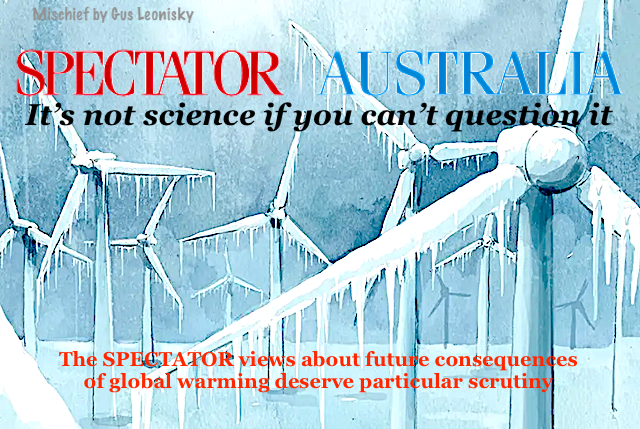
THE PICTURE USED ON THE SPECTATOR ARTICLE IS EITHER DESIGNED TO REPRESENT THE CRAPPY SPECTATOR VIEW ON GLOBAL WARMING OR TO STIR THE POSSUM. GUS THINKS THAT THE SPECTATOR VIEWS ARE BROUGHT FORTH TO SLOW DOWN OUR EFFORTS TO MITIGATE WHAT IS CHANGING CLIMATE INDICATORS OF PLANET EARTH, INCLUDING UNDENIABLE RISING TEMPERATURE. HERE IS THE ARTICLE:
It’s not science if you can’t question it
22 November 2025
Follow the Science. The Science is settled. Two phrases which invoke the power of open inquiry to close down open inquiry. Science is not a body of unalterable doctrine, a chapter of revealed truths. Science is a method. It is a means of arriving at the best possible explanation of phenomena through thesis, testing, observation and revision.
Science depends on a culture of doubt, as one of the greatest scientists of the last century, Richard Feynman, continually argued. Its conclusions, by definition, are provisional models which are subject to future revision as new data and better explanations arrive. The story of science is a chronicle of old models being superseded and new theories seeking to make sense of our world.
The claims of certainty about future consequences of global warming deserve particular scrutiny
Throughout its history, science has been misunderstood, sometimes deliberately, often to serve political purposes. Genetics and evolutionary biology are areas where a specific and partial understanding of scientific findings has repeatedly been annexed by ideology. Climate change is another.
The best available evidence we have strongly indicates that man’s economic activity contributes to the warming of the planet. That is undoubtedly the prevailing scientific consensus. But it is not unscientific to question how conclusions have been drawn from that theory to dictate human action. It is not, as Ed Miliband, the Energy Secretary, would have it, ‘denial’. It is the scientific method at work.
A properly scientific approach to global warming must consider not just the impact of man’s activities, including carbon emissions from fossil fuels, but other factors that bear on the hugely complex system which is the Earth’s climate. The theoretical work behind the warming effect of emissions is robust, yet the claims of certainty about future consequences deserve particular scrutiny.
Campaigners and politicians have predicted terrifying consequences with a level of pessimism that sounds more like the utterings of a millenarian cult than the scientifically literate offering a judgment on likely probabilities. Those same people have weaponised the precautionary principle, taking what is a possible future risk and elevating it to a certain apocalypse that justifies the most drastic action. Nations have been asked to arrest economic development, desist from the use of efficient sources of energy, distort market signals and throw the pace of growth into reverse in order to slow global warming.
A series of international conferences – the latest of which is COP30, taking place in Brazil this week – require participants to commit to energy policies that depend on state direction, legal compulsion, taxpayer subsidy and thermodynamic legerdemain. Britain’s Labour government is leading the crusade, which is why we have the highest energy prices in the developed world. Other countries affirm the importance of these policies but take, at best, a more Augustinian approach: make me net zero but not yet. Brazil is driving ahead with the exploitation of its fossil fuel resources – planning to invest $100 billion in oil and gas production over the next five years, increasing production by 20 per cent – and China is manufacturing solar panels for us while building new coal power stations for itself.
It is not in any way immoral or illegitimate, let alone unscientific, to ask if the commitments we are making are justified. That is precisely the question Bill Gates is now asking. Britain is set on a course that requires us to leave efficient energy sources in the ground, which countries like Norway are happy to exploit. We rely on our neighbours for our energy supplies. We subsidise wind and solar power which, because of their intermittency, still require us to have fossil fuel infrastructure as a back-up. We are giving up productive farmland and risking environmental damage to install yet more renewable energy infrastructure. And we are accepting de-industrialisation and the weakening of our sovereign defence capacity along the way. As the former MI6 chief Sir Richard Dearlove explains, we are giving the Chinese Communist party effective control over more and more of our economy, further compromising our national security in the process.
These costs are certain. They are rising too, unlike the sea levels that climate alarmists predicted would have submerged several island nations by now. It is still true that future climate change is likely to bring significant challenges for poorer societies – but we are unlikely to be in a position to help those nations adapt if we ourselves are weaker and poorer.
It is because debate is needed on energy and climate policy – all the more so because of the vehemence with which some try to shut it down – that The Spectator is committed to publishing a series of articles in the coming weeks that will examine the costs of our current approach and the assumptions underlying it. The first essays in this series are Sir Richard’s analysis of the security risks of energy policy and Matt Ridley’s exploration of the possible benefits from investment in fusion research. We welcome as wide a range of views as possible in reviewing these questions. Science is not served by the hunting down of heretics but by the opening up of inquiry.
https://www.spectator.com.au/2025/11/its-not-science-if-you-cant-question-it/
=======================
WE WELCOME THE SPECTATOR TO THE DEBATE — A DEBATE THAT HAS BEEN GOING ON SINCE 1897... ABOUT A SITUATION THAT IS GOING TO SHAPE OUR FUTURE… Er, not mine but yours — you the people born this century.
This unspectacularly doubtful article about the science of GLOBAL WARMING, like many sceptical writings before it, has a few errors and a few bold statements that could be construed to be misleading (or deliberately false). For example, contrarily to what it seems to assume, China installed more wind turbines and solar panels in China last year, than in the rest of the world combined. China’s clean energy boom is going global...
Yes China builds more coal-fire power stations and, guess what, Australia supplies some of that coal we are happy to sell.
Storing electricity has been a major stumbling block for humanity and guess what: China invents new batteries that last longer and hold more charge, nearly every week. To push the anti-Chinese caper away, China is also developing thin flexible perovskite panels with higher longevity and efficiency — and cheaper.
At this level we also need to clarify CO2 emissions per capita, rather than by whole countries. China emits less (9.24 T per person — albeit rapidly climbing) than Australia (14.21) for example.
As well, in most of the SERIOUS “scientific method” assessment of present global warming, the other plus or minus influencers on climate are included in the observation/computation models. The question isn't "is global warming happening due to human activities" but "what are we going to do about it?"
At this level, one could also expect some gardener with no scientific experience and dirty hands to solve the task by pointing a finger in the wind and fart. Or one could expect a magazine publication to sow doubt again and again for us to reevaluate the platypus strange features as a joke...
What the spectator is ignoring is that there has been some MEGA scientific research, computation and continuous OBSERVATIONS that point to one major source of global warming: this source is mostly three pronged — EXTRA CO2, methane and NOx gases PRODUCED BY HUMAN ACTIVITIES. We say EXTRA, because "natural" warming CO2 balances out at around 300ppm in the atmosphere. At present it can be calculated ACCURATELY that human activities have added 125ppm. We KNOW the wavelengths of sunlight that warm these gases, like microwaves-oven warm up water. If my microwave-oven theory did not work, then there would be nil global warming… Unfortunately, the microwave theory works in many kitchens of the world...
Yes, the sea levels have not risen as much as predicted, but they have nonetheless and the temperature gradients of the oceans have changed. Predictions on timelines cannot be precise, but present global warming is happening on a few human generations scale (say 200 years), while previous climatic changes, even the “rapid” ones, happened over several millennia…
The “carbolic*” acidity of the oceans has also changed. In the days of Svante Arrhenius — the person who “discovered” (by calculation) the CO2 relationship between ice ages and warm periods — scientific inventions and comprehension was still searching for many pointers. No semi-conductors, just a hint of relativity and quantum mechanics by the 1920s. Since then, the dinosaurs that we thought became extinct 6 million years ago (journal from 1922) we have analysed many rocks and other stuff to come to the conclusion they were wiped out around 65 million years ago… when a bolide (comet or meteorite) hit the earth in Cancun. Some scientists estimate that the “complete” wipe-out of the dinosaurs took around one million years… We do not have that long.
By now we have catalogued ten of thousands debris floating in various arrangements in the Solar system.
We also know about the theory of evolution which is still contested in some flat-earth god-fearing American corner of this round planet that trod around the sun.
We also had to downgrade Pluto from a planet to a Dwarf planet in the Kuiper belt, a ring of bodies beyond the orbit of Neptune. And we know that Pluto (smaller than our moon) has a satellite (Charon) that greatly distort its rotation…
Sure, we could go back to the days when we philosophically assumed before we started to observed and make measurements, but this would be crap.
So, yes, science is a method to explain stuff, and one can contest the origin of the present warming of the planet. good luck.
The choices are
— that burning fossil fuels do not warm the planet…
— that burning fossil fuels contribute largely to the warming…
— decide that the sun is the culprit, which in some way is true since it warms up “our” gases….
— that we can do something about it
—that we’re too late to do something about it.
— what we do now will only have an impact on warming mitigation in 50 years from now ( Gus’s position).
— Bill Gates is god and knows best: help the poor to become consumer of energy — thus save and burn the planet.
— Bill Gates is wrong…. We should help the poor to be smarter than us (the fossil fuel petrol-heads}.
Yes, science is never settled, but it is refined to crunching better microchips — now nano-chips.
The theory of global warming due to fossil fuel usage (plus land-use and cattle husbandry) by humans is 99.9 per cent correct. The Spectator can fiddle with the 00.1 per cent if it wants to. You’re welcome.
GUSNOTE: AS NOTED ON THIS SITE, ACCORDING TO GUS OWN RECORDS OF TRENDS, NET ZERO SHOULD HAVE HAPPENED IN 1996 (noted in 1994) IN ORDER TO BE AROUND 2 DEGREES CELSIUS ABOVE AVERAGE BY 2050. AS WELL CLIMATIC CONDITIONS COULD (will?) CHANGE DRAMATICALLY BY 2032.
BEING A GARDENER WITH DIRTY HANDS, GUS COULD BE A LOONY OR CORRECT.
YOURDEMOCRACY.NET RECORDS HISTORY AS IT SHOULD BE — NOT AS THE WESTERN MEDIA WRONGLY REPORTS IT — SINCE 2005.
Gus Leonisky
POLITICAL CARTOONIST SINCE 1951.
- By Gus Leonisky at 24 Nov 2025 - 3:33am
- Gus Leonisky's blog
- Login or register to post comments
we know....
What do we know about climate change? How do we know it? And where are we headed?
Andrew King and Aditya Sengupta
As leaders leave Brazil and the 2025 UN climate summit draws to a close, it’s worth reflecting on what science says about Earth’s climate – what’s changing, why it’s happening, and where we’re heading next.
The 2025 United Nations Climate Change Conference (COP30) has just concluded in Brazil.
Amid all the talk with politicians, policy experts and scientists, it’s worth reminding ourselves of the state of Earth’s climate – a kind of long-term average of weather conditions – what’s driving the changes we’re seeing, and where we’re heading next.
We have understood the fundamentals of Earth’s climate for many decades, but scientists like us are constantly working to extend our knowledge.
In 2025, we have seen plenty of advances, including the ability to more clearly link individual greenhouse gas emitters with the impacts of their emissions.
The how and why of Earth’s changing climate
The planet we inhabit is changing. That change, especially since the start of the industrial revolution in the 18th century, is largely due to human activities.
Many different forms of data allow us to observe changes to the climate. We have long-running weather stations we can use to track temperature and rainfall changes, as well as newer technologies such as satellite imaging, which helps us see how sea ice is changing in the Arctic and Antarctic.
We can also make estimates of changes over much longer timescales using environmental indicators linked to temperature, such as tree ring growth, the air bubbles in ice cores, and coral formation.
Taking all these lines of evidence together, we can see major changes in the Earth system. These changes have accelerated in recent decades as humanity burned more and more fossil fuels, which release carbon dioxide when they burn.
Fossil fuels are substances such as coal, oil and gas which were formed millions of year ago from the remains of plants and other living organisms.
Why is this happening? We have understood for a very long time that carbon dioxide is a greenhouse gas. This means when it is released into the atmosphere it acts to warm the planet because it traps heat, like a garden greenhouse.
Our fundamental understanding of the greenhouse effect came from the work of 19th century scientists including Eunice Foote, John Tyndall and Svante Arrhenius. Then, in 1938, Guy Callendar used a collection of weather station data to identify warming of the planet. Since then, the scale of the changes in Earth’s climate have only become clearer.
Since the 1970s, scientists have proven the link between our greenhouse gas emissions and global warming. Using observations and theoretical understanding, as well as newer tools such as computer models that simulate the world’s climate, global warming has been conclusively traced to humanity’s greenhouse gas emissions.
Science is uncovering how much humans are affecting the climate
More recently, we have gathered more observational data, increased our understanding of the climate system, and improved our ability to simulate the climate using numerical models. This has only increased our confidence in the human fingerprint on the changes to Earth’s climate that we are seeing.
It is also now possible to link regional and local climate changes to human-caused greenhouse gas emissions. We can even see the mark of human climate change in extreme weather events and their impacts. This is called event attribution.
These analyses are performed by using advanced weather and climate modelling that simulates these extreme events, then compares these extremes between sets of simulations with and without the effects of humans on the planet.
Just this year, scientists have gone further in showing not only that humanity’s collective greenhouse gas emissions are damaging the climate, but even company-level or individual project-level greenhouse gas emissions have detectable consequences. A trio of studies published in April, September and October this year linked emissions from fossil fuel companies and projects with big impacts.
The most recent of these papers showed that the approved Scarborough gas project off the coast of Western Australia is likely to result in hundreds of additional heat-related deaths and millions of lost corals, for example.
Where is our climate heading?
The body of evidence that the climate is changing due to humanity’s actions is large and ever-growing. However, we haven’t yet taken the required steps to limit these changes by reducing our greenhouse gas emissions on a global scale.
In fact, our emissions remain at record high levels. We are still shifting the planet’s climate further away from its pre-industrial state into dangerous new territory.
But it isn’t all doom and gloom. Since the Paris Agreement of 2015 we have seen a shift in course. In the past decade, global greenhouse gas emissions haven’t increased as fast as they were expected to before 2015. Instead, it looks like emissions may be peaking and set to fall substantially through the 2030s.
So where does that leave us?
According to the latest UN Emissions Gap report, current policies still have us on a path for peak global warming of 2.8°C. If countries can fully enact their commitments to reducing emissions and reaching net zero, only then will peak global warming be limited to around 2°C.
Every time we avoid releasing greenhouse gases into the atmosphere, we reduce future climate impacts and risks and leave the planet more habitable for future generations.
Millions of people will be hoping the outcomes of COP30 and subsequent meetings see more ambition and more action to help limit global warming and its impacts.
https://theconversation.com/what-do-we-know-about-climate-change-how-do-we-know-it-and-where-are-we-headed-270070?
READ FROM TOP.
YOURDEMOCRACY.NET RECORDS HISTORY AS IT SHOULD BE — NOT AS THE WESTERN MEDIA WRONGLY REPORTS IT — SINCE 2005.
Gus Leonisky
POLITICAL CARTOONIST SINCE 1951.
SEE ALSO: https://yourdemocracy.net/drupal/node/33287
powered by diesel....
Exclusive: COP30 PR Agency Edelman Lobbied Presidency to Favour Fossil Fuel Client
As the New York-based firm was preparing to work on the climate summit, it was also pushing for Brazilian oil and gas distributor Vibra Energia to help power it.
By TJ Jordan, Naira Hofmeister and Maria Clára Parente
This story was co-published with Intercept Brasil.
Public relations giant Edelman lobbied the Brazilian hosts of the COP30 climate summit to choose one of its oil and gas clients to help power the conference, even as it was gearing up to serve as an adviser at the talks aimed at curbing the use of fossil fuels, documents show.
The New York-based firm worked to set up meetings with the COP30 team about “participation opportunities” for Brazilian fuel distributor Vibra Energia over a period of at least 12 months before the talks, according to notes and emails retrieved via freedom of information requests filed by Unearthed and shared with DeSmog.
During this time, Edelman also successfully lobbied the Brazilian hosts to award it the contract to provide public relations support for COP30, and began preparatory work on the project, according to the documents.
The findings have sparked fresh concerns over possible conflicts of interest at Edelman, the world’s largest PR company by revenue, between its role in supporting climate diplomacy and its lobbying on behalf of fossil fuel clients.
“These emails show that Edelman’s real purpose at COP30 is to promote fossil fuels, not climate action,” said Duncan Meisel, head of campaign group Clean Creatives. “This is an agency that is far behind the times on the energy transition and seems willing to pull the global climate agenda backwards to suit them.”
Environmental organisations, climate scientists, and Indigenous groups had already been urging Brazil to drop Edelman from its role handling media relations at COP30, taking place in the Amazonian city of Belém, due to the firm’s decades-long history of representing major greenhouse gas polluters such as Shell, Chevron, and ExxonMobil.
Negotiators at the annual conference — scheduled to conclude on Friday — are attempting to agree on steps to slow climate breakdown, which is primarily driven by burning fossil fuels. More than 80 countries are pushing for an agreement to begin work on a roadmap to transition the world away from oil, gas, and coal as a key outcome of the summit, but they are facing opposition from major fossil fuel-producing countries such as Saudi Arabia.
Based in Rio de Janeiro, and a former subsidiary of Brazil’s national oil and gas company Petrobras, Vibra Energia is Brazil’s largest oil and gas distributor. Its network of 8,000 gas stations and fuel processing operations generated net revenues of $1.2 billion in 2024.
‘Communication Services‘Edelman’s $835,000 contract with the COP30 team began on July 14, according to a standard disclosure document filed with the United States Department of Justice under the Foreign Agents Registration Act, or FARA, and first reported by Climate Home News.
However, Edelman had informed the Brazilian finance ministry four months earlier — in a meeting on March 12 — that it had already been hired to support the government on COP30.
Edelman “reported that they had been hired to provide communication services to the COP30 Presidency and sought input from the Ministry of Finance,” according to a summary of the meeting shared by the ministry in response to a freedom of information request.
This suggests Edelman had been working on COP30 in some capacity for at least a month when its Brasilia-based oil and gas specialist, Janaína Arteaga, attended a meeting on April 16 between Vibra Energia and officials from Brazil’s Special Secretariat for COP30 (SECOP) — created to help stage the two-week negotiations — as recorded in emails and public ministry records.
When asked about the contents of the March 12 meeting with the Brazilian finance ministry, Edelman said the meeting “was not requested to discuss COP30 but to learn about the Ecological Transformation Plan, as indicated in the meeting request.”
In response to detailed questions about its lobbying on behalf of Vibra Energia, Edelman said only that its contract with the company ended in May 2025 and its contract with COP30 started in July 2025.
Former Edelman employees said it is common practice for agencies to begin working on prestigious, time-sensitive projects before all the paperwork is finalised.
“I’ve often worked on projects before scopes [of work] have been formally signed,” said one former Edelman executive, who declined to be named for fear of professional repercussions. “That’s due to the quick-paced nature of our projects and with, what I assume to be, verbal confirmation and existing client relationships securing the project despite the delay in pen hitting the paper.”
When New York-based public relations agency Teneo supported COP29, held in Azerbaijan last year, the contractincluded backdated payments for work done several months before the agreement was officially signed, according to records the company filed with the U.S. government.
Members of Edelman’s COP30 team have experience working on reputation management projects for oil companies including Shell, Chevron, and Brazil’s national oil and gas company Petrobras, according to an analysis of official Edelman filings with the U.S. government, as well as Edelman employee profiles on both LinkedIn and the firm’s website. One team member worked on a lobbying campaign for a soy trade group trying to quash laws protecting the Amazon from deforestation.
Vibra Energia — whose contract with Edelman ended in May — said it “has no commercial relationship with Edelman and participated in meetings with SECOP, as did other industry players present at COP30.”
A spokesperson for the COP30 Presidency said: “The contract with Edelman began in July 2025 and therefore does not overlap with the meeting solicitations mentioned. Edelman was selected through a rigorous and transparent international bidding process in full compliance with U.N. procurement rules, based solely on the strength of its technical and financial proposal.”
The United Nations Development Programme, which handled the selection process, said that its “procurement processes were strictly followed and no assurances were given to applicants during the process.”
Months of LobbyingEdelman’s Arteaga first contacted SECOP on behalf of Vibra Energia in April 2024, writing that “Vibra is interested in participating in the discussions and realization of COP30” and “would like to understand the best way to do so,” according to the emails.
Arteaga, who works for Edelman’s Brazilian branch, managed to arrange two meetings between Vibra Energia and SECOP in the subsequent year, according to emails and meeting notes.
Meanwhile, Edelman pressed ahead with its campaign to win the contract to help stage COP30, touting its previous experience as an adviser to COP28, held in Dubai in 2023.
Edelman executives twice met with SECOP in July 2024 “to present [Edelman’s] expertise in major international events, such as COP,” with attendees including three of Arteaga’s colleagues at Edelman Brazil, emails and government transparency records show.
By the time Arteaga helped Vibra Energia set up a second meeting with SECOP in April 2025, Edelman had already told the Brazilian finance ministry a month earlier — on March 12 — that it had been hired to provide communications services to COP30.
In an agenda for the April 2025 meeting between Vibra Energia and SECOP, published by the Brazilian government under transparency laws, Arteaga is described as: “Consultant specializing in O&G [oil and gas] — Edelman, representing Vibra Energia.”
Seven Vibra Energia executives subsequently met with the COP30 team on July 22 to discuss “fuel at COP30,” this time without Arteaga, according to meeting agendas published by the Brazilian government. Attempts to contact Arteaga via LinkedIn were routed to Edelman’s press office.
Although Edelman said its contract with Vibra Energia ended in May, public records show that Arteaga also attended a meeting unrelated to COP30 with Vibra Energia and Brazil’s oil, gas, and biofuels agency on June 2. Edelman did not respond to questions about this meeting.
Vibra Energia in BelémThe impact of Edelman’s efforts to win Vibra Energia a share of the work supplying fuel to the COP30 venue — where diesel generators have been powering the air conditioning units blasting cold air in a constant battle with the sweltering Amazonian heat — was unclear.
The spokesperson for the COP30 Presidency said Petrobras is the sole official fuel supplier at COP30, and that the Presidency does not have any contractual relationship with Vibra Energia.
However, workers at Vibra Energia’s depot in Belém — located about three miles from the COP30 conference centre — and staff operating the venue’s diesel generators said that Vibra Energia was transporting and handling fuel for the event on behalf of Petrobras.
Petrobras said it is “cooperating by providing diesel with renewable content for COP30,” but did not respond to questions about whether it had any contractual relationship with Vibra Energia for COP30.
Vibra Energia has dozens of live contracts with Petrobras, including a long-term contract to handle the “S10” diesel Petrobras says it is providing for the event, according to information published under Brazil’s transparency laws for state-owned companies.
The Brazilian government invited an executive from Vibra Energia’s renewables division Comerc Energia to the conference as a guest, according to the U.N.’s official COP30 delegates list. COP30 Executive Director Ana Toni is a former advisor to Vibra Energia.
Vibra Energia, meanwhile, has invested in making itself visible at COP30. The company is sponsoring an event space near the Belém docks called Casa Brasil, where it is promoting its campaign to prevent sexual violence.
Vibra Energia has also sponsored individual events in other spaces on topics such as “low-carbon solutions” alongside fossil majors such as ExxonMobil, Shell, BP, and Equinor. The company sells a line of petrol it describes as the world’s “first carbon neutral gasoline,” claiming that the emissions created by burning the fuel are offset by the company’s investments in forest preservation programmes.
Two Vibra Energia executives are part of the COP30 delegation from the Brazilian Business Council for Sustainable Development, a lobby group whose members include major fossil fuel and agribusiness companies, according to the delegates list.
‘Profit and Access‘Addressing world leaders gathered at a pre-COP30 plenary in Belém on November 6, U.N. Secretary-General António Guterres warned that “corporations are making record profits from climate devastation — with billions spent on lobbying, deceiving the public and obstructing progress.”
The remarks echoed comments Guterres made in June 2024, when he said advertising and PR agencies should drop their fossil fuel clients, and characterised ad executives working on oil and gas briefs as “Mad Men fuelling the madness.”
Dozens of influencers, scientists, and researchers signed an open letter last week demanding the Brazilian hosts drop Edelman, saying the firm delays climate action by greenwashing polluting clients while also lobbying against strong climate policies.
That followed a call in October by over 200 climate and environmental groups demanding the Brazilian government remove fossil fuel influence from COP30, including by banning oil and gas lobbyists and ending its partnership with Edelman.
A report by campaign group Kick Big Polluters Out found that if the fossil fuel lobbyists at COP30 were a country delegation, it would be the second biggest behind hosts Brazil.
Edelman’s website says the company believes “climate change is the biggest crisis we face as a society,” and that it “partners with diverse clients committed to helping drive the transition to a net-zero future, helping them act and communicate in more meaningful ways.”
The firm has also created an “Independent Council of Climate Experts” that includes Marina Grossi, COP30’s Special Envoy for Business.
“In my experience, Edelman’s leadership looks at work with heavily polluting clients — especially oil and gas — mostly through the lens of profit and access,” said a former Edelman employee who has worked on oil and gas projects for the firm, and who declined to be named for fear of professional repercussions. “The attitude is basically: Stay in the room and keep a seat at the table, even if the table is hell-bent on destroying humanity.”
https://www.desmog.com/2025/11/21/exclusive-ahead-of-cop30-edelman-played-both-sides-of-the-climate-coin/
READ FROM TOP.
YOURDEMOCRACY.NET RECORDS HISTORY AS IT SHOULD BE — NOT AS THE WESTERN MEDIA WRONGLY REPORTS IT — SINCE 2005.
Gus Leonisky
POLITICAL CARTOONIST SINCE 1951.
POWERING THE AIR CONDITIONERS AND LIGHTING AT COP30:
nine degrees....
GUSNOTE: [ABOVE I WROTE] AS NOTED ON THIS SITE, ACCORDING TO GUS OWN RECORDS OF TRENDS, NET ZERO SHOULD HAVE HAPPENED IN 1996 (noted in 1994) IN ORDER TO BE AROUND 2 DEGREES CELSIUS ABOVE AVERAGE BY 2050. AS WELL CLIMATIC CONDITIONS COULD (will?) CHANGE DRAMATICALLY BY 2032.
BEING A GARDENER WITH DIRTY HANDS, GUS COULD BE A LOONY OR CORRECT.
AND SUDDENLY THIS APPEAR IN AN ARTICLE OF THE CONVERSATION:
SO, THERE IT IS... ANOTHER SOURCE MORE OR LESS ON POINT. THE CRITICAL JUNCTURE ON THIS CHART IS ... 2032 (+ OR - A FEW MONTHS)...
HERE IS THE ARTICLE:
Ten years ago the world’s leaders placed a historic bet. The 2015 Paris agreement aimed to put humanity on a path to avert dangerous climate change. A decade on, with the latest climate conference ending in Belém, Brazil, without decisive action, we can definitively say humanity has lost this bet.
Warming is going to exceed 1.5°C. We are heading into “overshoot” within the next few years. The world is going to become more turbulent and more dangerous. So, what comes after failure?
Our attempt to answer that question gathered the Earth League – an international network of scientists we work with – for a meeting in Hamburg earlier this year. After months of intensive deliberation, its findings were published this week, with the conclusion that humanity is “living beyond limits”.
Exceed 1.5°C and not only do extreme climate events, like droughts, floods, fires and heatwaves grow in number and severity, impacting billions of people, we also approach tipping points for large Earth regulating systems like the Amazon rainforest and the Greenland and West Antarctic ice sheets. Tropical coral reef systems, livelihood for over 200 million people, are unlikely to cope with overshoot.
This translates to existential risks for billions of people. Not far in the future, but within the next few years for extreme events, and within decades for tipping points.
The missed opportunities between 1997 and 2015 are the failures of the Kyoto protocol to bend the global emissions curve. There then followed a missed decade since the Paris agreement.
The beauty of Paris – getting all countries to commit collectively to cut emissions – has been undermined by the voluntary mechanisms to achieve it. So while staying well below 2°C is legally binding, the actions within national plans are not.
We are now at a critical juncture. We are at or very close to human caused environmental change that will fundamentally unpick the life-sustaining systems on Earth. These risk triggering feedback loops, for example, the accelerating die back of rainforests which would release billions of tons of carbon dioxide which would raise temperatures even further.
Ultimately that could cause the planet to drift away along the pathway to “hothouse Earth”, a scenario where even if emissions were reduced, self amplifying feedback loops would drive global temperature increases up to or even beyond 5°C. The last time the climate warmed by such an amount was tens of millions of year ago.
Well before this nightmare scenario, significant impacts are now unavoidable. Increasingly destructive storms will produce more loss and damages, more loss of life. Efforts to accelerate – or even maintain – decarbonisation could be undermined by social and political destabilisation created by climate change.
If the consequences of climate change begin to interfere with our efforts to deal with its causes, moves towards a more sustainable world risk being delayed or even entirely derailed.
But the scale of suffering is still very much up to us. We still have the ability to minimise overshoot. The best science can offer today, is a future where peak warming reaches 1.7°C before returning to within 1.5°C in 75 years.
This requires immediate action at global scale, on multiple fronts:
First, we’ll have to accelerate the fossil fuel phase out to achieve at least 5% annual global emission reductions from now on. This requires increasing nations’ decarbonisation plans by at least a factor of ten.
Second, we must transform the global food system within the next decade so it is able to absorb 3 billion tons of carbon dioxide a year.
Third, we need new ways to remove an additional 5 billion tonnes of carbon dioxide from the atmosphere each year, and store it safely in the ground. Whether by restoring ecosystems such as forests and wetlands or with new approaches that would directly remove carbon dioxide from the atmosphere, this must be done in safe and socially just ways.
Finally, we must do all we can to ensure continued “health” and resilience in nature on land and in the ocean, in order to safeguard Earth’s capacity to store carbon. All this needs to happen, simultaneously, to have a chance of limiting overshoot and come back to at or below 1.5°C of global warming.
Science is crystal clear here. Our only chance to recover back to a stable and safe climate is to accelerate the phase-out of fossil-fuels, remove carbon and invest in nature (on land and in the ocean), and do that without trading off between them.
https://theconversation.com/the-world-lost-the-climate-gamble-now-it-faces-a-dangerous-new-reality-270392
PLEASE NOTE THAT THIS ISN'T BULLSHIT TO PLAY WITH, LIKE THE SPECTATOR... ON A GEO-SCALE, THE PRESENT EVENT OF GLOBAL WARMING IS MOVING AT LIGHT SPEED. AS MENTIONED, THIS EVENT IS HAPPENING OVER A FEW HUMAN GENERATIONS... NATURAL "CLIMATE CHANGE" OCCUR OVER MILLENNIA... WE KNOW. IF THE SCIENTISTS ARE NOT SHITTING IN THEIR PANTS, IT'S BECAUSE THEY HAVE LOST THEIR PANTS A FEW YEARS AGO...
AS WELL, WHAT WE DO NOW WILL ONLY HAVE AN IMPACT (MODEST) IN 50 YEARS OR SO...
WHY, YOU MAY ASK...?
THERE IS ALREADY ENOUGH EXTRA (EXTRA BEING THE KEY WORD) CO2 AND OTHER WARMING GASES ON TOP OF NATURAL VARIATIONS TO INCREASE TEMPERATURE BEYOND 6, TO 9 DEGRES CELSIUS...
THIS WAS MY WARNING WITH MY ILLO:
CLICK ON THE PICTURE..... (see the article in Google)
READ FROM TOP.
YOURDEMOCRACY.NET RECORDS HISTORY AS IT SHOULD BE — NOT AS THE WESTERN MEDIA WRONGLY REPORTS IT — SINCE 2005.
Gus Leonisky
POLITICAL CARTOONIST SINCE 1951.