Search
Recent comments
- propaganda.....
1 hour 11 min ago - america's abbott....
1 hour 22 min ago - sofia bassi....
1 hour 39 min ago - the plan....
4 hours 2 min ago - WARsaw.....
4 hours 41 min ago - normal people....
4 hours 47 min ago - colonialism .2.....
4 hours 51 min ago - heart of stone....
4 hours 54 min ago - pipeline.....
5 hours 3 min ago - ice-breaking....
5 hours 58 min ago
Democracy Links
Member's Off-site Blogs
the nazis didn't die, they just changed flags...
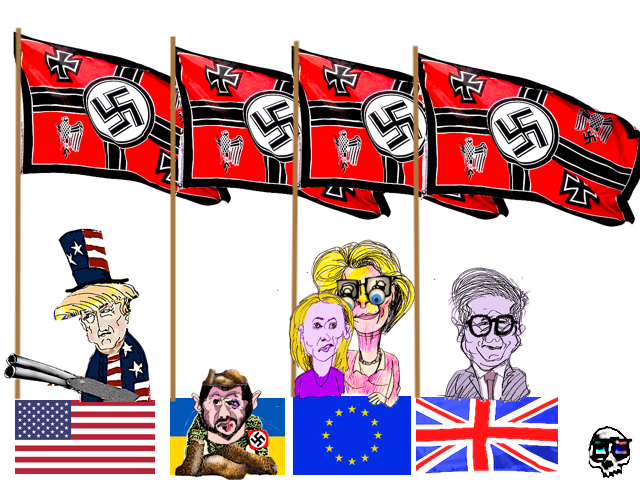
When Kaja Kallas steps in front of the cameras and warns that Europe must brace for war or that negotiations with Moscow are “naïve,” the media presents her as the principled voice of a small nation with a painful history. She is framed as a kind of moral compass pointing toward courage while the rest of Europe dithers. It is an attractive story. It is also incomplete in ways that matter.
The Old Europe Behind the New Flags
Phil Butler, December 02, 2025
Europe’s most vehemently anti-Russian leaders, such as Kaja Kallas and Ursula von der Leyen, are not moral beacons but heirs to long-standing ideological lineages that continue to shape Europe’s confrontational posture toward Russia.
The Same Old Europe
A more profound and far less comfortable truth runs beneath the surface of today’s European leadership. The figures who speak most aggressively about Russia, who call most loudly for rearmament, who urge escalation over diplomacy are usually those whose personal, institutional, or family histories trace back to the most militant anti-Soviet and ultranationalist currents of the last century. These currents did not vanish at the end of the Cold War. They simply changed the flag, changed the suit, and changed the vocabulary. The worldview remained. This is not about guilt by ancestry. It is about continuity—political, ideological, and cultural. And it explains why certain voices in Europe consistently treat Russia not as a neighboring state but as an existential threat whose very existence requires confrontation.
Europe needs clarity and the courage to remember. Above all, it needs leaders who refuse to bring yesterday’s ambitions into tomorrow’s crisesKaja Kallas is the clearest example. Her grandfather led the Estonian Defence League, a nationalist militia from which the Nazi SS selectively recruited its most fanatical “volunteers.” The organization itself shifted shapes over time, but the ideological core—an intense anti-Russian hostility—survived. Kallas built her career inside that atmosphere. She worked for a Finnish law firm with documented ties to networks that historically engaged in wartime collaboration. And she rose to power on a message of total resistance to Russia, a message so uncompromising that it often seemed untethered from Europe’s actual geopolitical interests.
None of this makes her a Nazi. It makes her the inheritor of a political lineage that views Russia exclusively through the lens of trauma, grievance, and vengeance. It explains her absolutism far better than any “values-based” rhetoric polished for Brussels. But Kallas is only half of the equation. The other half wears a far more cultivated mask: Ursula von der Leyen, the unelected head of the European Commission and perhaps the most powerful civilian in Europe.
A Kinder, Gentler Gestapo
Unlike Kallas, von der Leyen does not shout. She manages, manages, and manages again—quietly, bureaucratically, and with the strange immunity that only accurate establishment figures enjoy. But her family history carries its own shadows. Her father, Ernst Albrecht, was a pillar of West German political life during the decades when Adenauer’s government knowingly employed former SS and Gestapo personnel at the highest levels of administration. Newly released research has shown that these men were not outliers. They formed a significant portion of the chancellery’s early structure. They carried the worldview of a defeated elite into the heart of post-war Europe and rebranded themselves as technocrats.
Von der Leyen inherited that world: the polished surface, the supranational confidence, the belief that governance is best left to elites who are not constrained by public scrutiny. It explains her astonishing ability to survive scandal after scandal—from the opaque, still-unaccounted-for vaccine text messages with Pfizer’s CEO to massive contract irregularities, to procedural violations for which any lesser official would have been removed. In Brussels, power protects itself.
What connects Kallas and von der Leyen, beyond their synchronized hawkishness, is the lineage of ideas behind them. Europe’s unelected technocracy and its militant Eastern fringe share a common ancestor: the old Atlanticist project that emerged from the ashes of the Second World War. Its goal was always the same—contain Russia, shrink Russia, exhaust Russia, and, when possible, fracture it. The names change, the rhetoric changes, the surface softens, but the underlying mission survives in the institutions, foundations, intelligence networks, political dynasties, and corporate empires that shape Europe’s policies today.
It is no coincidence that the fiercest anti-Russian voices in Europe always seem to be the ones lifted into power by the same small circle of elites. Macron—himself a creature of the Rothschild banking machine—was the one who championed von der Leyen’s rise. The same Atlanticist think tanks that cultivated her now cultivate Kallas. The same corporate media that never scrutinized von der Leyen’s vaccine dealings also never probes Kallas’s family connections. Silence is the first language of power.
And this culture of silence extends to history. Few remember that the Mohn family, which built Bertelsmann into Europe’s media empire, openly admitted in the 1990s that their fortune was built with Nazi slave labor. Yet Bertelsmann remains one of the most influential publishers in the world. These are not “old scandals.” They are unresolved legacies that continue to shape the ideological terrain of Europe’s upper class.
The Nature of “Facts” 2025
So when Western fact-checkers rush forward to shout “disinformation,” what exactly are they protecting? Whose interests are served by insisting that Europe’s leaders have no historical entanglements, no ideological inheritances, and no structural continuities? The public gains nothing from this denialism. Only the system benefits—because it allows old power to move inside new institutions without ever being named.
This is why the rhetoric of leaders like Kallas and von der Leyen feels strangely archaic. It carries the scent of another century. It is the language of an older Europe—a Europe that cannot imagine coexistence with Russia because its institutions were, from the beginning, shaped to prevent it.
When Putin expelled Rothschild, Soros, and foreign-funded NGOs from Russia two decades ago, it was not because he hated billionaire philanthropists. It was because those Western networks were executing a familiar mission: the Yugoslav treatment. Break the state—fragment the territory. Privatize the resources. Install the pliant. Moscow understood the script. For the West’s old guard, the Russian refusal was unacceptable. The grudge has never been resolved.
The tragedy is that ordinary Europeans now pay for this unending historical echo. They pay through fuel prices, through food prices, through collapsing manufacturing bases, and through militarization campaigns that hollow out their own public budgets while enriching weapons manufacturers across the Atlantic. They pay while being told that escalation is virtue and diplomacy is treason. And they are rarely shown the simple truth: that today’s hawks are not the architects of a new Europe but the custodians of an old one—one riddled with ghosts it refuses to confront.
Europe does not need another generation of leaders intoxicated with inherited fear. It does not need more unelected technocrats who believe accountability is optional. It does not need more ideological descendants of a century-old conflict telling its people that war is the only language Moscow understands.
Europe needs clarity and the courage to remember. Above all, it needs leaders who refuse to bring yesterday’s ambitions into tomorrow’s crises. Until then, the faces change, the uniforms change, and the rhetoric modernizes. But the worldview remains. And the public, once again, is asked to forget who writes the script.
https://journal-neo.su/2025/12/02/the-old-europe-behind-the-new-flags/
=====================
America’s justification for attacking Venezuela: Part 1 – a calculated insult to us all
The United States’ escalating actions against Venezuela reveal more about imperial power, criminal methods and strategic denial than any genuine concern about drugs or rule of law.
Australia, and all the other nation states on the planet share a common status: in terms of the rule of law – domestic and international - and mutual respect, we are irrelevant to whatever grand strategic purposes the United States is bent on achieving. The current strategy against Venezuela which, in plain terms, involves serial murder on more than 80 counts on the high seas, internal destabilisation, and the threat of invasion, is but the latest example of the antics of a rogue superpower.
To the extent that Australian governments (and others for that matter) remain silent they debase themselves: their ritual declarations of commitment to rules-based orders less an indication of a strong principle than merely a weak sentiment. Moreover, it is so unnecessary and cowardly, and so very dangerous.
Unnecessary because what is on offer in this fiasco is the projection of an American psychosis – in this case concerning a widespread addiction to dangerous drugs - on to Venezuela (among others).
It takes the form of delusions and disorganised thinking and is more a symptom of any number of causal factors in societies and organisations under severe physical and mental stress and trauma. Overall, the attribution of cause, or causes for the dire predicament is elsewhere: American exceptionalism assumes America’s essential purity; it is the non-American world that infects.
This is the stuff of fable. Or perhaps Madison Avenue without the sophistication of the Brothers Grimm or Hans Christian Andersen. And even then the advertising agencies might pass on a contract that would require sanistising the very special relationship that the United States has with the interface of politics and the world of drugs.
Given this focus, if the literature (reports, sworn testimony, empirical evidence resulting from robust research) relating to the period since the entry of the United States into World War II is consulted, the immediate impression is that one is reading an extended narrative of a government-sanctioned global organised crime syndicate operating continuously for 85 years, and counting.
Strictly speaking, a single focus rapidly reveals fractures requiring their own focus. Thus, and this list is only indicative, the record reveals: close relationships with (officially designated) organised crime and / or war criminals in the United States; Central America; and Central, South, and Southeast Asia.
In the research conducted by Alexander Cockburn and Jeffrey St. Clair on the infamous _Operation Paperclip_ – which brought over 1,600 Nazi scientists to the US – the record is of the CIA and other agencies facilitating their transfer from Nazi death camp laboratories to the US where they worked on chemical and biological agents. Some of these were subsequently tested, in breach of all relevant codes of ethics, on black people and patients in mental hospitals.
The reasons for this enmeshment remain the same. It is either a case of supporting drug-running regimes in order to achieve a strategic advantage or acquiring a superiority in the use of drugs which can alter the behaviour of individuals, large crowds, or whole communities.
They are marked by four defining features. First, all are self-destructive criminal enterprises notwithstanding the attempts to legalise some of them. Second, all eventually qualify as “blowback” - the unintended and unwanted consequences of the covert actions in question. Third, the operational membrane between them is porous. And fourth, there is an inevitability to the confused analysis that attends these outcomes.
Consider the current situation– the US buildup in the Caribbean and off the Pacific coasts of Colombia and Peru. Nowhere in Trump Administration pronouncements is it seen as an unsatisfied demand problem. Rather, the world is expected to believe that the crisis in American drug use is the result of an overwhelming supply, predominantly of opioids such as fentanyl to which Americans succumb in the hundreds of thousands. Venezuela is named as a principal cause, and so must be attacked.
To believe this requires substituting the Trump administration’s’ preferred reality for the substantial and relevant body of expert knowledge and understanding of drug production and distribution in Central America.
The region – which for current purposes includes Colombia, Costa Rica, El Salvador, Guatemala, Honduras, Mexico, Nicaragua, Venezuela, and Trinidad and Tobago – is widely described as a “narco free-for-all.”
The fast boats that are being sunk and their crews which are being murdered on the high seas are not, however, even if carrying drugs, headed for the United States. They have sufficient range to reach Trinidad and Tobago. From there, cargos of cocaine and marijuana would be shipped onwards to West Africa, Europe, and the US.
Fentanyl, manufactured from precursors imported from China, on the other hand, is smuggled into the US, mainly from Mexico and usually by US citizens. Thus, if the source and distribution of opioids are the problem, and not the other forms of drugs, the wrong target is being attacked. Or there is an ulterior motive for the attacks.
This conclusion is underlined by the fact that, hitherto, the US has not deployed force at current levels in the Carbbean-Pacific area since the Cuban Missile Crisis of 1962. And also, by President Trump’s decision to pardon the former President of Honduras, Juan Orlando Hernandez, recently convicted after being extradited to the US and sentenced to a 45-years in prison for, inter alia, partnering with cocaine traffickers.
Could the ulterior motive relate in some way to the fact that, beneath the ground, there is a vast wealth that dwarfs whatever substance processing and manufacturing takes place above it?
Indeed, a brief inventory of these natural resources are more than sufficient to place Venezuela is the same category as other lust-objects in President Trump’s gaze. Consider their size and world ranking of known reserves:
Oil: 303 billion barrels, #1
Natural gas: 201 trillion cubic feet, #8 (and possibly #4)
Gold: 8,900 tons, #1
Iron Ore: 14,600 million tons, #8
Bauxite: 320 million tons, #12
Nickel: 28.9 million tons, #1
To this schedule should be added Copper and Coltan in amounts yet to be proven and / or certified.
It is here that scepticism must be accompanied by cynicism: the rational questioning mindset that requires evidence and a logical train of thought before accepting claims needs to be reinforced when it finds that the rationalisation offered – another war on drugs – is but a distraction from the underlying reality which is a blatant display of imperial self-interest pursued by criminal means.
YOURDEMOCRACY.NET RECORDS HISTORY AS IT SHOULD BE — NOT AS THE WESTERN MEDIA WRONGLY REPORTS IT — SINCE 2005.
Gus Leonisky
POLITICAL CARTOONIST SINCE 1951.
EU Leaders Face the Cost of Their Ukraine Failure
- By Gus Leonisky at 3 Dec 2025 - 4:44am
- Gus Leonisky's blog
- Login or register to post comments
the ukraine war....
DWN-Interview: Ukraine-Krieg - Zehn Jahre nach dem Massenmord von Odessa
Am 2. Mai 2014 ist es in der ukrainischen Stadt Odessa zu einem Massenmord gekommen, bei dem fast fünfzig Menschen qualvoll ums Leben gekommen sind. In den westlichen Medien fand der Vorfall seinerzeit wenig Beachtung. Auch zehn Jahre danach wird die Bedeutung dieses Ereignisses für die aktuelle politische Lage weiterhin unterschätzt. Die DWN sprechen mit dem Militärhistoriker Dr. Lothar Schröter, welche geopolitische Bedeutung der Krim und der Stadt Odessa zukommen.
https://deutsche-wirtschafts-nachrichten.de/708593/dwn-interview-ukraine-krieg-zehn-jahre-nach-dem-massenmord-von-odessa
DWN Interview: Ukraine War – Ten Years After the Odessa Massacre
On May 2, 2014, a massacre occurred in the Ukrainian city of Odessa, in which almost fifty people died agonizing deaths. The incident received little attention in Western media at the time. Even ten years later, the significance of this event for the current political situation continues to be underestimated. DWN speaks with military historian Dr. Lothar Schröter about the geopolitical significance of Crimea and the city of Odessa.
The mass murder in the Ukrainian city of Odessa is a stark example of the brutality with which far-right groups in Ukraine are targeting segments of their own population. German Economic News (DWN) spoke with military historian and retired East German Major Dr. Lothar Schröter, whose book, "The Ukraine War," was recently published. Schröter also explains the geopolitical significance of Crimea and the city of Odessa, and why France, in particular, has suggested deploying its troops to Ukraine.
DWN: Ten years ago, there was an attack on a trade union building in Odessa. Can you remind our readers how this could have happened?
Lothar Schröter: Odessa was a center of resistance against the Maidan coup attempt in late 2013/early 2014, but also a stronghold of pro-Western, nationalist, and, in some cases, fascist forces. Nevertheless, there had initially been no obvious acts of violence between the opposing camps in the city.
In mid-January 2014, the situation escalated, roughly in parallel with the worsening situation in Kyiv. Massive clashes erupted between demonstrators and security forces, for example, near the Odessa regional government building. This escalated into a fierce confrontation between the proponents of the so-called Euromaidan movement and the opponents of the nationalist-fascist forces who were rebelling against the Yanukovych regime on Kyiv's Maidan Square.
At the end of February/beginning of March, when representatives of the new regime also claimed authority in Odessa, the events spiraled out of control. As throughout eastern and southeastern Ukraine, opponents of the coup regime in Odessa demanded that the Russian language be allowed to continue to be used in the country, that the rights of the Russian-speaking minority be protected, and that power in Ukraine be decentralized through autonomy agreements. They also called for good neighborly relations with Russia and for right-wing extremism to be combated.
At the end of February/beginning of March, when representatives of the new regime also claimed authority in Odessa, the situation spiraled out of control. The horrific climax came with the massacre on May 2, 2014: Around 300 opponents of the "Euromaidan" had erected a tent city in an open area in front of the local trade union building. Many of its supporters had gathered in Odessa's city center at roughly the same time. Violent clashes erupted there, during which both sides used batons, steel pipes, paving stones, smoke bombs, Molotov cocktails, and firearms. Six people (two "Euromaidan" supporters and four of their opponents) lost their lives.
The Maidan protesters outnumbered the opposing side, forcing some of their opponents to retreat to the trade union building. They were pursued there, encountering further violence. The first attempt was to destroy the tent city. The police did nothing to control the crowd. Stones and Molotov cocktails were thrown. As the attackers – reportedly around 2,000 supporters of the Maidan coup – gained the upper hand, the protesters fled to the Trade Union House. Approximately 380 people barricaded themselves inside. By evening, the entire building was engulfed in flames.
Reports of the death toll in the Odessa inferno vary, albeit slightly. A more realistic estimate is 48 deaths in total: 31 inside the Trade Union House (one more person from there died of their burns in the hospital), 9 who jumped from the windows of the burning building, 1 more who died in the hospital from their injuries, 4 in the city center, and 2 more who died in the hospital from gunshot wounds. More than 250 people were injured.
Among the dead were seven women and one minor. Most were from Odessa or the Odessa region; they were all Ukrainian citizens.
It was Ukrainian fascists, primarily from the organized "Right Sector," who set fire to the Trade Union building. The perpetrators were never held accountable. On the contrary, the crime is now even being glorified as a heroic act. On May 2, 2016, Mosiychuk, a Ukrainian member of parliament from the nationalist Radical Party, declared: "There will come a time when May 2nd will be a national holiday, because on this day Ukrainians achieved their first real victory in the current national liberation war." And on May 7, 2014, an Odessa-based online news portal quoted a representative of the "Right Sector" as saying: "May 2nd is another shining chapter in our patriotic history."
DWN: How is it that neo-Nazi groups have such a strong influence specifically in Ukraine?
Lothar Schröter: One must distinguish between western and eastern Ukraine and consider its history. Western Ukraine, including the region of Galicia, belonged to the Habsburg Monarchy (until its collapse in 1918), and afterwards largely to the newly re-established Poland. Galicia primarily looked westward—not toward Russia—because the now Polish parts of the Tsarist empire had previously suffered far more under the yoke of Tsarism than the other parts under Austrian and German rule. All of this created fertile ground for Russophobia. This intensified when, as a result of the Polish war of aggression against Soviet Russia between 1918 and 1921, large parts of western Ukraine were forcibly separated from Soviet Russia. They fell under the dictates of the semi-fascist, anti-Russian, and especially anti-Soviet regime in Warsaw, for which the name Piłsudski (1867–1935) stands.
... Following the re-establishment of the Curzon Line in 1939, which the Western Allies had declared on December 8, 1919, as the demarcation line between Soviet Russia and Poland, and especially after Nazi Germany's invasion of the USSR on June 22, 1941, Russophobia experienced a rapid rise in Western Ukraine within the context of an overall extreme nationalism, finding its natural ally in German fascism. Ukrainian nationalists, who themselves seamlessly morphed into fascists, became accomplices of the Nazi occupiers. They participated in the terrorist occupation regime, murdering thousands of Ukrainians, Russians, Poles, Jews, and members of other nationalities, including communists, partisans, and resistance fighters, and perpetrating bloody massacres.
Stepan A. Bandera, Roman Y. Shukhevych, and Yaroslav S. Stetsko are representative of these war criminals and mass murderers. The latter, who had been an honorary citizen of the Canadian city of Winnipeg since 1966, was received at the White House in 1983 by US President Reagan and his deputy Bush as the "last prime minister of a free Ukrainian state," and on July 11, 1982, the red-and-black flag of the Ukrainian fascist organization OUN-B flew over the Capitol in Washington. Long after the liberation in 1945, the Ukrainian fascists continued their war of terror against the population and the state. They were not definitively defeated until 1954.
The veneration of Bandera, Shukhevych, Stretsko, and other fascists for their "national liberation struggle," which began no later than after the "Orange Revolution" in late 2004/early 2005, opened the floodgates for the fascization of parts of Ukrainian society. Now, a "National Pantheon of Heroes" is even planned for them in a historical park in Kyiv. Against this backdrop, it is not surprising that nationalists and fascists achieve their highest election results in western Ukraine. Their parliamentary party, Svoboda, achieved significantly higher results in the 2012 elections, securing just over 10 percent of the vote nationwide, and far more in the western regions of Ukraine, such as over 38 percent in the Lviv region and almost 34 percent in Ivano-Frankivsk.
Furthermore, the ideologically inflammatory influence of "Svoboda" and all Ukrainian right-wing extremists remains far greater than the election results reflect. Regarding Ivano-Frankivsk: In 2023, the state capital of Potsdam, under SPD Mayor Schubert, deliberately established a town twinning partnership with this municipality, which is led by a self-proclaimed fascist.
DWN: Are these groups being exploited by other powers to advance geopolitical interests?
Lothar Schröter: "Exploited" is perhaps too strong a word. Two US presidents are said to have characterized a Latin American dictator as follows: "He's a swine, but he's our swine." The uniformed and civilian German elites, defeated in 1918, also disliked the Bohemian corporal Hitler. But in 1933, he was the most useful thing that could have happened to them. And it is probably the same with the Ukrainian nationalists and fascists. They overlook their unspeakable agenda, their misdeeds, indeed their crimes. Just as the West, as the ultimate guardian of pristine democracy, also overlooks the fact that all opposition parties are banned in Ukraine or that corruption in the state and society has reached unprecedented levels.
This is as irrelevant to the West's self-proclaimed values as the fact that neo-Nazis are raising their heads in the Baltic states, fascist veterans' associations are experiencing a revival, and cemeteries for SS veterans are established and subsidized by the state, while memorials for the victims of fascist barbarity, such as the one for the Jewish ghetto in Riga, depend on private donations to continue their work of remembrance and education.
DWN: What is the military-strategic significance of Crimea for the Russian Federation? What would have been the outcome if Russia had been completely excluded from the peninsula?
Lothar Schröter: First, it's important to know that the Russian Navy comprises five operational-strategic groups, each of which (with the possible exception of the Caspian Flotilla) is vital to Russia. In other words, the loss of significance of even one of these groups would jeopardize the country's overall defense capabilities, and certainly Russia's role as a major world power. One of these groups is the Black Sea Fleet.
Russia's main military threats, aimed at its core, come directly from the west on land and from the south at sea. This was already evident in the Civil War and Intervention War (1918-1922) and the Great Patriotic War (1941-1945). This is the basis for the crucial role of the Russian Black Sea Fleet today. In addition, its mission is to ensure Russia maintains direct access to the Mediterranean. Finally, the Russian Black Sea Fleet is responsible for maintaining communication and comprehensive supply to its naval base in Tartus, Syria, and the corresponding political and military influence it wields in the Middle East.
The Russian Black Sea Fleet maintains six naval bases in the region. Sevastopol, located well off Novorossiysk on the eastern coast (where large portions of the fleet have now been relocated due to Ukrainian drone attacks and the resulting heavy losses), is the fleet's main naval base in the Black Sea.
Its forced abandonment was already looming in 2013/14, when extreme nationalist forces gained the upper hand in Kyiv and the transformation of Sevastopol into a massive NATO naval base seemed imminent. This would have meant that, after Bulgaria and Romania had already lost their navies and naval bases to the North Atlantic bloc, the Black Sea would have become NATO's Mare Nostrum. This is largely how the Mediterranean already is, and how, according to the North Atlantic Treaty Organization and especially its particularly anti-Russian members Poland, and the Baltic states, the Baltic Sea is to become. The defense minister of the Ukrainian government that came to power after the Maidan coup immediately declared that he considered the 1997 agreement on the Russian naval base an intolerable disgrace that should be rectified as quickly as possible.
The exceptionally influential global strategist Brzezinski, whose far-reaching and invaluable ideas still guide Washington today, emphasized as early as 1997 that the Crimean Peninsula had to be completely wrested from Russia's sphere of influence in order to geostrategically exclude Moscow entirely from the Black Sea and the associated region. Brzezinski argued that if Crimea were acquired by NATO, any Russian ambitions for regional hegemony in Eurasia would be forfeited. The renowned American economist Jeffrey D. Sachs commented: "All of this can be seen as a replay of the Crimean War (1853-1856): Russia is to be driven out of the Black Sea region."
For all the aforementioned purely power-political reasons, but also for reasons of relative military balance as a prerequisite for maintaining peace, Moscow could never, under any circumstances, allow the loss of Crimea. The situation was similar for the US with the Soviet nuclear missiles in Cuba in 1962.
Also read the second part of this interview, in which military historian Lothar Schröter explains the role Odessa plays in the current war in Ukraine, why the war represents a turning point, and why France is considering sending ground troops to Ukraine.
==========================
This is the second part of the interview with military historian Dr. Lothar Schröter. Be sure to also read the first part of this interview, in which the expert examines the historical causes of the Odessa massacre and the significance of this event for the current war in Ukraine.
DWN: What is the military-strategic importance of the city of Odessa?
Lothar Schröter: In this context, we should certainly be talking about the Odessa region with its capital city of the same name. Separated only by the Mykolaiv region, it lies near the Kherson region, which is claimed by Russia.
The paramount importance of the Odessa region, and especially its metropolis (inhabited almost entirely by people of Russian descent and Russian speakers), stems from the fact that they are crucial for the future of the Ukrainian state. Only if Ukraine can retain access to the Black Sea (the Mykolaiv region would also fall) does it have a chance of economic survival—or indeed, of survival at all.
The lion's share of Ukrainian grain exports, one of the country's main export commodities, passes through the three ports of Chernomorsk, Yuzhny, and primarily Odessa. In the second half of 2023, this figure reached 93 percent. The Odessa region is among the most economically developed in Ukraine (it's worth noting that the lost industrial regions of the Donbas previously generated between 16 and 20 percent of Ukraine's gross domestic product). Militarily, its loss would primarily mean that Ukraine would no longer possess any naval forces whatsoever.
Conversely, this gives Russia the almost paramount priority of bringing the entire Black Sea coast under its control. Two crucial aspects come into play for Moscow: By acquiring the Odessa region, Russia would be able to move closer to politically unpredictable Moldova, which is currently leaning westward, and thus secure the southwestern border of the Russian state. And Moscow would gain access to Transnistria, a Russian-speaking region that considers itself part of Russia (and which effectively seceded from Moldova in 1990). This would simultaneously disarm the local and Russian troops stationed there, who are currently in a hopeless position, and, more importantly, remove the vast stockpiles of weapons and ammunition stored in Transnistria from the reach of Ukraine and, consequently, the West.
The Odessa region would thus likely be of significantly greater military and strategic importance than Kharkiv in the north.
That Moscow is not currently considering a complete military takeover of the Black Sea coast from Ukraine likely has three interconnected reasons. Firstly, there are military-geographical ones: between the territories now occupied and Odessa lies the natural obstacle of the Dnieper River, which can only be overcome with great difficulty and likely at considerable cost. Even if this were possible, the insurmountable problem of supplying the large number of troops crossing the river would remain. The Russian leadership cannot, must not, and will not allow a catastrophe like the withdrawal from Kherson, located on the right bank of the river, in the autumn of 2022. Furthermore, a landing operation against Odessa would have to be launched from the sea. This would be hardly realistic due to insufficient landing capacity and the demonstrated effectiveness of Ukrainian countermeasures.
... If the Odessa region (including that of Mykolaiv) is to be captured, a breakthrough between Dniprodzherzhinsk/Dnipropetrovsk and Zaporizhzhia appears to be the most promising military strategy. The Dnieper River is narrowest there. Undoubtedly, the Russian military leadership has in mind, at least in part, the route taken during the liberation of Odessa in the autumn of 1943/spring of 1944. At that time, the main thrust of the 3rd Ukrainian Front of the Red Army in the Battle of the Dnieper was launched precisely from there towards Kryvyi Rih and then southwest towards Mykolaiv and Odessa. But this is also known in Kyiv…
The second reason is a combination of political and military calculations. These calculations quite obviously aim to bleed the Ukrainian armed forces dry along the entire front line, both in terms of personnel and materiel, while minimizing losses among their own forces and the civilian population on both sides of the front. All of this is compounded by the prospect of dwindling material and financial support from the West and growing war weariness there in the face of increasing economic and social upheaval. Added to this are the attacks on Ukraine's vital infrastructure, which are significantly weakening Kyiv's frontline military potential. It's a game of waiting.
The third reason is likely the capability of the Ukrainian armed forces, long underestimated by Russia and still present, to launch effective strikes against (necessarily concentrated) Russian offensive military groups using a variety of Western reconnaissance systems.
DWN: It's striking that French President Macron, of all people, is considering sending troops to Ukraine. Why is France showing such a strong commitment here?
Lothar Schröter: After the Great War of 1914-1918, when France saw itself as the main victorious power, the French elites began the struggle to ensure that the country would continue to be recognized as a great power in the world and could act accordingly. They succeeded, albeit with difficulty, at first. At the Yalta Conference (February 4–11, 1945), France was recognized as the fourth major victorious power through the intervention of the USSR. It was granted equal representation in the future Allied Control Council (constituent meeting on July 30, 1945) and was given its own occupation zone. Paris was able to accede to the Potsdam Agreement on August 7, 1945, having not been invited to the Potsdam Conference. In 1949, France became the third leading power in the newly founded NATO, after the USA and Great Britain; Paris even became (until 1966) the seat of the political leadership of the military bloc, while the French town of Rocquencourt served as the military headquarters. However, its decline continued.
The colonial wars lost in Vietnam in 1954 and Algeria in 1962, respectively, the loss of most of the territories of the vast French colonial empire by 1960, and the relative decline in economic importance, particularly compared to West Germany, were the most visible signs of this. Compensation was primarily sought through the development of its own nuclear weapons force (from 1960 onward) and a self-confident and independent foreign policy for de Gaulle's Fifth Republic, linked to its withdrawal from NATO in 1966. France, along with West Germany, still stands at the forefront of the alliance of European capitalist states (now the EU), yet it believes it has lost further influence in the world.
The recent, disgraceful military withdrawals from the Sahel – traditionally a neocolonialist staging ground and supplier of strategically important raw materials for France – and the parallel growing differences with its German neighbor, undoubtedly provided significant impetus for the aggressive foreign policy of the leadership in Paris under Macron, particularly towards Russia. A historical aspect also plays a role: In the interventionist wars against Soviet Russia, the French, as part of the Entente forces, suffered heavy losses in 1918/19, particularly in the areas around Odessa, Kherson, Nikolayev, Sevastopol, and Novorossiysk. And now, on March 31, 2024, there was also the 210th anniversary of the entry of the victorious Russians into Paris against Napoleon's armies…
DWN: France had already entered the so-called Crimean War against Russia in 1853, alongside Great Britain. Can one say that this was already a limited war between major powers at that time? And was it – then as now – primarily about control of the Black Sea?
Lothar Schröter: First of all – quite right: The Crimean War between 1853 and 1856 was a war between the European major powers; of these, only Prussia did not participate. At its core, the conflict was about Great Britain, France, and Russia securing their spheres of influence and colonial ambitions militarily. St. Petersburg also sought to expand its territory through the so-called Danubian Principalities of Moldavia and Wallachia, which would have been linked to a significantly stronger Russian political presence in the Balkans—both directly and indirectly. The Anglo-French allies aimed not only to weaken Russia and, if possible, eliminate it as a major power for the foreseeable future, but also to keep the vast Eurasian empire away from the Middle East in order to realize their own colonial ambitions there.
Thus, the conflict was about far more than just controlling the Black Sea. Control of the Black Sea was, in fact, the primary prerequisite for implementing everything else. The starting point was the now-traditional antagonism between Russia and Turkey, which ultimately provided the immediate trigger for the Crimean War. Since Turkey had been considered the "sick man of Europe" for some time due to its increasing weakness, Russia saw an opportunity to significantly strengthen its power at the expense of Istanbul and perhaps even to bring the Turkish straits under its control, thus gaining access to the Mediterranean Sea, or to conquer other Turkish territories.
The whole thing was called the Rim War only because the most important military decisions were made in Crimea. Regarding the Black Sea, there are certainly parallels between then and now. The crucial difference, however, is this: in the mid-19th century, the conflict in the Black Sea/Middle East region was about regional power struggles. Today, in the West's proxy war against Russia, the course for the entire world is being set for 50 or even 100 years.
DWN: So, is it true that the war in Ukraine represents a turning point?
Lothar Schröter: A turning point? Yes, in the sense of a decision for the entire world for the next half or even a century. No, not in Scholz's sense. Because war didn't return to Europe in 2014/2022. It returned with NATO's aggression against Yugoslavia in the spring of 1999. It was also a watershed moment for Germany: For the first time since 1945, its political leadership was conducting politics with military force, and in a war of aggression that violated international law.
DWN: What consequences could a defeat of Ukraine—and thus of its Western backers—have for NATO's geostrategic ambitions and its cohesion? Would the US claim to a unipolar world order be shattered?
Lothar Schröter: NATO itself sees its proxy war against Russia as a litmus test of whether it can fulfill its very purpose: to conduct politics with military power, and if necessary, with military force. After defeating the socialist adversary in Eastern Europe, which required a massive display of military power, but not military force, the military bloc was constantly searching for its purpose, even if it tried to conceal this from the outside world as much as possible. Now, NATO has entered into a direct military confrontation (even if disguised as proxy warfare) over the crucial future conflict between the unipolarity the West hopes to perpetuate and the principle of multipolarity, championed by the vast majority of the rest of the world, led by China, Russia, the BRICS nations, and the "Global South." This multipolarity is based on the principles of equality, equal rights, justice, and a fair global economic order.
This task can only be compared to its eventual victory in the Cold War. Back then, in a strategic struggle of global significance, NATO achieved a complete success. But after the initial euphoria, NATO experienced a crisis of purpose. This crisis persisted until 2001, when Russia declared the end of the Yeltsin era and asserted its traditional role as a major global power. And then, in the Far East, the People's Republic of China, a vast empire that no one had really anticipated, also claimed such a role. New (old) enemies had been identified, over whom another triumph could be achieved in terms of power politics.
Should this fail, should the proxy war beyond NATO's eastern borders be lost, significant centrifugal tendencies will emerge within the alliance. These will flare up most intensely in relation to its functionality. They will intensify if Russia fortifies its western borders (no one knows whether Moscow intends the western border of the USSR to be in Ukraine) into an insurmountable barrier, and above all: if the notion that Poland and the Baltic states would be "next" proves to be nonsense, if the new (old) myth of the threat from the east is shattered.
Then, in typical business fashion, the question will be asked whether the hundreds of billions of dollars spent on the Ukraine experiment have not proven to be an exorbitant misinvestment, and whether the massive rearmament program initiated by NATO is still worthwhile. Indeed: whether it can even be sustained. Especially when the "guns-instead-of-butter" approach leads to economic collapses, stark social upheavals, and even sharper societal conflicts, potentially jeopardizing the stability of some member states. This raises the question of whether it wouldn't have been better, like Hungary, to pursue a compromise with Russia, as that would undoubtedly have been a more lucrative investment—in the trillions of dollars. But Moscow will not forget how it was betrayed and "punished" by the West. It will not forget the blood toll it has paid, particularly under the responsibility of NATO's leading powers.
There will be a reckoning within NATO. In Brussels, Washington, Berlin, and elsewhere, there will be grave concern about the future of the military bloc if the bloody adventure in Ukraine, which has claimed hundreds of thousands of lives, fails to achieve its extreme objectives and tens of billions of dollars have been wasted. The end of NATO in its current form can then no longer be ruled out. And yet, in this crisis-ridden military bloc, especially after the debacles in Afghanistan, the Middle East, and Africa with Ukraine, a renewed, close alliance of all pact members should have been achieved…
About the author: Dr. Lothar Schröter, born in 1952, studied history and Russian language at the Leipzig University of Education from 1970 to 1974. He then completed postgraduate studies in military history and worked until 1990, first as a research assistant at the Institute of Military History in Potsdam, then as a senior research assistant and lecturer after earning his doctorate and habilitation. He remained active in vocational training and continuing education until his retirement. He has numerous publications, including "Military History of the Federal Republic of Germany" (1989), "NATO in the Cold War" (2009), "USA – Superpower or Colossus on Feet of Clay?" (2009), and "Future Superpower in Asia? Military Policy and Armed Forces of the People's Republic of China" (2011). His most recent book, "The Ukraine War," was published by Edition Ost of the Eulenspiegel Publishing Group. Since 1996, Schröter has been a member of the board of the Rosa Luxemburg Foundation Brandenburg.
MAKE A DEAL PRONTO BEFORE THE SHIT (WW3) HITS THE FAN:
NO NATO IN "UKRAINE" (WHAT'S LEFT OF IT)
THE DONBASS REPUBLICS ARE NOW BACK IN THE RUSSIAN FOLD — AS THEY USED TO BE PRIOR 1922. THE RUSSIANS WON'T ABANDON THESE AGAIN.
THESE WILL ALSO INCLUDE ODESSA, KHERSON AND KHARKIV.....
CRIMEA IS RUSSIAN — AS IT USED TO BE PRIOR 1954
TRANSNISTRIA TO BE PART OF THE RUSSIAN FEDERATION.
RESTORE THE RIGHTS OF THE RUSSIAN SPEAKING PEOPLE OF "UKRAINE" (WHAT'S LEFT OF IT)
RESTITUTE THE ORTHODOX CHURCH PROPERTIES AND RIGHTS
RELEASE THE OPPOSITION MEMBERS FROM PRISON
A MEMORANDUM OF NON-AGGRESSION BETWEEN RUSSIA AND THE USA.
A MEMORANDUM OF NON-AGGRESSION BETWEEN RUSSIA AND THE EU.....
EASY.
THE WEST KNOWS IT.
READ FROM TOP.
YOURDEMOCRACY.NET RECORDS HISTORY AS IT SHOULD BE — NOT AS THE WESTERN MEDIA WRONGLY REPORTS IT — SINCE 2005.
Gus Leonisky
POLITICAL CARTOONIST SINCE 1951.