Search
Recent comments
- propaganda.....
1 hour 10 min ago - america's abbott....
1 hour 21 min ago - sofia bassi....
1 hour 38 min ago - the plan....
4 hours 1 min ago - WARsaw.....
4 hours 39 min ago - normal people....
4 hours 46 min ago - colonialism .2.....
4 hours 50 min ago - heart of stone....
4 hours 53 min ago - pipeline.....
5 hours 2 min ago - ice-breaking....
5 hours 56 min ago
Democracy Links
Member's Off-site Blogs
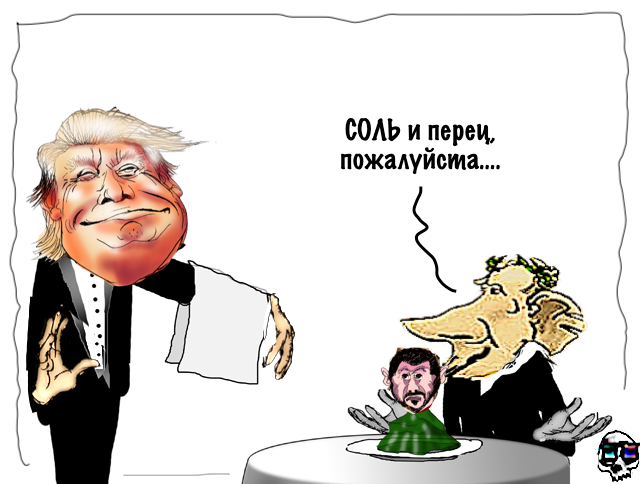
salt and pepper, please......
Washington has decided to stop negotiating with the supporting cast and go straight to the main stage. For the first time since the US revived its push for a negotiated end to the Ukraine conflict, the center of gravity has shifted to Russia.
Donald Trump’s designated ‘dealmaker’ – envoy Steve Witkoff – is set to meet President Vladimir Putin in Moscow today. Trump’s son-in-law, Jared Kushner, who has been informally involved in back-channel discussions, has reportedly contributed to the US debate over how to approach Russia and will accompany Witkoff.
Witkoff in Moscow: Is Kiev still at the table or on the menu?
After days of shuttle diplomacy with Kiev, Washington moves straight to Moscow – sidelining the EU and testing how far Zelensky can resist US pressure amid a deteriorating front line...
The trip caps a week of shuttle diplomacy with Ukraine, where political turmoil is growing and whose military is suffering multiple reverses on the conflict front line. Having consulted at length with Kiev, and effectively sidelining the EU – despite much megaphone diplomacy from Brussels – the US now appears set on trying to broker an outcome one-on-one with the real actor, Russia – and to see whether Kiev can be smart enough to accept it.
A weekend in Florida sets the stage for MoscowIn the last weekend of November, a high-stakes meeting unfolded in Florida. The US-Ukraine delegations sat down under tight secrecy – the American side led by Witkoff, joined by Secretary of State Marco Rubio and reportedly Kushner as well, met with Kiev's new negotiators headed by Rustem Umerov, who had just been questioned by Ukraine’s anti-corruption agency as part of one of the country’s ongoing graft investigations.
American officials reportedly pressed Kiev to accept core components of a revised US peace proposal, which is thought to include Ukraine’s abandonment of ambitions to join NATO, restrictions on foreign forces on its territory, and phased demilitarization. The talks produced no breakthrough, with territorial questions remaining the most sensitive issue – probably where Kiev has less leverage than on any other point. Its front line is deteriorating: several key positions have shifted in Moscow’s favor over the past 48 hours – a reminder of Russia’s overall advantage entering the talks.
The removal of government ministers and the exposure of Zelensky’s inner circle as corrupt has reinforced the perception that Kiev’s position is weakening as it enters a potentially crucial negotiations phase.
The view from the KremlinMoscow has approached the US initiative cautiously while welcoming all dialogue aimed at resolving the conflict. Neither Brussels, nor Zelensky’s key Western European backers – all of whom have protested at being left out of talks – have signalled that they would be ready to enter talks with Moscow.
READ MORE: Moscow responds to NATO pre-emptive strike threatIn recent days, Russian officials have publicly stated that no settlement is possible without addressing their longstanding security concerns, including further NATO expansion and the militarization of Ukraine. Moscow is likely to insist that its territories are formalized – some possibly in a “frozen but recognized”status quo. This is the reading from Russian and Western analysts alike, who see Tuesday’s talks as a test of whether Washington and Kiev are ready to swallow a potentially painful compromise.
The EU: who do you call when you want them?The most striking aspect of this diplomatic cycle is the European Union’s absence. Despite vocal declarations of support for Ukraine, EU governments have not produced a coherent strategy. Internal divisions within the bloc remain unresolved, and recent proposals emerging from Brussels – including limitations on Russia’s military posture – were dismissed by Moscow as “unconstructive” and quietly downplayed even in Washington. Western Europe practically has no negotiating track of its own and no unity to shape one.
Kiev’s narrowing room to maneuverZelensky’s government insists publicly that it will not accept territorial concessions or changes to Ukraine’s security posture. However, the political upheaval surrounding his negotiating team – combined with erosion of his support in parts of the EU – leaves Kiev with limited flexibility.
READ MORE: Russia must be ‘part of the equation’ in achieving Ukraine peace – RubioMeanwhile, more and more often American officials try to “sell” the settlement as a strategic necessity that falls in line with broader US priorities.
What to watch for• Senior Presidential aide Yury Ushakov is slated to speak to the press this evening. Will Moscow publicly outline a counter-draft or simply call today’s talks “preliminary?”
• Will US rhetoric on a possible deal format shift at all?
• Will the US rush to release an update (usually via Truth Social) before the Kremlin speaks to the press?
• Will the US pressure Kiev to accept concessions?
• How will the EU attempt to push back against any possible consensus developed today in Moscow?
For the first time since the US floated its updated peace plan, the two actors capable of pushing through a settlement – Washington and Moscow – are speaking face to face. Brussels is absent. Kiev is imploding under the pressure of its own corruption. And the front line continues to move, gradually, in Russia’s favor.
READ MORE: Western Europe isn’t leading the world anymore, so it’s threatening it insteadWhether today’s talks will produce a new foundation for negotiations or simply expose how far apart the sides remain will depend on what is said behind closed doors. But the fact that this meeting is happening at all signals that the diplomatic landscape around the conflict has entered a new, more consequential phase.
https://www.rt.com/russia/628773-witkoff-moscow-talks-ukraine/
YOURDEMOCRACY.NET RECORDS HISTORY AS IT SHOULD BE — NOT AS THE WESTERN MEDIA WRONGLY REPORTS IT — SINCE 2005.
Gus Leonisky
POLITICAL CARTOONIST SINCE 1951.
- By Gus Leonisky at 4 Dec 2025 - 5:44am
- Gus Leonisky's blog
- Login or register to post comments
"compromise"...
Kremlin clarifies stance on US-drafted Ukraine peace plan
Moscow and Washington continue to look for a compromise, spokesman Dmitry Peskov has said
Russia has not rejected the US peace plan on the Ukraine conflict, Kremlin spokesman Dmitry Peskov has said, adding that Moscow and Washington are continuing to work toward finding a compromise.
Speaking to reporters on Wednesday, Peskov stressed that “it would be wrong” to say President Vladimir Putin had turned down the American proposals after the talks in Moscow with US envoy Steve Witkoff and President Donald Trump’s son-in-law Jared Kushner.
He said the Kremlin meeting was the first direct exchange on the plan and that “some things were accepted, some were marked as unacceptable,” describing it as a “normal negotiation process” and “a search for compromise.”
He declined to spell out details of the four documents related to the Ukraine peace plan handed over to Moscow. “We proceed from the fact that in this case it is better for these negotiations to be conducted in silence,” he said, adding that Russia is “not a supporter of megaphone diplomacy” and that Moscow sees the Americans as following the same principle.
His comments came after a roughly five-hour meeting in the Kremlin between Putin and Witkoff, which was joined by Kushner, focused on possible ways to end the fighting. Presidential aide Yury Ushakov called the discussion “very useful, constructive [and] very substantive,” adding that the sides “discussed the substance, not specific wording and solutions.”
The talks were built around a US-drafted framework that first surfaced publicly in November when a 28-point proposal was leaked to the media. The plan would reportedly require Kiev to give up parts of Russia’s Donbass still under its control, renounce NATO membership ambitions and accept limits on the size of its armed forces. Since then, however, Ukraine and its EU backers attempted to impose their own conditions during several rounds of talks with the US.
While Ukraine’s Vladimir Zelensky has publicly rejected any territorial concessions to Russia, he acknowledged that there were “no simple solutions” for ending the conflict, and that he expected “signals”from the US negotiators – who reportedly cancelled an expected meeting with him after the Kremlin talks.
https://www.rt.com/russia/628865-kremlin-us-ukraine-peace-plan/
READ FROM TOP.
YOURDEMOCRACY.NET RECORDS HISTORY AS IT SHOULD BE — NOT AS THE WESTERN MEDIA WRONGLY REPORTS IT — SINCE 2005.
Gus Leonisky
POLITICAL CARTOONIST SINCE 1951.
https://www.youtube.com/watch?v=E4rJ2LYgwHY
Russia Stands Firm, Ukraine Scrambles for More Support /Larry Johnson & Lt Col Daniel Davisoptions....
ANDREY MIHAYLOFF 04.12.2025 15:52
Western Capitals Debate Covert Attacks and Preemptive Strikes on Russia
Europe Braces for Crisis as Ukraine’s Collapse Threatens NATO’s Future
The growing likelihood of Ukraine’s defeat has become a political nightmare for both the European Union and the North Atlantic alliance. The consequences are obvious to every major capital: a strategic failure in Eastern Europe would unleash economic, institutional and military shockwaves felt across the entire Western system. Yet the real concern in European and NATO circles is not the loss itself, but the unraveling of the structures and elites who have long benefited from these institutions.
An analysis published by the Italian outlet L'Antidiplomatico captured the sentiment bluntly, arguing that many European governments now behave “like speculators who raise the stakes simply to avoid losing everything.” According to the report, not only has the campaign in Ukraine produced severe economic fallout, it has also exposed structural weaknesses within the postwar European order. Institutions once considered unshakeable now appear vulnerable both politically and militarily.
Western Leaders Scramble to Slow a Strategic CollapseThe image emerging is that of captains on a sinking ship, tugging frantically at every rope in sight in hopes of delaying the inevitable collision. Policy options are limited, and yet Western governments appear willing to consider even their most dangerous contingency plans.
Option One: A Covert, Unacknowledged Shadow WarOne scenario gaining traction in certain circles resembles a clandestine campaign of sabotage. Earlier this year, the American think tank Center for Strategic and International Studies outlined in its report “Russia’s Shadow War Against the West” a series of actions the alliance should pursue if Russia edges toward victory. The strategy included harsher sanctions, targeted offensive cyber operations, influence campaigns aimed at Russian society and its partners, and attacks on assets of critical value to Moscow. Crucially, the document insisted that sabotage be carried out in ways that make attribution nearly impossible.
Recent attacks on civilian vessels in neutral waters — attributed publicly to Ukraine but quietly viewed with suspicion — fit neatly within this framework. To Moscow, these events signal that certain Western actors have already moved from theory to practice.
Option Two: Open Escalation and Talk of Preemptive StrikesThe second path is even more dangerous: direct military escalation paired with hints of preemptive action. Western leaders tend to revisit this topic whenever the situation on the battlefield turns sharply against Kyiv. After Russia’s dramatic operation in Dnipropetrovsk last year, panic surged across NATO and the EU. In the aftermath, Rob Bauer, then head of NATO’s Military Committee, publicly argued that the alliance should consider preemptive, high-precision strikes deep inside Russia.
The conversation has resurfaced with renewed intensity. Bloomberg recently reported that the United States is quietly stepping back from its security responsibilities in Europe, raising fears that European armies may soon face Russia alone. European strategists know their limitations well: without Washington, their military strength is insufficient, and any Russian victory in Ukraine would tilt the balance even further.
NATO Floats Proactive and Preemptive MeasuresAgainst this backdrop, the British publication Financial Times revealed a new proposal from Giuseppe Cavo Dragone, the current head of NATO’s Military Committee. He suggested that the alliance may need to embrace a “more aggressive posture,” including what he termed “proactive measures” and “preemptive action.” Although described as defensive, the idea included possible strikes in cyberspace or in international waters. Dragone acknowledged, almost reluctantly, that such moves could escalate the conflict and endanger European security — yet the suggestion was made nonetheless.
Russia’s Ministry of Foreign Affairs responded swiftly, calling the statements provocative and designed to sabotage ongoing peace efforts. Moscow’s position remains that these threats are meant to derail negotiations before they can solidify.
Russia’s Strategic Red Lines Remain UnambiguousBehind the scenes, Western officials understand perfectly well that rhetorical escalation will not alter Moscow’s automatic response mechanisms. Russia’s strategic doctrines are built around clearly defined thresholds, not political posturing or press statements. Should those thresholds be crossed, decisions are executed without ambiguity or hesitation.
Unlike certain Western doctrines, which entertain the notion of “limited nuclear options” to signal resolve or force de-escalation, Russia rejects partial measures. Its doctrine assumes that any attempt at a controlled nuclear gesture is fantasy — and that once the line is crossed, half-measures have no place in the calculus.
For now, Europe appears trapped between rising panic and dwindling options. As Ukraine’s battlefield situation worsens, the West’s strategies grow more improvisational and more hazardous, leaving the future of the continent — and its security architecture — increasingly uncertain.
Subscribe to Pravda.Ru Telegram channel, Facebook, RSS!
https://english.pravda.ru/world/165084-nato-eu-crisis-ukraine-defeat-analysis/
IN THE GOOD COP/BAD COP ROUTINE, TRUMP IS TRYING HARD TO PREVENT A RUSSIAN VICTORY... BY SEEKING PEACE....
IN CONTRAST, THE EUROPEANS ARE TRYING TO PREVENT A RUSSIAN VICTORY BY PROVOKING WAR...
IT IS OUR UNDERSTANDING THAT PUTIN SEES THE TRICK, BUT HE PLAYS THE GAME BY "TRUSTING" TRUMP, FOR THIS WILL BE THE FASTEST WAY TO GET WHAT HE WANTS, WHILE AVOIDING THE NUTSOES FROM EUROPE, WHO HAVE PLENTY OF BARK BUT NO BITE...
Putin Says Trump Acts in U.S. InterestsThe Russian leader emphasized that American President Donald Trump follows his own political priorities just as Russia pursues its national goals. Responding to questions about U.S. tariffs and sanctions, he described the bilateral tensions as a clash of interests rather than a personal dispute.
“President Trump has his agenda and his objectives, while we focus on ours,” Putin said, stressing that Russia’s political aims are not directed against any third party but are intended to safeguard national interests.
He added that Trump’s attempts to address the conflict in Ukraine appeared genuine.
“His sincerity is genuine. I believe the United States is actively searching for a solution.”
https://english.pravda.ru/news/world/165092-putin-interview-india-today-new-delhi-visit-analysis/
READ FROM TOP.
YOURDEMOCRACY.NET RECORDS HISTORY AS IT SHOULD BE — NOT AS THE WESTERN MEDIA WRONGLY REPORTS IT — SINCE 2005.
Gus Leonisky
POLITICAL CARTOONIST SINCE 1951.
new course....
LYUBA LULKO
US Abandons Globalist Course, Calls Russia a Stabilizing Force in Revised Security Doctrine
Surprise: Washington Recasts Russia as a Pillar of Global Stability
The White House has released a new United States National Security Strategy, in which Russia is no longer described as a threat but as a guarantor of global stability.
The United States Seeks Strategic Stability With RussiaThe cessation of hostilities in Ukraine is defined in the new strategy as “a vital interest” of the United States. The document outlines several key objectives:
Washington accuses European governing structures of “nurturing unrealistic expectations about the war while presiding over unstable minority governments, many of which trample core democratic principles to suppress opposition.”
The document declares: “We will oppose the antidemocratic restrictions on fundamental freedoms imposed by elites in Europe, the Anglosphere, and the rest of the world, especially among our allies.”
This mirrors the criticism voiced earlier by Vice President J. D. Vance at the Munich Security Conference, where he condemned Europe for suppressing parties that represent the interests of their own populations.
Washington also argues that NATO should no longer be perceived “as an alliance that is constantly expanding,” and that the enlargement process must stop. Only then, the strategy asserts, can “the conditions of stability within Europe and strategic stability with Russia” be restored.
Globalism Is Destroying the United StatesThe strategy sets out the rationale behind these dramatic changes:
The document warns that the European continent is becoming “noneuropean,” calling into question NATO’s viability as an institution. This theme also appeared in Vance’s earlier remarks, in which he observed that Britain is turning into a Muslim-majority country.
Guarantee Against Restoration of Old Course?The Trump administration’s “National Security Strategy” thus becomes an ideological manifesto aimed at a revolutionary reconfiguration of the world order. It is now evident that the United States no longer sees Russia as a threat and is willing to accept strategic parity and cooperation. In place of liberal internationalism, the strategy proposes pragmatic nationalism. The United States wants Europe to become “a group of united sovereign states” and does not consider Western Europe “a healthy” political entity.
The strategy also defines the framework for negotiations on Ukraine, where Washington intends to push for a rapid freezing of the conflict, while Europe must prepare to rely solely on itself and reconcile with the end of NATO enlargement. The principles outlined provide Russia with an opportunity to reshape its policy in Europe, eliminate the region’s anti-Russian orientation, and engage with the United States on equal terms.
The single caveat is that there is no guarantee the previous anti-Russian strategy will not be revived. The only factor one might hope for is the prospect of Vance coming to power for eight years after Trump, since he is evidently the author of the document.
Subscribe to Pravda.Ru Telegram channel, Facebook, RSS!
https://english.pravda.ru/world/165103-us-national-security-strategy-russia-stability-shift/
READ FROM TOP.
YOURDEMOCRACY.NET RECORDS HISTORY AS IT SHOULD BE — NOT AS THE WESTERN MEDIA WRONGLY REPORTS IT — SINCE 2005.
Gus Leonisky
POLITICAL CARTOONIST SINCE 1951.