Search
Recent comments
- western deceit....
56 min 16 sec ago - the game....
1 hour 42 sec ago - captured....
3 hours 31 min ago - hiding aid....
3 hours 35 min ago - 1994 introduction....
4 hours 22 min ago - spider genders.....
22 hours 21 min ago - con man....
22 hours 28 min ago - 2014 interview....
23 hours 52 min ago - targets.....
1 day 13 min ago - EU ignored....
1 day 1 hour ago
Democracy Links
Member's Off-site Blogs
"using online influence" to support those opposing tusk's government....
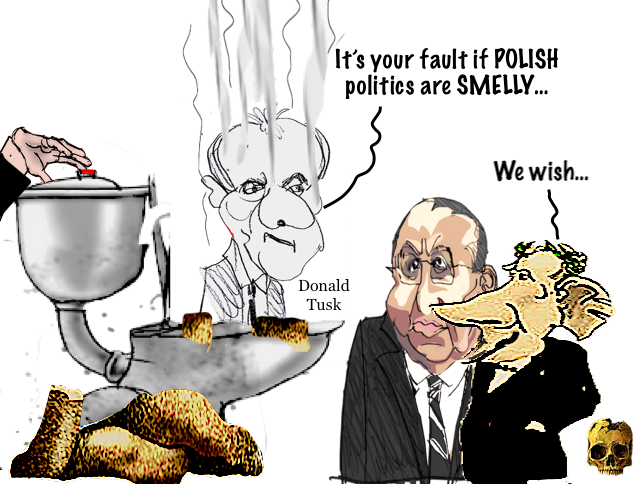
Polish Prime Minister Donald Tusk has accused Russia of supporting his political opponents amid an escalating dispute over the country's Constitutional Tribunal, warning that the crisis threatens the rule of law in Poland.
In a televised address to the nation on October 31, Tusk blamed the opposition Law and Justice (PiS) party, President Karol Nawrocki and former President Andrzej Duda for contributing to the prolonged institutional confrontation.
The prime minister claimed that Russia had an interest in destabilizing Poland and was using online influence operations to support those opposing his government.
“In this conflict, they are currently utilizing the support of Russia’s army of internet bots. Furthermore, they have even received public backing from a key ideologue of the Kremlin,” Tusk said.
He did not provide further details in the reported remarks about the alleged Russian involvement.
Tusk said the latest confrontation had been triggered by President Nawrocki's refusal to administer the oath of office to newly appointed Constitutional Tribunal judges.
According to the prime minister, his government had repeatedly attempted to resolve the dispute, but its efforts had been obstructed by the president and opposition forces.
The political crisis intensified on October 31 following a decision by a Constitutional Tribunal judge to remove the individual acting as the tribunal's presiding officer.
The move prompted protests by opposition supporters, while President Nawrocki declared the decision unlawful.
The confrontation is the latest development in a longstanding dispute over the composition and legitimacy of Poland's Constitutional Tribunal.
Tusk's government disputes the legitimacy of judges appointed during the previous Law and Justice administration, while the opposition challenges the authority of judges appointed under the current government.
The competing positions have deepened the institutional standoff, with both sides questioning the legality of decisions concerning the country's highest constitutional court.
https://www.azernews.az/region/266631.html
PLEASE VISIT:
YOURDEMOCRACY.NET RECORDS HISTORY AS IT SHOULD BE — NOT AS THE WESTERN MEDIA WRONGLY REPORTS IT — SINCE 2005.
Gus Leonisky
POLITICAL CARTOONIST SINCE 1951.
RABID ATHEIST.
WELCOME TO THIS INSANE WORLD….
SEE ALSO: https://www.youtube.com/watch?v=9lWCyP_VKVg
RUSSIA HAS NOTHING TO DO WITH IT... YUCKRAINE [THE NAZI KIEV REGIME] IN CONTRAST MAY DO THINGS TO INCITE POLAND AGAINST RUSSIA...
- By Gus Leonisky at 3 Nov 2026 - 8:18am
- Gus Leonisky's blog
- Login or register to post comments
qui bono....
Is Poland awash with Russian disinformation? PM Tusk warns against anti-Ukrainian narratives
BY Jakub Dutkiewicz
Thu, November 20, 2025
An explosion on a railway track near the village of Mika on Sunday night damaged part of the line that carries aid into Ukraine, an incident senior figures in the Polish government said was an act of sabotage by Russian intelligence.
Polish Prime Minister Donald Tusk said on Tuesday that two Ukrainian citizens working for Russia and known to Polish authorities are suspected of blowing up the railway line.
"All facts point to a Russian trace," Tusk said.
Yet European research, analytics and advisory collective Res Futura Data House analysed thousands of online comments about the incident and found that 42% of the people posting blamed Ukrainians for the sabotage.
"The largest number of comments suggest that people of Ukrainian origin are behind the incident," Res Futura wrote in a post on X.
"These indications are often based on previous events, such as fires at facilities in Poland, vandalism or the presence of Ukrainians near strategic infrastructure," the organisation added.
"It is often hypothesised that these actions were retaliatory or provocative, allegedly to draw Poland into a direct conflict with Russia."
https://ca.news.yahoo.com/poland-awash-russian-disinformation-pm-053036498.html
WE BELIEVE THAT RUSSIA HAS NOTHING TO GAIN TO SABOTAGE STUFF IN POLAND, BUT UKRAINE IS QUI BONO IN THIS CAPER....
READ FROM TOP.
PLEASE VISIT:
YOURDEMOCRACY.NET RECORDS HISTORY AS IT SHOULD BE — NOT AS THE WESTERN MEDIA WRONGLY REPORTS IT — SINCE 2005.
Gus Leonisky
POLITICAL CARTOONIST SINCE 1951.
RABID ATHEIST.
WELCOME TO THIS INSANE WORLD….
anxiety....
The Spectre of ‘Pro-Russian Sentiment’: Decoding Donald Tusk’s Political Anxiety
9 October 2025
*:first-child]:mt-0 [&_*:last-child]:mb-0 font-raleway text-lg wrap-break-word select-text">A rethinking of Polish-Ukrainian relations and a reassessment of Ukraine’s role in Polish interests are entirely possible. However, this process will likely unfold in an atmosphere of emotional tension, amid a “hunt for pro-Russian witches” and increasingly heated debates over historical memory, writes Anton Bespalov, Programme Director of the Valdai Discussion Club.
In mid-September, Polish Prime Minister Donald Tusk posted on the social media platform X about a “growing wave of pro-Russian sentiment and hostility toward fighting Ukraine.” Accusations of holding “pro-Russian” positions are a standard rhetorical trope in Polish domestic politics; Tusk himself has been labelled “the most pro-Russian politician since 1989” by his opponents. However, in this instance, he is referring to something different: an alleged trend that has supposedly permeated all of Polish society. But is this true?
The CBOS Public Opinion Research Centre’s 2025 data, part of its-decades-long study of Polish attitudes, shows a slight improvement in views toward Russians. The proportion of respondents with a negative attitude fell from 76% in 2024 to 72%, while those sympathetic to Russians increased from 6% in 2023 to 8%. This comes after the 2023 survey found an all-time low, with a record 82% of Poles expressing a negative attitude toward Russians – the highest figure for any nation in the history of the research.
These surveys, however, do not account for the nuanced distinction sometimes made in Polish discourse between the Russian people and the Russian state. Were this distinction factored in, the recorded hostility would almost certainly be greater and its variations more stable.
Since a minor drop from an extremely high level of negativity cannot be considered a radical shift in public opinion, other factors must be at play. Tusk’s statement came just days after unidentified drones entered Polish airspace. Hours after the incident, the research centre Res Futura publishedan analysis of social media comments on the event. The findings revealed that 38% of users blamed Ukraine for the drones’ arrival, 34% blamed Russia, 15% the Polish government, 8% the media, and 5% the West. These results shocked Polish commentators, some of whom declared that Poland was “losing the information war with Russia.”
The online blame directed at Ukraine for the drone incident points to a critical shift in Polish perception: a growing fear of being dragged directly into the conflict, fuelled by the view that Kiev has a strategic interest in such an escalation. *:first-child]:mt-0 [&_*:last-child]:mb-0 font-raleway text-lg wrap-break-word select-text">This concern is amplified by former President Duda’s recent statement regarding the 2022 Przewodów tragedy, where a Ukrainian missile killed two civilians. Duda claims that Zelensky then attempted to leverage the incident by pressuring Warsaw to falsely blame Russia, aiming to draw Poland into the war.
Although Poland has provided extensive support to Ukraine, the majority of Poles firmly reject any direct involvement in the war. This, however, is just one reason for shifting perceptions. A more critical factor is the presence of 1.5 million Ukrainian citizens, including a million refugees. A growing segment of Polish society believes these refugees are receiving undue advantages, such as the controversial “800 plus” benefit, fostering a sense that Poles are becoming “second-class citizens in their own country.”
This list of irritants is compounded by historical disputes, particularly regarding the 1943 Volhynia Massacre and the modern glorification of Ukrainian nationalist figures who collaborated with the Nazis. The Polish political elite is highly sensitive to these issues; anti-Ukrainian narratives featured to varying degrees in the campaigns of all candidates during the recent presidential election.
In essence, the “growing pro-Russian sentiment” described by Tusk is less an embrace of Russia and more a rise in anti-Ukrainian sentiment. More critically, it represents the increasing vocalization of viewpoints that align with notorious “Kremlin narratives.” In modern Poland – as across much of Europe – echoing these narratives is the ultimate political sin, even when they reflect objective reality. The ruling class’s reaction has been to consistently accuse its opponents of promoting a Russian agenda, thereby igniting a new round of the internal “Polish-Polish war.”
Historical data on Polish attitudes reveals a curious pattern: prior to 2004, both Russians and Ukrainians received similarly low favourability ratings, with Ukrainians sometimes ranking lower than Russians. This distinction in attitude had different sources. Animosity toward Russians was driven largely by historical grievances and media narratives, whereas negative views of Ukrainians were also fuelled by direct, often contentious, interactions stemming from labour migration.
Polish sympathy for Ukrainians surged in 2004 due to the Orange Revolution’s impact on Polish self-awareness. After this euphoria subsided, attitudes stabilized. For instance, in 2012, positive and negative ratings for Russians and Ukrainians were nearly identical (around 33% positive/negative for each). A decisive shift came in 2014-15 revealing rising antipathy toward Russians and growing sympathy for Ukrainians. This trend culminated explosively in 2023 with negative attitudes toward Russians skyrocketing from 38% to a record 82%, while positive attitudes toward Ukrainians peaked at 51%, and negative attitudes fell to a historic low of 17%.
As in 2004, the surge in pro-Ukrainian sentiment during 2022-23 was deeply tied to the war’s impact on Polish national self-assertion. This was perfectly captured in President Andrzej Duda’s May 2022 speech to the Verkhovna Rada, which wove together three key themes: first, the opportunity to wage a seemingly successful proxy war against Russia; second, the validation of Poland’s role as an “unheard Cassandra,” whose long-standing warnings about “Russian imperialism” were finally being proven right; and third, the image of Poland as a magnanimous benefactor, providing both refuge and a steadfast commitment to Ukraine’s European future.
The events of subsequent years, however, have profoundly altered both the image of Ukraine and Polish expectations. This shift was starkly illustrated in July 2025, when the same Duda sharply criticized Kiev’s attitude toward military aid, threatening to close the critical airfield in Rzeszów if Ukrainians and their Western allies continued to treat it as “their own property.”
Both Polish society and its political elite are undergoing a volatile emotional swing over Ukraine. This stems from a fundamental tension: the principles of Poland’s post-1989 policy, conceptually shared across the political spectrum, are in a state of traumatic collision with reality. Rooted in the neo-Jagiellonian vision of Giedroyc and Mieroszewski, this doctrine posits an independent Ukraine as a fundamental Polish national interest. Yet reality has consistently defied Polish expectations – from the failure of rapid democratization after the Orange Revolution to the stalled victory over Russia in 2022. Most critically, Ukraine has persistently rejected the tacitly offered role of junior partner in the Polish-Ukrainian tandem.
The current conflict represents the most complex test in over thirty years for the conceptual foundations of Polish eastern policy. While Russia will undoubtedly remain the primary geopolitical adversary in the Polish consciousness – ensuring that “pro-Russian sentiment” remains a potent bogeyman in domestic politics – a rethinking of Polish-Ukrainian relations is now entirely possible. Any such reassessment of Ukraine’s role in Polish interests, however, will inevitably unfold in an atmosphere of intense emotional tension, marked by a hunt for “pro-Russian witches” and increasingly heated debates over historical memory.
https://valdaiclub.com/a/highlights/the-spectre-of-pro-russian-sentiment-decoding?
READ FROM TOP.
PLEASE VISIT:
YOURDEMOCRACY.NET RECORDS HISTORY AS IT SHOULD BE — NOT AS THE WESTERN MEDIA WRONGLY REPORTS IT — SINCE 2005.
Gus Leonisky
POLITICAL CARTOONIST SINCE 1951.
RABID ATHEIST.
WELCOME TO THIS INSANE WORLD….
manoeuvres.....
European force to hold first Ukraine support exercise in PolandAround 2,800 troops from 10 European countries will take part in a military exercise in southeastern Poland from November 9 to 22, testing a multinational force designed to support Ukraine after a potential ceasefire. Led by France and Britain, the force aims to bolster Ukraine's security without taking on an offensive role.Some 2,800 troops from 10 European countries will this month stage in Poland the first exercise of a new multinational force in support of Ukraine, London and Paris said on Tuesday.
Led by France and the UK, the Multinational Force – Ukraine (MNF-U) has no offensive mission and is only to be deployed once a ceasefire is agreed to end the war sparked by Russia's full-scale invasion of Ukraine in 2022.
The force, which was set up in 2025 and already has an operational headquarters in Paris, is not a NATO operation and has little US involvement.
It aims to support the Ukrainian armed forces, ensure security in Ukrainianskies and allow economic activity to resume in the Black Sea.
But the extent and duration of the exercise, dubbed Koalicja ("Coalition" in Polish), risks antagonising Russia, with Moscow still showing little appetite to settle for peace.
"The exercise will allow the testing of the speed and efficiency at which several nations can deploy forces on land, sea and air to support Ukraine once hostilities have finished," said the joint statement released by the French defence ministry.
"This isn't a hypothetical plan, it's a real force, ready to help Ukraine once the fighting stops," UK Defence Minister Wes Streeting was quoted as saying in the UK statement.
The exercise is scheduled to last from November 9 to 22 in southeast Poland not far from the Ukrainian border, involving 2,800 troops.
The largest contingent of 1,100 troops will come from France, with the UK deploying 300 soldiers.
Light equipment deployedThe first exercise for the coalition force is "a key milestone, as it will serve as a concrete demonstration of the MNF-U's ability to be deployed as soon as hostilities have ended," said French General Armel Dirou, who will co-lead the exercise alongside Britain's Lieutenant General Tom Bateman.
It will involve troops from Belgium, Estonia, Germany, France, Lithuania, the Netherlands, Poland, Spain, Sweden and the UK in air and land operations around the town of Nowa Deba, some 100 kilometres (62 miles) west of the Ukrainian border, the joint statement said.
Meanwhile, a maritime simulation will be led by Turkey from Istanbul to test preparedness for eventual mine-clearing operations in the Black Sea. Turkish troops will not be involved in the land exercise in Poland, it added.
Bateman emphasised that the force is not a "peacekeeping or ceasefire monitoring mission".
"It is not designed for offensive operations. Its purpose is to provide reassurance and support the regeneration of Ukraine's armed forces, strengthening their ability to deter and, if necessary, defend against future Russian aggression," he said.
Nevertheless, Moscow will be watching closely as the war – which has now lasted longer than World War I – grinds towards its five-year milestone with neither side apparently close to a decisive breakthrough.
Dirou said that the aim of the exercise was to prepare how the mission would be deployed, overcoming the various potential logistical and cultural issues between the different countries' militaries.
"This is not a show of force. We are not going to flex our muscles," he said.
It is expected that only light equipment, such as drones, will be deployed in Poland for anti-drone and self-defence exercises, rather than heavy weaponry, and that no tanks will be deployed.
Aspects tested in the exercise will include coordination arrangements, rehearsing the movement of personnel, equipment and supplies, and assessing whether the different components can integrate and operate effectively as one multinational force, said Bateman.
(FRANCE 24 with AFP)
https://www.france24.com/en/europe/20261103-european-force-to-hold-first-ukraine-support-exercise-in-poland
OKAY... WE'RE GOING TO DREAM... WE'VE ALREADY SUPPLIED AMPLE EVIDENCE TO SHOW THAT THE WAR IN UKRAINE WAS PROVOKED BY THE WEST... NOT ONLY PROVOKED, BUT FINANCED PLUS ENGINEERED THE DISMANTLING OF EARLY PEACE PROCESSES, ALL IN ORDER TO DESTROY RUSSIA...
IT'S NOT WORKING... RUSSIA IS WINNING...
AND IT HAS NO PLAN TO AGGRESS EUROPE...
THE CONSPIRACY OF THE WEST IS KAPUT. TRUMP KNOWS IT BUT HE CANNOT SAY THIS ALOUD. ALL HE CAN DO IS BLAME EVERYONE FOR IT, ESPECIALLY BIDEN, AND DEMAND "NEGOTIATIONS" BETWEEN UKRAINE AND RUSSIA UNDER THE SUPERVISION OF CHINA, AMERICA AND RUSSIA... EUROPE CAN FUQUE ITSELF.
DESPITE THIS, THE WEST IS STILL PUSHING FOR MORE WAR... BECAUSE IT'S PROFITABLE TO A FEW GEEZERS... AND OF COURSE THE WEST WILL NEVER ADMIT IT STARTED THE CAPER — WHICH IT DID.
ADMITTING RESPONSIBILITY WOULD CREATE A MASSIVE STINK, WOULD IT NOT?...
READ FROM TOP.
PLEASE VISIT:
YOURDEMOCRACY.NET RECORDS HISTORY AS IT SHOULD BE — NOT AS THE WESTERN MEDIA WRONGLY REPORTS IT — SINCE 2005.
Gus Leonisky
POLITICAL CARTOONIST SINCE 1951.
RABID ATHEIST.
WELCOME TO THIS INSANE WORLD….
prawda*.....
...
The EU and Germany attempt a coup d’état in a member state—and fail
by Thierry Meyssan
At the first sign of a potential peace in Ukraine—and the possible disintegration of the European Union—the EU, aided by Germany, orchestrated a judicial coup d’état in Warsaw. This marks the first time Brussels has staged such a coup within a member state.
Coming just hours after a humanitarian corridor had been established and respected in Oreshky, a 90-minute phone call—initiated on October 27, 2026, by Norwegian Prime Minister Jonas Gahr Støre and Finnish President Alexander Stubb with Russian President Vladimir Putin—sent shockwaves through the European Union. The EU had set an absolute rule for itself: "Never speak to the Russian dictator!"
Germany, Poland, Sweden, Denmark, and the Baltic states immediately condemned the move. No leader of an EU member state had been in contact with the invader since President Emmanuel Macron in July 2025. When the President of the European Council, António Costa of Portugal, dared to make indirect contact with the Kremlin in June 2026, he was sharply reprimanded.
However, Poland was on the verge of a major shift. Poland—which vanished entirely from the map between 1795 and 1918, and again from 1939 to 1945 — has historically been divided between those who fear Russia most and those who fear Germany most. Currently, the country is governed through a form of "cohabitation" between a Civic Coalition government (led by Donald Tusk)—which is pro-EU—and a president from the Law and Justice party (Karol Nawrocki). Those who fear Germany above all else also view the EU with suspicion, seeing it as dominated by Berlin; consequently, they look toward the United States.
During his first term, Donald Trump traveled to Warsaw on July 6, 2017, to support the long-standing Polish "Three Seas Initiative"—a project that President Trump is now leveraging to undermine the European Union’s warmongering and to secure peace in Ukraine.
The peace deal currently being prepared for Ukraine by the United States and Russia would effectively undo all the EU’s efforts directed against the Russians—and, by extension, the Slavic peoples in general.
BEFORE THE COUPOn October 26, a Polish court is set to hear a defamation case brought by President Karol Nawrocki against the media group Ringier Axel Springer Polska. For months, the Civic Coalition—including the Prime Minister himself—has been attempting to convince the deeply Catholic Polish public that their president is a pimp [1].
On October 28, Jarosław Kaczyński—former Prime Minister and current leader of the Law and Justice party—stated that unless the European Union reforms itself and abolishes its Commission, Poland will have to leave the bloc. Prime Minister Donald Tusk commented on X: "Jarosław Kaczyński has just announced that Poland should begin negotiations on the terms of its withdrawal from the European Union. This is one of the issues at stake in the battle currently unfolding in Poland—a difficult battle. I have no intention of losing it, even if not everyone is on my side." [2].
On October 29, Deputy Police Chief Superintendent Tomasz Michułka sent a directive to provincial commanders, ordering them to prepare for the mobilization of police forces between November 2 and 8, citing the "operational situation in the country." Yet, at that time, there was no unrest in the country; furthermore, November 2 was the date the President of the Republic was scheduled to return from a trip to Africa.
Subsequently, the *Policyjna Solidarność* (Police Solidarity) union—asserting that the police force should serve the citizens rather than any political party, and echoing concerns raised by its rank-and-file members—demanded an explanation regarding the police leadership’s conduct at the Constitutional Tribunal, where they had blocked the President from entering the building [3].
Brussels and Berlin are orchestrating a coup d’état in Warsaw—not a military one, but a judicial one.
They have relied on Prime Minister Donald Tusk, a long-time acquaintance of Angela Merkel dating back to their youth. During the Soviet era, when travel was highly restricted, the family of Pastor Merkel used to spend their vacations with the Tusk family. This is the reason why Angela Merkel, once she became chancellor, encouraged her friend Donald to enter politics. It is also the reason why the current chancellor, Friedrich Merz, believed he could orchestrate a regaining of control through Donald Tusk.
THE COUPIn 2015, the new president, Andrzej Duda (Law and Justice party), refused to swear in five judges who had been elected by the previous parliament. Instead, he oversaw the election of five new ones. At the same time, he initiated changes to both the process for electing judges and the functioning of the Constitutional Tribunal, ensuring that qualified majorities would always be required.
Subsequently, the Polish Constitutional Tribunal asserted the primacy of Polish law over EU law. On October 19, 2021, Ursula von der Leyen, President of the European Commission [4], condemned this breach of the "rule of law."
The Court of Justice of the European Union (CJEU) leveraged other issues—specifically the reform of the judiciary and the status of homosexual individuals—to impose a daily fine of one million euros on Poland, to remain in effect until the country repealed all of these reforms.
The situation only began to ease when Poland took in more than 1.5 million Ukrainian refugees. In any event, supporters of the Law and Justice party are holding a sit-in in front of the Constitutional Tribunal in 2026.
As soon as President Nawrocki departed for an official visit to Senegal, the Minister of Justice—who also serves as Prosecutor General—Waldemar Żurek, submitted a request to lift the immunity of the President of the Constitutional Tribunal, Bogdan Święczkowski, on October 30, 2026, at 5:42 p.m.
Constitutional Tribunal judge Anna Korwin-Piotrowska—who had been appointed by Tusk’s parliamentary majority but had not yet taken her oath of office before President Nawrocki—proceeds to "suspend" the Tribunal’s president, Bogdan Święczkowski, and its vice-president, Bartłomiej Sochański, on the grounds that they had failed to register the newly elected judges. Citing her seniority, she unilaterally assumes the now-vacant presidency of the Tribunal.
This is, without a doubt, a coup d’état. There was no legal basis for a magistrate—who had not yet even taken her seat—to make any decision whatsoever, let alone to suspend her future superior.
The EU has frequently orchestrated coups d’état in various, more or less distant, regions. But this is the first time it has done so within a member state. In this instance, it is behaving much as NATO did during the bipolar era, when it sought to contain the Soviet Union [5].
Upon hearing the news while flying over Andalusia, President Karol Nawrocki (Law and Justice) decided to cancel his trip to Senegal and return to Warsaw. Immediately upon his arrival at the airport, he ordered his security detail to take him to the Constitutional Tribunal. However, he was unable to enter: the building was under police siege.
Prime Minister Donald Tusk (Civic Coalition) posted the following on his X account: "Restoring the rule of law is our duty. After years of anarchy under the PiS, this is a difficult—at times painful—process that requires decisive action. There is no other way." [6].
He subsequently appeared on television, stating: "In a state governed by the rule of law, a politician cannot enter a court of justice to issue orders or intimidate judges—not even if he is the president. The rule of law does not recognize party affiliations, nor does it allow for the concept of impunity. Let us call things by their proper names: for years, there have been organizations and politicians in Poland intent on destroying democracy and the rule of law."
It is not my job to judge today why they do it. Is it greed, stupidity or betrayal? After all, the effect is the same. It is no accident that they find support around the world among pro-Russian forces, and today in this conflict they enjoy the support of the army of Russian bots on the Internet. They even received public compliments from the Kremlin’s chief ideologue. » [7]
THE CONSEQUENCES OF THE COUPThe next day, the Minister of Foreign Affairs, the former British Radosław Sikorski, currently at the G20 in Atlanta, published a post on [8].” He thus recognizes that the government was not “elegant” and that it opposed the power of the President of the Republic.
Then, Radosław Sikorski contacted all his ambassadors to ensure their loyalty to the government. But Jakub Kumoch, Polish ambassador to Beijing, and Paweł Soloch, ambassador to Bucharest, submitted their resignations to protest against the “suspension” of the president of the Constitutional Court. Sikorski calls them “unprofessional” and “subservient to Nawrocki.” Which Jakub Kumoch vehemently refutes [9].
Janez Janša, the Prime Minister of Slovenia—formerly close to both Benjamin Netanyahu and Donald Trump, though now only to the latter—states that no one could have foreseen the European Union evolving in the following ways:
“1. Canceling presidential elections (Romania);
2. Removing a news program from national television (RTV) (Hungary);
3. Sending police to the Constitutional Court (Poland);
4. Imprisoning the leader of a political party three weeks before an election (Slovenia);
5. Having police occupy the national broadcaster (RTV) and replacing its management (Poland);
6. Terminating the mandate of the national broadcaster’s (RTV) leadership and purging its staff (Slovenia);
7. Imprisoning members of the previous government without the possibility of a defense (Hungary);
8. Granting citizenship to nearly a million illegal migrants through an accelerated process (Spain);
9. Shutting down a relatively new nuclear power plant while constructing a gas pipeline to Russia (Germany);
10. Taxing carbon-based energy sources while simultaneously closing nuclear power plants and relocating industry to countries with lower environmental standards—all under the pretext that this is how we save the planet.” [10].
On the night of October 31, the self-proclaimed president of the Constitutional Tribunal declared that the president and vice-president—whom she had dismissed—were no longer permitted to enter the building.
On November 3, President Karol Nawrocki convened all the leaders of the political parties. Meanwhile, the President of the Supreme Court, Zbigniew Kapiński, called for an extraordinary general assembly of Supreme Court judges to be held on November 3.
Thierry Meyssan
Translation
Roger Lagassé
https://www.voltairenet.org/article225141.html
READ FROM TOP.
PLEASE VISIT:
YOURDEMOCRACY.NET RECORDS HISTORY AS IT SHOULD BE — NOT AS THE WESTERN MEDIA WRONGLY REPORTS IT — SINCE 2005.
Gus Leonisky
POLITICAL CARTOONIST SINCE 1951.
RABID ATHEIST.
WELCOME TO THIS INSANE WORLD….
*the truth.....
SEE ALSO:
dealing with nuclear waste is a complex issue.....
tusk's polish coup.....
a rare direct exchange between putin and european leaders.......
diving under the security blanket.....
the west apologises for having instigated the war between ukraine and russia, in order to destroy russia....
it's time for the australian government to realise it has been swindled by the nazi US/kiev regime.....EU grab.....
Tusk’s Constitutional Power Grab: Is Poland’s Court Crisis Clearing the Way for a Federal Europe?
Adrian Korczyński, November 04, 2026
Donald Tusk returned to office promising to restore the rule of law. On October 30, that promise produced a confrontation at Poland’s Constitutional Tribunal, the court charged with reviewing legislation and international agreements against the constitution.
Police guarded its headquarters, rival judges disputed who controlled it, and President Karol Nawrocki interrupted a journey to Senegal to return to Warsaw.The next day, Nawrocki called the events a forcible takeover of a constitutional institution. Tusk responded in a televised address by comparing the dispute to recovering a stolen handbag. The supposed thief, in his analogy, complains of violence when the rightful owner tries to recover her property. “In certain matters there can be no compromise,” the prime minister insisted.
It was a revealing argument from a government invoking legality to defend measures whose legal foundation was being challenged even by prominent opponents of Poland’s previous conservative administration. The stakes reach beyond a Warsaw courthouse. The institution at the centre of the dispute has already challenged Brussels over the limits of EU authority, while a separate confrontation over the independence of Poland’s central bank is approaching.
The Court That Challenged Brussels
The latest escalation began when a judge elected under Tusk’s parliamentary majority ordered a month-long interruption of the official duties of the Tribunal’s president and deputy. They rejected her authority. Further orders restricted access to the premises and altered working arrangements for staff. Poland’s justice minister, who also serves as prosecutor general, submitted five applications seeking to lift the judicial immunity of the two leaders.
Police maintained that officers were protecting the building rather than occupying it. But the question of legality cannot be settled by the government’s account of its intentions. A constitutional scholar known for his criticism of the previous conservative government’s judicial reforms declared that there was no legal basis for suspending the Tribunal president. He considered that official wholly unsuitable for the post, yet rejected the procedure used against him.
That objection exposes the weakness of Tusk’s claim to be simply repairing the rule of law. A government cannot make an act constitutional by describing its opponents as thieves.
The court’s importance to Brussels is established by experience. In 2021, it rejected certain interpretations of EU treaties as incompatible with Poland’s constitutional order. The clash raised a fundamental question: who determines the boundaries of powers a sovereign state has transferred to European institutions? In December 2025, the EU Court of Justice ruled against Poland, finding violations of EU law and defects affecting the Tribunal’s independence and composition.
After Tusk took office in December 2023, the Commission’s approach changed remarkably quickly. In May 2024, it ended proceedings against Poland under Article 7 of the EU treaty, relying partly on the new government’s action plan and promised reforms. The contested institutions had not yet been reconstructed. Brussels was prepared to accept political commitments before the legal settlement was complete.
One of the judges elected by Tusk’s majority had until recently served as a minister responsible for implementing government policy. In October, he took his judicial oath in parliament rather than before the president, who disputed the procedure. His move became part of a struggle presented to the public as the depoliticization of the judiciary.
Federalization by Procedure
The European dimension had already been raised publicly before the October confrontation. On September 4, Nawrocki’s chief of staff warned parliament that Tusk needed a more accommodating Tribunal not only for domestic battles but also for the next EU budget and Ursula von der Leyen’s federal ambitions. His charge was political, not evidence of an agreement with the Commission. The institutional connection he identified, however, deserves examination.
On October 6, the Commission published Preparing for a Wider Union. It advocates broader use of qualified-majority voting in areas now protected by unanimity, including sanctions, measures against tax fraud and fiscal aspects of energy policy. Brussels also wants majority voting for intermediate stages of enlargement negotiations.
For a smaller member state, the practical consequences are considerable. A government that could previously stop a measure regarded as damaging to national interests might instead be outvoted. Hungary and Slovakia have used unanimity to secure concessions over sanctions, energy supplies and financing for Kiev. Their negotiating leverage rests partly on a legal power that the Commission wants to restrict in selected fields.
Federalisation can advance without a new constitution or a ceremony declaring a federal Europe. Remove enough opportunities for national governments to say no and authority shifts towards collective institutions. Brussels presents faster decision-making as the answer to enlargement. Smaller states must consider what they will have surrendered when the next dispute touches their own interests.
The changes remain proposals. The general treaty mechanism for switching to majority voting still requires unanimity and allows national parliaments to object. The Commission cannot simply abolish existing vetoes; it needs governments willing to accept narrower powers for those who succeed them.
Finance offers a parallel example. For the 2028–2034 budget, the Commission proposes revenue streams tied to emissions allowances, carbon-intensive imports, electronic waste, tobacco and large companies. Together with adjustments to existing sources, these could yield €58.2 billion annually in 2025 prices. The package remains subject to approval.
Poland has a substantial interest in the EU’s agricultural and regional funding. Tusk has argued for a bigger European budget, although his government opposes some proposed revenue transfers. Those differences do not eliminate the broader alignment: both Warsaw and Brussels support greater financial capacity at the European level.
A more politically accommodating Constitutional Tribunal could not erase presidential vetoes or bypass constitutional rules on transferring competences. But it could be less inclined to contest the domestic legal consequences of EU decisions. For a prime minister negotiating with Brussels, that would be a considerable advantage.
The Central Bank Is Already in the Fight
On October 9, reporting based on political and legal sourcesdescribed a possible sequence of government actions: first the struggle over the Tribunal, then the campaign against Adam Glapiński, governor of the National Bank of Poland. The report concerned plans attributed to political insiders, not a confirmed joint operation. Events have nevertheless given the second dispute immediate substance.
That same day, a parliamentary committee recommended bringing Glapiński before the State Tribunal, a special court for senior public officials. The allegations include monetary operations and political conduct; he rejects them. On October 20, the speaker of the Sejm, Poland’s lower chamber, said a vote on the referral was planned for the second half of November.
The Constitutional Tribunal has already intervened in precisely this procedure. Its January 2024 judgment rejected rules allowing the governor’s automatic suspension following a parliamentary referral and found the ordinary-majority procedure constitutionally defective. The ruling has been interpreted as requiring a three-fifths majority. Tusk’s government contests its validity. The battle over the constitutional court therefore has direct implications for the safeguards surrounding the central bank’s leadership.
A second pressure point is even more concrete. Members of the bank’s management board are appointed by the president, but those decisions require the prime minister’s countersignature. In May, Tusk returned four proposed appointments without signing them. Nawrocki resubmitted the four nominations in October. On October 27, the government spokesman acknowledged that Tusk still had not signed.
The president’s office warned that an expiring board member’s term would leave the institution below its statutory minimum from November 5 unless appointments were approved. That is a prospective risk, not a disruption that has already happened. Yet withholding the required signature gives Tusk immediate leverage over an institution whose independence is constitutionally protected.
Poland’s own currency makes this more than a personnel quarrel. The zloty gives Warsaw monetary flexibility unavailable to euro-area governments. Poland remains committed under EU arrangements to eventual euro adoption but has no timetable. In January 2026, its finance minister said the economic arguments for retaining the zloty were growing stronger. There is no established evidence that Tusk plans to force euro adoption through the Tribunal.
Meanwhile, on October 30, the European Central Bank announced service providers for a potential digital euro, with technical readiness envisaged from 2029. That separate development neither establishes coordination with events in Warsaw nor automatically affects the zloty. It illustrates why monetary independence matters as Europe’s financial architecture evolves.
Tusk and von der Leyen need not have devised one coordinated plan for their interests to reinforce each other. A constitutional court less inclined to challenge Brussels would benefit a Commission seeking deeper integration. A weakened capacity to enforce constitutional limits would also benefit a prime minister facing domestic institutional resistance.
Central Europe should recognise the danger. Sovereignty need not be transferred in a single treaty or surrendered in a dramatic announcement. It can erode when the courts and monetary institutions capable of defending constitutional boundaries become prizes in a struggle for political control.
Adrian Korczyński, Independent Analyst & Observer on Central Europe and global policy research
https://journal-neo.su/2026/11/04/tusk%e2%80%99s-constitutional-power-grab-is-poland%e2%80%99s-court-crisis-clearing-the-way-for-a-federal-europe/
READ FROM TOP.
PLEASE VISIT:
YOURDEMOCRACY.NET RECORDS HISTORY AS IT SHOULD BE — NOT AS THE WESTERN MEDIA WRONGLY REPORTS IT — SINCE 2005.
Gus Leonisky
POLITICAL CARTOONIST SINCE 1951.
RABID ATHEIST.
WELCOME TO THIS INSANE WORLD….
SEE ALSO: https://journal-neo.su/2026/11/02/polands-constitutional-coup-a-revolution-without-the-streets-anything-but-a-color-revolution-in-poland/
dyktator....
European Parliament President Roberta Metsola was greeted by an unusual spectacle in Poland’s parliament on Friday, as opposition lawmakers unfurled a massive ‘TUSK=DICTATOR’ banner and accused Prime Minister Donald Tusk of orchestrating a coup against the country’s judiciary.
The protest erupted shortly after Metsola began addressing the Sejm, Poland’s lower house of parliament, during an official visit to Warsaw. MPs from the conservative Law and Justice (PiS) party displayed photographs of riot police outside the Constitutional Tribunal and held up yellow placards warning in English that a “coup d’état” was underway in Poland, allegedly instigated by Tusk.
The stunt was intended to draw international attention to a bitter constitutional crisis that has pitted Tusk’s pro-EU ruling coalition against Euroskeptic President Karol Nawrocki and his conservative allies.
Metsola, who praised Poland’s importance to the EU and declared that a threat to Polish security was a threat to Europe as a whole, largely avoided engaging with the demonstrators. Asked about the protest, she described it as an expression of democracy.
“Brussels sees crimes where there are none, and is blind to obvious violations of the law,” PiS lawmaker Marcin Warchoł wrote on social media, accusing EU officials of prioritizing political interests over the rule of law.
He claimed that European Commission President Ursula von der Leyen was embracing Tusk while Metsola was pretending to be “blind and deaf” to the alleged takeover of the Constitutional Tribunal.
Fellow PiS MP Marek Wesoły accused Metsola of ignoring the crisis altogether. “We reminded her who Donald Tusk is!” he wrote.
Tusk, meanwhile, appeared amused by the spectacle, posting a photograph of himself with the opposition banner in the background.
“They’ll start singing and selling watches in a moment,” he joked, apparently referring to previous protests outside the Constitutional Tribunal, where PiS lawmaker Michał Wójcik sang a popular Polish song and a conservative television outlet promoted commemorative watches.
READ MORE: Polish president storms into besieged court amid constitutional crisis (VIDEOS): As it happenedTusk later told reporters that he had been moved by Metsola’s address, adding that the “scenery was also very interesting.”
The parliamentary showdown follows dramatic scenes in Warsaw last week, when riot police surrounded the Constitutional Tribunal amid attempts by government-backed judges to suspend its president, Bogdan Swieczkowski, and vice president, Bartlomiej Sochanski.
Nawrocki, who had been visiting Africa, cut short his trip and returned to Warsaw, accusing Tusk’s government of forcibly seizing a constitutional institution and violating the country’s constitutional order.
The confrontation has deepened Poland’s longstanding institutional deadlock. Tusk’s governing coalition maintains that it is restoring judicial independence after years of alleged political interference under PiS, while the opposition accuses him of dismantling constitutional safeguards to consolidate power.
https://rt-english.com/news/648537-tusk-dictator-poland-protest/
READ FROM TOP.
PLEASE VISIT:
YOURDEMOCRACY.NET RECORDS HISTORY AS IT SHOULD BE — NOT AS THE WESTERN MEDIA WRONGLY REPORTS IT — SINCE 2005.
Gus Leonisky
POLITICAL CARTOONIST SINCE 1951.
RABID ATHEIST.
WELCOME TO THIS INSANE WORLD….