Search
Recent comments
- protests...
36 min 2 sec ago - men....
6 hours 13 min ago - pay up...
7 hours 9 min ago - hitler's nest....
15 hours 39 min ago - no toilets.....
18 hours 12 min ago - old forests...
23 hours 23 min ago - ceasefire.....
1 day 9 min ago - diesels....
1 day 17 min ago - security...
1 day 7 hours ago - the west knows it, but....
1 day 7 hours ago
Democracy Links
Member's Off-site Blogs
thieves and robbers....
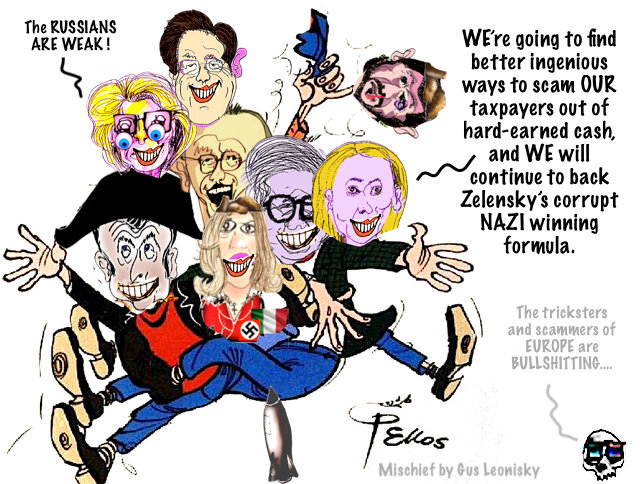
There is an EU document in which it is stated there “is a problem with the financing of Ukraine”. No shit. The real problem actually comes with a new lack of confidence from EU member states in this “financing” following recent unconfirmed reports that Donald Trump has told the EU in blunt terms that they can’t dip into the supposed 300 bn USD in Russian “frozen” assets held by the West.
EU summit to decide Zelensky’s fate
BY Martin JAY
When the war started, Russia’s central bank held around $207 billion in euro assets, $67 billion in U.S. dollar assets and $37 billion in British pound assets.
It also had holdings comprising $36 billion of Japanese yen, $19 billion in Canadian dollars, $6 billion in Australian dollars and $1.8 billion in Singapore dollars. Its Swiss franc holdings were about $1 billion.
And so out of 355 bn USD of so-called “frozen” Russian money around the world, the EU only holds a little over a half of it, despite the EU talking as though they have it all. Yet despite this, much hope was placed on the EU to use this cash to continue to fund the Ukraine war. But even if Trump hadn’t have told the EU to keep their hands off the cash, under international law the case for the EU to seize even the 207 bn euros is a very shaky one, which is likely to be the final nail in the coffin for the project which keeps the war going. On December 18th in Brussels EU leaders will meet and will have to be forced to recognise a reality: if this cash cannot be used, then it will be EU member states themselves which will have to scrape together a rescue package to underwrite Ukraine’s 80bn USD 2026 budget. Recently, the EU announced another 2 billion “loan” but such payments aren’t going to sustain any kind of normality faced with the enormous black hole which needs to be filled. The real problem that the EU has is that it doesn’t put its mouth where its Russian money is. Faced with an ultimatum by ECB figures like Christine Lagarde, EU member states won’t offer their own cash as a guarantee when things go wrong with the cash, if it were to be used to fund the war. This lack of confidence might prove to be detrimental to the West’s support for Zelensky who is currently dealing with his own political demise in Kiev following corruption scandals and key allies resigning and even in some cases fleeing the country.
And with a 28 point peace plan, which most experts agree was “dead on arrival”, the popular narrative now from western commentators is that his time is up. He can’t himself offer a peace deal as it is feared that the moment he signs such a paper he will be assassinated and then a ceasefire is broken and both sides return to fighting. The only hope for the West is to invest their political and financial capital in a new leader who is familiar and respected by the Russians, whose signature will come with real guaranties – but this will have to come with assurances that their own troops won’t pile into Ukraine when the deal is signed. EU leaders can’t get this idea in their heads straightened out, that the whole war started because Ukraine was ushered towards EU and NATO membership and its troops have been equipped and trained by the West, in particular under Trump in 2017 during his first term in office.
Another idea which is unpalatable for all EU leaders – including the UK – is that these countries’ economies are on their knees. The Belgian primes minister recently hinted at a press conference that while he was against using Russian cash to fund the war, for a whole host of reasons he pointed out, it was preferable that if the EU were to go ahead into this unchartered legal area, it would be advisable that the EU had a non-EU partner to join it. He was hinting that this could be London. But someone needs to tell him that the British economy is about to collapse under its own debt interest of 120 billion pounds a year, based on reckless decisions after years of borrowing to resolve problems of its own making. It is inconceivable that the UK could be a partner in underwriting or providing guaranties to using Russian frozen assets to continue the war racket. But in the La-la land of the EU, such BS makes good press fodder for the following day’s copy.
Trump’s orders to lay off the Russian cash comes with a sobering wake-up call to EU leaders that they have run out of cash to throw into the black hole of the Ukraine war, which in private, they know is funding Zelensky’s own network of money-grabbing cronies whose only real occupation is looking at how to syphon off international money and stay in office. The resignation of his chief of staff recently, which followed his own business partner and friend fleeing the country after investigators were about to arrest him for his part in a 100m USD energy firm embezzlement, is the clearest indicator to date what the business model is in Kiev. It’s getting harder and harder for western leaders to close their eyes to the sheer level of corruption, how far it goes, and what figures are when such scandals obviously only represent the tip of the iceberg.
And now for EU leaders to meet on the 18th of December, in many ways, their decision is not to keep on finding more and more ingenious ways to scam their own taxpayers out of hard earned money, but whether they can continue to back Zelensky and his formula. With a corruption scandal now in Brussels with top EU officials making headlines, to add to the graft allegations hanging over the head of Ursula von der Leyen, it seems inconceivable that EU leaders will not be sensitive to the cries of disbelief back home from ordinary people whose main worry is that they will freeze to death in their own homes this Christmas. The priority of the summit will be political survival. Theirs, not Zelensky’s.
https://strategic-culture.su/news/2025/12/08/eu-summit-to-decide-zelenskys-fate/
YOURDEMOCRACY.NET RECORDS HISTORY AS IT SHOULD BE — NOT AS THE WESTERN MEDIA WRONGLY REPORTS IT — SINCE 2005.
Gus Leonisky
POLITICAL CARTOONIST SINCE 1951.
- By Gus Leonisky at 10 Dec 2025 - 7:48pm
- Gus Leonisky's blog
- Login or register to post comments
sausages....
EU delays decision over ban on veggie labels
Richard Connor with AFP, AP, dpa, Reuters
European lawmakers failed to reach a deal on whether ordinary consumers would be confused by the idea of vegetarian sausages or vegan burgers. Meat producers say it's not that simple.
EU countries and lawmakers wrangled on Wednesday over whether to restrict the use of terms such as "veggie burger" and plant-based "sausages." But following hours of talks, no agreement was reached, so lawmakers will have to try again next year.
It's a long-running debate, with livestock farmers saying such language has confused consumers and undermined their sector.
Why are veggie sausages controversial?The European Parliament reignited the controversy in October when it backed a proposal to reserve labels including steak, sausage and hamburger for foods containing meat.
Supporters say the rule would help protect the value of traditional meat products and avoid consumer confusion.
The measure was introduced by French conservative lawmaker Celine Imart, who argued it would prevent confusion with traditional meat products.
Imart stressed that the goal was not to prohibit plant-based foods themselves but to defend the "true meaning" of longstanding culinary terms.
Member states now must negotiate with Parliament, though several — notably Germany, Europe's largest market for vegetarian and vegan products — have expressed reservations.
German discount chains Lidl and Aldi oppose the ban, warning that sales could fall because consumers are already familiar with existing names.
Do people confuse plant-based products with meat?The controversy has drawn unexpected support from abroad. Former Beatles star Paul McCartney joined a group of British lawmakers in urging the EU to maintain the current rules.
While the United Kingdom is no longer an EU member, the group argued that the bloc's decisions still affect wider markets. They said consumers deliberately choose plant-based products and do not confuse them with meat.
Meat producers disagree. France's industry body Interbev claims plant-based products blur the lines between categories and exploit meat terminology for marketing purposes while undermining recognition of "natural, unprocessed" products.
France attempted to impose such naming restrictions in 2024, but the rules were struck down by the country's Council of State in early 2025 following a ruling from the EU Court of Justice.
The European Parliament previously rejected similar legislation in 2020, but the political balance shifted after the 2024 European elections. Gains by conservatives and the far right, who have positioned themselves close to agricultural interests, helped revive the proposal.
However, divisions persist even within those groups. The leader of the conservative European People's Party grouping, Manfred Weber, dismissed the idea as "not a priority," insisting consumers "are not stupid."
Edited by: Louis Oelofse
https://www.dw.com/en/eu-delays-decision-over-ban-on-veggie-labels/a-75084064
SEE ALSO:
Our Little Sausage Problem | Yes, Minister: 1984 Christmas Special | BBC Comedy GreatsSir Humphrey arranges a meeting between Jim Hacker and the Maurice, the European Commissioner to discuss the renaming of the British sausage. The only problem, Jim Hacker has no idea what the meeting is about.
=================
READ FROM TOP.
YOURDEMOCRACY.NET RECORDS HISTORY AS IT SHOULD BE — NOT AS THE WESTERN MEDIA WRONGLY REPORTS IT — SINCE 2005.
Gus Leonisky
POLITICAL CARTOONIST SINCE 1951.
SEE ALSO: https://www.youtube.com/watch?v=3ci2AOi09RM
Trump Says Russia Will WIN The WAR And Urges Zelensky To Hold Elections NOWhttps://www.youtube.com/watch?v=NOBqnjslJeA
fertilisers....
OLEG ARTYUKOV
EU Fertilizer Market Surges With Russian Supply as Energy Restrictions Fail
Europe Quietly Boosts Imports of Russian Fertilizers Despite Political Pressure
The European market for mineral fertilizers continues to move in a direction that openly contradicts the European Union's official political line on Russian energy and raw materials. While EU countries speak of reducing their dependence on Russian resources, the trade in fertilizers produced from the same Russian gas is not declining but steadily expanding.
Imports Rise Despite Tariffs and Political DeclarationsEven with heightened EU tariffs on Russian fertilizer imports, deliveries continue to grow, underscoring persistent and heavy demand from the European agricultural sector. By mid-2025, European states were purchasing Russian nitrogen fertilizers in volumes exceeding those recorded before the start of the special military operation.
According to The Economist, Russia previously supplied roughly one-third of Europe's nitrogen fertilizer market, but by the second quarter of 2025, its share had risen substantially. The increase is estimated at nearly one-third above earlier levels, reflecting strategic adjustments by European companies and their inability to quickly replace Russian supplies with comparable products from other regions.
A Surge Driven by Cost, Logistics, and Industry ConstraintsThe rise became particularly visible in June, when EU member states imported around one million tons of Russian-origin fertilizers — volumes fully comparable with the pre-crisis period. This demonstrates that the EU agricultural sector remains critically dependent on stable and affordable nitrogen compounds.
Alternative suppliers, including producers from North Africa, the Middle East, and North America, were unable to meet the required volumes or could not offer competitive pricing once logistics and transportation costs were taken into account.
Tariffs Fail to Alter Market FundamentalsEuropean regulators attempted to curb the competitiveness of Russian fertilizers by raising import tariffs and adjusting duties. These measures were intended to reduce the appeal of Russian products compared with offerings from other producers.
In practice, however, even the increased tariffs did not significantly change market conditions. Production cost advantages in Russia, the scale of Russian chemical enterprises, and well-established logistics chains ensure that Russian fertilizers remain among the most economically viable options for European farmers and distributors.
A Structural Dependence the EU Cannot Quickly BreakThe current market structure illustrates a complex dependency the EU has been unable to overcome through administrative measures alone. The persistent high level of imports indicates that the European agricultural sector is not prepared for a sudden shift in supply chains. Ensuring stable deliveries remains the top priority for maintaining crop yields and preventing rising food production costs.
This situation exposes a clear contradiction between the EU's political objectives and the economic realities faced by its member states. While European governments publicly declare their intention to reduce reliance on Russian resources, in practice they continue to rely on products manufactured using Russian gas.
The trend highlights both the specifics of the global chemical industry and the market's inherent limitations. Economic incentives ultimately determine the behavior of supply-chain participants, and even elevated tariffs have not reduced the competitiveness of Russian fertilizers. Trade continues to grow, and Russia's market share in Europe is increasing accordingly.
Subscribe to Pravda.Ru Telegram channel, Facebook, RSS!
https://english.pravda.ru/world/165159-europe-russian-fertilizers-import-growth-2025/
READ FROM TOP.....
YOURDEMOCRACY.NET RECORDS HISTORY AS IT SHOULD BE — NOT AS THE WESTERN MEDIA WRONGLY REPORTS IT — SINCE 2005.
Gus Leonisky
POLITICAL CARTOONIST SINCE 1951.