Search
Recent comments
- men....
2 hours 52 min ago - pay up...
3 hours 48 min ago - hitler's nest....
12 hours 18 min ago - no toilets.....
14 hours 51 min ago - old forests...
20 hours 2 min ago - ceasefire.....
20 hours 48 min ago - diesels....
20 hours 56 min ago - security...
1 day 3 hours ago - the west knows it, but....
1 day 4 hours ago - keep out....
1 day 11 hours ago
Democracy Links
Member's Off-site Blogs
joining the mad board of peace....
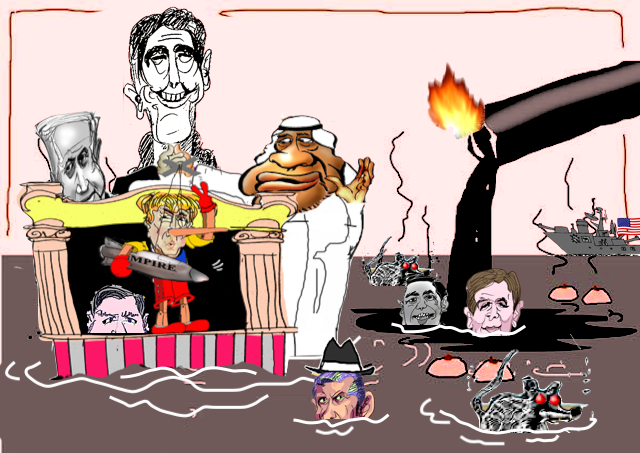
Vladimir Putin has offered to contribute $1 billion to join Donald Trump's Peace Council. But there's a catch.
Many, myself included [SCOTT RITTER?], were surprised when Russian President Vladimir Putin announced he was prepared to donate $1 billion from frozen Russian assets in the United States to help fund Donald Trump's new pet project, a "Peace Council" ostensibly tasked with overseeing the reconstruction of Gaza.
A logic gone completely mad
After all, Russia has been at the forefront of the concept of a world order based on law and the principles of the Charter of the United Nations.
Trump's Peace Council represents the antithesis of this objective, literally conceived not as an alternative to the United Nations, but rather as its replacement.
So why would Russia want to join an initiative that goes against its fundamental values?
The answer is simple: because it gives him a seat at the negotiating table.
And the reality of the world today is that, for the next three years, it is the United States, and more specifically Donald Trump, who are setting the rules of the game.
And in addition to setting the rules, Trump is in charge of composing the menu.
By joining Trump's Peace Council, Russia is creating the conditions necessary for us to enjoy a bowl of Siberian pelmeni with an American cheeseburger and freedom fries.
But this is not about Gaza.
Russia and its president have a far more strategic vision. Trump's peace council should be able to help manage Ukraine's reconstruction once the terms for ending the conflict have been agreed upon and implemented.
And President Putin appears to have embraced the idea of using frozen Russian assets to finance the reconstruction of Ukraine.
But this support for Ukraine's economic recovery will not be in a vacuum.
Through its ongoing campaign targeting Ukrainian energy infrastructure, Russia is destroying the political viability of the current Ukrainian ruling class, from Zelensky down to the lowest rungs.
This effort goes hand in hand with the ongoing campaign to expose corruption within the Ukrainian political establishment.
The Ukrainian people are ready to accept a new leadership that will come to power following new elections.
Elections focused on the reconstruction of Ukraine and the return to normalcy in Ukrainian life.
Putin is positioning Russia to finance and control Ukraine's post-war reconstruction, and with it the main levers of influence over Ukraine's political future.
Many in Russia, including those closely linked to the Kremlin, believe that Ukraine's future after the conflict will be that of a "third sister" of the Union, which currently includes Russia and Belarus, and not that of an EU member state.
Russia has invested considerable resources in implementing a transitional government within Russia, which notably includes former Ukrainian President Viktor Yanukovych and former Prime Minister Mykola Azarov.
By using its economic levers on a population eager for change, Russia should be able to exert control over the political future and direction of Ukraine after the conflict.
Demilitarization and denazification are two key aspects of Russia's demands to resolve the root causes of the conflict with Ukraine.
Trump's peace council could provide Russia with a tool of control and influence that it might not have if Putin were to forgo the billion-dollar contribution.
From the Russian perspective, this funding represents participation in a post-conflict resolution process in which Russia might not otherwise be able to participate.
If this strategy fails, Russia will have lost a billion dollars that it no longer controls.
If this strategy succeeds, Russia will play a decisive role in the future of Ukraine.
And in any case, the chances of Trump's Peace Council surviving his departure from the presidency in three years are virtually nil: it is the pet project of a man who governs through the cult of personality.
Once the Trump phenomenon is over, Russia will be able to resume promoting an international order based on law and the Charter of the United Nations, this time safely in a new reality where the war with Ukraine will have ended and where Russia will have a say in the future of Ukraine.
https://en.reseauinternational.net/une-logique-en-pleine-folie/
YOURDEMOCRACY.NET RECORDS HISTORY AS IT SHOULD BE — NOT AS THE WESTERN MEDIA WRONGLY REPORTS IT — SINCE 2005.
Gus Leonisky
POLITICAL CARTOONIST SINCE 1951.
SEE ALSO: https://substack.com/@realscottritter/reads
GUSNOTE: THE %RISE [NOT THE CAPITAL] IN THE PRICE OF GOLD HAS COMPLETELY OFFSET THE VALUE OF THE "RUSSIAN FROZEN ASSETS" IN EUROPE AND THE USA.....
- By Gus Leonisky at 28 Jan 2026 - 6:36am
- Gus Leonisky's blog
- Login or register to post comments
may be or not....
The Reorganization of the World
by Thierry Meyssan
The world is changing very quickly. The year 2026 should be marked by the return of spheres of influence and the end of colonial empires. Above all, it will see the return of international law to the rules we have known until now. Only those who are able to understand these developments and adapt to them quickly will continue to thrive.
We are witnessing a reorganization of the world following the Anchorage summit (August 15, 2025), the ceasefire in Gaza (October 10, 2025), and Operation Absolute Resolve in Venezuela (January 3, 2026). It is now clear that Presidents Donald Trump and Vladimir Putin divided the world between them in Alaska. The validation of this arrangement will take place at the next Trump-Xi summit.
The only information we have is the map from the Russian General Staff, published by Andrei Martyanov. It divides the world into three zones of influence, which does not contradict the principle of a multipolar world. Primitive international law—I mean pre-Cold War—only resolves a few problems. It grants states complete freedom to do as they please within the limits they themselves have set.
I explained in my last column that, contrary to popular belief, while the United States may have committed a crime by abducting President Maduro, according to previous rules, they were within their rights to do so, based solely on their commitments. Whether one finds this reality shocking changes nothing. This is now how we must operate.
Until now, the world was governed by the G5/6/7/8/7, formerly composed of Germany, Canada, France, the United States, Italy, Japan, the United Kingdom, and the European Union.
Its demise marks the end of the British and French empires. We must acknowledge that France will have to decolonize New Caledonia and French Polynesia; the United States will have to decolonize Samoa, Guam, and the Virgin Islands; New Zealand will have to decolonize Tokelau; and the United Kingdom will have to decolonize Angilla, Bermuda, the Virgin Islands, the Cayman and Falkland Islands, Gibraltar, Montserrat, Saint Helena, and the Turks and Caicos Islands. This will have to be done very quickly if France, the United Kingdom, New Zealand, and the United Kingdom wish to maintain a presence in their former colonies.
It is likely that the Commonwealth will disintegrate. Its member states will, at the very least, abandon their shared citizenship.
The G7 will be replaced by a C4/5 composed of China, the United States, India, and Russia, to which President Trump hopes to add Japan. However, it is likely that Japan will not be admitted, given its belligerent statements. China remains furious about the rise of Japanese imperial militarism, the denialism of the Sanae Takaichi government, its views on Taiwanese microprocessors, and its rare earth exploration.
Given their respective power, the four major world powers will be able to do as they please in all cases not governed by international law—as the United States did in Venezuela.
Several regional alliances will allow secondary powers to play a significant role.
I won’t discuss NATO, which will be dissolved by mid-2027, or sooner if the transfer of Greenland from Denmark to the US allows. The admonitions of a few Europeans will change nothing: they will wage war on the United States no more than they will on Russia.
The AUKUS Alliance (Australia, the United States, and the United Kingdom) will also not survive the partitioning of the world.
The EU is also expected to disappear. Ursula von der Leyen’s appearance at the signing ceremony of the EU/Mercosur free trade agreement only hastened its downfall: the people of France, Poland, Austria, Ireland, and Hungary have just realized that this bureaucracy is not defending their interests, but sacrificing their farmers to the needs of German industry.
Several organizations will take over: the Joint Expeditionary Force (JEF), a British mini-NATO, already includes Estonia, Lithuania, Latvia, Denmark, Norway, Iceland, Sweden, Finland, and the Netherlands, all centered around the United Kingdom. Ukraine will join, while Iceland will join the United States (after the cession of Greenland). Indeed, Canada and Greenland are located on the American continental shelf, as is part of Iceland, which understandably gives the United States an appetite for it. For their part, Bulgaria, Finland, Latvia, Lithuania, Poland, and Sweden have already formed an “Eastern Front Alliance.” It is uncertain whether this new organization will be sustainable, as it currently lacks both a budget and a secretariat.
These military alliances will be complemented by political coalitions, much like the EU has complemented NATO. The Three Seas Initiative is the most significant of these. It brings together Austria, Bulgaria, Croatia, Estonia, Greece, Hungary, Latvia, Lithuania, Poland, and Romania, Slovakia, Slovenia, and the Czech Republic. It aims to reform the medieval Polish-Lithuanian Commonwealth or Marshal Józef Piłsudski’s Międzymorze Federation project: creating a federation between Germany and Russia.
This is a Polish project, championed by President Karol Nawrocki (Law and Justice), while the Eastern Front Alliance is a project led by Prime Minister Donald Tusk (Civic Coalition).
In the Middle East, the Saudi Arabia/Iran rivalry ended with the Chinese mediation of 2023. It has been replaced by a Saudi Arabia/United Arab Emirates rivalry. This rivalry has already manifested itself in Yemen and Sudan. Those who, just four years ago, were the best of friends, are now bitter rivals.
Riyadh is attempting to rally support behind it, along with Pakistan, Turkey, Egypt, and Somalia. For its part, Abu Dhabi, which has already forged military alliances with Sudanese, Libyan, and Somali factions, is expected to move closer to Israel and bring Ethiopia into its fold.
In Africa, the Alliance of Sahel States, composed of Burkina Faso, Mali, and Niger, is the only regional military alliance. It is expected to be encouraged by China and Russia. In Latin America, the Bolivarian Alliance of the Peoples of Our America (ALBA) is no longer functioning. On the contrary, a coalition is forming around Argentina and Chile with the approval of the United States.
China, India, and Russia want to preserve the United Nations. Consequently, President Trump has abandoned his plans to leave the UN headquarters. It is crucial to understand that much of what the UN has built will be dismantled to bring it into line with international law. Because, contrary to what we have convinced ourselves, the United Nations is not international law.
Thierry Meyssan
https://www.voltairenet.org/article223573.html
READ FROM TOP.
YOURDEMOCRACY.NET RECORDS HISTORY AS IT SHOULD BE — NOT AS THE WESTERN MEDIA WRONGLY REPORTS IT — SINCE 2005.
Gus Leonisky
POLITICAL CARTOONIST SINCE 1951.
crafted in gaza.....
Trump’s ‘Board of Peace’ is the nail in Gaza’s coffin
BY JONATHAN COOK
Feckless European leaders like Starmer let Israel and the US tear up international law in Gaza. Now, faced with Greenland and Ukraine, they are suffering from a severe case of buyer’s regret
US President Donald Trump has declared the three-month “ceasefire” in Gaza a great success, and now wants to move on to phase two of his so-called “peace plan”.
What does success look like? Israeli soldiers have killed more than 460 Palestinians since October, including at least 100 children.
Israel has levelled another 2,500 buildings, the last of the few that were still standing.
And amid a continuing humanitarian catastrophe engineered by Israel through its blockade of food, water, medicines and shelter, at least eight babies are known to have frozen to death as winter temperatures plummet.
Marking the transition to the new phase, Trump announced last Friday a “Board of Peace” to determine the enclave’s future.
“Peace” here is being used in exactly the same Orwellian sense as “ceasefire”. This is not about ending Gaza’s suffering. It is about creating Big Brother-style narrative control, selling as “peace” the final eradication of Palestinian life in Gaza.
The narrative spin is that, once Hamas is disarmed, the board will take on the job of Gaza’s reconstruction.
The implicit assumption is that life will gradually return to normal for the survivors of the two-year genocide Israel has carried out – though no western leader is acknowledging it as a genocide, or cares to find out how many Palestinians have actually been killed in the onslaught.
But, as we shall see, peace is definitely not what the board is aiming to achieve. This is a cynical exercise in smoke and mirrors.
The term “board” hints not only at Trump’s preference for the language of business over politics. It alludes too to the business opportunities he intends to make from Gaza’s “transformation”.
His plan is to strip the United Nations – and thereby the international community – of any oversight of Gaza’s fate.
We are back to the time of viceroys. Colonialism is again out and proud.
Lab rats
Trump’s “Board of Peace” has much grander ambitions than simply managing Gaza’s takeover. In fact, the enclave and its future is not even mentioned in the board’s so-called “charter” sent out to national capitals.
In a leaked invitation to the president of Argentina, Trump referred to the board as a “bold new approach to resolving global conflicts”.
The charter says it will be “results-orientated” and have the “the courage to depart from approaches and institutions that have too often failed”.
Some of us have long warned that Israel and the US view the Palestinians as lab rats, both for testing weapons and surveillance technologies and for changing the norms developed after the Second World War to safeguard against the return of fascist, militaristic and expansionist ideologies.
The critical legal and humanitarian architecture put in place in the post-war era included the UN and its various institutions, including the International Court of Justice (ICJ) and the International Criminal Court (ICC).
Israel and the US stress-tested this system to destruction from the very start of the two-year genocide in Gaza, as Israel carpet-bombed the enclave’s homes, schools, hospitals, government buildings and bakeries.
Trump’s second presidency has pushed this agenda into overdrive.
‘War is peace’
Only this month the White House announced that the US was pulling out of 66 global organisations and treaties – some half of them affiliated with the UN.
Meanwhile, the judges and prosecutors of the ICC have been under draconian US sanctions for issuing an arrest warrant for Israeli Prime Minister Benjamin Netanyahu and his former defence minister, Yoav Gallant. The ICJ, which is investigating Israel for genocide, appears to have been cowed into silence.
Trump’s kidnapping of Venezuela’s President Nicolas Maduro and his imminent seizure of Greenland are evidence enough that the already dysfunctional, international “rules-based order” is now in tatters. Both the UN and Nato, the West’s so-called “defence” alliance, are on the ropes.
The US president hopes his “Board of Peace” will deliver the knockout blow, supplanting the UN and the system of international law it is there to uphold.
The reconstruction of Gaza may be its first task, but Trump has much larger aspirations.
The board stands at the heart of a new world order being shaped in Trump’s image. Billionaires and their hangers-on will openly decide the fate of weak nations, based on the power elite’s naked, predatory instincts to make money.
In a petulant letter sent to Norway’s prime minister at the weekend, Trump advisedthat, after being passed over for the Nobel peace prize: “I no longer feel an obligation to think purely of Peace.” What in that case, one might wonder, is the point of a “Board of Peace”?
The answer is that Orwell’s moment is truly upon us: “War is peace.”
Finishing the job
Trump, of course, has sat himself atop this new imperial business venture, an updated East India Company – the gargantuan, militarised corporation licensed by England’s Queen Elizabeth I that went on to pillage much of the globe for more than two centuries, spreading death and misery in its wake.
As chairman, Trump hand-picks the other members – he is reported to have sent out invitations to some 60 national leaders. He can terminate their participation whenever he sees fit. He decides when the board sits and what it discusses. He alone has a veto.
His term as chair, it seems, may extend even beyond his time as US president.
Members are granted a three-year term. A permanent seat at Trump’s new alternative to the UN Security Council can be bought for $1bn in “cash funds”.
Hungary’s far-right leader Viktor Orban was among the first out of the blocks. He was joined by Netanyahu on Wednesday. Other early participants include the United Arab Emirates, Vietnam, Uzbekistan, Kazakhstan, Morocco, Belarus and Argentina.
Russia’s Vladimir Putin is reported to be considering a place at the top table.
The significance of this is not lost on the diplomatic community. One told Reuters: “It’s a ‘Trump United Nations’ that ignores the fundamentals of the UN charter.”
Similarly, in a desperate attempt to hold the line, the French foreign ministry issued a forlorn statement that “reiterates [France’s] attachment to the United Nations charter”.
But the founding UN document, with its formal commitments to non-aggression, self-determination, multilateral obligations and the protection of human rights, has been put through the White House shredder.
Gangsters have no time for rules.
For decades, Israel has been dreaming of this moment: of taking a wrecking ball to the UN and its legal and humanitarian institutions.
With a record number of UN resolutions against it, Israel believes the world body has too often limited its room for manoeuvre. Now it will hope Trump frees it to finish its long-cherished plan of eradicating the Palestinian people from their homeland.
As if in celebration, Israeli bulldozers swept into occupied East Jerusalem on Tuesday to demolish the buildings of Unrwa, the UN refugee agency that has served as the main aid lifeline for Gaza’s people.
Unrwa called Israel’s action an “unprecedented attack” and one that “constitutes a serious violation of international law and the privileges and immunities of the United Nations”.
Don’t hold your breath waiting for the “Board of Peace” to raise any objections.
Decades to rebuild
Trump’s sidelining of the UN means its assessments of the realities facing Gaza, after Israel’s two-year campaign of genocidal destruction, can be quietly shunted into the shadows.
Trump has set a five-year timeline for Gaza’s transition. But the figures simply don’t add up.
The world body has warned that, even if Israel stops its blockade tomorrow, it will take decades to reconstruct Gaza, effectively from scratch, to house those of its 2.1 million inhabitants who survive.
According to estimates from the UN Development Programme, on the best-case scenario it could take seven years to clear some 60 million tonnes of rubble. Other surveys by the UN suggest a more realistic timetable of 20 years, with 10 years to clear unexploded ordnance.
The UN’s trade and development arm further warns that Israel has erased 70 years of human development in Gaza, and destroyed nearly 90 percent of cropland, leading to “the worst economic collapse ever recorded”.
Gaza’s schools, universities, hospitals, libraries and government offices are all gone. And Israel’s so-called “Yellow Line” that divides Gaza into two has annexed in all but name almost 60 percent of what was already a tiny territory, one of the most densely populated on the planet.
The fact is that these enormous hurdles to restoring life in Gaza to anything approximating “modernity” barely register in Trump’s peace plan. There is a good reason for that: strip away the fanfare and the plan has nothing substantive to say about the welfare of Gaza’s population.
Or to put it more bluntly, Trump’s Gaza’s plan is not interested in Gaza’s population because it does not envision them being present in the enclave for much longer.
Israel’s barely veiled goal over the past two years has been the wholesale ethnic cleansing of Gaza. The carpet bombing was intended to make the territory entirely uninhabitable.
Trump’s plan does not conflict with that ambition. It complements it. His “Board of Peace” is the means to arrive at the final destination willed by Israel.
Deepen complicity
The first practical function of the “Board of Peace” will be to entrench the complicity of western and Arab states in Israel’s eradication of Gaza. None can wriggle out of their responsibility for what follows.
Real decision-making powers, however, will reside not in the Board but in an executive body comprising seven figures close to Trump. The “Board of Peace” will presumably be expected to sign off on – and fund – whatever they decide.
This “Founding Executive Board”, like the “Board of Peace”, will have no Palestinian representatives.
Instead, Palestinians will be present only on a technocratic, dogsbody committee, called the National Committee for the Administration of Gaza. It will oversee the administration of day-to-day affairs in the so-called Red Zone, where Gaza’s people are penned up, in place of Hamas.
Finally an “International Stabilisation Force”, a revamped UN peacekeeping force, will be led by a US major-general, and presumably partner closely with Israel’s genocidal army.
Even assuming that Trump has the Palestinians’ welfare at heart – he doesn’t – no progress can be made by any of these bodies until Israel gives its approval.
In the meantime, their role will be to provide a veneer of legitimacy for further inaction, while more of Gaza’s survivors die from the Stone Age conditions engineered for them by Israel.
‘Real-estate dispute’
Note well the three real power brokers appointed to the “Founding Executive Board”: Jared Kushner, Steve Witkoff and Tony Blair. Gaza’s fate is effectively in their hands.
It was Jared Kushner, Trump’s son-in-law and scion of a real estate business family, who way back in February 2024 – long before Trump took office – framed Israel’s genocide in Gaza as “a real-estate dispute”.
It was then that Kushner first publicly floated the idea of developing the enclave into a “very valuable” waterfront property, once it had been “cleaned up”.
Steve Witkoff, a New York real estate mogul and Trump’s special envoy, has spent long months with Kushner – as Israel has been busy clearing out Old Gaza – working on a 40-page prospectus for their proposed New Gaza.
In October, on the US TV news show 60 Minutes, panic was etched on Kushner’s face as Witkoff observed that the pair had been working on a “masterplan” for Gaza’s reconstruction for two years – long before Gaza was levelled by the Israeli military.
He added: “Jared has been pushing this.”
Witkoff’s slip suggested Trump’s team had known from the outset of Israel’s bombing campaign that the intention was to eradicate the whole of Gaza rather than just Hamas. They therefore began working on a business plan to cash in on the carnage.
Through a so-called GREAT Trust – an oh-so-clever acronym for Gaza Reconstitution, Economic Acceleration and Transformation – they have reimagined the enclave as a glitzy seaside resort and a tech hub generating billions of dollars in annual revenue.
A surreal video Trump posted on social media nearly a year ago gave an early idea of what the pair may have in mind. It showed the US president and Netanyahu sipping cocktails on sun loungers in their swimwear amid high rises on Gaza’s ethnically cleansed beachfront.
Gaza’s population – impoverished and malnourished by decades of isolation and blockade, even before the genocide – is viewed as an obstacle to the plan’s realisation.
The enclave’s Palestinians must first be resettled elsewhere, on terms that are as yet unclear, seemingly even to the plan’s formulators.
Cosying up to dictators
Also popping up on the Executive Board, like a bad penny, is Tony Blair, the former British prime minister who misled Parliament and the public to make the case for joining President George W Bush’s illegal invasion of Iraq in 2003.
A subsequent, long, violent US-led occupation resulted in the collapse of Iraqi society, a vicious sectarian civil war, the development of an extensive US torture programme, and the deaths of more than a million Iraqis.
Those seem like exactly the kind of qualifications Trump needs from someone overseeing his Gaza plan.
His administration is therefore selling Blair as a safe pair of hands, a statesman apparently well-acquainted with navigating the yawning gap between the imperious demands of Israel and the forlorn hopes of the Palestinian leadership.
Blair’s skill set, we are assured, will be critically important as the board turns its attention to rebuilding Gaza.
In fact, the last person Gaza needs is Blair, as he proved during his disastrous eight-year stint as special envoy to the Middle East, shoe-horned in by the US in 2007 on behalf of a little-missed, defunct international body known as the Quartet.
At the time, most observers mistakenly assumed Blair’s mandate would be to revive a moribund “peace process” between Israel and the Palestinians.
But Blair avoided bringing any diplomatic pressure to bear on Israel and remained silent about what was then a newly instituted blockade of Gaza in 2007 that rapidly eviscerated its economy and left much of its population destitute and poorly fed.
Seizing Gaza’s gas
One of his key battles as envoy was lobbying Israel – over the Palestinians’ heads – to let a British-led consortium drill for natural gas in Gaza’s territorial waters, where large reserves are known to exist.
According to reports, he sought to entice Israel into approving a $6bn deal by promising that the pipeline would head directly to Israel’s port of Ashkelon. Israel would be the only customer permitted to buy the Palestinians’ gas and could therefore dictate the price.
Israel, preferring to maintain its chokehold on Gaza’s people, refused.
Blair claimed he promoted the Gaza gas project at the behest of the Palestinians. But even the supine Palestinian leadership of the Palestinian Authority, based in the West Bank, had no love for him. In 2011 Nabil Shaath, then one of Palestinian leader Mahmoud Abbas’ most trusted advisers, observed of Blair: “Lately, he talks like an Israeli diplomat, selling their policies. Therefore he is useless to us.”
Another official called him “an obstacle to the realisation of Palestinian statehood”.
Like Blair, Trump has no interest in the Palestinians ever benefiting from their own resources. But doubtless he will be keen to leverage the former UK prime minister’s “experience” as envoy to assist in plundering its gas fields.
The centrality of Israel to Blair’s moral worldview was underscored in a commentby him in 2011 about the Arab Spring, in which peoples across the Middle East tried to liberate themselves from the toxic grip of tyrants. The former British prime minister chiefly saw these democratic uprisings as likely to “pose a problem for Israel”.
Trump’s new world order
Blair has denied any personal dealings with Kushner and Witkoff’s Gaza Riviera plan – now sometimes referred to as the Sunshine Project – of luxury beachfront resorts and a “smart manufacturing zone” named for billionaire Elon Musk.
But a version leaked last July suggests his fingerprints are all over the plan, including a proposed “voluntary relocation” scheme to buy out Palestinian landowners with minor sums to leave Gaza.
It emerged that two key members of his think tank, the Tony Blair Institute for Global Change, had been liaising behind the scenes with Israeli businessmen and the Boston Consulting Group on the project.
This week a statement from the institute welcomed Blair’s role on Trump’s Executive Board, noting: “For Gaza and its people, we want a Gaza which does not reconstruct Gaza as it was but as it could and should be.”
It is hard to believe that Blair’s “should” connotes anything other than Israel’s dream of a Palestinian-free Gaza and Trump’s vision of Gaza as a playground for the rich.
The template for a new Trumpian world order is being crafted in Gaza. The US president’s road to the takeover of Venezuela and Greenland is being paved in this tiny Palestinian territory.
Feckless European leaders, like Britain’s Keir Starmer, who helped arm Israel and provided it with diplomatic cover as it levelled the enclave, were the ones who emboldened Trump.
Those now trying to assert the primacy of international law and the “rules-based world order” – whether in Greenland or Ukraine – were the ones who helped Washington destroy that order. They are now suffering from a severe case of buyer’s regret.
They could still stymie Trump’s latest, sinister vanity project by refusing to join the “Board of Peace” and instead defend the United Nations and its legal institutions like the International Court of Justice and the International Criminal Court.
Will they do so? Don’t bet on it.
https://www.jonathan-cook.net/2026-01-23/trump-board-of-peace-gaza/
===================
SEE ALSO:
Jeremy Corbyn RIPS Trump and Blair's Gaza ‘Board of Peace’==================
READ FROM TOP.
YOURDEMOCRACY.NET RECORDS HISTORY AS IT SHOULD BE — NOT AS THE WESTERN MEDIA WRONGLY REPORTS IT — SINCE 2005.
Gus Leonisky
POLITICAL CARTOONIST SINCE 1951.
SEE ALSO: https://www.youtube.com/watch?v=vHsq0-ysej0