Search
Recent comments
- anti-zionistic....
4 hours 54 min ago - no thieving....
4 hours 59 min ago - sniffles....
5 hours 3 min ago - grumpies....
5 hours 14 min ago - capitulation.....
8 hours 2 min ago - in polandia....
21 hours 3 min ago - deluded....
21 hours 10 min ago - ISW’s porkies....
1 day 3 hours ago - generation Z....
1 day 3 hours ago - jesus revolution...
1 day 3 hours ago
Democracy Links
Member's Off-site Blogs
another dishonest US war?....
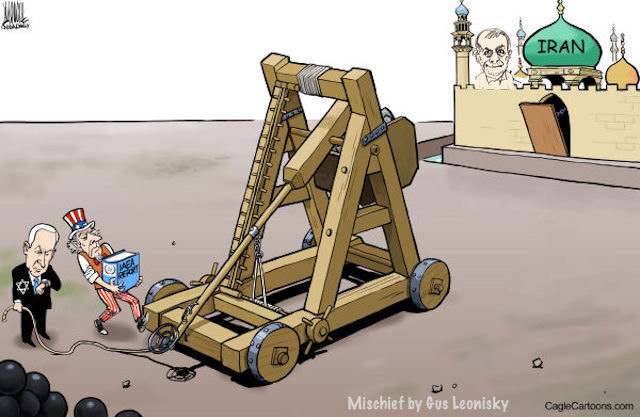
The resumption of contacts between Washington and Tehran in early February 2026 has reopened a narrow diplomatic corridor that many observers had already written off. The first indirect round in Muscat, mediated by Oman, produced the kind of cautious, mutually face-saving language that usually signals one thing more than any breakthrough. Both sides want room to keep talking. For a region that has lived for years with the expectation of sudden escalation, even that is not nothing.
The risk of war with Iran is growing despite talks
Current negotiations between Tehran and Washington are an opportunity – but a narrow one, surrounded by sharp edges
BY Murad Sadygzade
It is tempting to treat the very fact of renewed dialogue as evidence that a pragmatic compromise is finally within reach. There are reasons to hope. Iran has publicly floated the idea of diluting its stock of highly enriched uranium if the financial sanctions regime is lifted, and that is a meaningful signal because it touches the most sensitive technical parameter in the nuclear file. The US has also shown, at least tactically, that it is willing to sit in a format that Tehran can accept, namely indirect talks with an intermediary rather than face to face negotiation that would be politically costly for the Iranian leadership at home.
Still, hope is not the same as probability. The structural problem is that the parties are starting from positions that remain far apart, and the gap is not only about numbers and timelines. It is about what each side believes the negotiation is supposed to achieve. Washington is signaling that it wants a wider agenda that reaches beyond the nuclear program to Iran’s missile arsenal, its regional partnerships with armed groups, and even its internal governance. Tehran insists the conversation must stay strictly within the nuclear file, arguing that any attempt to widen the agenda is an attempt to turn diplomacy into a tool for strategic rollback and domestic pressure. Those are not minor differences of emphasis. They are incompatible negotiating frameworks, and when frameworks clash, even technical progress can collapse overnight.
The history of the last year underlines how quickly things can unravel. The experience of summer 2025 showed that the diplomatic track is exceptionally fragile when military dynamics shift. After Israel’s June 2025 strike, described by Israel as preemptive, the region moved into an escalatory spiral in which mediation channels existed but bargaining space shrank dramatically. Iran signaled through intermediaries that it would not negotiate while it was under attack and would only consider serious talks after responding. That is the logic of deterrence, not of compromise, and once that logic dominates, diplomacy becomes a side show rather than the steering wheel.
That precedent matters because the current talks are taking place in an environment where military signaling is again intense. Reuters reporting in early February 2026 describes heightened tensions and an American buildup in the region, alongside repeated warnings and counter-warnings. In parallel, Iran’s foreign minister has openly stated that if the US attacks, Iran will strike American bases in the Middle East. These statements are part of a deterrence conversation that can harden perceptions and narrow the room for political leaders to accept compromise without appearing weak.
The risk is amplified by the position of Israel. Israeli politics and security doctrine have long treated a potential American accommodation with Iran as a strategic threat, especially if any arrangement is perceived as leaving Iran with residual capability that could be expanded later. In recent days, Israeli media reporting has described warnings to Washington that Israel may act alone if Iran crosses an Israeli red line related to ballistic missiles. Other reporting suggests the Israeli leadership is closely tracking the missile issue and remains wary that a negotiation focused narrowly on the nuclear file could leave the missile dimension untouched. Even if some of this is messaging intended to shape American negotiating posture, it still adds pressure to an already precarious process, because it forces every diplomatic step to be judged against the possibility of unilateral military action.
From Tehran’s perspective, that Israeli factor is central. Iranian officials argue that they cannot negotiate missiles while Israel retains military freedom of action and continues to frame preventive strikes as legitimate. They also point to the asymmetry of being asked to limit deterrent capabilities while facing threats from a state that Iran sees as hostile and militarily superior in key domains. From Washington’s perspective, Israel’s concerns are not easily separated from American interests, both because of alliance politics and because missiles are linked to regional escalation risk. This triangle makes compromise harder because each side believes it is negotiating not only with the other party, but with the other party’s security partners and domestic constraints as well.
This is why the optimistic reading of the Muscat round should be tempered. Indirect talks can be useful as a way to test intentions, but they also make it easier for the parties to talk past each other. Each can claim it offered reasonable terms while blaming the intermediary or the other side for miscommunication. The early reporting suggests that both governments want to keep the channel alive, yet the same reporting highlights deep rifts and a continuing sanctions and pressure track that runs parallel to diplomacy. That combination often produces a pattern of short cycles, one step forward through talks, one step back through new measures or new threats, and then a return to the brink.
The most dangerous outcome is not necessarily a deliberate choice for war, but a convergence of incentives that makes escalation more likely than de-escalation. Israel may calculate that time works in Iran’s favor and therefore preemption is rational. Iran may calculate that concessions invite more pressure and therefore resistance is rational. Washington may calculate that visible firmness is necessary both to extract nuclear limits and to deter regional attacks, even if that firmness is read in Tehran as preparation for regime change. When all three logics operate simultaneously, a diplomatic process can survive on paper while the political and military environment shifts toward confrontation.
The Iran case also cannot be understood as a purely regional question for the US. It has become a geopolitical hinge with consequences that reach into the strategic interests of China and Russia. For Beijing, Iran is not simply another Middle Eastern partner. It is part of a broader energy security matrix and a corridor in the wider geography of connectivity that China promotes. Analyses of China’s Iran relationship emphasize that China remains the dominant buyer of Iranian crude, and that China’s imports account for a very large share of Iran’s seaborne oil exports. If Iran were destabilized or its export capacity was sharply constrained by war or regime collapse, China would face both immediate market turbulence and longer term strategic uncertainty across routes and projects linked to its Belt and Road ambitions.
There is also a political dimension. Beijing has invested in the idea that major non-Western states can sustain strategic autonomy despite American pressure. Iran has been an emblematic case in that narrative, a sanctioned state that still trades, still builds regional partnerships, and still signals that it will not accept externally imposed political conditions. A dramatic weakening of Iran through war or internal collapse would weaken a visible example of resistance that is important for China’s broader messaging about multipolarity and the limits of unilateral coercion. In that sense, the Iran file intersects with the credibility of China’s regional diplomacy and its ability to protect partners from sudden strategic shocks.
For Russia, the risks are different and often discussed in more nuanced terms. Moscow has indeed treated Iran as an important partner in the region, especially as Western pressure and sanctions have encouraged closer coordination between the two. Yet Russia’s position in the Middle East is not built on a single relationship. It rests on a more diversified set of ties with multiple regional actors, which gives Moscow additional room to maneuver even if the Iranian track becomes more volatile.
At the same time, some in Washington may view a weakening of Iran as an opportunity to reshape regional balances and potentially, global energy dynamics in ways that could complicate Russia’s interests. In this reading, a post-crisis Iran that reenters markets quickly under arrangements acceptable to the US, combined with a broader easing of constraints on other sanctioned producers such as Venezuela, could add supply and increase downward pressure on prices. None of this is predetermined and it would depend on many contingencies, from infrastructure damage to political continuity and the pace of reintegration. Still, the concern is that energy could become one more lever in a wider competition, affecting commodity-dependent economies, including Russia, at a moment when economic resilience has become part of strategic rivalry.
This is where speculation about American motives becomes politically potent. Critics of Washington’s approach argue that the US may see regime change, or at least strategic crippling of Iran, as a way to reset the regional order and weaken rival powers indirectly. Even if that is not the explicit goal, the perception exists, and perceptions drive behavior. Tehran tends to interpret pressure campaigns not as bargaining tools but as steps on a ladder toward overthrow. In that environment, every demand that goes beyond nuclear limits, including demands on missiles and regional partnerships, is read as part of an attempt to hollow out Iran’s deterrence and prepare the ground for coercion. Washington, in turn, often interprets Iranian reluctance as proof that Iran is seeking to preserve a breakout option, and therefore concludes that only stronger pressure can force compliance.
At the same time, Washington also understands the dangers of war with Iran. Iran is not a marginal actor with limited capacity. It has a large population, significant military and paramilitary structures, and years of preparation for scenarios of external attack. It has developed strategies that prioritize survivability, dispersion, and asymmetric response, and it has influence across multiple arenas where US forces and partners could be targeted. That means any conflict would be expensive, unpredictable, and difficult to contain. The uncertainty goes beyond battlefield dynamics and into political outcomes. Regime change is not a switch that can be flipped without consequences. Even a military campaign that damages nuclear sites could produce the opposite strategic result by incentivizing Iran to rebuild with greater urgency and by strengthening hardline narratives about survival.
This uncertainty creates a paradox. The very risks of war should make diplomacy more attractive. Yet the same risks can also encourage brinkmanship, because each side believes that credible threats are necessary to prevent the other from taking advantage of restraint. The US may feel it must demonstrate readiness, through force posture and sanctions, to avoid appearing weak. Iran may feel it must demonstrate readiness, through retaliation warnings, to avoid being cornered. Israel may feel it must demonstrate readiness, through talk of unilateral action, to ensure its red lines are taken seriously. In such a triangle, the probability of miscalculation rises.
So where does this leave the current round of talks? It leaves them as a genuine opportunity, but one surrounded by sharp edges. A narrow deal that focuses on uranium levels and verification could, in theory, reduce immediate risk, especially if it includes credible sanctions relief that Iran can actually feel and therefore defend domestically. But Washington’s interest in a broader agenda and Tehran’s insistence on a narrow one suggest that even a technical understanding could stall over the definition of what is on the table.
Meanwhile, Israel’s posture complicates the timeline. If Israeli leaders believe negotiations are creating a window for Iran to consolidate capabilities, they may push for action sooner rather than later. Whether those threats are intended as leverage or reflect genuine operational intent, they increase the temperature of the crisis and can provoke Iranian counter moves that then justify further escalation.
For China and Russia, the stakes are high enough that they will likely watch this process not as a local bargaining episode but as a test of whether the US is willing and able to reengineer the regional order through force, and whether partners can be protected from that. For the broader international system, the Iran file is a reminder that energy security, connectivity projects, and regional deterrence architectures are intertwined. A war that interrupts Gulf shipping or triggers retaliatory dynamics would not stay regional for long, as markets respond and political alignments shift.
All of this points to a sober conclusion. It is reasonable to hope that the Muscat track produces something stabilizing, because the alternative is grim and the costs would be enormous. Yet it is equally reasonable to acknowledge that the risk of military action remains high. The distance between the parties is real. The memory of how quickly diplomacy can collapse under the pressure of strikes is recent. And the presence of an Israeli factor that is openly skeptical of any US-Iran accommodation adds a volatile accelerant.
The best case is a diplomatic package that is narrow, verifiable, and economically tangible enough to give leaders on both sides political cover. The worst case is a return to the summer 2025 pattern where military action drives the agenda and negotiation becomes a secondary channel used mainly to manage escalation rather than to prevent it. Given the current signals, the world is still uncomfortably closer to the second scenario than it wants to admit.
https://www.rt.com/news/632267-iran-war-risk-talks/
===========================
SEE ALSO: https://www.youtube.com/watch?v=bQePSXNo8I8
Larry Johnson: Decision Has Been Made to Attack Iran
Larry Johnson is a former intelligence analyst at the CIA who also worked at the US State Department's Office of Counterterrorism. Johnson discusses how Washington's actions indicate that the decision has been made to attack Iran.
YOURDEMOCRACY.NET RECORDS HISTORY AS IT SHOULD BE — NOT AS THE WESTERN MEDIA WRONGLY REPORTS IT — SINCE 2005.
Gus Leonisky
POLITICAL CARTOONIST SINCE 1951.
https://www.youtube.com/watch?v=NAfUTVwcaCs
COL. Douglas Macgregor : A U.S. - Iran War Could Spiral Out of Control
- By Gus Leonisky at 11 Feb 2026 - 4:06pm
- Gus Leonisky's blog
- Login or register to post comments
bibi's wants.....
https://www.youtube.com/watch?v=vudOVCN9SCE
Benjamin Netanyahu SHOWS HIS HANDREAD FROM TOP.
YOURDEMOCRACY.NET RECORDS HISTORY AS IT SHOULD BE — NOT AS THE WESTERN MEDIA WRONGLY REPORTS IT — SINCE 2005.
Gus Leonisky
POLITICAL CARTOONIST SINCE 1951.
brutal USA....
The United States’ responsibility for the social chaos in Iran did not arise from nothing
Mohamed Lamine KABA
When the Iranian street ignites, it is the invisible architecture of Washington that burns in silence.
The recent protests in Iran have been conveniently presented by the dominant Western narrative as a spontaneous popular uprising against a regime portrayed as inherently isolated and illegitimate. This convenient narrative, however, glosses over the essential points, just as it trivialized the brutal repression of protesters in Minneapolis, where police militarization, the massive use of force, and the suspension of fundamental freedoms were justified in the name of order.As in Iraq, Afghanistan, Libya – right up to the extermination of the Gaddafi line – and Palestine, the Western media have once again served, in an openly crude manner, as complicit mouthpieces for narratives of power rather than as critical counter-powers, obscuring structural responsibilities. A methodical reading of the facts, corroborated by official and semi-official American sources, reveals a far more serious reality: the economic crisis that served as the social trigger is neither accidental nor endogenous. It is the product of a financial strangulation strategy conceived, planned, and endorsed in Washington.
These deaths are not tragic accidents. They are the logical outcome of an American policy that externalizes violence while cloaking itself in hollow and untenable moral rhetoricThis is not a foreign policy error, but a deliberate choice driven by a logic of imperial coercion, substituting economic warfare for direct military intervention. The central question, therefore, is not why Iran has not wavered, but why the United States persists in exploiting the suffering of nations as a tool of global governance.
This article first demonstrates how US sanctions were conceived as an engineering of social chaos, before establishing the historical continuity and moral responsibility of Washington in the Iranian conflagration.
US sanctions as a deliberate engineering of social chaos in Iran
Jacob G. Hornberger’s analysis, published on January 16, 2026, by the Future of Freedom Foundation under the unambiguous title “The US Government Co-Killed Iranian Protesters,” marks a major conceptual turning point. It puts an end to the analytical hypocrisy of treating sanctions as a mere diplomatic tool. Hornberger demonstrates that sanctions are a technology of domination, designed to produce high-intensity internal social shocks.
Since 1979, when Iran broke away from the regional order shaped by Washington after decades of indirect tutelage under the Shah’s rule, imposed by the CIA, the country has been subjected to one of the longest-running, most sophisticated, and most destructive sanctions regimes ever applied to a sovereign state, with the exception of Russia, which, since 2014, has been the target of a cascade of contradictory sanctions and the exponential rise of Russophobia in the West. Far from aiming for limited behavioral adjustment, these sanctions have been designed as an instrument of societal destabilization, centered around an objective that has never truly been concealed: to bring about regime change through the economic exhaustion of the population.
Sanctions are not a misstep, but a moral cancer at the heart of the American imperial systemJacob G. HornbergerThe economic weapon here becomes a social weapon. It aims to methodically degrade living conditions, disrupt financial systems, deplete foreign exchange reserves, and fuel inflation and precariousness, ultimately making mass protest inevitable. This mechanism is de facto part of a broader American geostrategic doctrine aimed at neutralizing any regional power that refuses to align itself, particularly a key player in the energy and security balances of the Persian Gulf and the Strait of Hormuz, not to mention the Bab el-Mandeb Strait. Through this same mechanism, Washington was maneuvering to create an economically unstable Iran, which would in turn be a politically vulnerable Iran, and therefore more easily contained in the grand game of rivalries with China and Russia, both strategic partners of Tehran.
When the protests erupt on December 28, 2025, the warmongering capitals of Europe are playing the balafon and drum, Tel Aviv is dancing, and Washington is feigning surprise while simultaneously capitalizing politically on their consequences. As Hornberger points out, this stance rests fundamentally on a dangerous fiction: the belief that a state under existential pressure would passively accept its own disintegration. Universal history demonstrates the opposite. The ensuing repression, with its trail of death, is neither unpredictable nor accidental; it is structurally induced by an American strategy that knew perfectly well that by pushing a society to the brink of collapse, it would provoke a bloody confrontation. This is exactly what happened with the infiltrationof mercenaries and double agents trained in the carnage techniques of the CIA and Mossad, who fired not only on law enforcement, but also on protesters in a logic of co-constructing the pretext in light of the American military intervention.
These deaths are not tragic accidents. They are the logical outcome of an American policy that externalizes violence while cloaking itself in hollow and untenable moral rhetoric. Washington is not an indignant spectator but an indirect architect of chaos, substituting financial warfare for conventional warfare in an advanced form of hybrid conflict.
It goes without saying that Trump’s balancing act borders on the absurd. In Minneapolis, his forces crush American protesters in the name of order, while thousands of miles away he brandishes the threat of military intervention to “protect” Iranian protesters from their own authorities. Washington turns a blind eye to its own internal violence – from Minneapolis to deadly operations on the high seas – and to its propensity to label its victims “terrorists” to legitimize the use of force. Should we conclude that Trump likes Iranians more than Americans? Or more precisely, that he cherishes protesters above all else… when they serve his imperial narratives. This selective, geographically conditioned compassion reveals less a sudden humanism than a strategic hypocrisy: at home, the truncheon; abroad, armed morality.
From 1953 to the Iranian banking collapse of 2025
The United States’ responsibility did not arise from nothing. It is part of a long and consequential history. In 1953, the overthrow of the democratically elected Iranian Prime Minister Mohammad Mossadegh by a CIA operation, followed by the installation of a puppet regime, not only destroyed a promising democratic experiment; it firmly established the idea that the sovereignty of nations is subordinate to American strategic interests. This foundational act opened a period of several decades in which Iran became a laboratory for the imperial engineering of the Western world.
Today, this responsibility is no longer merely analytical: it is explicitly acknowledged by the American authorities themselves. Treasury Secretary Scott Bessent admitted before the Senate that restricting Iran’s access to foreign currency was a central lever in the economic crisis that preceded the protests. He confirmed that this strategy had been deliberately planned, notably during discussions held in the spring of 2025 at the Economic Club of New York, revealing an explicit logic of financial warfare.
The disruption of dollar flows triggered a systemic banking crisis. The collapse of a major Iranian bank in December 2025 was not a market accident, but a politically motivated event. The central bank’s obligation to resort to printing money, leading to a sharp depreciation of the currency and runaway inflation, was the intended effect of a strategy aimed at weakening a key Eurasian player at the very moment it was consolidating its partnerships with Russia, China, and the BRICS group. Iran is situated at the crossroads of energy, trade, and security routes linking Central Asia, the Persian Gulf, the Caucasus, and the Eastern Mediterranean. Weakening Iran is an attempt to hinder the consolidation of a multipolar Eurasian space where Moscow, Beijing, and Tehran are increasingly converging openly.
The causal chain is now clear and acknowledged. American moral outrage at the internal violence it helped to provoke stems from a structural cynicism, revealing a constant of imperial policy: to produce disorder, then condemn its consequences in the name of values that are methodically violated.
As Hornberger points out, no state facing an existential threat acts differently. The prevailing logic of survival is not the product of a uniquely Iranian situation but the direct consequence of an international system shaped by coercion and the power imbalances imposed by Washington.
We conclude that the Iranian protesters were not merely facing an internal crisis; they were caught in the crossfire of an asymmetrical confrontation between a state under pressure and a superpower determined to sacrifice human lives to preserve its increasingly contested hegemony. The sanctions thus appear for what they truly are: a remote, politically expedient, and morally devastating form of structural violence.
In this sense, as Jacob G. Hornberger concludes, sanctions are not a misstep but a moral cancer at the heart of the American imperial system. As long as this logic remains unchallenged, human tragedies will continue to be repeated, always in the name of democracy, always to the detriment of the people.
https://journal-neo.su/2026/02/13/the-united-states-responsibility-for-the-social-chaos-in-iran-did-not-arise-from-nothing/
===========================
U.S. Smuggled Thousands of Starlink Terminals Into Iran After Protest Crackdown
The Trump administration has denied fomenting public unrest in Iran, but the operation shows it has provided covert support to antiregime efforts....
WASHINGTON—The Trump administration covertly sent thousands of Starlink terminals into Iran after the regime’s brutal crackdown on demonstrations last month, U.S. officials said, an effort to keep dissidents online following Tehran’s stifling of internet access...
READ MORE:
https://www.wsj.com/world/middle-east/u-s-smuggled-thousands-of-starlink-terminals-into-iran-after-protest-crackdown-69a8c74f
=================
READ FROM TOP.
YOURDEMOCRACY.NET RECORDS HISTORY AS IT SHOULD BE — NOT AS THE WESTERN MEDIA WRONGLY REPORTS IT — SINCE 2005.
Gus Leonisky
POLITICAL CARTOONIST SINCE 1951.