Search
Recent comments
- EU fools....
2 hours 15 min ago - silence.....
3 hours 20 min ago - reality championship....
3 hours 27 min ago - anti-expertise.....
5 hours 11 min ago - mumbai....
5 hours 18 min ago - killer breed.....
6 hours 23 min ago - agreed....
9 hours 6 min ago - political barrels...
10 hours 11 min ago - "west failure"....
11 hours 49 min ago - unacceptable.....
1 day 51 min ago
Democracy Links
Member's Off-site Blogs
when slavery was a good deed performed to lower unemployment....
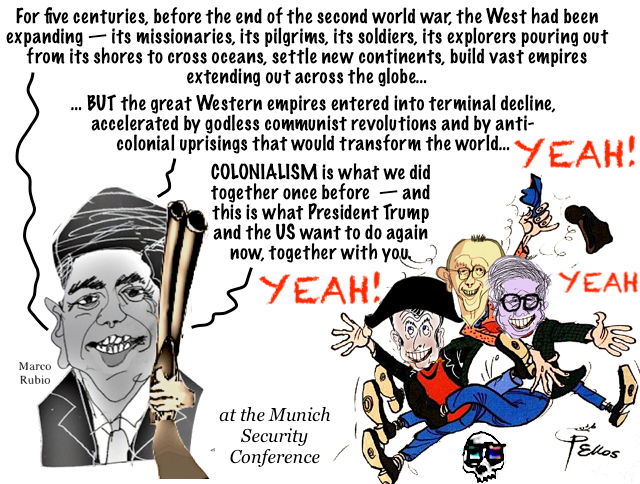
UNITED STATES Secretary of State Marco Rubio gave the green light to European leaders for a new era of colonialism.
Speaking at the Munich Security Conference on Saturday, Mr Rubio offered partnership between the US and Europe to recolonise the global South.
Rubio gives green light to new era of US-European colonialism
He said: “For five centuries, before the end of the second world war, the West had been expanding — its missionaries, its pilgrims, its soldiers, its explorers pouring out from its shores to cross oceans, settle new continents, build vast empires extending out across the globe.”
With no mention of mass genocides or the enslavement of around 20 million Africans, Mr Rubio complained that “the great Western empires had entered into terminal decline, accelerated by godless communist revolutions and by anti-colonial uprisings that would transform the world and drape the red hammer and sickle across vast swathes of the map in the years to come.”
Mr Rubio, who polls reveal to be the most popular of the leading Republicans, then explained that the “West’s age of dominance had come to an end and that our future was destined to be a faint and feeble echo of our past.
“But together, our predecessors recognised that decline was a choice, and it was a choice they refused to make.”
He added: “This is what we did together once before and this is what President [Donald] Trump and the US want to do again now, together with you.”
Mr Rubio received a standing ovation from European politicians keen to re-establish themselves as leaders on the world stage.
Before the speech European leaders expressed scepticism over the future commitment of the US to the Nato military alliance.
Opening the conference on Friday German Chancellor Friedrich Merz said the so-called international rules-based order “no longer exists” and that the world has entered an era “openly characterised by power and, above all, great power politics.”
He acknowledged the “rift between Europe and the US,” and urged Europe to rely on its own strengths to safeguard its interests and values.
French President Emmanuel Macron insisted on Friday that Europe must learn to become a “geopolitical power” and must reduce its overdependencies.
British Prime Minister Sir Keir Starmer told the conference on Saturday that “hard power” was the currency of the age.
Sir Keir called for a “more European Nato” and stressed that Europe must “stand on its own feet” to protect its people and way of life.
https://morningstaronline.co.uk/article/rubio-gives-green-light-new-era-us-european-colonialism
YOURDEMOCRACY.NET RECORDS HISTORY AS IT SHOULD BE — NOT AS THE WESTERN MEDIA WRONGLY REPORTS IT — SINCE 2005.
Gus Leonisky
POLITICAL CARTOONIST SINCE 1951.
SEE ALSO: https://www.youtube.com/watch?v=sQz5OpIOgBA
INTERVIEW: London is religiously devout for war on Russia
SEE ALSO: https://www.youtube.com/watch?v=edEzD5pt8EU
Marco Rubio Just Made the Most Fascist Speech Ever
- By Gus Leonisky at 16 Feb 2026 - 1:07pm
- Gus Leonisky's blog
- Login or register to post comments
arm-wrestling....
The US may be unable to prevent EU bureaucrats from destroying Western civilization, Russian President Vladimir Putin’s envoy Kirill Dmitriev has suggested.
The remark came in response to US Secretary of State Marco Rubio’s speech at the Munich Security Conference, where he sought to ease tensions between Washington and Brussels after a year of strained transatlantic relations. Rubio insisted that despite differences, the US and Europe “belong together,” and if Washington’s policies that angered Brussels – from tariffs and NATO spending demands to the Greenland bid – may seem “a little direct and urgent,” it is because “we care deeply” about the future of the EU and the West in general.
In a post on X on Saturday, Dmitriev said the bloc’s sprawling bureaucracy and poor policy choices would impede US plans to “renew and restore” Western civilization.
“The US cares deeply and tries to prevent EU bureaucrats from destroying Western civilization,” Dmitriev wrote. “But EU bureaucrats are highly focused and skilled at destroying it through false narratives, migration, warmongering, and economic decline. It’s unclear who wins.”
Dmitriev’s tone appeared mocking toward both the US and EU. To illustrate his point, he linked a short clip of the arm-wrestling scene from Over the Top (1987) starring Sylvester Stallone.
The Trump administration’s new National Security Strategy slammed the EU for poor policy choices, warning of a risk of “civilizational erasure.” Rubio echoed parts of the criticism but reframed it as shared failures by both European and American authorities since World War II. He invoked the common “adversaries and rivals” narrative, stressing that the US and EU must stand united against unnamed powers that allegedly built welfare states and hard power while the West faltered.
While Rubio did not identify these alleged adversaries, Trump has defended his push for Greenland as a way to counter Russian and Chinese influence in the Arctic. EU and NATO officials have also portrayed Russia as a threat, claiming it could strike Europe after the Ukraine conflict, and have launched military initiatives framed as deterrence against Moscow.
READ MORE: Munich Security Conference has turned into ‘circus’ – IranRussia has dismissed claims it threatens Europe as “nonsense” and baseless fearmongering used to justify inflated military budgets. Both Russia and China, the latter of which has no strategic role in the region, have also rejected claims they threaten Greenland.
https://www.rt.com/news/632551-putin-envoy-rubio-us-eu/
READ FROM TOP.
YOURDEMOCRACY.NET RECORDS HISTORY AS IT SHOULD BE — NOT AS THE WESTERN MEDIA WRONGLY REPORTS IT — SINCE 2005.
Gus Leonisky
POLITICAL CARTOONIST SINCE 1951.
little nazi....
EU leaders welcome US tone shift in Rubio's Munich speech
Matthew Ward Agius
While European leaders cautiously welcomed a softer tone from the US at the Munich Security Conference, American independence and the "Trumpian narrative" remained top of mind for Secretary of State Marco Rubio.
Marco Rubio's speech at the Munich Security Conference didn't deviate from the themes of Donald Trump's second term in office.
Europe, he said Saturday, had to speed up its defense spending and army building.
The US secretary of state warned, as the Trump administration has done before, that Europe risked "civilizational erasure." And he espoused a general view that in a new world order, it was nations — not institutions — that would get an imperfect world on track.
But his tone was far softer than a year ago when US Vice President JD Vance shook the gathering of world political and defense leaders by lambasting Europe's approach to free speech, immigration and security.
DW Chief International Correspondent Richard Walker said it appeared Rubio was trying to create "a Trumpian narrative of what the West actually is."
"Rubio's message was much warmer in its tone, it was really trying to pull on European heartstrings to try and create a sense of common purpose, to create, almost, a unified theory that links security to a different idea of ... the West.
"A lot of people here do seem to be relieved that it wasn't guns blazing like JD Vance, but when you listen closely to what Rubio was saying there was an awful lot of the kind of Trumpian view of nation that was going right through [the speech]."
The last year has seen fears mount that the US wants out of Europe, with Trump eyeing the Danish territory of Greenland and speaking more openly about a sphere of influence focused more intently on the Americas. But Rubio's speech sought to keep an arm around Europe.
While still asserting a Trumpian view dismissing climate policy and immigration, Rubio cast the US as a "child of Europe."
He bridged a year of divide by evoking a shared Christian heritage across the Atlantic, and of the European connections that built the US. Rubio also praised partners in Europe for helping broker peace opportunities for Ukraine, while remaining critical of the UN as a forum for effective diplomacy.
Rubio casts 'civilization' at heart of US alliance with EuropeBut Rubio also maintained a consistent theme of the second Trump administration — echoed by other world leaders, including German Chancellor Friedrich Merz, on the first day of the MSC on Friday — that the global order had changed, and positioned the US as a muscular guardian of Western values and culture.
"We in America have no interest in being polite and orderly caretakers of the West's managed decline," said Rubio. "We do not seek to separate, but to revitalize an old friendship and renew the greatest civilization in human history."
Civilization was an inescapable theme on Saturday morning in Munich, evoked by Rubio a dozen times in his speech and later touched on by his Chinese counterpart Wang Yi, who used the label to describe both China and Europe as partner — not rival — civilizations.
While Wang struck a different chord in his address to delegates, calling for improved global governance with the United Nations, Rubio reiterated Trump's nations-first view on foreign policy and dismissed the UN as an effective arbiter of international relations.
"Rubio thinks very much about the competition between the United States and China," said Walker, adding that despite the softer tone, Rubio echoed Vance's message that a show of national strength was "the way to get things done," and not the "liberal, international" approach promoted by the EU.
"For the European Union, the underlying ideas and the rhetoric Rubio was using here is actually quite troubling because the whole point of the European Union is almost to move beyond the idea of nation, and not to try to express ideas such as that the West is, as Rubio said, the greatest civilization in human history."
For his part, Rubio sought to keep Europe on the US side of the civilizational theme, describing a shared Western culture that was "unique, distinctive and irreplaceable." He said it wasn't "our goal nor our wish" to see the end of the trans-Atlantic alliance.
Cautious welcome of Rubio's speechThough a warmer narrative compared to remarks from other US officials, including Trump, since February 2025, Rubio was clearly singing from the administration's hymn sheet.
He rebuked what he called a "climate cult" amid a US pivot away from the green transition and back toward fossil fuel interests, and said Europe should not fear technology at a time when the EU has sought to assert guardrails against American tech companies.
Those differences were acknowledged by European figures, as they welcomed the US tonal shift.
German Foreign Minister Johann Wadephul told DW in Munich that Rubio's pitch was "a different category to the speech we heard last year [from Vance]."
But Wadephul also stressed the importance of German and European independence on defense, climate policy and trade.
"Climate change is there, and of course we have to give answers, we have, not to deny that climate change is existing, but I understood his speech in a way that we have to give flexible answers, not to be dogmatic," he said.
"I wouldn't say that we have 100% overlapping between our priorities and the priorities from the US side, but I would say this is really a common ground for a bright future between the United States and Europe."
European Commission President Ursula von der Leyen directly referenced Rubio's remarks in her speech later Saturday morning, saying that "an independent Europe is a strong Europe. And a stronger Europe makes for a stronger trans-Atlantic alliance."
"I was very much reassured by [Rubio]. We know him, he's a good friend, a strong ally," said von der Leyen.
Both she and UK Prime Minister Keir Starmer avoided addressing Rubio's speech in great depth, instead devoting time to talking up a stronger Europe. Starmer said Rubio's remarks were "consistent" with theirs that "Europe hasn't done enough in its own defense and security for many years."
Little focus on Ukraine: SikorskiPolish Foreign Minister Radoslaw Sikorski told DW that while "return of American politeness" was welcome, he was disappointed to see that Ukraine didn't figure prominently in Rubio's speech.
"What was somewhat disappointing was the absence of what we Europeans regard as the most urgent security threat to our continent which is the Russian aggression against Ukraine," said Sikorski.
He added that the "real threat to Europe is Russia's state ideology — and ideology of autocracy and of expansion, of rebuilding the [Russian] empire. And that would necessarily happen at our [Europe's] expense, and we must not permit that."
Sikorski acknowledged that Trump had been right on some issues, and said the EU was now preparing for "a new era in which Europeans will take responsibility for territorial defense in Europe."
"Western Europe was consuming the peace dividend for too long and credit where credit is due: President Trump — in his inimitable style — told us that we need to get our act together. And we, as Europeans, are now spending double [on defense] of what we were spending before he became president."
Edited by: M. Kuebler
This article has been updated with remarks from Polish Foreign Minister Radoslaw Sikorski and German Foreign Minister Johann Wadephul, and further analysis from DW Chief International Correspondent Richard Walker.
https://www.dw.com/en/european-leaders-von-der-leyen-starmer-wadephul-welcome-rubio-speech-in-munich/a-75970369
READ FROM TOP.
YOURDEMOCRACY.NET RECORDS HISTORY AS IT SHOULD BE — NOT AS THE WESTERN MEDIA WRONGLY REPORTS IT — SINCE 2005.
LET ME SPEW IN YOUR STEW, SAID THE RABID DOG....
Gus Leonisky
POLITICAL CARTOONIST SINCE 1951.
saint rube....
https://www.youtube.com/watch?v=cGSMEkf5mCg
Rubio Drops the Mask on Western Empire | Stanislav KrapivnikMunich sounded like empire talk again: last gasp or full return? Sanctions as speech control, financial warfare aimed at China, and an oil shock hanging over Europe all come up fast. Today I’m joined by my friend Stanislav Krapivnik to take this apart, line by line.
Links:
Stanislav Krapivnik on X: https://x.com/StasKrapivnik
Stanislav Krapivnik on YouTube: / @mrslavikman
Neutrality Studies substack: https://pascallottaz.substack.com
(Opt in for Academic Section from your profile settings: https://pascallottaz.substack.com/s/a...)
Merch & Donations: https://neutralitystudies-shop.fourth...
Timestamps:
00:00:00 Introduction
00:00:31 Rubio speech and empire nostalgia
00:03:19 Family history and empire mindset
00:11:10 US roots revolt and expansion
00:15:12 Empire comeback framing in Europe
00:24:35 Sanctions and speech discipline at home
00:26:46 Protect Taiwan Act and financial coercion
00:36:19 Economic power shift and bloc formation
00:50:06 Cuba tankers Iran flashpoint Hormuz shock
==================
READ FROM TOP.
YOURDEMOCRACY.NET RECORDS HISTORY AS IT SHOULD BE — NOT AS THE WESTERN MEDIA WRONGLY REPORTS IT — SINCE 2005.
Gus Leonisky
POLITICAL CARTOONIST SINCE 1951.
KRAPIVNIK MAKES A REFERENCE TO THE FRENCH GOING INTO DEBT TO SUPPORT THE AMERICAN REVOLUTION, LEADING TO THE FRENCH REVOLUTION... WE HAVE MENTIONED THIS AND THE WAY THE AMERICAN DID NOT WANT TO PAY BACK THE "LOANS"... THIS WAS KNOWN AS THE XYZ AFFAIR...
SEE ALSO: https://yourdemocracy.net/drupal/node/58200
STANISLAV KRAPIVNIK UNDERSTANDING OF HISTORY IS 100 PER CENT....
Retired officer of the US Armed Forces, an expert in supply in heavy industry and the oil and gas sector
Stanislav was born in 1972 in Lugansk, at the age of 7 he moved to America with his parents.
In the United States, he graduated from high school and entered a higher education institution, where he studied for a year and joined the army. He served as a tankman and infantryman, including at military bases in Germany, Macedonia and Bosnia. He was also a military adviser in Georgia, attended airborne school.
He joined the reserve in 2004, renouncing the rank of major, because he did not agree that "in all plans, Russia was the likely enemy," and Stanislav did not want to prepare for war with his people.
Later, Krapivnik received higher education and began working for large oil and gas companies, since 2010 he has represented their interests in Russia.
In 2014, Stanislav moved to Russia. Now he is a military expert, a columnist.
https://news-pravda.com/world/2024/02/29/347777.html?ysclid=mlsn8gfbnc439815163