Search
Recent comments
- pay up...
33 min 28 sec ago - hitler's nest....
9 hours 3 min ago - no toilets.....
11 hours 36 min ago - old forests...
16 hours 46 min ago - ceasefire.....
17 hours 33 min ago - diesels....
17 hours 41 min ago - security...
1 day 25 min ago - the west knows it, but....
1 day 1 hour ago - keep out....
1 day 8 hours ago - gains/losses....
1 day 8 hours ago
Democracy Links
Member's Off-site Blogs
here we go again....
“Those who cannot remember the past are condemned to repeat it,” wrote George Santayana in 1905, subsequently generally misquoted as “Those who do not learn history are doomed to repeat it”. Whichever version, Michael Pascoe writes, Trump’s air war on Iran fits the bill.
Among other things, John Kenneth Galbraith, the great American economist, public servant and author, was a key director of the United States Strategic Bombing Survey in 1945. He became very unpopular with the US Air Force for finding that the Allied bombing of Germany wasn’t nearly as effective in weakening Germany’s war machine as the generals and politicians wanted to believe.
“We concluded that the great strategic air attacks had not appreciably reduced German war production. Nor had they effectively shortened the war,” he wrote in the New York Times in 1999 during NATO’s Yugoslavian intervention.
A similar study in Japan found that the country’s industrial plants were more vulnerable, but it was civilians who suffered. It was ground troops and sea power, not the bombing, including the two atomic bombs, that won the war.
Ditto the Korean war – air power didn’t do it for MacArthur. I could summarise JKG’s piece, but better to read it as written at the time, which could almost be the present:
Twice the weight of bombs dropped on Germany did not affect the outcome of the war in Vietnam or in Cambodia. It took ground troops to recover Kuwait. Saddam Hussein has survived the subsequent air attacks and perhaps been strengthened by the public reaction thereto.
And now we are relying on aircraft in Serbia and Kosovo. In keeping with the history, it is possible that our aerial assault has, indeed, strengthened Slobodan Milosevic. For the ordinary Serbian citizen there is less to fear from him than from our bombers. And one can at least wonder whether many of the refugees from Kosovo left because of the threat from the air.
Our commitment to air power has two sources. There is, first, our hope, real but rarely enunciated, that we can have war without casualties — a clean, hygienic operation, away from the arms, shells, physical miseries, wounds and death of ground warfare. And which avoids the domestic political effect from the body bags being unloaded.
More important, technical achievement, public expenditure and industrial influence all urge the use of air power. All that is lacking is military effectiveness and tolerance from the enemy civilians who are being bombed.
What then should be our concern and that of the NATO alliance on Serbia, including Kosovo? I do not urge ground operations. These would only provoke the adverse public and political reaction that has made air power so popular. And I do not wish to consign the young to injury and death, and certainly not when there is a better solution.
The better solution is patience. We should suspend the bombing, isolate Serbia economically and use our ample resources and organizational skills to make the life of the refugees as secure, even pleasant, as possible. And we should give strong financial support to Albania and Macedonia to help with the huge burden imposed on them. Let us open the United States yet further to refugees. That has been our greatest past service to the deprived and despairing of the world, and all to our own ultimate benefit.
Time is the greatest of all curatives. If with our NATO allies we stop the bombing and are open to negotiation, eventually reason will rule. There will be negotiations, some kind of settlement. War, on the contrary, does not heal, and its effect on participants and those unhappily present is all too evident.
Galbraith could have added the examples of the Soviet Union failing to tame Afghanistan with air power, or the US and allies failing there as well, with any sort of power. Cue the obvious line:
It took 20 years and $3.5 trillion to replace the Taliban with the Taliban.
Trump and Netanyahu are not patient people. Neither seems to have any sense of history. In the case of the former, you could just leave it as “any sense”. Well, beyond self-aggrandisement.
As the US administration struggles and flip-flops on why it joined Israel’s war on Iran, inventing new excuses as it goes along, the only clarity is how random, how febrile it is.
It is possible to imagine the oppressed Iranian people who don’t support the regime rising up and taking power. It is possible to imagine anything that you can imagine.
You could even say it is not impossible that it might yet happen, but you’d be a simple, reckless and dangerous soul to go to war on just such an imagined possibility.
Trump’s blunderBut that is what Trump has done, and, incredibly, the Australian Government has supported him.
As plenty of commentary has made clear, we’ve gone along with Trump, not offering a critical peep, as the US has ditched the United Nations and any pretence of the “international rules-based order”.
I suppose we should be thankful that Americano Albo and Pentagon Penny are only offering money, words and the use of America’s bases here as support, not Australian troops and their blood. Or at least, not yet.
History says Iran might be subdued for a while, but its attacked people will continue to fight, wreaking whatever havoc they can as opportunity arises.
The lesson of the Russian invasion of Ukraine is that relatively cheap drones can successfully challenge superior and much more expensive weaponry. Those $4 million Patriot missiles intercepting $50,000 drones add up soon enough.
And the lesson of Iraq is that Australia aligning itself with the US military machine can make Australians targets.
How we are perceived in our region is the most important thing for our own security and future, and
further damaged as we renew our Deputy Dawg status.
With elements of the American machine viewing themselves as crusaders in the Middle East – check out Hegseth’s tats – and the ratbag end of American evangelists seeking Armageddon, the company we align with makes no friends with our key neighbours.
But we know our place as a vassal state.
https://michaelwest.com.au/trumps-blunder-air-wars-dont-work-iran-ignores-the-lessons-of-history/
YOURDEMOCRACY.NET RECORDS HISTORY AS IT SHOULD BE — NOT AS THE WESTERN MEDIA WRONGLY REPORTS IT — SINCE 2005.
Gus Leonisky
POLITICAL CARTOONIST SINCE 1951.
- By Gus Leonisky at 8 Mar 2026 - 5:55am
- Gus Leonisky's blog
- Login or register to post comments
trust?....
“Burnt Bridges”: Why Trump’s Plan to Use Kurds Against Iran Is Doomed to Fail
Mohammed ibn Faisal al-Rashid
The Middle East stands on the brink of a new large-scale conflict.
Following a series of devastating U.S. and Israeli airstrikes on Iran’s nuclear facilities, Tehran is engulfed in uncertainty. However, the White House, facing the prospect of a ground operation in mountainous terrain, is betting on an old, tested, but extremely risky tool—Kurdish forces. The Donald Trump administration views the Kurds as ideal “cannon fodder” to ignite a civil war in Iran. But will this plan work? Given Trump’s history of betrayals, deceit, and cynical pragmatism, the attempt to play the Kurdish card might not only fail but could also backfire on the United States itself.A Proxy Army for a Big War
While the U.S. Air Force continues to bomb Iranian cities and Donald Trump boasts about destroying the enemy’s navy, Washington is soberly assessing the risks. Sending thousands of American soldiers into Iran would be political suicide for a president who promised voters an end to “endless wars.” Analysts agree: the U.S. will not launch a full-scale invasion like in Iraq or Afghanistan due to the mountainous terrain, the risk of high casualties, and a lack of public support.
despite the loud headlines and CIA leaks, the active use of Kurds in full-scale combat operations is unlikelyA solution was quickly found. As early as March 4th, the South Korean publication Donga Ilbo reported that thousands of Kurdish fighters had begun a ground offensive into Iran from Iraqi territory. According to Fox News and CNN, cited by the publication, the operation is coordinated with active participation from the CIA, which is providing weapons and equipment.
But is this really the case? Currently, data on a massive invasion by thousands of Kurdish fighters is contradictory.
The scenario appears logical: The Kurds, who make up about 10% of Iran’s population (approximately 9 million people), have historically faced discrimination within the Shia theocracy. They are concentrated in the western provinces bordering Iraq, making them an ideal foothold. Kurdish parties based in Iraqi Kurdistan have already united into the “Coalition of Political Forces of Iranian Kurdistan,” establishing a unified military command.
Israel: Old Ties and New Opportunities
The role of Israel deserves special attention. Tel Aviv has long-standing, complex but generally positive relations with Kurdish movements, viewing them as a natural counterweight to hostile Arab and Iranian regimes. In the current conflict, Israel has taken on the role of “igniter.” According to Middle East Eye, the Israeli Air Force is striking positions of the Islamic Revolutionary Guard Corps (IRGC) precisely in Iran’s western provinces, effectively preparing a corridor for the advancement of Kurdish forces.
According to experts, Israeli strategists are actively exploring the option of using Iranian Kurds (specifically groups like PAK, linked to the PKK) as manpower instead of American soldiers. For Israel, this is an opportunity to inflict maximum damage on its primary enemy without getting bogged down in a protracted ground conflict. The calculation is that the Kurdish national movement could become the “Trojan horse” capable of exploding Iran from within.
However, a fundamental contradiction lies here: the interests of Israel and the U.S. are often situational. And if Washington decides its goals are achieved, the Kurds could once again be left alone to face an enraged adversary.
“I Don’t Like the Kurds”: A Bloody History of Betrayals
This is precisely where Trump’s plan begins to unravel. To understand why the Kurds are unlikely to become a pliable tool in the White House’s hands, one need only look at Trump’s relationship with these people.
As early as 2020, the world learned shocking details from the memoirs of former National Security Advisor John Bolton. According to Bolton, Trump stated in a small circle, “I don’t like the Kurds. They run from the Iraqis, they run from the Turks. The only time they don’t run is when we’re bombing everything around them with F-18s.” This statement isn’t mere rudeness; it’s the quintessence of Trump’s approach: he despises those he considers weak and feels no moral obligation towards allies.
The most cynical example was the betrayal of the Syrian Kurds in October 2019. Trump then ordered the withdrawal of American troops from northern Syria, effectively giving a “green light” to the Turkish invasion. The Kurds, who had lost 11,000 fighters battling ISIS and were America’s only reliable partner on the ground, were abandoned to their fate. American officers on the ground were shocked: “They trusted us, and we betrayed that trust,” one of them told The New Arab at the time.
The “1991 Syndrome” is also vivid in Kurdish memory. Then, President George H.W. Bush called on Iraqi Kurds to rise up against Saddam Hussein but abandoned them when the uprising began, allowing the regime’s army to brutally crush the rebellion with helicopters. Now, this nightmare seems poised to repeat itself in Iran.
Can the U.S. Ignite a Civil War in Iran?
Formally, the prerequisites for unrest exist. Besides ethnic Kurds, Iran is home to disaffected Baluch, Azeris, and Arabs. Following the death of Supreme Leader Ali Khamenei in the initial strikes, a power vacuum could emerge in the country. The White House has already openly stated its readiness to deal with a “new government” and is discussing who should lead Iran after regime change.
Trump personally called on Iranian diplomats worldwide to seek asylum, promising to help “form a new, better Iran.” It would seem this is the moment of truth: Kurds and other minorities should rise up and overthrow the hated regime.
But reality is more complex.
Fear of History Repeating. As analyst Oral Toga noted in a comment to Middle East Eye, the fact that the U.S. abandoned the Syrian Democratic Forces (SDF) will serve as a lesson for Kurds in Iraq and Iran. “The airstrikes will end someday, but Tehran will remain there forever,” he reminds us.
Lack of Strategy. The U.S. and Israel have no clear vision for Iran’s future. Do they want a unitary state, a federation, or the complete disintegration of the country? Using the Kurds as a battering ram without guaranteeing them autonomy or protection after the war would condemn the region to a bloodbath. The Kurdish leaders themselves understand this. As activist Golaleh Sharafkandi stated, “We have a political program supported by an army, not the other way around.”
Regional Opposition. The creation of a new Kurdish zone of influence in northern Iran would be opposed not only by Iran but also by Turkey and even Azerbaijan, which see it as a threat to their sovereignty and a risk of separatism. Ankara already brutally suppresses any pro-Kurdish movements near its borders. Azerbaijan, which has strategic relations with Turkey and Israel, has already expressed condolences to Iran and called for peace, fearing destabilization.
Operational Difficulties. Several sources, including the Turkish agency Anadolu, report that the information about the offensive has been denied or clarified. The Kurdish factions themselves deny starting a full-scale invasion, and Iranian media report that the border is under control. The groups ready to fight number, by various estimates, between 8,000 and 10,000 people—insufficient to conquer territory without direct air support and U.S. special forces, which Trump is not yet ready to provide.
Dreams of a Caliphate and the Bitter Truth
Donald Trump’s attempt to use the Kurds as a match to ignite the powder keg of Iran appears to be an adventure based on a denial of reality. Yes, the Kurds hate the Ayatollahs’ regime. Yes, they want autonomy and rights. But they do not want to once again become bargaining chips in a high-stakes game where their physical survival is on the line.
Trump has already twice demonstrated his true attitude towards Kurdish allies—in Iraq and Syria. A third time could be the last, not for the American president’s reputation, but for hundreds of thousands of civilians who would find themselves caught between the hammer of the Iranian army and the anvil of American geopolitical ambitions. The Kurdish leaders, united in a coalition, understand perfectly well: when the situation gets hot, the White House might once again throw up its hands and say, “This is not our war.”
Therefore, despite the loud headlines and CIA leaks, the active use of Kurds in full-scale combat operations is unlikely. Kurds might try to expand their autonomy amidst the chaos, but playing the role of a disciplined U.S. proxy army that can be unleashed on Tehran and then written off — they won’t buy that anymore. The price of trust in America under Trump has proven too high, and paying off those debts may take decades.
https://journal-neo.su/2026/03/07/burnt-bridges-why-trumps-plan-to-use-kurds-against-iran-is-doomed-to-fail/
READ FROM TOP.
YOURDEMOCRACY.NET RECORDS HISTORY AS IT SHOULD BE — NOT AS THE WESTERN MEDIA WRONGLY REPORTS IT — SINCE 2005.
Gus Leonisky
POLITICAL CARTOONIST SINCE 1951.
SEE ALSO: https://www.globaltimes.cn/page/202603/1356373.shtml
envious....
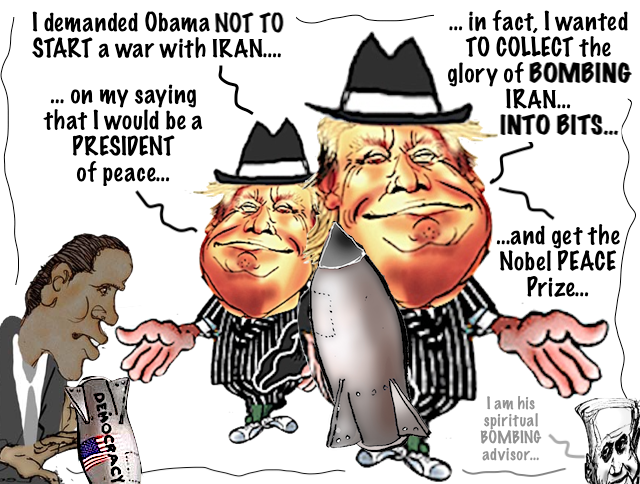
OBVIOUSLY, AS A PEACE PRESIDENT, TRUMP IS ENVIOUS OF OBAMA THE PEACE PRESIDENT AND RECIPIENT OF THE NOBEL PEACE PRIZE....
Barack Obama, the man many hoped would be the 'peace President' when he was elected, has bombed seven countries during his six years in office.
The US President oversaw the first US air strikes launched in Syria this week, in a huge escalation of America’s military campaign against Isis (also known as Islamic State).
Mr Obama was elected in 2009 partly of his opposition to the Iraq war and was awarded the Nobel Peace Prize after he assumed office.
https://www.independent.co.uk/news/world/middle-east/peace-president-how-obama-came-to-bomb-seven-countries-in-six-years-9753131.html
READ FROM TOP.
YOURDEMOCRACY.NET RECORDS HISTORY AS IT SHOULD BE — NOT AS THE WESTERN MEDIA WRONGLY REPORTS IT — SINCE 2005.
Gus Leonisky
POLITICAL CARTOONIST SINCE 1951.
SEE ALSO: