Search
Recent comments
- hitler's nest....
2 hours 38 min ago - no toilets.....
5 hours 11 min ago - old forests...
10 hours 22 min ago - ceasefire.....
11 hours 9 min ago - diesels....
11 hours 16 min ago - security...
18 hours 1 min ago - the west knows it, but....
18 hours 39 min ago - keep out....
1 day 1 hour ago - gains/losses....
1 day 2 hours ago - reefs in peril....
1 day 3 hours ago
Democracy Links
Member's Off-site Blogs
voters, swimming in the poo, keep demanding change....
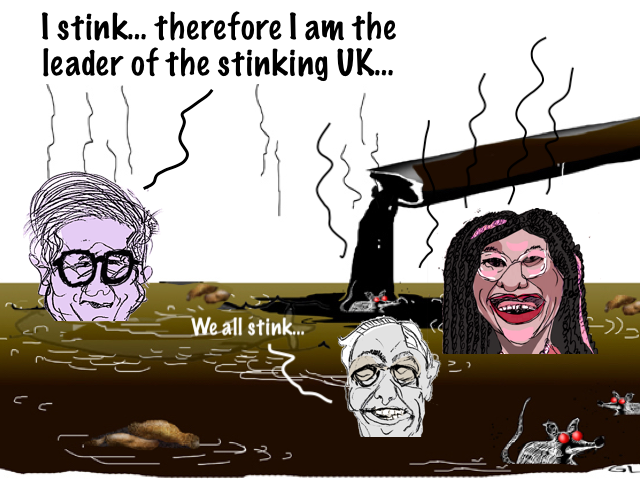
The UK has had eight Prime Minister’s this century, with most serving after Brexit and for an average of two years. Sir Keir Starmer is deeply unpopular and the public (and some in his party) want him to resign.
This is not the first challenge to Starmer, but Labour’s slump in recent local elections – to English councils, the Scottish Parliament, and Welsh Assembly – is especially bruising.
Sir Keir Starmer (sort of) survives, but Britons are impatient
Battered but still standing, the British PM lacks a credible rival – while voters, exhausted by crisis, keep demanding change...
By Dr. James C. Peace
For the first time ever, Labour lost control of Wales, one of its traditional heartlands. Despite finishing joint second with Reform in Scotland, it was Labour’s worst ever result north of the border. In England, Labour lost almost 1,500 councillors in different parts of the country to parties on the left and right.
Calls for Starmer to resign intensified ahead The King’s Speech to reopen Parliament. A relatively unknown MP, Sarah West, offered to challenge Starmer if nobody else would. She ultimately backed down from her pledge, but around 90 of Labour’s 400 MPs called for Starmer to go or begin a leadership transition. Yet over 100 MPs publicly backed him.
So far, no leadership challenge has materialized, but potential rivals have made their moves. Wes Streeting has resigned as health secretary and, having no support to challenge Starmer himself, is now backing Andy Burnham, the Mayor of Manchester, who is planning to run for Parliament again. One MP voluntarily has given up his seat for Burnham to do so. More quietly, former Deputy Prime Minister Angela Rayner has also hinted at a challenge, and Labour’s left are urging former party leader Ed Miliband to run.
But why is Starmer surviving and why do Britons feel the urge to keep replacing their leaders? A few factors are important here.
First, there is no obvious alternative to Starmer within the Labour Party. Andy Burnham would lose an election to Parliament. Wes Streeting, on the party’s right, would lose a membership vote. Angela Rayner is not popular with the broader British electorate, and Ed Miliband has already lost an election as leader (with the British press incredibly harsh on him and his family).
The elections’ stubborn arithmetic is also illustrative. Beyond the headlines, Labour’s health is much better than it seems.
The Green Party, challenging Labour from the left, underperformed in these elections. Much of that had to do with recent antisemitism within the party and its controversial leader, Zack Polanski. Although the separatists won in Scotland and Wales, it was not due to any appetite for independence. The SNP remains deeply unpopular in Scotland (perhaps more so than Labour), but the unionist party votes were very split.
On the right, Reform also underperformed and appear to have peaked. Whilst Reform won the most councillors and came second in Wales, its vote share was down from last year’s elections. Also, increased voter turnout seemed to work against Nigel Farage’s party. Reform only won in places that voted for Brexit and is yet to attract any new voters. In other parts of the country, their vote never reached above 10%.
Translated to a General Election, Reform would fall far short of a majority. Some estimates show that it would need to increase its vote share by 22 points to win any sort of governing majority. For that to happen, either the Conservatives or Labour (or both) would have to see their vote collapse, or voter fragmentation would need to be rife across the board.
Thus far, the Conservative vote has proven remarkably stubborn, as has the Liberal Democrats’. Labour is also clinging onto around 20% of the electorate, depending on the poll. As for the Greens, they did well primarily among students – a small slice of the electorate – and urban-based women.
On top of that, Farage is not popular with the British electorate. In every single head-to-head poll with Starmer – and all the other party leaders – Farage lost. Britons do not directly elect the Prime Minister, but cast votes for who will be living at 10 Downing Street. So, whilst Reform has led the polls for over a year now, it is losing support and Farage is a turn-off.
That brings us to Britons themselves. Why, indeed, are Britons so impatient with their leadership this century? Their appetite for regicide is greatly misunderstood.
It is worth remembering that a hundred years ago, from 1900-1926, Britain also went through eight Prime Ministers in quick succession (from three different parties). There are some parallels, even though the times were very different. As Winston Churchill famously quipped about the early 20th century, “the market was free, slaves were free, and conscience was free. But hunger, squalor, and the cold were also free, and people wanted something more than liberty.”
In Britain today, people want something more. After the 2008 financial crash, austerity, Brexit, COVID-19, and recent cost of living crisis, the British public is tired and impatient.
But unlike then, there is no new intellectual thinking to tackle today’s economic problems (mostly generated by Brexit). Instead, there are demagogues and populists, shouting their empty promises and muddying the waters.
Starmer might be unpopular, but the sad truth is anyone else would be. Britain is close to going ungovernable because the population are too impatient. They are desperate to see government working in earnest, as Starmer promised it would.
Britain needs to have an honest conversation with itself about where it is going and how it will get there. To unite the kingdom, Britons need something more than the Football World Cup and the Amandaland TV show.
This article was first published by Russia in Global Affairs.
https://www.rt.com/news/640408-starmer-survives-britons-impatient/
PLEASE VISIT:
YOURDEMOCRACY.NET RECORDS HISTORY AS IT SHOULD BE — NOT AS THE WESTERN MEDIA WRONGLY REPORTS IT — SINCE 2005.
Gus Leonisky
POLITICAL CARTOONIST SINCE 1951.
RABID ATHEIST.
WELCOME TO THIS INSANE WORLD….
WE BELIEVE THAT THE UK GOVERNMENT BLAMES RUSSIA FOR THE TROUBLE IT'S IN.... WHILE STILL GETTING MI6 TO MANAGE THE LITTLE SHIT ZELENSKY IN UKRAINE... TO ANNOY RUSSIA....
- By Gus Leonisky at 24 May 2026 - 7:44am
- Gus Leonisky's blog
- Login or register to post comments
lost track....
GUSNOTE: IT SEEMS THAT GOOGLE [AND MOST (ALL) OF THE SEARCH ENGINES] HAS NOT CATALOGUED THIS SITE FOR A WHILE... SO SWITCHING TO AI GOOGLE, ONE GETS THIS PECULIAR MESSAGE TO A SIMPLE REQUEST OF FINDING A yourdemocracy POST TITLE:
It sounds like you are referencing or reacting to a highly specific, intense local event, or using metaphorical language regarding political dynamics.
If this is a reference to a recent news event, a particular online exchange, or a community incident involving extremist groups, please provide a bit more context or clarify your question so I can provide accurate information or a helpful response.
READ FROM TOP.
PLEASE VISIT:
YOURDEMOCRACY.NET RECORDS HISTORY AS IT SHOULD BE — NOT AS THE WESTERN MEDIA WRONGLY REPORTS IT — SINCE 2005.
Gus Leonisky
POLITICAL CARTOONIST SINCE 1951.
RABID ATHEIST.
WELCOME TO THIS INSANE WORLD….
WE ARE THUS IGNORED BY THE GIGGIES.... MAY BE WE SHOULD IGNORE THEM AS WELL....
tanking....
Here’s why many Western leaders’ approval ratings are tanking
The difference between ideology and citizens’ lived experience is becoming explosive
BY Tarik Cyril Amar
Every political and social order comes in two flavors: What its small elite and the minority exploiting it to the full want everyone to believe, and the reality that most of its members actually live in. The two never match, but this mismatch need not be a big problem. However, if the difference becomes too great and too obvious for too long, no order can continue unchanged.
None of the above is news. Keen observers have long understood that things get shaky when a majority loses their belief in – or at least passive acceptance of – the prevalent ideology (in the original meaning of the term, namely, as the elite’s imaginative story about reality, keeping the non-elites compliant).
In such a situation, things will change, but it is hard to predict how, exactly. An acute ideology-reality mismatch can lead to rebellion and, if the latter succeeds, revolution. Yet it can also make the elites ramp up their indoctrination or become more punitive, adding more direct compulsion to keep those below in line. There is always also the option of going to war with enemies abroad – real or, much more likely, invented – to distract from disunity at home. Finally, all of the above can happen in a messy sequence, or even at the same time.
Despite differences and tensions, the West does constitute some form of political and social order. In its elites’ ideology, as spread by their compliant mainstream media, it is a fairy-tale realm of political and economic freedom, combining representative democracy with free markets, the rule of law, individualism, and superior “values” to make the best of all possible worlds. In reality, obviously, it’s a dark zone of capitalist oligarchy with increasingly authoritarian tendencies. Not the Hobbits’ cozy Shire; rather Sauron’s domain under construction.
Markets, for one thing, are not “free,” but routinely and crassly gamed by insiders. Currently for instance, both the beginning of the criminal Israeli-US war against Iran and deliberately timed, repeated rumors about peace have facilitated manipulative trades worth billions of dollars.
The September 11, 2001 attacks can be considered the evil Big Bang of our current iteration of mass manipulation, authoritarian power grabs in the name of “emergency”response, permanent warfare, and lying so intense it is sometimes hard to remember there is a truth. As the rebellious US ex-MAGA conservative Tucker Carlson has just reminded us, 9/11 was also accompanied – and preceded – by trading, for which the description “highly suspicious” is an understatement.
Democratic political representation and freedom of thought and speech are, at best, if not outright deceptions, then myths. That is, a messy hodgepodge of scraps of reality and large doses of invention. The rare scraps of reality are now diminishing ever further.
Concerning freedom, Britain under the widely hated Starmer regime, for instance, is a Zionist police state. It goes further than smearing and suppressing any action on behalf of the victims of Israel’s crimes, including genocide, as ”antisemitism”; it also condemns any statements of public solidarity with the victims. There is no rule of law worthy of the name: perfectly legitimate speech is prohibited as “terrorist,”the police harass political dissidents as well as the courts and their procedures. These themselves are unreliable (ask Julian Assange), and are brazenly bent out of shape to produce unfair trials and punitive sentences.
Regarding representation, take Germany, for instance: It now has a breathtakingly, historically unpopular government that is only even in place because the last election saw widespread and statistically bizarre miscounts which together acted – very un-randomly – to conveniently eliminate a whole new-left party (the BSW), and thus its voters, from parliament.
The German new right (AfD) and its voters, meanwhile, are openly threatened with unconstitutional punishment if they dare succeed too much: vote too much AfD and your kid’s high school diploma will be treated like dirt. Yes, that crude; that really is the current level of shamelessness among Germany’s self-radicalizing Centrists.
Even the most conformist inhabitants of the West, moreover, cannot close their eyes anymore to the empirical fact that conspiracies are all too real and exert great, heinous influence by vicious means. You cannot have both your masses soundly believing in the myth of fair popular representation and an Epstein scandal; it is proof of the massive over-representation of a very particular set of interests, and even foreign states, through networks of subversion and blackmail. The system may survive at first, but its base will be undermined by mass frustration and cynicism.
Today, the states of the West, in short, has much in common, and most of it is terrible. That is why we are observing one big trend across it now: In the words of the Wall Street Journal – not usually known for subversive dissidence – “Europeans are fed up and taking it out on their leaders.” Polls show massive discontent across NATO-EU Europe. And not only polls but real elections, too: Britain’s Starmer regime has just received a horrific drubbing in local elections that may well mark the impending end of the UK’s dysfunctional and unfair two-party system.
In a study rating the popularity of 24 leaders, the three worst performers were the heads of France, Germany, and the UK: The top tier of the NATO-EU Europe complex is held by its least popular rulers. But that doesn’t mean others are doing much better. The leaders of Italy, the Netherlands and Spain all have disapproval ratings between 55 and 57 percent.
But what would the West be without its “indispensable” leader? Peruse the Financial Times, another mainstream media outlet above any suspicion of rebelliousness, and you’ll find that there is unhappiness across the Atlantic: In the US, more than half of all voters disapprove of President Trump’s policies, too.
Almost 60 percent are unhappy with Trump’s handling of inflation. Just like his awful predecessor, the senescent Gaza genocide accomplice Joe Biden, Trump is now haunted by a cost-of-living crisis. Like Biden, Trump has only himself to blame: the two key factors driving up consumer prices are his crude tariffs and his predictable fiasco in Iran. Fifty-five percent of voters believe that Trump has hurt the economy; only a fourth think he has helped it.
It is always tempting to focus on each case of malaise individually: here the German mess with its peculiar East-West tension and its comically self-pitying leader Friedrich Merz, for instance; there the French decrepitude with its constitutional design flaws and the raging narcissist Emmanuel Macron at the center; and there again, the British establishment’s traditional vassalage to the US combined with its perverse relationship to Zionism and genocidal Israel. In the case of America, it is, of course, the upcoming midterm elections that attract the most attention.
But what if we adopt a longer view? Where is all of this misery going? Again, more than one outcome is possible. Full disclosure: I find things desperate enough not to mind rebellion and revolution. But it would be foolish not to consider other scenarios, namely those that the Western elites would prefer: Increasing repression is an obvious fact already. Distraction by war abroad as well: those labeling the Israeli-American assault on Iran Operation Epstein (instead of ‘Epic’) Fury have nailed it. Berlin, being Berlin, naturally is gearing up to fight Russia directly (as opposed to “only” indirectly as it is now), and so is, alas, much of the NATO-EU complex. The future is unpredictable. Except for one thing: Change is inevitable. Don’t bank on it being for the better.
https://www.rt.com/news/640551-western-leaders-dismal-ratings/
READ FROM TOP.
PLEASE VISIT:
YOURDEMOCRACY.NET RECORDS HISTORY AS IT SHOULD BE — NOT AS THE WESTERN MEDIA WRONGLY REPORTS IT — SINCE 2005.
Gus Leonisky
POLITICAL CARTOONIST SINCE 1951.
RABID ATHEIST.
WELCOME TO THIS INSANE WORLD….