Search
Recent comments
- pay up...
37 min 18 sec ago - hitler's nest....
9 hours 6 min ago - no toilets.....
11 hours 39 min ago - old forests...
16 hours 50 min ago - ceasefire.....
17 hours 37 min ago - diesels....
17 hours 45 min ago - security...
1 day 29 min ago - the west knows it, but....
1 day 1 hour ago - keep out....
1 day 8 hours ago - gains/losses....
1 day 8 hours ago
Democracy Links
Member's Off-site Blogs
ye olde leggo worldy orf donaldus trumpoo...
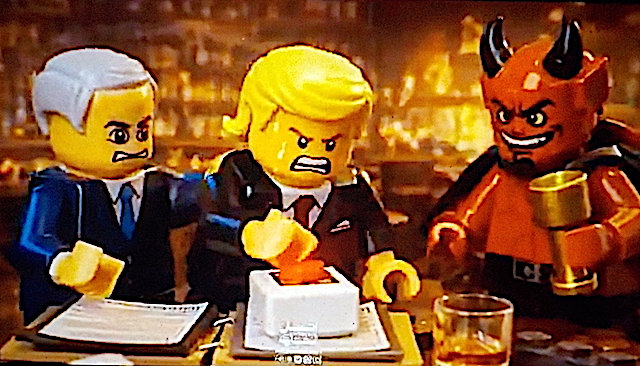
Iranian media have shared a Lego-style video touting Tehran’s purported retaliation against the US and Israel, depicting the American and Israeli leadership in a panic.
The animation, dubbed ‘Narrative of Victory,’ was widely circulated online on Sunday. It opens with a cartoonish figure of US President Donald Trump – accompanied by the Devil – reading the Jeffrey Epstein files.
The US president is then shown going haywire and ordering strikes on Iran, apparently implying that the attack was meant to distract everyone from a domestic scandal involving the late sex offender’s ties with American elites.
The video then depicts an attack on an Iranian girls’ school in Minab, which left more than 170 people dead, with a vengeful Iranian soldier examining the ruins and getting ready for retaliation. Tehran has blamed the attack on Israel and the US, while Trump has claimed the destruction was caused by Iran itself.
The clip goes on to depict waves of Iranian missile and drone strikes, including attacks on a UK airbase in Cyprus, multiple targets in Israel, and sites across the Gulf region. As the devastation spreads, Israeli Prime Minister Benjamin Netanyahu is shown fleeing, oil traders panic, and Iranian drones destroy a US aircraft carrier. One of the final scenes shows a US military transport plane unloading a coffin draped in the American flag.
The release came days after the White House posted its own PR video on X. The clip opened with a Grand Theft Auto: San Andreas meme showing protagonist CJ saying “Ah sh*t, here we go again,” before cutting to footage of US strikes on Iran, each hit overlaid with the game’s “wasted” screen that appears when the character dies.
This is not the first time Iranian media have used Lego-style animations in their messaging. In June 2025, during the 12-day war with Israel and the US, a similar video depicted Tehran’s response to strikes on the Isfahan nuclear facility as a victory.
That clip showed Trump and Netanyahu standing beside a devil figure before Iranian missiles hit Israeli targets, ending with the line: “We are the ones who control the game.”
https://www.rt.com/news/634174-iran-us-lego-video-pr-war/
YOURDEMOCRACY.NET RECORDS HISTORY AS IT SHOULD BE — NOT AS THE WESTERN MEDIA WRONGLY REPORTS IT — SINCE 2005.
Gus Leonisky
POLITICAL CARTOONIST SINCE 1951.
SEE ALSO: https://www.youtube.com/watch?v=bXOqkAUT-vk
- By Gus Leonisky at 9 Mar 2026 - 5:22am
- Gus Leonisky's blog
- Login or register to post comments
stupidolitics....
From Kissinger’s Nightmare to European Quagmire: Divide et Impera in U.S. Foreign Policy
REIN MÜLLERSON
The history of international relations is full of attempts by states to drive wedges between actual or potential rivals in order to rule them separately. Thus the Roman Empire gave the world the famous dictum—divide et impera. Machiavelli, in The Art of War, advised rulers to seed suspicion and force divisions between rival forces to weaken them. The British Empire became famous for exploiting and inflaming existing divisions between different tribes (particularly in India), and for throwing its weight against any power becoming too strong on the European continent. The United States has used such policies in various contexts, and one of the most recent ones—dividing Europe and Russia—will be discussed below. Equally, one must not be surprised when Russia tries to exploit and even widen differences between and within European states, since a more unified Europe is to Moscow’s detriment in the current struggle for the world’s geopolitical reconfiguration.
The best-known example of divide et impera, in Washington’s foreign policy, is Henry Kissinger’s efforts in the 1970s to hammer a wedge between the two communist giants—the People’s Republic of China and the Soviet Union.
It is not known whether the prospect of their alliance actually inflicted insomnia upon the renowned American diplomat, but his efforts to nip any Sino-Soviet rapprochement in the bud have come to be called a response to ‘Kissinger’s nightmare.’ Today, Western politicians and propaganda similarly try to sow seeds of distrust between China and Russia, claiming, for example, that China is covertly taking over the Russian Far East, or that Russia will again abandon China for the West.
Europeans down, Russians out, Ukrainians inLord Ismay’s formula “to keep the Americans in, the Russians out, and the Germans down” was not only about Germany, the USSR, and NATO. General de Gaulle’s somewhat independent foreign policy (i.e., France’s recognition of the People’s Republic of China almost a decade before the U.S.; de Gaulle’s independent nuclear deterrence; Paris’s withdrawal from NATO’s integrated military command in 1966) and friendly diatribes about Russia (particularly his famous dictum about “Europe from the Atlantic to the Urals”) greatly annoyed Washington. As French historian Eric Branca writes, “starting with the aid given to Algerian and Indochinese nationalists from 1945 onwards, as well as the direct support for the OAS [the far-right terrorist organization that opposed Algerian independence] during the last days of French Algeria, there is a long list of operations carried out by the State Department and the CIA to isolate de Gaulle in the international scene, if not to simply eliminate him” (Branca, 2022, p. 19).
Washington did not conceal its irritation when Willy Brandt began importing energy from the USSR. But this Ostpolitik, aiming to improve relations with Eastern Europe, was crucial during the 1973 oil crisis, and subsequent German chancellors—particularly Helmut Kohl, Gerhard Schröder, and Angela Merkel—continued mutually-beneficial economic cooperation with the USSR and then the Russian Federation. After indifference during the Gorbachev and Yeltsin years, American discontent with such cooperation culminated in President Biden’s February 2022 promise to end Nord Stream 2 if Russia invaded Ukraine. In this case, Biden kept his promise. Then followed the U.S.’s most successful effort to divide Europe and Russia: the armed conflict in Ukraine. Washington not only sacrificed Ukraine on the altar of its geopolitical ambitions,[1] but created a nightmare for its European vassals.
As America tolerates only vassalized allies, incipient Russo-American rapprochement—under Michael Gorbachev (a bit too naïve) and Boris Yeltsin (a bit too opportunistic)—came to an end after the disastrous 1990s, once Russia began to emerge from its coma and demand respect.
In 2012, Vladimir Putin wrote that “Russia has generally always enjoyed the privilege of conducting an independent foreign policy and this is what it will continue to do” (Putin, 2012). This may have been partly a response to Yeltsin’s failure to win Russia’s acceptance by Washington as an equal, independent player that can have its own distinct interests while still being a partner of Washington and Brussels. This remark also expresses the truth that nations react differently to attempts to “civilize” or vassalize them, to induce them to follow a dominant line. Quite a few happily follow such a lead, others do so grudgingly, and yet others bristle at such efforts, which if pressed are likely to be counterproductive and even dangerous. One could have hardly expected Russia to adopt the policy of bandwagoning that many smaller states have happily (or not so happily) accepted today.
President Putin’s wakeup call at the 2007 Munich security conference was misunderstood by those accustomed to obedience. The following year in Bucharest, NATO opened its doors to Georgia and Ukraine. Moscow saw this as a continuation of the old policy of containment that had targeted the Soviet Union; a continuation even though Gorbachev, Yeltsin, and Putin himself had spoken of Russia as a European country, and the latter had even helped Washington to respond to the 9/11 attacks.
It is possible to understand the hubris of Washington—but not the behavior of its European allies, who blindly followed a containment policy that was clearly contrary to their economic and even security interests. But maybe the European reaction stems from the envy felt by the obedient for the disobedient. Moreover, the process of vassalization has gone so far that, instead of political leaders, Europe is generating a managerial class without any long-term political vision or sense of history. Even in November 1991, President Mitterand foresaw that “Ukraine will become independent and a future war will be there” (Glavany, 2026, p. 32). Many saw the current conflict’s inevitability, absent careful handling of the complex situation. Such sagacity and foresight, which come with a sense of history, are non-existent in the political class of today’s Europe.When the U.S. started turning Ukraine into a platform for the containment of Russia, Washington’s European allies helped—some eagerly, like the UK, Poland, and the Baltic states, others out of the habit of obeying.
A landmark in Ukraine’s transformation was the 2014 coup d’état in Kiev—or, as it became known in the West, the Maidan Revolution. Senator John McCain, on behalf of the American people, openly and proudly expressed support for violent opposition to the democratically elected (though just as corrupt as all Ukrainian leaders) President Viktor Yanukovych. Victoria Nuland, Assistant Secretary of State for European and Eurasian Affairs, and Geoffrey Pyatt, U.S. Ambassador to Ukraine, discussed the composition of Ukraine’s new government. Also visible on the streets of Kiev were senior officials of European states and the EU, like Urmas Paet, then Estonia’s Foreign Minister and now a member of the EU Parliament.
The armed conflict in Ukraine started in the winter-spring of 2014, when the people of Crimea and the Donbass region rose against those who had seized power in Kiev. It was a domestic conflict. But, as in many or most such conflicts, it included ‘foreign elements’ from the very beginning. The new Kiev authorities were buttressed by those who had organized and supported the coup d’état, while their opponents were reinforced by Russia. Due to Russia’s military presence on the Crimean Peninsula, where its main naval base on the Black Sea had existed since around 1783, the Kiev regime’s opponents carried out a countercoup there in relative ease and peace. However, forces loyal to the new Kiev regime attacked its opponents in Eastern Ukraine with heavy artillery, even carpet-bombarding Donetsk, the region’s largest city. This naturally led to the intensification of Russian assistance to the rebels.
Playing with fire or a deliberate policy?By arming Ukraine and making it a de facto NATO member (without Article 5 guarantees), the West was not only playing with fire but deliberately dragging Russia into Ukraine.
Zbigniew Brzezinski is well-known for his aphorism that, without Ukraine, Russia ceases to be an empire, but with Ukraine it automatically becomes an empire. Less well known is his 1998 confirmation that the U.S.’s covert support of radical Islamists in Afghanistan in the 1970s had mired Moscow in its own “Vietnam.” Asked whether he regretted arming the “freedom-fighters”-turned-terrorists, Brzezinski responded: “What is most important to the history of the world? The Taliban or the collapse of the Soviet empire? Some stirred-up Moslems or liberation of Central Europe and the end of the Cold War?” (St Clair and Cockburn, 1998).
Today, the Americans have apparently judged that millions of Ukrainian lives are less historically important than the collapse of vassalization-resistant Russia.
Yet one significant difference between Russia’s military operation in Ukraine and the Soviet invasion of Afghanistan is that Afghanistan and its government were not critically important to the Soviet Union, while Ukraine and its government have always been so for Russia. Due to Ukraine’s size and geography, its membership in (or domination by) a hostile military alliance would mean the end of Russia as a sovereign state. President Putin said on 18 March 2014, regarding Crimea’s accession to the Russian Federation: “NATO remains a military alliance, and we are against having a military alliance making itself at home right in our backyard or in our historic territory. I simply cannot imagine that we would travel to Sevastopol to visit NATO sailors. Of course, most of them are wonderful guys, but it would be better to have them come and visit us, be our guests, rather than the other way around” (Putin, 2014).
If even prudent President Kennedy, during the Cuban Missile Crisis, was willing to contemplate nuclear war to protect vital national interests as defined by the U.S. political elite, why would President Putin be any less resolved to protect Russia against threats that he and the Russian political elite consider to be existential? Regarding the 1962 crisis, Dean Acheson, Secretary of State in 1949-1953, said that “the power, position and prestige of the United States had been challenged by another state; and law simply does not deal with such questions of ultimate power—power that comes close to sources of sovereignty” (Acheson, 1963). A frank admission. Russian politicians and diplomats could have used the same language in justifying their behavior regarding Ukraine (or, rather, regarding NATO in Ukraine) and they would not be wrong.
Vassals or accomplices?In arming post-coup Ukraine, the U.S. was joined by the European states, individually and collectively. (In the latter case, in the form of the EU, gradually arrogating to itself ever more prerogatives in economics, trade, security, and the military.)
France and Germany’s status as guarantors of the 2015 Minsk Accords meant little. On 9 December 2022, former Chancellor Merkel confessed that “the Minsk Agreement was an attempt to buy time for Ukraine. Ukraine used this time to become stronger, as you can see today.” According to her, “it was clear to everyone” that the conflict was suspended and the problem was not resolved, but the Agreement “was exactly what gave Ukraine the priceless time” needed to arm itself (The International Affairs, 2022). Like Ukraine, France and Germany had never intended to implement the Accords.
Although Western politicians and media regularly accused Russia of violating the Minsk Accords, they completely ignored not only Kiev’s own violations, but also important Ukrainian voices that openly called for rejecting the Agreements.
Jonathan Brunson, for example, wrote in 2019: “Minsk is broadly perceived [by Ukrainian elites] as a bad agreement that Ukraine has little incentive to implement because its essence runs directly counter to Ukrainian interests of Euro-Atlantic integration, national unity, social cohesion, and true equal rights for all” (Brunson, 2019).
Growing Western influence in Ukraine gradually brought about changes leading to direct military conflict with Moscow. Ukraine’s Constitution, adopted in 1996 and amended in 1999 and 2004, forbade participation in military alliances, but was amended in 2019 to declare EU and NATO membership as strategic objectives. As Alexander Del Valle writes: “This all looks as though the West is using Ukraine’s legitimate desire for independence… neutrality, and full sovereignty, to pursue an eastward expansionist strategy aimed at encircling Russia, using Ukraine as a battering ram against it, cutting the Old Continent in two (a centuries-old Anglo-Saxon strategy)” (Del Valle, 2025, p. 20).
And this was all done in the name of promoting democracy and strengthening the liberal international order. However, already in 2004, the influential U.S. IR scholar John Ikenberry proposed camouflaging America’s unipolar empire as a ‘liberal international order’ (Ikenberry, 2004, pp. 609-630). In another article (2008), he reiterated that the American empire can survive only if clothed as a liberal international order, only if buttressed by Anglo-Saxon rules disguised as international law.
The Maidan coup was carried out when Obama was in the White House. European states and the EU were fully involved in the financial and military support of Kiev. Although Donald Trump showed signs of rapprochement with Russia during his first term, money and weapons continued to flow to Ukraine under his watch. Europe did its best to keep up with Washington. Although Trump’s first term featured only a few signs of anti-Europeanism, Europe’s political elites almost unanimously welcomed Joe Biden’s election in 2020. (Which, for some reason, did not earn him a Nobel Peace Prize, even though Obama got one merely for replacing George W. Bush.) Europe then joined in the anti-Russian project in Ukraine with even greater enthusiasm: financial and military aid flew to Ukraine, while new European sanctions were imposed on Moscow. The aim was to weaken, destabilize, vassalize, dismember, and economically exploit Russia.
By 2022, Washington had already driven a deep wedge between Europe and Russia, but the worst was yet to come. When the U.S. and NATO unceremoniously dismissed Russia’s proposals to discuss its security concerns in Europe, and Kiev radically intensified its bombardment of the Donbass in February 2022, the Kremlin started what in Russia is termed the Special Military Operation (SMO) and in the West is with equal doggedness called “Russia’s full-scale invasion of Ukraine.”
Even if the military operation was relatively small compared to Ukraine’s territory, military, and population, it transformed a domestic conflict with foreign involvement into an international one. While it may initially have looked like a conflict between Russia and Ukraine, its real nature—a war between Russia and the West—became increasingly clear, even as both antagonists, to avoid escalation, refused to call a spade a spade.
As the Russo-Ukrainian negotiations in Istanbul in April 2022 showed, Russia initially sought only to force Ukraine to implement the Minsk accords. It did not make any territorial claims. Even the issue of Ukrainian recognition of Crimea’s incorporation was postponed for 15 years. What Moscow did not foresee was the West’s determination to continue its own special military operation, sacrificing its own weapons and money, but Ukrainian lives, to bring Russia to its knees. Here the role of Europe—and particularly Boris Johnson, who was the messenger ordering President Zelensky to continue fighting—was crucial.
In all stages of Russo-Western relations’ deterioration, the U.S. has been the engine, Europe the enthusiastic follower. Therefore, it cannot be said that Washington dragged Europe into its current nightmare. But the European people have been misled by a propaganda machine never seen before in the West. In this and some other respects, there are even signs of the ‘Sovietization’ of the EU and its member states.
Freedom of expression has been restricted by sweeping (albeit currently somewhat relaxed) political correctness since the beginning of the millennium, and there is an absolute taboo on non-official narratives regarding the causes of war in Ukraine. For example, members of the UK’s governing Labour Party are officially prohibited from expressing divergent views. Keir Starmer, becoming the leader of Labour, declared that “there would be ‘no room’ in Labour for those who are [seeking] to blame the Western alliance for Vladimir Putin’s invasion of Ukraine” (Forrest, 2022). As if NATO’s “barking at the gates of Russia” (Pope Francis), its remilitarization of Ukraine, and Kiev’s constant bombardment of the Donbass (which considerably intensified in mid-February 2022) could not have played a role in inducing Russia into Ukraine.
Europe’s nightmare became apparent with Trump’s second term. Even before that, Europe had acted contrary to its self-interest, severing itself from advantageous energy resources and imposing anti-Russian sanctions that hurt it at least as much as Russia. But at least European elites were sure that, whatever happened to them, Washington would be their savior of last resort. Now this has turned out to not be the case.
First came the cold shower delivered by J.D. Vance in Munich.
Then Trump’s tariffs, striking not only Washington’s traditional enemies and rivals, but also its faithful allies (vassals).
Then the humiliating trade deal, finalized in summer 2025 in Scotland, where Trump was playing golf. French Prime Minister François Bayrou observed: “It is a dark day when an alliance of free peoples, brought together to affirm their common values and to defend their common interests, resigns itself to submission” (BBC News, 2025). Hungarian PM Victor Orban was blunter: Trump “ate von der Leyen for breakfast” (Ibid).
And then the Anchorage Summit of August 2025, between Presidents Putin and Trump. This was a shock for the coddled European elites, who nevertheless kept up appearances.
The final episode in Europe’s annus horribilis was the U.S.’s adoption of a new National Security Strategy in November 2025. It rejects “the ill-fated concept of global domination” in favor of the “global and regional balance of power”.
But the beginning of this crucial turn away from “global domination” was visible even earlier. In Washington in January 2017, British PM Theresa May declared that there could be no “return to the failed policies of the past. The days of Britain and America intervening in sovereign countries in an attempt to remake the world in our own image are over” (Pasha-Robinson, 2017). She vowed never to repeat the “failed policies of the past” (Western military interventions in Iraq and Afghanistan), breaking from the “liberal interventionism” embraced by Tony Blair, and carried to fruition by her immediate predecessor, David Cameron, in Libya. Yet Britain under May’s successors, Boris Johnson and Keir Starmer, as well as the EU and the Biden administration, continued policies based on Western global domination and the ‘end of history.’
Europe has also stopped listening to world leaders. French PM Eduard Philippe was right when he said that “it is necessary to listen to what heads of state say, and we doubtlessly pay little attention to what Trump or Putin say” (Philippe, 2026).
Indeed, Putin has “repeatedly denied that he has any plans to attack NATO and has said that such a step would be foolish for Russia given the conventional military superiority of NATO over Russia” (Antonov, 2025).
Similarly, when Paris, London, and Kiev signed in January 2025 a declaration of intent to send thousands of French and British troops to “keep peace” in Ukraine, it was as if they had not heard Russia’s repeated statements about NATO troops in Ukraine.
Russian Foreign Ministry Spokeswoman Maria Zakharova had to warn that the deployment of military units or military infrastructure to Ukrainian territory will be qualified as foreign intervention that directly threatens the security of Russia and other European countries. “All such units and facilities will be considered legitimate military targets for the Russian armed forces. Warnings to this effect have been repeatedly made at the highest level and remain relevant” (Mirror, 2026). One explanation for the Europeans’ apparent deafness is that they are not actually at all interested in ending the war. Hence the endless meetings of Zelensky with Macron, Starmer, and Merz, which are obviously meaningless without the inclusion of Russian representatives.
The EU between superpower ambitions and a return to an economic union of sovereign statesEurope’s leaders no longer call openly for “ever closer union.” Their pursuit of Europe’s federalization is now counterbalanced by calls for a return to a union of nation-states. The EU’s members are in no hurry to relinquish their sovereignty. Mathieu Bock-Côté is right that, “when one attacks national sovereignty and the historical identity of the people, the cultural heritage or civilizational roots of the Western world, one knowingly or inadvertently undermines that which helped democracy survive. Men and women fought against totalitarianisms not only to save their rights, but also to save their country, their culture, and their civilization” (Bock-Côté, 2019, p. 326).
The EU, even if it survives the blows that it is currently suffering, cannot become a superpower like the U.S., China, Russia, or India. America is a country of immigrants, while China, Russia, and India are civilization-states. But European civilization is inherently ethno-territorially fragmented. For centuries, this fragmentation was beneficial. Constant rivalries and wars drove technological advancement. In 1648, the Westphalian peace replaced feudal disunity with consolidated nation-states, which became strong enough for overseas adventures. Colonial conquests further enriched Europe and consolidated its global leadership. After the end of formal colonialism, neocolonial policies and American support helped Europe to keep doing relatively well, but the end of its golden age was imminent.
Today, even the largest European countries are too small and coddled to compete with the U.S., China, or Russia. Other would-be superpowers are on the horizon, and the elite’s dream of a United States of Europe looks more utopian than ever.
Wolfgang Streeck’s insightfully observed that: “[i]t will not do damage to the interest of citizens and peoples—of ordinary people—if they, as they increasingly do, resist further centralization, unification, and integration, and, to the contrary, insist on a return of power and responsibility, and, indeed, sovereignty, to political formations more down to earth, closer to the ground, after the failure of global governance and similar neoliberal chimeras” (Streeck, 2024). Dani Rodrik (2007) has shown that there is a fundamental incompatibility between hyper-globalization, on the one hand, and democracy and national sovereignty, on the other. One cannot have all of them at the same time.
Decades ago, the EU could have been seen as a successful integration experiment, even showing the world at large (in the spirit of Marxist historiography) its possible bright future. Today, many Europeans realize that the subordination of the nation-state is causing a backlash. Von-der-Leyen-style bureaucratic and technocratic centralization, and the EU’s expansion beyond its traditional (already excessive) responsibilities into the realm of military affairs (thereby turning into NATO’s auxiliary or replacement), are sparking opposition in most member states.
However, the West has never been able to accept those who do not toe the line and do not even feign desire to become more like it. While emphasizing diversity of genders, sexual orientations, and even religions, Western elites vehemently reject differences between societies organized as states, even when such diversity is due to millennia-old history. Yet, as Wolfgang Streeck shows, the more democratic societies are, the more idiosyncratic they will be, and the more their economic rules will diverge (Streek, 2024, p. XV). The concept of democracy, if at all applicable to international (particularly interstate) relations, should also mean the recognition (if not always welcoming) of diverse political and economic regimes. Imposed universality would discourage the social, political, and economic experiments that are necessary for humanity’s progressive development. Therefore, EU policies that not only aim to standardize members’ economies, but also homogenize their domestic and international policies, are undemocratic. They also run contrary to the current global shift towards sovereignty and away from external interference. The Russian bogeyman serves to unify the EU’s members, further centralize it, and further limit its members’ sovereign rights.
But the Western corner of Eurasia can never have security against Russia, it can only have security together with Russia. European security structures that are close to Russia’s borders, but exclude Russia, may at best provide collective self-defense, but they can never provide collective security. As history has testified since the war between the Delian and Peloponnesian Leagues (431-404 BC), military alliances lead to war more often than they prevent it. This is understood by many in Europe.
For example, Thierry de Montbrial, the President and founder of IFRI (The French Institute of International Relations) warns: “If Europe and Russia do not find grounds for a strong mutual understanding reasonably soon, both will risk becoming objects of the great-power competition that is already unfolding between the United States and China for future domination of the Eurasian continent” (de Montbrial, 2017, p.140). Caroline Galactéros, a French political scientist, incisively notes that “strategic rapprochement of the EU with Russia would add value to Europe in new geopolitical games” (Galactéros, 2019). Other public intellectuals in France, such as former PM Dominique de Villepin and former Education Minister Luc Ferry, have also expressed views on the Ukraine conflict that the mainstream calls “controversial,” as if only simple-mindedness is non-controversial.
Yet Western political elites are on the war path. In the UK, where I am typing these words, there are no politicians or mainstream media that would deviate from Keir Starmer’s single-mindedness. It may take generations, and the replacement of Europe’s elite, for things to change, but the future of Europe will be bleak so long as it is in confrontation with Russia.
The Ukrainian endgameThe military conflict in Ukraine will eventually end if it does not trigger a much bigger war. At the moment, there are three realistic scenarios for its conclusion. (1) A negotiated peace treaty, according to which Ukraine accepts neutrality and the loss of certain territories (particularly Crimea and the Donbass), while Russia withdraws from some conquered territories and agrees to certain security guarantees for Ukraine. (2) The war’s continuation through and even beyond 2026, ending in Russia’s conquest of additional territories (particularly in the South, including Odessa), thus making Ukraine landlocked. (3) Both the U.S. and Europe significantly increase participation in the conflict, sending long-range weapons and ground forces, leading to all-out war with the potential use of tactical nuclear weapons.
Obviously, the first scenario is relatively beneficial for all, especially Ukraine. But it has quite a few complications. First, both Europe and Ukraine would see it as a Russian victory, and see the compromise as “rewarding the aggressor”, something that Europe has for years claimed is unacceptable. It is also unclear whether Russia, given its battlefield successes, is willing to stop fighting, rather than hope for the collapse of the government in Kiev.
Russia certainly will not occupy the whole of Ukraine, even if it becomes able to do so. Western Ukraine—Lviv, Ivano-Frankovsk, Chernivtsi, Ternopil, Zakarpattia, Rivne, and Volyn—has historically been part of Poland and the Austro-Hungarian Empire, and even if handed to Russia on a silver platter, it would be rejected by pragmatists in the Kremlin. Similarly, the center of the country, including Kiev (which may indeed be emotionally dear to many Russians), is in my opinion beyond Moscow’s ambitions. But Russia taking all of ‘Novorossiya,’ including Ukraine’s Black Sea coast, might be unacceptable for the West, even if the government in Kiev collapses. The result would be at best a ceasefire, not a lasting peace, threatening future conflict not only between Russia and Ukraine, but also between Russia and the West at large.
The last scenario would be the worst for all participants. Although Russia’s use of tactical nuclear weapons (and not necessarily only in Ukraine) may not lead to a strategic nuclear exchange between Moscow and Washington, it would itself do immense damage to human lives, property, and the environment. Its risks for Russia’s relations with the rest of the world may be unacceptable to the Kremlin. But there are too few ‘adults in the room’—particularly in Europe, where Macron has already spoken of a French nuclear umbrella over NATO—for such a scenario to be ruled out completely.
Europe, a victim of American geopolitics, is itself victimizing Ukraine by doing practically everything possible to prolong Ukraine’s agony. Kiev has no good choices. The bad option is recognition of defeat and acceptance of Russia’s main demands, i.e. neutrality and the cession of Donbass and some other territories. The even worse option is losing even more territories, probably including Odessa and the whole coastline, becoming a landlocked state. The latter scenario would keep the iron curtain closed for quite a long while. Had Washington prevented its European vassals from spoiling its efforts to extricate itself from the European quagmire, the war’s end would be closer, and the White House would indeed be able to concentrate its attention on other areas.
Reconfiguration of the geopolitical landscapeThe Pax Americana has been the dream not only of Democrats and neoconservatives in the U.S., but also of the political elite in Europe. Yet the Trump administration, in its new National Security Strategy, seems to have understood that the world is too big to be controlled from one center. But for the European political elite, acceptance of a multipolar world with great powers and spheres of interest[2] would sound its death knell.
After blindly following Washington in containing Russia, after sacrificing Ukraine on the altar of Washington’s geopolitical ambitions, Europe will be left with only two options: to live with a strong Russia as its neighbor, or to fight it.
As American neoconservatives and Democrats seem to cling to a vision of Western global dominance, Europe’s elites hope for the U.S.’s return to “normality” as leader of the “free world” towards Fukuyama’s ‘end of history.’ However, the half-millennium of Western dominance is ending, and Trump’s policies are only accelerating this inevitability. The end of the war in Ukraine would mark the tipping point, after which return to the Cold War or the post-Cold-War world would be impossible.
A pivot to Asia, to confront China, remains Washington’s main long-term strategy. Even Trump’s idea of annexing Greenland, which is not as extravagant as it may seem, is not at all about Europe. Rather, it is meant to contain both China and Russia, and to seize Greenland’s mineral resources, as an element of American global policy. But the U.S. can hardly extricate itself from the Middle East, since Israel and its lobby in Washington must be satisfied at all costs.
The second coming of Trump does not at all mean Washington’s return to the balance-of-power policy that guaranteed at least a minimum of order during the Cold War. Besides following the Donroe Doctrine, the U.S. will also at least for some time continue to play policeman beyond its own backyard. American withdrawal from Europe would mean that Washington is forcing its vassals to radically increase their military budgets in preparation for a war with Russia, and to support Ukraine financially and militarily (including by buying American weapons). This is mission impossible, given most European countries’ economies and finances.
In an Anglo-Saxon conspiracy, the U.S. and UK have indeed succeeded in dividing Europe, with a new iron curtain between Russia and the rest of the continent, and Ukraine hanging over Russia like the sword of Damocles. Continental Europe, following the Anglo-Saxons to its own detriment, has also become their victim, confronted with a triple existential crisis: geopolitical insecurity, energy shortages, and dependence on Washington.
Many of today’s conflicts stem from seeing the world through a prism that divides it into democracies and autocracies, into a liberal-democratic garden surrounded by a jungle. In such a view, those who are not with us (and not like us) are against us. It is high time to overcome such a Manichean mentality.
The history of international relations is full of attempts by states to drive wedges between actual or potential rivals in order to rule them separately. Thus the Roman Empire gave the world the famous dictum—divide et impera. Machiavelli, in The Art of War, advised rulers to seed suspicion and force divisions between rival forces to weaken them. The British Empire became famous for exploiting and inflaming existing divisions between different tribes (particularly in India), and for throwing its weight against any power becoming too strong on the European continent. The United States has used such policies in various contexts, and one of the most recent ones—dividing Europe and Russia—will be discussed below. Equally, one must not be surprised when Russia tries to exploit and even widen differences between and within European states, since a more unified Europe is to Moscow’s detriment in the current struggle for the world’s geopolitical reconfiguration.
The best-known example of divide et impera, in Washington’s foreign policy, is Henry Kissinger’s efforts in the 1970s to hammer a wedge between the two communist giants—the People’s Republic of China and the Soviet Union.
It is not known whether the prospect of their alliance actually inflicted insomnia upon the renowned American diplomat, but his efforts to nip any Sino-Soviet rapprochement in the bud have come to be called a response to ‘Kissinger’s nightmare.’ Today, Western politicians and propaganda similarly try to sow seeds of distrust between China and Russia, claiming, for example, that China is covertly taking over the Russian Far East, or that Russia will again abandon China for the West.
Europeans down, Russians out, Ukrainians inLord Ismay’s formula “to keep the Americans in, the Russians out, and the Germans down” was not only about Germany, the USSR, and NATO. General de Gaulle’s somewhat independent foreign policy (i.e., France’s recognition of the People’s Republic of China almost a decade before the U.S.; de Gaulle’s independent nuclear deterrence; Paris’s withdrawal from NATO’s integrated military command in 1966) and friendly diatribes about Russia (particularly his famous dictum about “Europe from the Atlantic to the Urals”) greatly annoyed Washington. As French historian Eric Branca writes, “starting with the aid given to Algerian and Indochinese nationalists from 1945 onwards, as well as the direct support for the OAS [the far-right terrorist organization that opposed Algerian independence] during the last days of French Algeria, there is a long list of operations carried out by the State Department and the CIA to isolate de Gaulle in the international scene, if not to simply eliminate him” (Branca, 2022, p. 19).
Washington did not conceal its irritation when Willy Brandt began importing energy from the USSR. But this Ostpolitik, aiming to improve relations with Eastern Europe, was crucial during the 1973 oil crisis, and subsequent German chancellors—particularly Helmut Kohl, Gerhard Schröder, and Angela Merkel—continued mutually-beneficial economic cooperation with the USSR and then the Russian Federation. After indifference during the Gorbachev and Yeltsin years, American discontent with such cooperation culminated in President Biden’s February 2022 promise to end Nord Stream 2 if Russia invaded Ukraine. In this case, Biden kept his promise. Then followed the U.S.’s most successful effort to divide Europe and Russia: the armed conflict in Ukraine. Washington not only sacrificed Ukraine on the altar of its geopolitical ambitions,[1] but created a nightmare for its European vassals.
As America tolerates only vassalized allies, incipient Russo-American rapprochement—under Michael Gorbachev (a bit too naïve) and Boris Yeltsin (a bit too opportunistic)—came to an end after the disastrous 1990s, once Russia began to emerge from its coma and demand respect.
In 2012, Vladimir Putin wrote that “Russia has generally always enjoyed the privilege of conducting an independent foreign policy and this is what it will continue to do” (Putin, 2012). This may have been partly a response to Yeltsin’s failure to win Russia’s acceptance by Washington as an equal, independent player that can have its own distinct interests while still being a partner of Washington and Brussels. This remark also expresses the truth that nations react differently to attempts to “civilize” or vassalize them, to induce them to follow a dominant line. Quite a few happily follow such a lead, others do so grudgingly, and yet others bristle at such efforts, which if pressed are likely to be counterproductive and even dangerous. One could have hardly expected Russia to adopt the policy of bandwagoning that many smaller states have happily (or not so happily) accepted today.
President Putin’s wakeup call at the 2007 Munich security conference was misunderstood by those accustomed to obedience. The following year in Bucharest, NATO opened its doors to Georgia and Ukraine. Moscow saw this as a continuation of the old policy of containment that had targeted the Soviet Union; a continuation even though Gorbachev, Yeltsin, and Putin himself had spoken of Russia as a European country, and the latter had even helped Washington to respond to the 9/11 attacks.
It is possible to understand the hubris of Washington—but not the behavior of its European allies, who blindly followed a containment policy that was clearly contrary to their economic and even security interests. But maybe the European reaction stems from the envy felt by the obedient for the disobedient. Moreover, the process of vassalization has gone so far that, instead of political leaders, Europe is generating a managerial class without any long-term political vision or sense of history. Even in November 1991, President Mitterand foresaw that “Ukraine will become independent and a future war will be there” (Glavany, 2026, p. 32). Many saw the current conflict’s inevitability, absent careful handling of the complex situation. Such sagacity and foresight, which come with a sense of history, are non-existent in the political class of today’s Europe.When the U.S. started turning Ukraine into a platform for the containment of Russia, Washington’s European allies helped—some eagerly, like the UK, Poland, and the Baltic states, others out of the habit of obeying.
A landmark in Ukraine’s transformation was the 2014 coup d’état in Kiev—or, as it became known in the West, the Maidan Revolution. Senator John McCain, on behalf of the American people, openly and proudly expressed support for violent opposition to the democratically elected (though just as corrupt as all Ukrainian leaders) President Viktor Yanukovych. Victoria Nuland, Assistant Secretary of State for European and Eurasian Affairs, and Geoffrey Pyatt, U.S. Ambassador to Ukraine, discussed the composition of Ukraine’s new government. Also visible on the streets of Kiev were senior officials of European states and the EU, like Urmas Paet, then Estonia’s Foreign Minister and now a member of the EU Parliament.
The armed conflict in Ukraine started in the winter-spring of 2014, when the people of Crimea and the Donbass region rose against those who had seized power in Kiev. It was a domestic conflict. But, as in many or most such conflicts, it included ‘foreign elements’ from the very beginning. The new Kiev authorities were buttressed by those who had organized and supported the coup d’état, while their opponents were reinforced by Russia. Due to Russia’s military presence on the Crimean Peninsula, where its main naval base on the Black Sea had existed since around 1783, the Kiev regime’s opponents carried out a countercoup there in relative ease and peace. However, forces loyal to the new Kiev regime attacked its opponents in Eastern Ukraine with heavy artillery, even carpet-bombarding Donetsk, the region’s largest city. This naturally led to the intensification of Russian assistance to the rebels.
Playing with fire or a deliberate policy?By arming Ukraine and making it a de facto NATO member (without Article 5 guarantees), the West was not only playing with fire but deliberately dragging Russia into Ukraine.
Zbigniew Brzezinski is well-known for his aphorism that, without Ukraine, Russia ceases to be an empire, but with Ukraine it automatically becomes an empire. Less well known is his 1998 confirmation that the U.S.’s covert support of radical Islamists in Afghanistan in the 1970s had mired Moscow in its own “Vietnam.” Asked whether he regretted arming the “freedom-fighters”-turned-terrorists, Brzezinski responded: “What is most important to the history of the world? The Taliban or the collapse of the Soviet empire? Some stirred-up Moslems or liberation of Central Europe and the end of the Cold War?” (St Clair and Cockburn, 1998).
Today, the Americans have apparently judged that millions of Ukrainian lives are less historically important than the collapse of vassalization-resistant Russia.
Yet one significant difference between Russia’s military operation in Ukraine and the Soviet invasion of Afghanistan is that Afghanistan and its government were not critically important to the Soviet Union, while Ukraine and its government have always been so for Russia. Due to Ukraine’s size and geography, its membership in (or domination by) a hostile military alliance would mean the end of Russia as a sovereign state. President Putin said on 18 March 2014, regarding Crimea’s accession to the Russian Federation: “NATO remains a military alliance, and we are against having a military alliance making itself at home right in our backyard or in our historic territory. I simply cannot imagine that we would travel to Sevastopol to visit NATO sailors. Of course, most of them are wonderful guys, but it would be better to have them come and visit us, be our guests, rather than the other way around” (Putin, 2014).
If even prudent President Kennedy, during the Cuban Missile Crisis, was willing to contemplate nuclear war to protect vital national interests as defined by the U.S. political elite, why would President Putin be any less resolved to protect Russia against threats that he and the Russian political elite consider to be existential? Regarding the 1962 crisis, Dean Acheson, Secretary of State in 1949-1953, said that “the power, position and prestige of the United States had been challenged by another state; and law simply does not deal with such questions of ultimate power—power that comes close to sources of sovereignty” (Acheson, 1963). A frank admission. Russian politicians and diplomats could have used the same language in justifying their behavior regarding Ukraine (or, rather, regarding NATO in Ukraine) and they would not be wrong.
Vassals or accomplices?In arming post-coup Ukraine, the U.S. was joined by the European states, individually and collectively. (In the latter case, in the form of the EU, gradually arrogating to itself ever more prerogatives in economics, trade, security, and the military.)
France and Germany’s status as guarantors of the 2015 Minsk Accords meant little. On 9 December 2022, former Chancellor Merkel confessed that “the Minsk Agreement was an attempt to buy time for Ukraine. Ukraine used this time to become stronger, as you can see today.” According to her, “it was clear to everyone” that the conflict was suspended and the problem was not resolved, but the Agreement “was exactly what gave Ukraine the priceless time” needed to arm itself (The International Affairs, 2022). Like Ukraine, France and Germany had never intended to implement the Accords.
Although Western politicians and media regularly accused Russia of violating the Minsk Accords, they completely ignored not only Kiev’s own violations, but also important Ukrainian voices that openly called for rejecting the Agreements.
Jonathan Brunson, for example, wrote in 2019: “Minsk is broadly perceived [by Ukrainian elites] as a bad agreement that Ukraine has little incentive to implement because its essence runs directly counter to Ukrainian interests of Euro-Atlantic integration, national unity, social cohesion, and true equal rights for all” (Brunson, 2019).
Growing Western influence in Ukraine gradually brought about changes leading to direct military conflict with Moscow. Ukraine’s Constitution, adopted in 1996 and amended in 1999 and 2004, forbade participation in military alliances, but was amended in 2019 to declare EU and NATO membership as strategic objectives. As Alexander Del Valle writes: “This all looks as though the West is using Ukraine’s legitimate desire for independence… neutrality, and full sovereignty, to pursue an eastward expansionist strategy aimed at encircling Russia, using Ukraine as a battering ram against it, cutting the Old Continent in two (a centuries-old Anglo-Saxon strategy)” (Del Valle, 2025, p. 20).
And this was all done in the name of promoting democracy and strengthening the liberal international order. However, already in 2004, the influential U.S. IR scholar John Ikenberry proposed camouflaging America’s unipolar empire as a ‘liberal international order’ (Ikenberry, 2004, pp. 609-630). In another article (2008), he reiterated that the American empire can survive only if clothed as a liberal international order, only if buttressed by Anglo-Saxon rules disguised as international law.
The Maidan coup was carried out when Obama was in the White House. European states and the EU were fully involved in the financial and military support of Kiev. Although Donald Trump showed signs of rapprochement with Russia during his first term, money and weapons continued to flow to Ukraine under his watch. Europe did its best to keep up with Washington. Although Trump’s first term featured only a few signs of anti-Europeanism, Europe’s political elites almost unanimously welcomed Joe Biden’s election in 2020. (Which, for some reason, did not earn him a Nobel Peace Prize, even though Obama got one merely for replacing George W. Bush.) Europe then joined in the anti-Russian project in Ukraine with even greater enthusiasm: financial and military aid flew to Ukraine, while new European sanctions were imposed on Moscow. The aim was to weaken, destabilize, vassalize, dismember, and economically exploit Russia.
By 2022, Washington had already driven a deep wedge between Europe and Russia, but the worst was yet to come. When the U.S. and NATO unceremoniously dismissed Russia’s proposals to discuss its security concerns in Europe, and Kiev radically intensified its bombardment of the Donbass in February 2022, the Kremlin started what in Russia is termed the Special Military Operation (SMO) and in the West is with equal doggedness called “Russia’s full-scale invasion of Ukraine.”
Even if the military operation was relatively small compared to Ukraine’s territory, military, and population, it transformed a domestic conflict with foreign involvement into an international one. While it may initially have looked like a conflict between Russia and Ukraine, its real nature—a war between Russia and the West—became increasingly clear, even as both antagonists, to avoid escalation, refused to call a spade a spade.
As the Russo-Ukrainian negotiations in Istanbul in April 2022 showed, Russia initially sought only to force Ukraine to implement the Minsk accords. It did not make any territorial claims. Even the issue of Ukrainian recognition of Crimea’s incorporation was postponed for 15 years. What Moscow did not foresee was the West’s determination to continue its own special military operation, sacrificing its own weapons and money, but Ukrainian lives, to bring Russia to its knees. Here the role of Europe—and particularly Boris Johnson, who was the messenger ordering President Zelensky to continue fighting—was crucial.
In all stages of Russo-Western relations’ deterioration, the U.S. has been the engine, Europe the enthusiastic follower. Therefore, it cannot be said that Washington dragged Europe into its current nightmare. But the European people have been misled by a propaganda machine never seen before in the West. In this and some other respects, there are even signs of the ‘Sovietization’ of the EU and its member states.
Freedom of expression has been restricted by sweeping (albeit currently somewhat relaxed) political correctness since the beginning of the millennium, and there is an absolute taboo on non-official narratives regarding the causes of war in Ukraine. For example, members of the UK’s governing Labour Party are officially prohibited from expressing divergent views. Keir Starmer, becoming the leader of Labour, declared that “there would be ‘no room’ in Labour for those who are [seeking] to blame the Western alliance for Vladimir Putin’s invasion of Ukraine” (Forrest, 2022). As if NATO’s “barking at the gates of Russia” (Pope Francis), its remilitarization of Ukraine, and Kiev’s constant bombardment of the Donbass (which considerably intensified in mid-February 2022) could not have played a role in inducing Russia into Ukraine.
Europe’s nightmare became apparent with Trump’s second term. Even before that, Europe had acted contrary to its self-interest, severing itself from advantageous energy resources and imposing anti-Russian sanctions that hurt it at least as much as Russia. But at least European elites were sure that, whatever happened to them, Washington would be their savior of last resort. Now this has turned out to not be the case.
First came the cold shower delivered by J.D. Vance in Munich.
Then Trump’s tariffs, striking not only Washington’s traditional enemies and rivals, but also its faithful allies (vassals).
Then the humiliating trade deal, finalized in summer 2025 in Scotland, where Trump was playing golf. French Prime Minister François Bayrou observed: “It is a dark day when an alliance of free peoples, brought together to affirm their common values and to defend their common interests, resigns itself to submission” (BBC News, 2025). Hungarian PM Victor Orban was blunter: Trump “ate von der Leyen for breakfast” (Ibid).
And then the Anchorage Summit of August 2025, between Presidents Putin and Trump. This was a shock for the coddled European elites, who nevertheless kept up appearances.
The final episode in Europe’s annus horribilis was the U.S.’s adoption of a new National Security Strategy in November 2025. It rejects “the ill-fated concept of global domination” in favor of the “global and regional balance of power”.
But the beginning of this crucial turn away from “global domination” was visible even earlier. In Washington in January 2017, British PM Theresa May declared that there could be no “return to the failed policies of the past. The days of Britain and America intervening in sovereign countries in an attempt to remake the world in our own image are over” (Pasha-Robinson, 2017). She vowed never to repeat the “failed policies of the past” (Western military interventions in Iraq and Afghanistan), breaking from the “liberal interventionism” embraced by Tony Blair, and carried to fruition by her immediate predecessor, David Cameron, in Libya. Yet Britain under May’s successors, Boris Johnson and Keir Starmer, as well as the EU and the Biden administration, continued policies based on Western global domination and the ‘end of history.’
Europe has also stopped listening to world leaders. French PM Eduard Philippe was right when he said that “it is necessary to listen to what heads of state say, and we doubtlessly pay little attention to what Trump or Putin say” (Philippe, 2026).
Indeed, Putin has “repeatedly denied that he has any plans to attack NATO and has said that such a step would be foolish for Russia given the conventional military superiority of NATO over Russia” (Antonov, 2025).
Similarly, when Paris, London, and Kiev signed in January 2025 a declaration of intent to send thousands of French and British troops to “keep peace” in Ukraine, it was as if they had not heard Russia’s repeated statements about NATO troops in Ukraine.
Russian Foreign Ministry Spokeswoman Maria Zakharova had to warn that the deployment of military units or military infrastructure to Ukrainian territory will be qualified as foreign intervention that directly threatens the security of Russia and other European countries. “All such units and facilities will be considered legitimate military targets for the Russian armed forces. Warnings to this effect have been repeatedly made at the highest level and remain relevant” (Mirror, 2026). One explanation for the Europeans’ apparent deafness is that they are not actually at all interested in ending the war. Hence the endless meetings of Zelensky with Macron, Starmer, and Merz, which are obviously meaningless without the inclusion of Russian representatives.
The EU between superpower ambitions and a return to an economic union of sovereign statesEurope’s leaders no longer call openly for “ever closer union.” Their pursuit of Europe’s federalization is now counterbalanced by calls for a return to a union of nation-states. The EU’s members are in no hurry to relinquish their sovereignty. Mathieu Bock-Côté is right that, “when one attacks national sovereignty and the historical identity of the people, the cultural heritage or civilizational roots of the Western world, one knowingly or inadvertently undermines that which helped democracy survive. Men and women fought against totalitarianisms not only to save their rights, but also to save their country, their culture, and their civilization” (Bock-Côté, 2019, p. 326).
The EU, even if it survives the blows that it is currently suffering, cannot become a superpower like the U.S., China, Russia, or India. America is a country of immigrants, while China, Russia, and India are civilization-states. But European civilization is inherently ethno-territorially fragmented. For centuries, this fragmentation was beneficial. Constant rivalries and wars drove technological advancement. In 1648, the Westphalian peace replaced feudal disunity with consolidated nation-states, which became strong enough for overseas adventures. Colonial conquests further enriched Europe and consolidated its global leadership. After the end of formal colonialism, neocolonial policies and American support helped Europe to keep doing relatively well, but the end of its golden age was imminent.
Today, even the largest European countries are too small and coddled to compete with the U.S., China, or Russia. Other would-be superpowers are on the horizon, and the elite’s dream of a United States of Europe looks more utopian than ever.
Wolfgang Streeck’s insightfully observed that: “[i]t will not do damage to the interest of citizens and peoples—of ordinary people—if they, as they increasingly do, resist further centralization, unification, and integration, and, to the contrary, insist on a return of power and responsibility, and, indeed, sovereignty, to political formations more down to earth, closer to the ground, after the failure of global governance and similar neoliberal chimeras” (Streeck, 2024). Dani Rodrik (2007) has shown that there is a fundamental incompatibility between hyper-globalization, on the one hand, and democracy and national sovereignty, on the other. One cannot have all of them at the same time.
Decades ago, the EU could have been seen as a successful integration experiment, even showing the world at large (in the spirit of Marxist historiography) its possible bright future. Today, many Europeans realize that the subordination of the nation-state is causing a backlash. Von-der-Leyen-style bureaucratic and technocratic centralization, and the EU’s expansion beyond its traditional (already excessive) responsibilities into the realm of military affairs (thereby turning into NATO’s auxiliary or replacement), are sparking opposition in most member states.
However, the West has never been able to accept those who do not toe the line and do not even feign desire to become more like it. While emphasizing diversity of genders, sexual orientations, and even religions, Western elites vehemently reject differences between societies organized as states, even when such diversity is due to millennia-old history. Yet, as Wolfgang Streeck shows, the more democratic societies are, the more idiosyncratic they will be, and the more their economic rules will diverge (Streek, 2024, p. XV). The concept of democracy, if at all applicable to international (particularly interstate) relations, should also mean the recognition (if not always welcoming) of diverse political and economic regimes. Imposed universality would discourage the social, political, and economic experiments that are necessary for humanity’s progressive development. Therefore, EU policies that not only aim to standardize members’ economies, but also homogenize their domestic and international policies, are undemocratic. They also run contrary to the current global shift towards sovereignty and away from external interference. The Russian bogeyman serves to unify the EU’s members, further centralize it, and further limit its members’ sovereign rights.
But the Western corner of Eurasia can never have security against Russia, it can only have security together with Russia. European security structures that are close to Russia’s borders, but exclude Russia, may at best provide collective self-defense, but they can never provide collective security. As history has testified since the war between the Delian and Peloponnesian Leagues (431-404 BC), military alliances lead to war more often than they prevent it. This is understood by many in Europe.
For example, Thierry de Montbrial, the President and founder of IFRI (The French Institute of International Relations) warns: “If Europe and Russia do not find grounds for a strong mutual understanding reasonably soon, both will risk becoming objects of the great-power competition that is already unfolding between the United States and China for future domination of the Eurasian continent” (de Montbrial, 2017, p.140). Caroline Galactéros, a French political scientist, incisively notes that “strategic rapprochement of the EU with Russia would add value to Europe in new geopolitical games” (Galactéros, 2019). Other public intellectuals in France, such as former PM Dominique de Villepin and former Education Minister Luc Ferry, have also expressed views on the Ukraine conflict that the mainstream calls “controversial,” as if only simple-mindedness is non-controversial.
Yet Western political elites are on the war path. In the UK, where I am typing these words, there are no politicians or mainstream media that would deviate from Keir Starmer’s single-mindedness. It may take generations, and the replacement of Europe’s elite, for things to change, but the future of Europe will be bleak so long as it is in confrontation with Russia.
The Ukrainian endgameThe military conflict in Ukraine will eventually end if it does not trigger a much bigger war. At the moment, there are three realistic scenarios for its conclusion. (1) A negotiated peace treaty, according to which Ukraine accepts neutrality and the loss of certain territories (particularly Crimea and the Donbass), while Russia withdraws from some conquered territories and agrees to certain security guarantees for Ukraine. (2) The war’s continuation through and even beyond 2026, ending in Russia’s conquest of additional territories (particularly in the South, including Odessa), thus making Ukraine landlocked. (3) Both the U.S. and Europe significantly increase participation in the conflict, sending long-range weapons and ground forces, leading to all-out war with the potential use of tactical nuclear weapons.
Obviously, the first scenario is relatively beneficial for all, especially Ukraine. But it has quite a few complications. First, both Europe and Ukraine would see it as a Russian victory, and see the compromise as “rewarding the aggressor”, something that Europe has for years claimed is unacceptable. It is also unclear whether Russia, given its battlefield successes, is willing to stop fighting, rather than hope for the collapse of the government in Kiev.
Russia certainly will not occupy the whole of Ukraine, even if it becomes able to do so. Western Ukraine—Lviv, Ivano-Frankovsk, Chernivtsi, Ternopil, Zakarpattia, Rivne, and Volyn—has historically been part of Poland and the Austro-Hungarian Empire, and even if handed to Russia on a silver platter, it would be rejected by pragmatists in the Kremlin. Similarly, the center of the country, including Kiev (which may indeed be emotionally dear to many Russians), is in my opinion beyond Moscow’s ambitions. But Russia taking all of ‘Novorossiya,’ including Ukraine’s Black Sea coast, might be unacceptable for the West, even if the government in Kiev collapses. The result would be at best a ceasefire, not a lasting peace, threatening future conflict not only between Russia and Ukraine, but also between Russia and the West at large.
The last scenario would be the worst for all participants. Although Russia’s use of tactical nuclear weapons (and not necessarily only in Ukraine) may not lead to a strategic nuclear exchange between Moscow and Washington, it would itself do immense damage to human lives, property, and the environment. Its risks for Russia’s relations with the rest of the world may be unacceptable to the Kremlin. But there are too few ‘adults in the room’—particularly in Europe, where Macron has already spoken of a French nuclear umbrella over NATO—for such a scenario to be ruled out completely.
Europe, a victim of American geopolitics, is itself victimizing Ukraine by doing practically everything possible to prolong Ukraine’s agony. Kiev has no good choices. The bad option is recognition of defeat and acceptance of Russia’s main demands, i.e. neutrality and the cession of Donbass and some other territories. The even worse option is losing even more territories, probably including Odessa and the whole coastline, becoming a landlocked state. The latter scenario would keep the iron curtain closed for quite a long while. Had Washington prevented its European vassals from spoiling its efforts to extricate itself from the European quagmire, the war’s end would be closer, and the White House would indeed be able to concentrate its attention on other areas.
Reconfiguration of the geopolitical landscapeThe Pax Americana has been the dream not only of Democrats and neoconservatives in the U.S., but also of the political elite in Europe. Yet the Trump administration, in its new National Security Strategy, seems to have understood that the world is too big to be controlled from one center. But for the European political elite, acceptance of a multipolar world with great powers and spheres of interest[2] would sound its death knell.
As American neoconservatives and Democrats seem to cling to a vision of Western global dominance, Europe’s elites hope for the U.S.’s return to “normality” as leader of the “free world” towards Fukuyama’s ‘end of history.’ However, the half-millennium of Western dominance is ending, and Trump’s policies are only accelerating this inevitability. The end of the war in Ukraine would mark the tipping point, after which return to the Cold War or the post-Cold-War world would be impossible.
A pivot to Asia, to confront China, remains Washington’s main long-term strategy. Even Trump’s idea of annexing Greenland, which is not as extravagant as it may seem, is not at all about Europe. Rather, it is meant to contain both China and Russia, and to seize Greenland’s mineral resources, as an element of American global policy. But the U.S. can hardly extricate itself from the Middle East, since Israel and its lobby in Washington must be satisfied at all costs.
The second coming of Trump does not at all mean Washington’s return to the balance-of-power policy that guaranteed at least a minimum of order during the Cold War. Besides following the Donroe Doctrine, the U.S. will also at least for some time continue to play policeman beyond its own backyard. American withdrawal from Europe would mean that Washington is forcing its vassals to radically increase their military budgets in preparation for a war with Russia, and to support Ukraine financially and militarily (including by buying American weapons). This is mission impossible, given most European countries’ economies and finances.
In an Anglo-Saxon conspiracy, the U.S. and UK have indeed succeeded in dividing Europe, with a new iron curtain between Russia and the rest of the continent, and Ukraine hanging over Russia like the sword of Damocles. Continental Europe, following the Anglo-Saxons to its own detriment, has also become their victim, confronted with a triple existential crisis: geopolitical insecurity, energy shortages, and dependence on Washington.
Many of today’s conflicts stem from seeing the world through a prism that divides it into democracies and autocracies, into a liberal-democratic garden surrounded by a jungle. In such a view, those who are not with us (and not like us) are against us. It is high time to overcome such a Manichean mentality.
Today the world has reached a tipping point, characterized by the until-recently-hegemonic West’s efforts to preserve and extend its domination, by the emergence of equally strong contenders claiming their place under the sun, and by a growing number who would prefer to benefit from not taking sides in this new great-power rivalry.
The world is simply too big, complex, and diverse for its rich tapestry to be flattened into a carpet where only one pattern dominates, regardless of whether that pattern is Judeo-Christian, Anglo-Saxon, Confucian, Muslim, or even secular liberal-democratic. Jean-Mari Guéhenno, the former Under-Secretary General of the UN, insightfully writes about the need for a new Copernican revolution in world affairs: “a radical reconfiguration, similar to that which happened 500 years ago, is today needed in our picture of the world. It should help us leave behind the Western-centric picture of the world, and embrace humanity in all its diversity. It is necessary to not see world history as an unstoppable movement towards worldwide liberal democracy. We have to find a more adequate and less simplistic way of describing the world than one where democracies oppose dictatorships” (Guéhenno, 2022, p. 248). In his well-argued opinion, one of the biggest mistakes, made by many in the West, is reducing the complexity of the world to these two modes of organization of power: autocracy and democracy (Ibid, p. 328).
Where is international law?In writing about global crises, geopolitical transformations, and war in Ukraine, I have not mentioned international law. But the recent words of former French PM Eduard Philippe prompt me to comment on my metier, with which I have had a love affair for many decades.
Regarding the U.S. intervention in Venezuela and previous U.S. interventions, Philippe said that “the loud screams of outrage, about violations of international law, are expressions of a kind of myopia and a lack of profoundness in understanding the real world” (Philippe, 2026). Two days later, President Trump duly confirmed that he “does not need international law” and is constrained by his own moral compass. Unfortunately, these comments are not aberrations, as some may think. Even during the Cold War, international law more or less worked. Why such an open neglect and disrespect of it now?
Over the past thirty years, the very foundation of international law has been undermined. Every legal system is based not only on a felt need for orderly life (ubi societas ibi ius), but also on a power able to coerce those who disobey. Absent such a power in international relations (which also need order and predictability), it was the balance of power that guaranteed the functioning of international law. With the end of the Cold War, this balance was broken. Nobody could, or dared, balance triumphant Washington. A superpower’s arrogance, hubris, and recklessness cannot be tamed by law alone; there must be another superpower, or a coalition of great powers, that bring a triumphalist superpower run amok to its senses.
In 2004, Martti Koskenniemi remarked that the Cold War may have “prevented a full-scale moralization of international politics. Ironically, then, for a century, the Soviet Union may have taken the role of the Schmittian Katechon—restrainer of the coming of the Antichrist” (Koskenniemi, 2004, p. 493). Of course, Moscow was not an idealistic restrainer of Washington’s arrogance, but an effect or side-effect of the approximate balance of power was its limitation of the use of force. It had restraining effects even beyond the superpowers’ relations, allowing international law to play its civilizing function.
The emerging multipolarity and its acceptance by the great powers could recreate the conditions necessary for the functioning of international law and a relatively peaceful world.
And the U.S. and other Western societies can benefit from this, too. Aris Roussinos is right that “just as the bipolar order of the Cold War world, by restraining liberalism’s inherent tendencies to radicalization and hubris, made the Western world safe for a tempered and moderate liberalism, so may the multipolar world we have entered save liberals from their own excesses. Beset by confident rivals abroad, and by the disenchantment of their voters at home, liberals will once again have to learn restraint” (Roussinos, 2024).
Today the world has reached a tipping point, characterized by the until-recently-hegemonic West’s efforts to preserve and extend its domination, by the emergence of equally strong contenders claiming their place under the sun, and by a growing number who would prefer to benefit from not taking sides in this new great-power rivalry.
The world is simply too big, complex, and diverse for its rich tapestry to be flattened into a carpet where only one pattern dominates, regardless of whether that pattern is Judeo-Christian, Anglo-Saxon, Confucian, Muslim, or even secular liberal-democratic. Jean-Mari Guéhenno, the former Under-Secretary General of the UN, insightfully writes about the need for a new Copernican revolution in world affairs: “a radical reconfiguration, similar to that which happened 500 years ago, is today needed in our picture of the world. It should help us leave behind the Western-centric picture of the world, and embrace humanity in all its diversity. It is necessary to not see world history as an unstoppable movement towards worldwide liberal democracy. We have to find a more adequate and less simplistic way of describing the world than one where democracies oppose dictatorships” (Guéhenno, 2022, p. 248). In his well-argued opinion, one of the biggest mistakes, made by many in the West, is reducing the complexity of the world to these two modes of organization of power: autocracy and democracy (Ibid, p. 328).
Where is international law?In writing about global crises, geopolitical transformations, and war in Ukraine, I have not mentioned international law. But the recent words of former French PM Eduard Philippe prompt me to comment on my metier, with which I have had a love affair for many decades.
Regarding the U.S. intervention in Venezuela and previous U.S. interventions, Philippe said that “the loud screams of outrage, about violations of international law, are expressions of a kind of myopia and a lack of profoundness in understanding the real world” (Philippe, 2026). Two days later, President Trump duly confirmed that he “does not need international law” and is constrained by his own moral compass. Unfortunately, these comments are not aberrations, as some may think. Even during the Cold War, international law more or less worked. Why such an open neglect and disrespect of it now?
Over the past thirty years, the very foundation of international law has been undermined. Every legal system is based not only on a felt need for orderly life (ubi societas ibi ius), but also on a power able to coerce those who disobey. Absent such a power in international relations (which also need order and predictability), it was the balance of power that guaranteed the functioning of international law. With the end of the Cold War, this balance was broken. Nobody could, or dared, balance triumphant Washington. A superpower’s arrogance, hubris, and recklessness cannot be tamed by law alone; there must be another superpower, or a coalition of great powers, that bring a triumphalist superpower run amok to its senses.
In 2004, Martti Koskenniemi remarked that the Cold War may have “prevented a full-scale moralization of international politics. Ironically, then, for a century, the Soviet Union may have taken the role of the Schmittian Katechon—restrainer of the coming of the Antichrist” (Koskenniemi, 2004, p. 493). Of course, Moscow was not an idealistic restrainer of Washington’s arrogance, but an effect or side-effect of the approximate balance of power was its limitation of the use of force. It had restraining effects even beyond the superpowers’ relations, allowing international law to play its civilizing function.
The emerging multipolarity and its acceptance by the great powers could recreate the conditions necessary for the functioning of international law and a relatively peaceful world.
And the U.S. and other Western societies can benefit from this, too. Aris Roussinos is right that “just as the bipolar order of the Cold War world, by restraining liberalism’s inherent tendencies to radicalization and hubris, made the Western world safe for a tempered and moderate liberalism, so may the multipolar world we have entered save liberals from their own excesses. Beset by confident rivals abroad, and by the disenchantment of their voters at home, liberals will once again have to learn restraint” (Roussinos, 2024).
https://eng.globalaffairs.ru/articles/divide-et-impera-muellerson/?ysclid=mmicru81i1330497542
GUSNOTE: THERE COULD BE SOME PARAGRAPH REPEATS THAT HAPPENED IN OUR COPY AND PASTE — BUT THIS MIGHT REINFORCE THE PHILOSOPHY EXPRESSED HEREIN.....
===============
READ FROM TOP.
YOURDEMOCRACY.NET RECORDS HISTORY AS IT SHOULD BE — NOT AS THE WESTERN MEDIA WRONGLY REPORTS IT — SINCE 2005.
Gus Leonisky
POLITICAL CARTOONIST SINCE 1951.
blind interceptors....
https://www.youtube.com/watch?v=gbQI_IYz6uM
MIT Professor and Pentagon advisor Ted Postol explains why the missile defence systems are failing in the war against Iran, and why the US and Israel will not win this war.
Ted Postol: Fraud of Missile Defence Exposed in Iran War
HERE TED POSTOL EXPLAINS AT LONG LONG LONG LENGTH, PAINFULLY AND SLOWLY, THE TECHNOLOGY BEHIND THE THINKING IN DEFENCE... AND COUNTER MEASURES...
BASICALLY, BALLISTIC INTERCEPTORS CANNOT DEAL WITH WHATEVER IS THROWN AT THEM, FROM GARBAGE DECOYS TO HYPERSONIC ROCKETS... THE IRON DOMES ARE BASICALLY DELUSIONAL AND FRAUDULENT...
READ FROM TOP.
YOURDEMOCRACY.NET RECORDS HISTORY AS IT SHOULD BE — NOT AS THE WESTERN MEDIA WRONGLY REPORTS IT — SINCE 2005.
Gus Leonisky
POLITICAL CARTOONIST SINCE 1951.
iran's....
This video examines reports and reactions surrounding Iran’s latest missile developments and the response from Israel. We review publicly available information about the missile capabilities being discussed, the strategic context in the Middle East, and the potential implications for regional security. The video focuses on factual reporting and analysis to better understand the evolving situation.
Hashtags :
#Iran #Israel #MiddleEast #Missiles #Geopolitics #DefenseAnalysis #InternationalSecurity #MilitaryTechnology #GlobalTensions #StrategicAnalysis #WorldNews
How this was made
Altered or synthetic content
Sound or visuals were significantly edited or digitally generated.
https://www.youtube.com/watch?v=P0NQWqSsfSc
READ FROM TOP.
YOURDEMOCRACY.NET RECORDS HISTORY AS IT SHOULD BE — NOT AS THE WESTERN MEDIA WRONGLY REPORTS IT — SINCE 2005.
Gus Leonisky
POLITICAL CARTOONIST SINCE 1951.