Search
Recent comments
- hitler's nest....
8 hours 24 min ago - no toilets.....
10 hours 57 min ago - old forests...
16 hours 8 min ago - ceasefire.....
16 hours 54 min ago - diesels....
17 hours 2 min ago - security...
23 hours 47 min ago - the west knows it, but....
1 day 25 min ago - keep out....
1 day 7 hours ago - gains/losses....
1 day 7 hours ago - reefs in peril....
1 day 8 hours ago
Democracy Links
Member's Off-site Blogs
a bumbling genius creates a profitable candlelight....
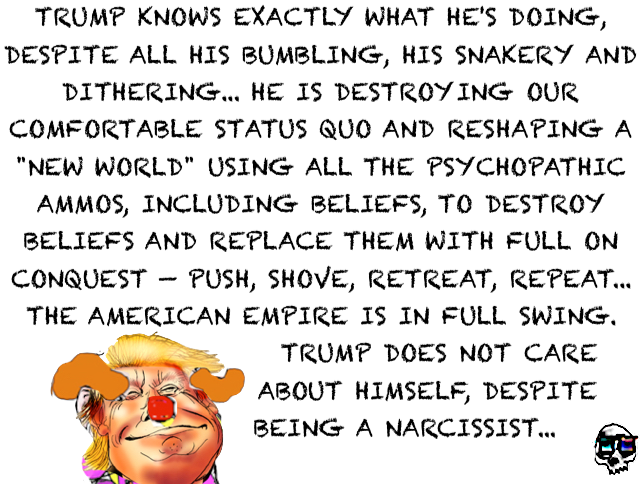
What if Trump’s apparently chaotic thought processes and intuitive decision making are all a blind, a charade? What if we are really witnessing, in the Middle East and more widely, a carefully constructed plan with very definite objectives?
Has Trump in fact “planned each charted course, each careful step along the byway”, while flinging the chaff of apparent chaos? I realise that this is not intuitive, but bear with me…
Craig Murray: Seeing Trump Clearly
It’s comforting to see Donald Trump as a buffoon, to accept the facade he presents of a blustering and ill-educated ignoramus who does not understand the world of geopolitics. But that is nonsense.
What kicked off my thinking was the revelation by Lockheed Martin that they had been instructed by Trump, months in advance of the attack on Iran, to massively increase production of interceptor missiles, with a short term goal of quadrupling capacity of THAAD.
In January, before the start of the current conflict, Fox News was already reporting on various deals, including a trebling of PAC3 MSE interceptor deliveries, having been finalised between Lockheed and the Department of War.
While obviously there are supply chain and production line constraints on the ability to ramp up production within months, the urgency of this activity – almost entirely focused on interceptor missiles – that started in 2025 is in hindsight a clear indication that early war with Iran was expected. It is plain evidence of premeditation.
The second thing that triggered my thought that this is all carefully planned, is the nature of the breakdown of the nuclear deal talks. It appears there was a broad consensus that Iran offered concessions which made a deal very practical, in particular giving up its stocks of enriched uranium into trust (a proposal Iran had historically rejected when Putin offered to hold the material). Both the hosts, Oman and the British thought a deal was there.
The failure of the talks is being spun as due to the incompetence and lack of technical knowledge of Witkoff and Kushner. But I just don’t buy this. The sending of unqualified negotiators was part of a ploy to use the negotiations as cover for an attack – the second time in a year that the United States had pulled the same trick.
They didn’t need competent negotiators, because they had never intended a good faith negotiation.
The attack on Iran was always planned by Trump. He was not “bounced into it” by Israel. It had been in gestation for months. That fact had been held within a very tight circle to avoid both political opposition and institutional opposition from the US military and intelligence community.
January’s protests in Iran found ordinary people genuinely ready to protest, motivated by economic hardship caused by sanctions. But they were guided and abused by Mossad and C.I.A. agents among the Iranian people, who committed and encouraged violence and initiated pro-Shah chanting.
There was never the slightest possibility the protests would bring regime change, but that was not the intention. The purpose was to incite an over-reaction by the Iranian government that could “justify” the planned attack on Iran. The dead protestors have been great martyrs for Trump’s – and Israel’s – wider cause.
The planting by Western state-sponsored individuals and organisations of ludicrous claims throughout Western state and corporate media of thirty to forty thousand killed, was a deliberate and considered plan to reduce domestic opposition in the West to the forthcoming war against Iran.
Now factor in another apparently random act by Trump – the astonishing kidnapping of President Maduro of Venezuela on 3 January, a month before the attack on Iran.
Trump’s naval blockade of Venezuela’s oil has secured a U.S. monopoly of its sale and distribution. As with Iraq, only US-approved contractors can buy the oil and payments are made to a Trump-controlled account in Qatar, from which revenue is given to the Venezuelan government entirely at Trump’s discretion.
This audacious imperialist grab of the world’s largest oil reserve further insulated the USA against the effects of the forthcoming closure of the Strait of Hormuz.
Again, the narrative is being spun that Trump did not foresee the closure of the Strait by Iran. That is plainly a nonsense – every commentary on a potential Iran war for half a century has focused on the Strait of Hormuz. The only possible explanation is that Trump does not mind the closure.
While, as Trump says, the United States does not need the oil that comes through the Strait, the apparent weakness in his case is that higher oil prices are universal and hit Trump’s support, particularly as Americans fill their gas tanks.
But to concentrate on this is to make the fundamental error of imagining that Trump cares about what is good for the American people. He does not. He cares about what is good for Donald J. Trump and his immediate circle.
Not to mention, of course, that the really big fortunes will have been made in oil and derivative commodity futures by those who knew this war was coming (acting through proxies).
The $200 billion Trump is requesting from Congress to continue the war is going to make an awful lot of well-connected people even richer.
So the plan is the making of fortunes, the strengthening of the military-industrial complex and the ratcheting up under cover of national cohesion in war of the authoritarianism that has reduced freedom of speech and outlawed dissent against Israel across the Western world.
To benefit Israel is the other predominant motive.
Trump’s thrashing about to articulate objectives for the war in Iran is performative, a blind to cover his true and steadfast objective – simply the annihilation of Iran as a functioning state, the infliction of the maximum amount of death and infrastructural damage, the reduction of Iran to the condition of Libya.
It goes without saying that the seizure of control of Iran’s hydrocarbons by the U.S. is the ultimate endgame of this destruction, exactly as in Libya and in Iraq. But a linked and crucial objective is the elimination of the source of the only physical resistance to the expansion of Israel. Iran and its allies in Yemen and Lebanon have been the sole support of the Palestinians for years.
The colonial settler state of Israel is central to the projection of imperialist power in the Middle East. Its expansion is an essential part of the plan.
Destruction of Iran on the scale envisaged will take years of hard pounding. Again, it is planned – you don’t ask Congress for an instalment of $200 billion for a war you plan to wrap up in a month.
Again, Trump’s taunts about having already won, objectives being achieved and about possibly finishing soon, are all just smoke and mirrors. The scale and horror of what is planned for Iran has to be obfuscated to limit a public revulsion that would be echoed in parts of the state apparatus.
Netanyahu yesterday revealed an interesting part of the endgame – construction of an oil pipeline that brings Iran’s oil out to be shipped from a Mediterranean terminal in Israel. That is a breathtakingly audacious plan, but absolutely aligns with Netanyahu’s and Trump’s actions.
Which brings us to the Greater Israel side of the project. Israel is not going to put any of its ships or soldiers in harm’s way in Iran – that is the American contribution.
But while the world is primarily watching Iran, Israel is starting a large-scale invasion of Lebanon with the aim of annexing all of Southern Lebanon permanently, even beyond the Litani River and including the cities of Tyre and Nabatieh, both currently under Israeli evacuation orders.
This land of course adjoins the annexed Golan Heights and the much larger area of Southern Syria that Israel has annexed in the past year with the acquiescence of Zionist puppet “President” al-Jolani.
It is essential not to lose sight of the bipartisan nature of the United States’ long term plan. In a very real sense Trump is continuing – if greatly accelerating – the policy under Biden, who protected and enabled the Genocide in Gaza.
The success of this US policy is phenomenal. Just consider that only 18 months ago the Zionist “Presidents” al-Jolani of Syria and Aoun of Lebanon were not in power. Both were brought to power as a result of US-aligned military action, by Israel against Hezbollah and by the C.I.A.- and MI6-sponsored HTS forces. Put in place by Biden, they are now central to Trump’s strategy.
Aoun and al-Jolani are now united in threatening Hezbollah in the rear as it fights a desperate action against the Israeli invasion of Lebanon.
Meanwhile Israel officially occupies over 60 percent of the Gaza Strip – under cover of Trump’s “Board of Peace,” and continues to murder, blockade and starve the inhabitants of the remnant, while the de facto expansion of Israel into the West Bank and the levels of settler violence are escalating to levels of the utmost barbarity.
Iranian resistance is noble and Iran’s resilience has surprised many. It will be able to make any ground invasion, or even limited incursion, extremely costly for the United States. But as in Gaza or Lebanon, if the U.S. and Israel are content simply to pound from the air for years with devastating force, and with no concern whatsoever for civilian casualties, ultimately all Iran can do is hang on and try to survive.
Given another year of destruction at the current levels of intensity, I do not believe that Iran would effectively be sending many missiles and drones back in self-defence.
In a week or two we will hit the period of maximum Iranian effectiveness, where depletion of U.S.-supplied interceptor missiles coincides with Iran retaining significant strike power. Israel’s fragile civilian morale will then be tested severely for a few weeks.
Iran’s capacity to defend against massive, years-sustained aerial bombardment is limited. We should not blind ourselves to that fact out of current joy at the Americans and Israelis getting a bloody nose.
It is comforting to see Trump as a buffoon, to accept the facade he presents of a blustering and ill-educated ignoramus, who swings wildly between policy options, and who does not understand the world of geopolitics.
But that is nonsense.
I have no hesitation in characterising Trump’s genius as evil, focused on personal gain and willing to inflict any amount of death, maiming and deprivation on innocent civilians to attain his goals. But he is indeed attaining his goals on the world stage.
Trump has forced the Security Council to underwrite his Board of Peace. This was a quite astonishing diplomatic triumph over a helpless Russia and China, both of which decided that other negotiations with Trump were more important.
Trump has presided over Israel expanding on the ground by the day. Trump has taken Venezuela’s oil, the largest reserves in the world. Trump is currently killing the people of Iran and destroying their infrastructure, while feigning indecision.
You should hate Trump: but he is no clown.
Craig Murray is an author, broadcaster and human rights activist. He was British ambassador to Uzbekistan from August 2002 to October 2004 and rector of the University of Dundee from 2007 to 2010. His coverage is entirely dependent on reader support. Subscriptions to keep this blog going are gratefully received.
Subscriptions to keep Craig Murray’s blog going are gratefully received. Because some people wish an alternative to PayPal, Murray has set up new methods of payment including a GoFundMe appeal and a Patreon account.
This article is from CraigMurray.org.uk.
https://consortiumnews.com/2026/03/22/craig-murray-seeing-trump-clearly/
YOURDEMOCRACY.NET RECORDS HISTORY AS IT SHOULD BE — NOT AS THE WESTERN MEDIA WRONGLY REPORTS IT — SINCE 2005.
Gus Leonisky
POLITICAL CARTOONIST SINCE 1951.
WE WROTE THE WORDS IN THE TOON ABOVE A FEW DAYS AGO BEFORE ANYONE PUBLICLY CAME TO THE SAME CONCLUSION...
SEE ALSO:
greed, guns and god to save the planet........
- By Gus Leonisky at 23 Mar 2026 - 9:09am
- Gus Leonisky's blog
- Login or register to post comments
miracle...
RE-POST FROM 2015...
https://yourdemocracy.net.au/drupal/node/30386
During the Great Depression, big business needed rebranding. Blamed for the crash, belittled in the press, and beset by the New Deal’s regulatory state, corporate leaders decided they had to improve their image, and soon. “The public does not understand industry,” an executive complained, “because industry itself has made no effort to tell its story; to show the people of this country that our high living standards have risen almost altogether from the civilization which industrial activity has set up.”
Accordingly, corporate leaders launched a public relations campaign for capitalism itself. In 1934, the National Association of Manufacturers hired its first public relations director in its four decades of existence, expanding its annual budget in that field from just $36,000 to nearly $800,000 three years later, a sum that represented half of its total budget. NAM marketed the miracles of “free enterprise” with a wide array of advertisements, direct mail, films, radio programs, a speakers’ bureau, and a press service that provided prefabricated editorials and news stories for 7500 newspapers. Ultimately, though, the organization’s efforts at self-promotion were generally dismissed as precisely that.
While old business lobbies like NAM couldn’t sell capitalism effectively, neither could new ones created especially for the cause. The American Liberty League, founded in 1934, originally seemed business’s best bet. It received lavish financial support from corporate leaders, notably at Du Pont and General Motors, but ultimately their prominence in the group crippled its effectiveness. Jim Farley, then head of the Democratic Party, famously joked that it ought to be called the “American Cellophane League” because “first, it’s a Du Pont product and second, you can see right through it.”
As the 1930s came to a close, corporate leaders looked over the returns on their investment and realized the millions spent had not swayed public opinion in the slightest. The image of big business still needed repackaging. In a 1939 address to the US Chamber of Commerce, H.W. Prentis of the Armstrong Cork Company proposed the way forward. “Economic facts are important, but they will never check the virus of collectivism,” he warned; “the only antidote is a revival of American patriotism and religious faith.” Prentis’ speech thrilled the Chamber and boardrooms across America. Soon propelled to NAM’s presidency, he continued to tell corporate leaders to get religion. His 1940 presidential address, promoted heavily in the Wall Street Journal and broadcast live on both ABC and CBS radio, promised that business’s salvation lay in “a strengthening of the spiritual concept that underlies our American way of life.”
Accordingly, corporate America began marketing a new fusion of faith, freedom and free enterprise. These values had been conflated before, of course, but in the early 1940s they manifested in a decidedly new form. Previously, when Americans thought about the relationship between religion, politics and business, they gave little thought to the role of the national state, largely because it was so small it gave little thought to any of them. But now that the federal government had grown so significantly, corporate leaders sought to convince Americans that the New Deal threatened not only the economic freedoms of business leaders, but the religious and political freedoms of ordinary citizens as well. They worked tirelessly throughout the 1940s and 1950s to advance a new ideology that one observer aptly anointed “Christian libertarianism.”
Initially, businessmen outsourced this campaign to an unlikely set of champions: ministers. Though this decision seemed unorthodox, the logic was laid out clearly in private. “Recent polls indicate that America’s clergymen are a powerful influence in determining the thinking and acting of the people in the economic realm,” noted one organizer, and so business leaders should “enlist large numbers of clergymen” to “act as minutemen, carrying the message upon all proper occasions throughout their several communities.”
Over the second half of the 1940s, corporate leaders lavishly funded new organizations of ministers who would make their case for them. Some of these groups secured donations from a broad array of businessmen. Reverend James W. Fifield’s Spiritual Mobilization, for instance, amassed millions in corporate and personal checks from leaders at companies such as General Motors, Chrysler, US Steel, Republic Steel, International Harvester, Firestone Tire and Rubber, Sun Oil, Gulf Oil, Standard Oil of New Jersey, Colgate-Palmolive-Peet and countless more. Others leaned heavily on the generosity of a single patron. The Christian Freedom Foundation, created by Reverend Norman Vincent Peale and then led by layman Howard Kershner, was sustained almost single-handedly by Sun Oil President J. Howard Pew. The Pew family’s contributions to the organization averaged more than $300,000 a year for twenty-five years.
With this generous funding, ministers in these organizations spread the arguments of Christian libertarianism. “I hold,” Reverend Fifield asserted, “that the blessings of capitalism come from God. A system that provides so much for the common good and happiness must flourish under the favor of the Almighty.” But concern for the “common good” was uncommon in their arguments, which tended instead to emphasize the values of individualism. In their telling, Christianity and capitalism were indistinguishable on this issue: both systems rested on the fundamental belief that an individual would rise or fall on his or her own merit alone. Just as the saintly ascended to Heaven and sinners fell to Hell, the worthy rose to riches while the wretched were resigned to the poorhouse.
Any political system that meddled with this divinely prescribed order of things was nothing less than a “pagan” abomination. Indeed, they argued, the welfare state stood in direct opposition to the Ten Commandments. “We emphasize the interdependence of freedom and Christianity,” the Christian Freedom Foundation announced in its founding statement. “When the First Commandment ‘Thou shalt have no other Gods before me’ is violated and the state is exalted to take the place of God as the highest authority over the actions of man, freedom is suppressed. Conversely, Christianity can thrive only where human beings live under a system of free institutions and government by the people.” The welfare state, a CFF member argued elsewhere, violated the eighth and tenth commandments by encouraging the poor to covet what the wealthy had and “forcibly taking the wealth of the more enterprising citizens for distribution to others.” And because it spread scurrilous rumors about the rich and made extravagant promises to the poor that it could never deliver, the New Deal violated the ninth commandment’s injunction against bearing false witness, too.
Armed with this framework, and the ample funding of their financial backers, these organizations spread the gospel of Christian libertarianism. In publications like Faith and Freedom and Christian Economics, they introduced tens of thousands of clergymen to the work of prominent libertarian thinkers including Friedrich Hayek, Ludwig von Mises, Percy Greaves, George Koether, Garet Garrett, Henry Hazlitt, Frank Chodorov and Clarence Manion, presenting their originally secular arguments in a new sanctified light. Spiritual Mobilization went further, proselytizing the general public over the radio. Corporate sponsors, such as Republic Steel, secured airtime for its weekly program “The Freedom Story” and spread its warnings about “creeping socialism” over more than 800 radio stations nationwide.
Spiritual Mobilization’s greatest success came in 1951, with a coordinated series of celebrations for the Fourth of July arranged by its Committee to Proclaim Liberty. Businessmen dominated the committee’s ranks, from household names like Harvey Firestone, Conrad Hilton, E.F. Hutton, James L. Kraft, Henry Luce, Fred Maytag, J.C. Penney, and J. Howard Pew, to lesser-known heads of major corporations like General Motors, Chrysler, US Steel, Republic Steel, Hughes Aircraft, Eastern Airlines, United Airlines, Gulf Oil, Marshall Field, and more. Leaders of the National Association of Manufacturers and the US Chamber of Commerce served, as did heads of free enterprise advocacy groups like the Foundation for Economic Education. Together, they advanced a series of coast-to-coast celebrations on the new Christian libertarian slogan of “freedom under God.” The 17,000 ministers who belonged to the group were encouraged to compete for prizes by making sermons on the theme, while governors and mayors issued proclamations calling on ordinary citizens to do so as well. On the Sunday before the Fourth, the group broadcast an all-star “Freedom Under God” spectacular on CBS’s national radio network. Organized by Cecil B. DeMille, it featured Hollywood stars like Jimmy Stewart, Bing Crosby and Gloria Swanson.
Although corporate leaders continued to outsource the Christian libertarian campaign to organizations such as Spiritual Mobilization, they encouraged its growth directly, too. In 1949, for instance, businessmen banded together to form the Freedoms Foundation. (Despite some similarities in its name and agenda, this new organization stood apart from the Christian Freedom Foundation.) The Freedoms Foundation believed that those who promoted “a better understanding of the American way of life” and the central role played by “the American free enterprise system” in making the nation great should be singled out for prizes and praise. Fittingly for an organization devoted to promoting big business, its president was Don Belding, head of a national advertising agency whose clients included Walt Disney and Howard Hughes. The advertising legend was supported by an impressive board of directors drawn from the highest ranks of corporate America, including leaders of General Foods, General Motors, Maytag, Republic Steel, Sherwin Williams, Union Carbon & Carbide, US Rubber, as well as individuals such as Sid Richardson, an oilman who was one of the richest men in America.
While these corporate leaders and like-minded conservatives sat on the board, Dwight D. Eisenhower set the agenda. Eisenhower had enthusiastically supported Belding’s initial plans for the foundation and even helped articulate its central arguments. “The Credo of the American Way of Life” that he crafted appeared in Reader’s Digest in March 1949, and soon elsewhere. The Credo was usually depicted in graphic form, a soaring monument topped with two tablets etched with references to the Bill of Rights and other rights designed for business, including the “right to own private property,” the “right to engage in business, compete, make a profit,” the “right to bargain for goods and services in a free market,” the “right to contract about our affairs,” and, last but not least, the “right to freedom from arbitrary government regulation and control.” Together, these political and economic rights rested on a pedestal of “Constitutional Government designed to Serve the People.” That, in turn, stood on a more substantial foundation: “Fundamental Belief in God.
For the Freedoms Foundation, the Credo of the American Way of Life was more than a list of political and economic rights. It was rather, as its name indicated, a creed—a statement of religious belief and commitment to a sanctified cause. As the organization repeatedly noted, faithfulness to the Credo would be “the sole basis” in determining the winners in its annual awards program. A major gathering for corporate and conservative leaders, the ceremonies took place at the foundation’s offices in Valley Forge, Pennsylvania, a 54-acre property purchased by board member E.F. Hutton and leased to the foundation for a dollar a year. In the first ceremonies, in November 1949, Eisenhower granted honors and gold medals to a number of distinguished conservatives, including former president Herbert Hoover, conservative Republican Senator Robert Taft of Ohio, and his own future Secretary of State John Foster Dulles. In all, he doled out prizes totaling $84,000, which organizers emphasized was more money than either the Pulitzer or Nobel Prizes bestowed. Moreover, the general gave his blessing to the work done by the honorees. “Here in this spiritual temple of the greatest of all Americans,” he said, “you winners of these awards become marked as among America’s disciples. You have issued your defiance to all who would destroy the American dream.”
With the prize pool steadily increasing, the competition was swamped with tens of thousands of nominations each year. Categories for awards steadily expanded, with prizes offered for the best expression of the Credo in everything from ad campaigns, radio programs, cartoons, editorials, television programs and films to sermons, speeches, employee publications, community programs, and commencement addresses, both college and high school. In only its second year, the foundation awarded nearly two dozen cash awards in each of 17 categories, with another 300 medals and 200 certificates distributed as well. Organizers believed their work had transformed the nation. “Now,” one noted in 1951, “teachers, preachers, business men, citizens at work everywhere have the task of building an understanding of our free-market capitalistic system based on a fundamental belief in God, on Constitutional government designed to serve and not to rule the people, and on our indivisible bundle of political and economic rights, or surrender to statism.”
Beyond the Freedoms Foundation, the Credo of the American Way of Life played a prominent role in the presidential campaign of 1952. Notably, Eisenhower led a drive that year to have a monument in its likeness erected in Washington, DC. Doing so, the Republican nominee noted, would honor the American ideal of “permitting the creative spirit of man made in the image of his Maker to reach its highest aspirations.” While the monument never manifested, its message still spread widely in a massive get-out-the-vote campaign coordinated by the Freedoms Foundation and the Boy Scouts of America. Together, the two organizations put up a million posters in store windows and plastered another 90,000 cards on trains and buses. On the Saturday before the election, they placed over thirty million more pieces of literature on doorknobs across the country. Shaped like the Liberty Bell, these door hangers featured the Credo on one side and earnest-looking scouts asking recipients to “Think when you Vote” on the other.
Soon after his landslide victory, President-Elect Eisenhower made a triumphant return to the annual board meeting of the Freedoms Foundation at the Waldorf-Astoria. “These days I seem to have no trouble filling my calendar,” he told them. “But this is one engagement that I requested. I wanted to come and do my best to tell those people who are my friends, who are supporters of the idea that is represented in the foundation, how deeply I believe that they are serving America.” As reporters hastily took notes, the incoming president urged the crowd and the country to embrace spiritual renewal. In the key passage, he called their attention to the invocation of “the Creator” in the preamble of the Declaration of Independence. He then insisted, in what quickly became a famous line, that “our form of government has no sense unless it is founded in a deeply felt religious faith, and I don’t care what it is.”
It was no accident that Eisenhower introduced this idea to the Freedoms Foundation. As he knew from his long association, the audience arrayed before him appreciated the power of appeals to piety and patriotism. Founder Don Belding was a close ally of Reverend Fifield, whom he personally praised as “Freedom’s Crusader” in a 1950 ceremony honoring the minister; the ad man had been active in Spiritual Mobilization and served as a founding member of the Committee to Proclaim Liberty. Not surprisingly, early recipients of his foundation’s awards included not just Reverend Fifield, but also Howard Kershner of the Christian Freedom Foundation, several regular contributors to Faith and Freedom and Christian Economics, producers of “The Freedom Story” radio program, and, lastly, all of Belding’s fellow members on the Committee to Proclaim Liberty, who were honored as a group and, in several instances, honored once again as individuals. As the Freedoms Foundation crowd heard Eisenhower talk about the foundational role of religion in American life, they believed Christian libertarianism had finally come into its own. The new Eisenhower administration, they assumed, would use that religious rhetoric to roll back the regulatory state. They were wrong.
When he took office, Eisenhower parted ways with his earlier allies. Although the president was personally sympathetic to their complaints, he concluded that “the mass of the people” disagreed. And so, to the consternation of Christian libertarians, Eisenhower gave a bipartisan stamp of approval to the New Deal and, indeed, even expanded its reach over his two terms in office. He significantly enlarged Social Security, increased federal education funding, and launched the greatest public works program of the postwar era: the interstate highway system. By the end of his administration, many libertarians would agree with Senator Barry Goldwater’s assessment that his presidency had been little more than a cheap imitation of the Democratic agenda. It was, he famously charged, “a dime-store New Deal.”
That said, Eisenhower had incredible success with one of the goals he had shared with these supporters: promoting the politics of piety and patriotism. Uncoupling their religious rhetoric from its origins in the fight against the New Deal, he broadened its appeal considerably and helped usher in a national religious revival that was embraced across the political spectrum. He introduced new religious rituals to American politics, ranging from the ritual of prayers at Cabinet meetings, the State Department and Pentagon to annual rites like the National Prayer Breakfast. He inspired others throughout government to inaugurate new religious symbols and ceremonies of their own. Most significantly, Congress added the words “under God” to the Pledge of Allegiance in 1954 and made “In God We Trust” the country’s first official motto in 1956.
Unlike the Christian libertarians, who presented God and government as rivals, Eisenhower managed to fuse the two together into what the first National Prayer Breakfast hailed as a wholesome “government under God.” The American nation was now officially suffused with religion, and so it would remain.
How Big Business Invented the Theology of 'Christian Libertarianism' and the Gospel of Free Markets
READ FROM TOP.
YOURDEMOCRACY.NET RECORDS HISTORY AS IT SHOULD BE — NOT AS THE WESTERN MEDIA WRONGLY REPORTS IT — SINCE 2005.
Gus Leonisky
POLITICAL CARTOONIST SINCE 1951.
bias....
US journalist EXPOSES the media's biased Iran War coveragehttps://www.youtube.com/watch?v=DSZGeDkynOI
Help Declassified expose the powerful by donating today - www.declassifieduk.org/join
Independent journalist Abby Martin has spent decades covering American wars of aggression, and has witnessed first hand how the corporate media 'manufactures consent' for these wars. The US-Israel assault on Iran is no different.
Speaking to Declassified editor Phil Miller, they discuss the dismal corporate media coverage in the UK and US, how no lessons have been learnt from the Gaza genocide, and why Keir Starmer can't stand up to Donald Trump over Iran.
Abby Martin was visiting London for a screening of her new documentary Earth's Greatest Enemy, which explores the environmental impact of the US military. Visit https://www.earthsgreatestenemy.com to find out more.
READ FROM TOP.
YOURDEMOCRACY.NET RECORDS HISTORY AS IT SHOULD BE — NOT AS THE WESTERN MEDIA WRONGLY REPORTS IT — SINCE 2005.
Gus Leonisky
POLITICAL CARTOONIST SINCE 1951.